
Key points
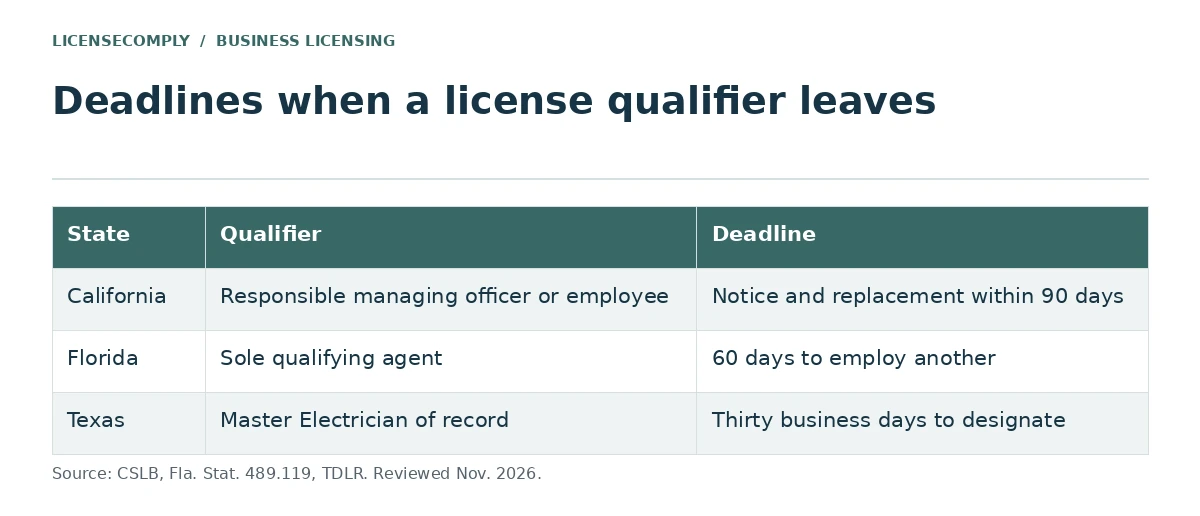
- In California, a contractor must notify the Contractors State License Board within 90 days after a responsible managing officer or employee leaves and must replace that qualifier within 90 days of the disassociation date.
- Under Florida Statutes section 489.119, a construction business whose only qualifying agent leaves has 60 days to employ another qualifying agent.
- Texas requires an electrical contractor to designate a new Master Electrician of record within thirty business days after the prior one separates from the business.
- A license and permit bond is a bond required by state law, ordinance or regulation before a license is granted or an activity begins, and a canceled bond can suspend the license it supports.

A license qualifier is the individual whose experience, exam or personal license a state relies on when it issues a license to a business. When that person leaves, or when a bond, insurance policy or entity filing tied to the license lapses, the license can be suspended in the middle of its term, long before the renewal date on your calendar. State rules give businesses short windows to fix these breaks, often 30 business days to 90 days.
For companies holding dozens or hundreds of licenses across states, the costly failures rarely come from a missed expiration date. They come from a dependency that broke between renewals: a responsible managing officer resigned, a surety canceled a license and permit bond, continuing education was not completed, or the license-holding entity fell out of good standing.
This guide walks through those four dependencies using official rules from California, Florida, Texas and other jurisdictions, reviewed November 2026. Requirements differ by state, city and license type, so confirm current rules with each issuing agency before acting.
What happens when a license qualifier leaves?
Many business licenses are issued to a company but rest on one licensed person. Contractor licenses are the clearest example, and when the qualifier leaves, a deadline starts running.
| State and license | Who qualifies the business | Deadline after the qualifier leaves |
|---|---|---|
| California contractor license | Responsible managing officer (RMO) or responsible managing employee (RME) | Notice within 90 days; replacement within 90 days of disassociation |
| Florida construction contracting | Qualifying agent | 60 days to employ another, if the departing agent was the only one |
| Texas electrical contractor | Master Electrician of record | Notify and designate a new one within thirty business days |
In California, the Contractors State License Board (CSLB) says a disassociation request must be received within 90 days of the disassociation date, and the company must replace the RMO or RME within 90 days to keep working in that classification; failure to replace results in suspension of the license or removal of the classification, and only one 90-day extension may be granted (CSLB, Change in Personnel).
In Florida, if the qualifying agent was the only certified or registered contractor affiliated with the business, the business has 60 days from the termination to employ another, and it may not engage in contracting until it does unless a temporary nonrenewable certificate is granted to finish incomplete contracts (Florida Statutes section 489.119).
In Texas, the Texas Department of Licensing and Regulation (TDLR) requires an electrical contractor to notify the department and designate a new Master Electrician of record within thirty business days from the date of separation (TDLR, Electrical Contractor License).
Late notice extends the old qualifier’s exposure
CSLB adds a detail that affects both the company and the departing employee. If notice arrives after the 90-day window, the license record treats the disassociation date as the date CSLB received written notice, the license is automatically suspended or the classification removed as of that date, and the RMO or RME remains responsible for all work performed before the recorded disassociation date (CSLB).
One person often cannot qualify several companies
Holding companies sometimes move a key licensee between subsidiaries. In Texas, a Master Electrician may be assigned to only one electrical contractor unless that Master Electrician owns more than 50 percent of the business (TDLR). Moving that person to fill a gap in one company can open a gap in another.
Human resources offboarding usually starts the clock, and compliance teams often hear about it last. If exit workflows do not ask whether the person qualifies any license in any state, the window can close unnoticed. Individual credentials work differently from business licenses, as our guide to what an occupational license is explains.
How can a license and permit bond suspend a license?
The Texas Department of Insurance describes license and permit bonds as bonds required by state law, municipal ordinance or regulation that must be filed before a license is granted or a particular activity begins (Texas Department of Insurance, Bond Resources). They renew through brokers and sureties, often outside the compliance team’s view.
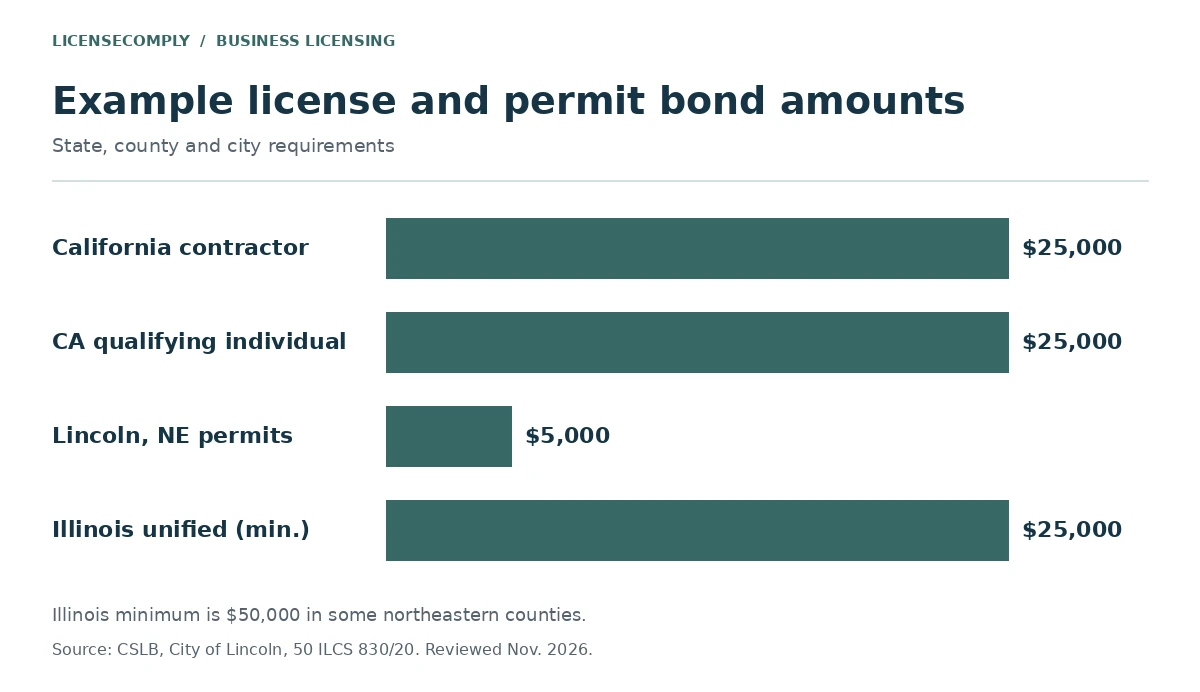
California shows how quickly a bond issue becomes a licensing issue. The contractor’s bond and the Bond of Qualifying Individual are each $25,000, and the qualifying individual bond is required when the license is qualified by an RME or by a responsible managing officer who owns less than 10 percent of the corporation’s voting stock (CSLB, Bond Requirements).
CSLB lists the events that place a license under bond suspension, including a surety canceling the bond, a judgment or claim payment reducing the bond amount, the surety losing its authorization from the California Department of Insurance, and an RMO’s ownership dropping below 10 percent of voting stock (CSLB, Bond Suspensions). Work performed while a license is suspended is considered unlicensed, and disciplinary action can follow (CSLB, Bond Suspensions).
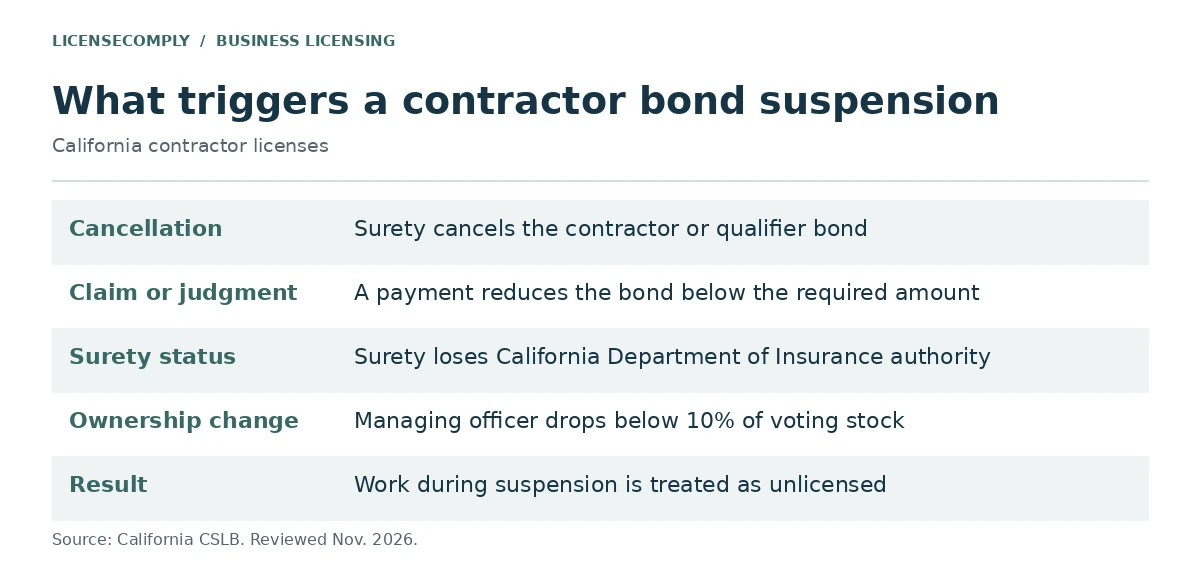
The ownership trigger deserves attention. A routine change to the capitalization table, such as a new investor diluting an officer below 10 percent, creates a bond requirement that did not exist the day before, and CSLB states the suspension is effective from the date the ownership requirement no longer exists (CSLB). CSLB also requires licensees to report any change to the license within 90 days.
Local bonds multiply the tracking load
State bonds are only part of the picture. The City of Lincoln, Nebraska requires a $5,000 License and Permit bond, or a $5,000 cashier’s check, for excavation, sign and street use permits (City of Lincoln). Illinois lets contractors file a unified license and permit bond with the county clerk in place of separate local bonds, in an amount of at least $25,000, or at least $50,000 in counties formerly covered by the Northeastern Illinois Planning Act (50 ILCS 830/20).
Insurance behaves the same way. A Texas electrical contractor must carry at least $300,000 per occurrence, $600,000 aggregate and $300,000 aggregate for products and completed operations, and must provide proof of workers’ compensation coverage, a certificate to self-insure, or a statement electing not to carry coverage with an online notice filed with the Texas Department of Insurance (TDLR). A policy reduced or dropped at renewal can put the license out of compliance well before the license itself expires.
Why do individual renewals and continuing education matter?
The qualifier’s own license usually renews on a different schedule from the business license. In Texas, Master Electricians, Journeyman Electricians, Residential Wiremen, Maintenance Electricians, sign electricians and apprentices must complete 4 hours of continuing education (CE) before each renewal, from a TDLR-registered provider, within the term of the license being renewed (TDLR, Continuing Education for Electricians). The four hours must cover the National Electrical Code, Texas electrician law, Texas electrician administrative rules and electrical safety under NFPA 70E, and unapproved courses do not count.
TDLR also states that contractors are not required to complete continuing education (TDLR). That split is common: the business license renews with one set of conditions, and the qualifier’s individual license renews with another. Texas electrician licenses are valid for one year from issuance (TDLR), but the issuance dates of the business and individual licenses rarely line up. If the Master Electrician’s license lapses, the contractor license that depends on employing a Master Electrician is exposed even though its own renewal is months away. Our business license renewal guide covers renewal timing more broadly.
What happens when the license-holding entity loses good standing?
Every license assumes the holder is a valid legal entity. The terms vary by state (suspension, forfeiture, administrative dissolution), but the effects follow a common pattern: the entity loses the right to do business, access to the courts, or both.
In California, a business suspended by the Franchise Tax Board (FTB) cannot legally do business, bring or defend an action in court, or keep the right to use its name, and contracts it enters while not in good standing can be voided by the other party unless it obtains relief (California FTB, My Business Is Suspended).
Texas shows how far the consequences reach. The franchise tax annual report is due May 15, with a $50 penalty for each late report and 5 or 10 percent penalties on late payment, and entities at or below the $2,650,000 no tax due threshold for 2026 reports still must file a Public Information Report or Ownership Report (Texas Comptroller, Franchise Tax). The Comptroller is required by law to forfeit the right to transact business when filing requirements are not met, after at least 45 days following the notice of pending forfeiture (Texas Comptroller, Franchise Tax Account Status).
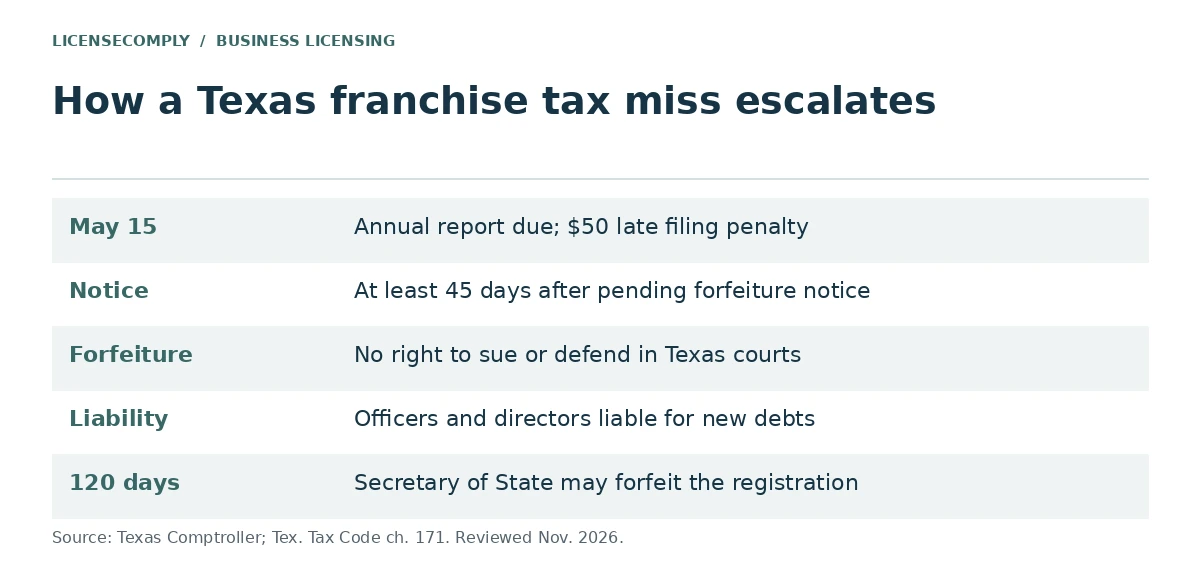
Once privileges are forfeited, the corporation is denied the right to sue or defend in a Texas court (Texas Tax Code section 171.252). Each director or officer becomes liable for corporate debts created or incurred in Texas after the report, tax or penalty was due and before privileges are revived, and revival does not erase that liability (Texas Tax Code section 171.255). If privileges are not revived within 120 days, the Secretary of State may forfeit the charter, certificate or registration (Texas Tax Code section 171.309).
The registered agent is the other entity-level dependency. Texas requires every domestic and foreign filing entity to continuously maintain a registered agent and registered office, an entity cannot serve as its own agent, and failure can lead to involuntary termination or revocation of a foreign registration (Texas Secretary of State, Registered Agent FAQs). If the agent relationship lapses, forfeiture warnings may never reach anyone who can act. When expanding, the order of entity, tax and license steps matters, as covered in our new state registration sequence guide.
How do mobile licensed employees fit in?
Staffing companies and multi-site health operators also track individual licenses that cross state lines. The Nurse Licensure Compact reports 43 participating jurisdictions, and a nurse’s multistate license is tied to a single primary state of residence (Nurse Licensure Compact, How It Works). Track each person’s license by issuing state, privilege type and expiration date, and review it when an employee relocates.
What should a resilient license record contain?
Each license record should link to everything it relies on, not just an expiration date.
| Field | Why it matters |
|---|---|
| Legal entity holding the license | Licenses usually belong to one entity and are not transferable |
| Qualifying individual and their license number and expiration | Departures and lapses start short deadlines |
| Bonds and insurance, with amounts, sureties and expiration dates | Cancellations and reductions can suspend licenses |
| Ownership thresholds that change requirements | Dilution can create new bond obligations |
| CE requirements and completion evidence | CE must fall within the license term from approved providers |
| Entity standing in each state and registered agent | Forfeiture affects the right to do business and to sue or defend |
| Change-reporting deadlines and date last verified | Many changes must be reported within 30 business days to 90 days |
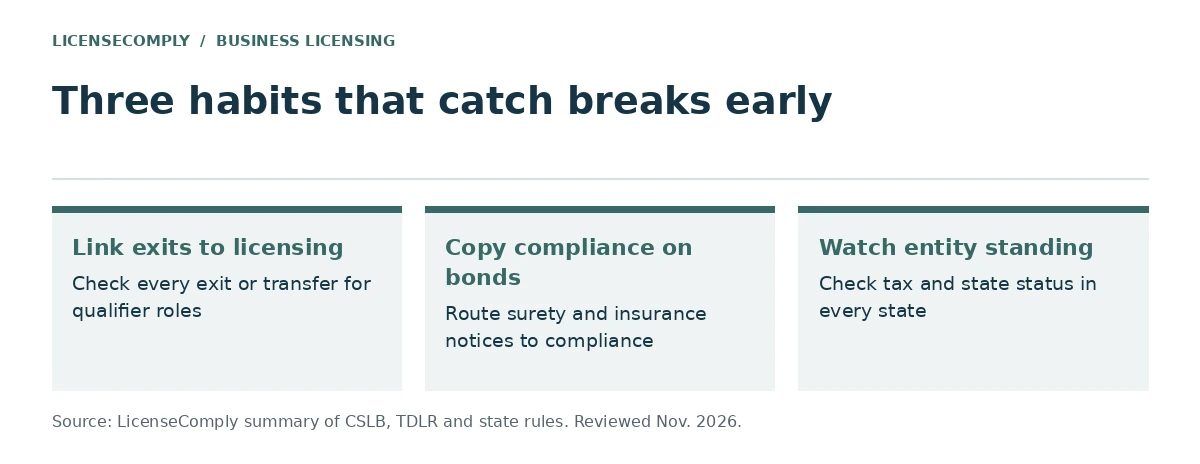
Operating practices close the gaps. Connect every termination, transfer and role change to a qualifier check. Ask brokers and sureties to copy compliance on cancellations, reductions and renewals. Review capitalization and officer changes for licensing effects. Check tax and Secretary of State status for every license-holding entity on a regular cycle, not just at renewal. Store bond certificates, CE certificates and agency confirmations alongside each record. A periodic business license lookup against agency databases helps confirm the record matches the state’s.
Frequently asked questions
What is a license qualifier?
A license qualifier is the individual whose experience, examination or personal license supports a license issued to a business. California calls this person a responsible managing officer or responsible managing employee, Florida uses the term qualifying agent, and Texas electrical contractors designate a Master Electrician of record. The business usually holds the license, but the license depends on keeping a qualifying individual associated with it. Each state defines the role differently, so check the issuing agency’s rules.
What is a responsible managing officer?
In California contractor licensing, a responsible managing officer (RMO) is an officer of a corporation who qualifies the company’s license with the Contractors State License Board. If the RMO owns less than 10 percent of the voting stock, a $25,000 Bond of Qualifying Individual is required. If the RMO leaves, the company must notify CSLB within 90 days and replace the qualifier within 90 days of the disassociation date, or the license or classification can be suspended or removed.
What is a license and permit bond?
A license and permit bond is a surety bond that a state law, local ordinance or regulation requires before a license is granted or an activity, such as right-of-way work, begins. Amounts are set by the requiring agency. Examples include California’s $25,000 contractor’s bond and the City of Lincoln, Nebraska’s $5,000 License and Permit bond for excavation, sign and street use permits. A canceled or reduced bond can suspend the related license.
Can a business keep working while it replaces a qualifier?
It depends on the state. California allows the replacement period of 90 days from disassociation, plus one possible 90-day extension, but notice must be timely. Florida bars a business whose only qualifying agent left from contracting until a new agent is employed, except under a temporary certificate limited to incomplete contracts. Texas requires a new Master Electrician of record within thirty business days. Confirm with the licensing agency before continuing work.
Does entity good standing affect professional or trade licenses?
Yes. A license assumes the holder is a valid entity. In California, an FTB-suspended business cannot legally do business, and contracts it signs while suspended can be voided. In Texas, forfeiture for franchise tax failures denies court access and can make directors and officers personally liable for debts incurred during the forfeiture. Monitoring entity status in every state of registration is part of keeping licenses valid.
Is every license in your portfolio still valid today?
LicenseComply tracks renewals and ongoing maintenance requirements across states and locations so qualifier, bond and filing deadlines are not missed.
Official sources and further reading
- CSLB: Change in Personnel
- CSLB: Bond Requirements
- CSLB: Bond Suspensions
- Florida Statutes section 489.119
- TDLR: Electrical Contractor License
- TDLR: Continuing Education for Electricians
- Texas Department of Insurance: Bond Resources
- City of Lincoln: Contractor Bond, Insurance and Registration Requirements
- Illinois Compiled Statutes 50 ILCS 830/20
- California Franchise Tax Board: My Business Is Suspended
- Texas Comptroller: Franchise Tax
- Texas Comptroller: Franchise Tax Account Status
- Texas Tax Code Chapter 171
- Texas Secretary of State: Registered Agent FAQs
- Nurse Licensure Compact: How It Works
Disclaimer: LicenseComply provides professional business licensing and compliance services. However, the informational content on this site (including articles, guides, tools, and videos) is provided for general educational purposes only and does not constitute legal, tax, or accounting advice. Laws and regulations change frequently, and we cannot guarantee that all information is accurate, complete, or up to date for your specific circumstances. Your use of this website and its content does not create an attorney-client, accountant-client, or other advisory relationship. You should consult with a qualified attorney, accountant, or other appropriate professional for advice tailored to your business.