
Key points
- Renewal timing depends on the specific license. Some renew annually, some on a fixed statewide date and some from the date of an inspection.
- Build an inventory of every license, its issuer, its expiration and the person responsible for it.
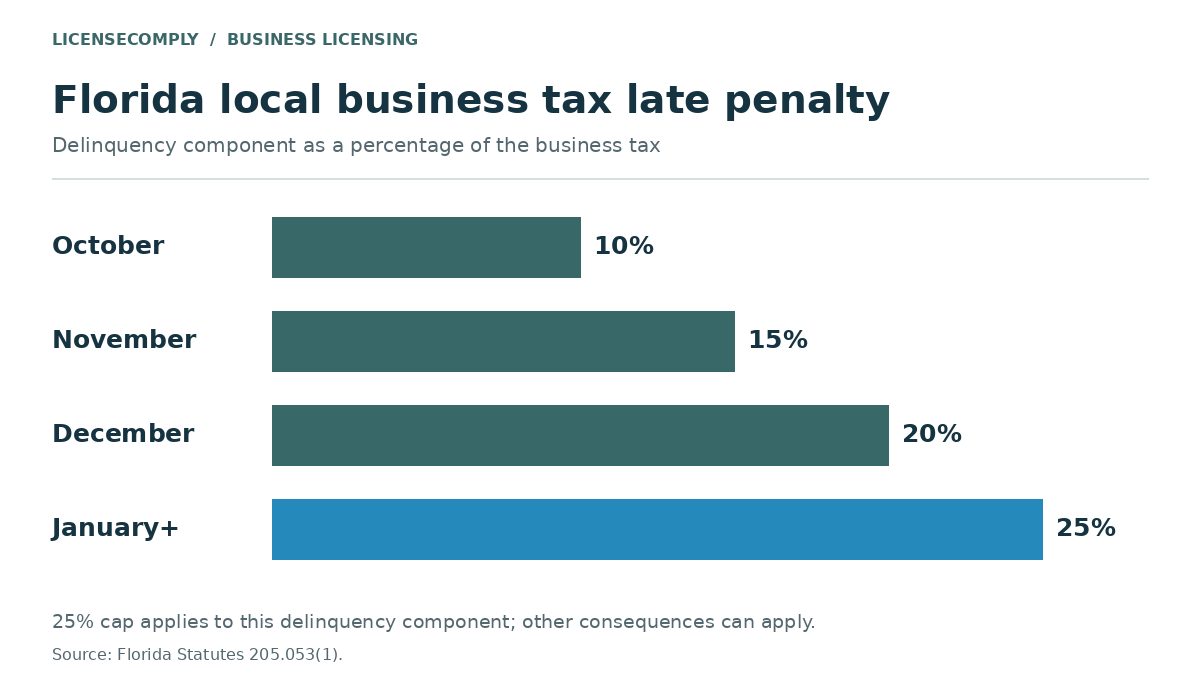
- Late renewal can be expensive. Florida’s local business tax adds a delinquency penalty that starts at 10% in October and caps at 25%.
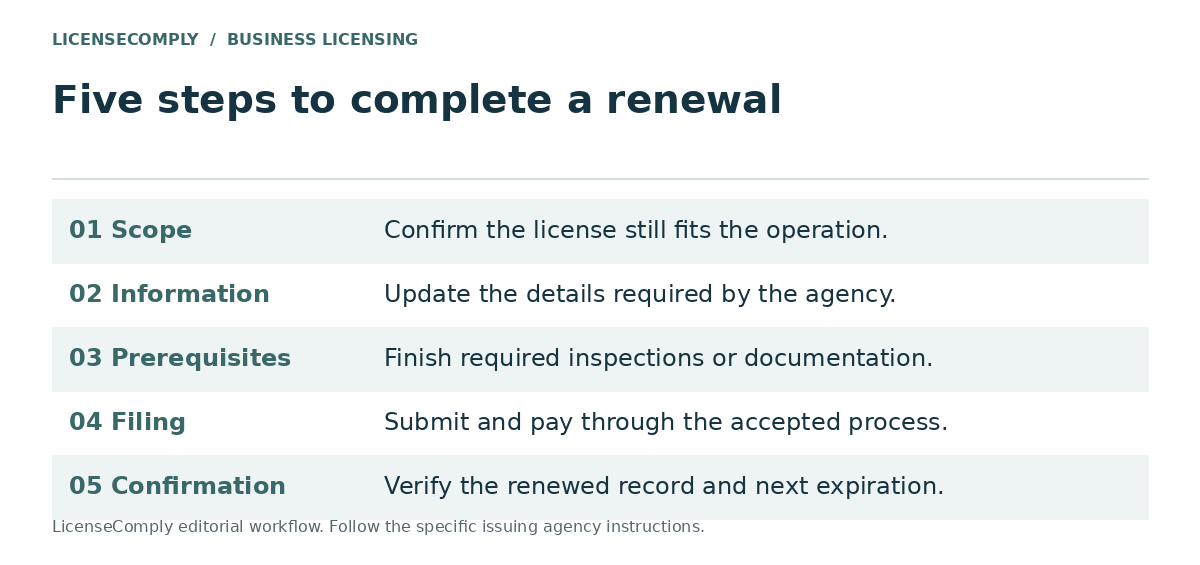
- Renew in five steps: confirm scope, update information, complete prerequisites, submit and pay, then confirm the renewed status.
A business license renewal is the process of keeping a renewable authorization current with its issuing agency. The due date, required information, and charges depend on the particular license. A company with several locations can have multiple renewal calendars even when all locations operate under one brand.
The most useful renewal system starts with the actual records: what each license covers, who issued it, when it expires, and who is responsible for completing the next filing. A reminder email helps, but it should not be the only place that information exists.
This guide explains how to renew, how to respond to a missed deadline, and how to organize licenses across locations. The Washington, Florida, and Texas examples are jurisdiction-specific; they are not nationwide renewal rules.

First determine whether and when the license renews
Not every record follows an annual renewal cycle. A license, tax registration, professional credential, and entity annual report can have different requirements. Keep them distinct even when they are managed by the same employee.
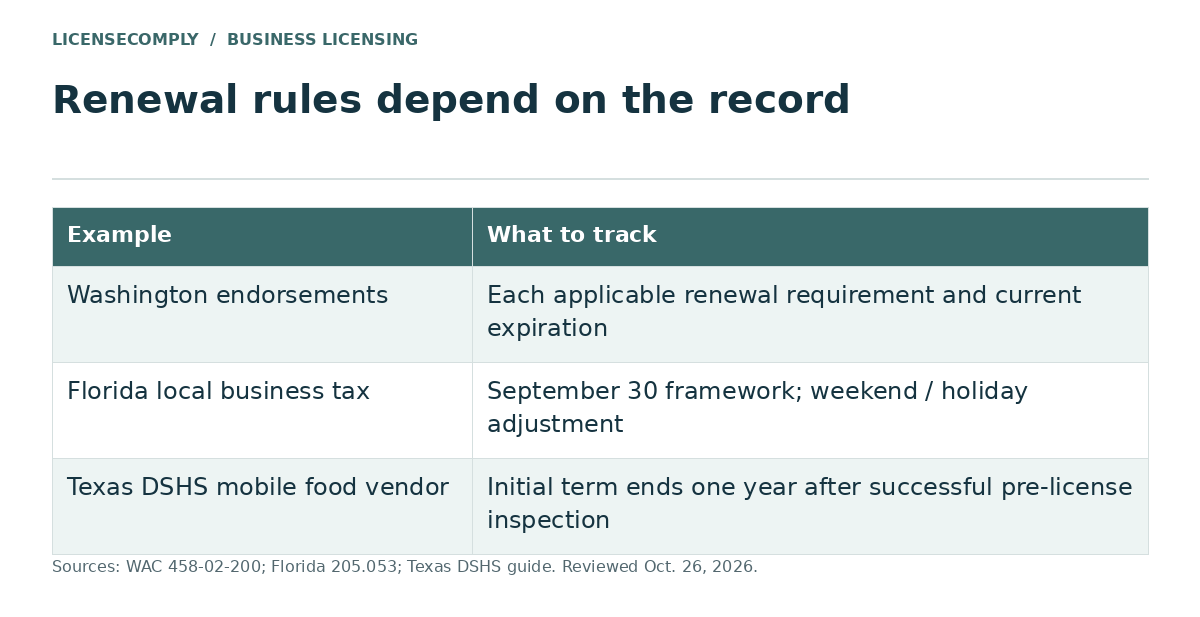
Washington’s business licensing rule explains that individual licenses endorsed on a business license can have periodic renewal requirements. The department can prorate terms and fees to align renewals. Read the current license and account record rather than assuming that every endorsement follows its original issue date.
For Florida local business tax receipts, section 205.053 establishes the annual September 30 due-date framework, including a first-working-day adjustment when September 30 falls on a weekend or holiday. The statute also addresses partial receipts. Confirm how the local collector applies those rules to your account.
Texas’s mobile food vendor guide states that the initial DSHS license expires one year after the successfully completed pre-licensing inspection. That is a different starting point from assuming the license expires one year after the application payment.
Build a reliable license inventory
List every license by legal entity and operating location. Include the exact license type, agency, account number, expiration date, and a link to the issued document. Record whether renewal requires an inspection, continuing education, updated information, or another prerequisite.
Separate the expiration date from your internal target date. A license expiring at the end of a month might need work to start much earlier if a prerequisite requires scheduling. The agency’s deadline is the legal or administrative date; your internal date is a planning control.
Add an owner and backup for each record. The owner should know who approves payment, who supplies application information, and who has authorized portal access. Without those details, a shared calendar entry can still lead to a last-minute scramble.
If a certificate is missing, begin with How to Look Up a Business License. Verify the current status and obtain the available copy before building a renewal plan around an old email.
Check the current agency instructions
Open the official renewal page before completing the filing. Confirm whether the online account is ready for renewal, which forms apply, and what supporting information is required. Avoid using a saved application from a prior year without checking for changes.
Read the notice carefully. It could cover one location or endorsement rather than the entire company. Verify the entity and address before paying, particularly when a bookkeeper receives notices for several related businesses.
Courtesy reminders are useful, but their absence does not necessarily excuse a missed deadline. The City of San Diego’s business tax FAQs expressly say that failure to send a notice does not remove the obligation to pay required taxes or applicable fees and penalties.
Update contact information through the agency’s process when staff or addresses change. Forwarding one former employee’s inbox is an unreliable long-term substitute for current account ownership.
Renew in five practical steps
1. Confirm the license still fits the operation
Review what changed since the last filing. Has the business moved, changed ownership, added a regulated service, or opened another location? A renewal might not be the correct procedure for every change. Ask the issuing agency whether an amendment, transfer, or new application is required.
This check is especially valuable after an acquisition. Possession of the seller’s certificate does not establish that it can simply be renewed under the buyer’s name. Resolve the ownership question before treating the renewal invoice as routine.
2. Update the information requested
Use current legal names, addresses, contact details, and ownership information as required. Reconcile the application with the business’s supporting records. Correct discrepancies through the agency’s prescribed process rather than typing a different answer each year without explanation.
Document who reviewed the information. For several locations, have someone confirm site-specific details instead of copying the previous location’s answers into every application.
3. Complete any prerequisites
Some licenses require inspections, education, insurance evidence, or other documents. Follow the rules for the actual credential. Do not add requirements from another profession or jurisdiction merely because they appeared on a general checklist.
Start these tasks early enough to resolve deficiencies. If another team or outside professional supplies the documentation, give that person a clear internal due date and identify the exact record required.
4. Submit and pay
Complete the renewal using the issuing agency’s accepted method. Check the instructions for what counts as timely submission or payment. Do not assume a draft saved in a portal, an unsubmitted cart, or an initiated payment equals a completed filing.
Save the submitted application, payment confirmation, and any agency acknowledgment. Separate government charges from an outside service provider’s fee. If the amount differs from the prior year, check the published fee basis rather than assuming it is an error.
5. Confirm the renewed status
Retrieve the renewed certificate or official account confirmation. Check the new term and verify that all intended endorsements or locations are included. Resolve pending information requests instead of closing the task as soon as payment clears.
Then record the next expiration and the internal preparation date. Store the final document with the previous record so the team can trace what changed. A renewal is complete when the required process and resulting status are confirmed, not just when someone says it was “handled.”
What late renewal can cost
The consequences depend on the issuing authority. Some agencies assess a delinquency charge; others also cancel or suspend authorizations or require a new application after a lapse. Contact the agency about operating authority during the gap rather than assuming payment immediately cures every problem.
Florida local business tax example
Florida section 205.053 sets a 10% delinquency penalty for October and another 5% for each subsequent delinquent month, capped at 25% of the business tax for the delinquent establishment.
| Delinquent month | Cumulative statutory delinquency percentage |
|---|---|
| October | 10% |
| November | 15% |
| December | 20% |
| January and later | 25% cap |
This table shows the stated delinquency component, not every possible consequence. The statute separately addresses operating without a required receipt and additional enforcement circumstances. Do not describe the 25% cap as a cap on all possible liabilities.
For an illustrative $100 tax amount, the listed delinquency component would be $10 in October and reach $25 at the cap. This is arithmetic illustrating the statutory percentages, not a quote for any particular business’s tax bill.
Washington business licensing example
WAC 458-02-200 lists a late renewal delinquency fee of up to $150 per business location and directs readers to the applicable statutory calculation. It also explains that other regulators can assess their own penalties or cancel licenses for nonrenewal. Reissuance can require a new application.
The rule includes limited waiver or refund provisions, including specified department errors and qualifying timely-renewal history. Do not assume a waiver will be granted. Follow the agency’s current procedure and provide the facts it requests.
What to do after missing a deadline
First confirm the actual status. An expired license, a canceled endorsement, and a renewal awaiting additional information are different situations. Check the official account and contact the responsible office if the status is unclear.
Ask which procedure applies now, what amount is due, and whether the business can continue the licensed activity while resolving the issue. Keep the response and the name or reference associated with the inquiry. Do not continue an activity solely on the assumption that a late fee purchases a grace period.
Complete the required corrective process, then verify the outcome. If the agency requires a new application or inspection, incorporate that into the schedule. Preserve any instructions that affect a planned opening, customer commitment, or site operation.
After the immediate issue is resolved, identify why it occurred. Common operational causes include notices sent to a departed employee, an invoice awaiting approval, or a certificate saved without its expiration date. Fix the process rather than adding another reminder to an already unreliable chain.
Changes that require more than routine renewal
Ownership changes, relocations, and new activities deserve an agency-specific review. For example, San Diego’s business tax guidance says its certificate is not transferable when ownership changes and requires the new owner to apply for a new certificate.
That example should not be extended to every license. Another jurisdiction might have a transfer procedure, and a professional credential can raise different questions from a local tax record. Identify the particular requirement before choosing the filing route.
If you are unsure what “occupational license” means on a renewal notice, read What Is an Occupational License. The phrase can refer to different kinds of authorization depending on the jurisdiction.
Managing renewals across locations
Use one shared record system, whether that is a carefully maintained spreadsheet or a dedicated platform. The important controls are accurate data, assigned responsibility, visible status, and access to the supporting documents.
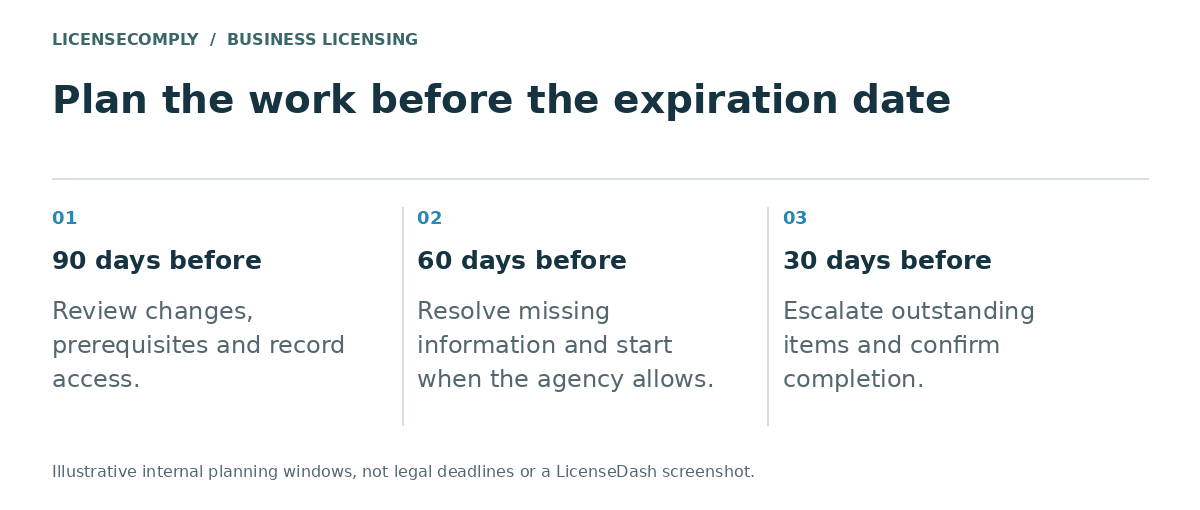
A 90/60/30-day reminder sequence is a useful internal planning example, not a legal requirement. At 90 days, confirm prerequisites and changes. At 60 days, resolve missing information and start the filing when the agency allows it. At 30 days, escalate outstanding items and verify that the application will be completed on time.
Adjust those windows to the actual license. A lengthy inspection process might require an earlier start; an agency might not accept a renewal until a defined window opens. Keep the agency’s rules and your internal reminders in separate fields.
Review an exceptions list regularly: missing documents, uncertain expiration dates, pending payments, unanswered agency requests, and licenses tied to closed locations. A calendar is useful for known dates, but it does not reveal records whose dates are missing.
LicenseComply can help with business license renewal support across locations. Ask about the scope appropriate to your license inventory and establish who is responsible for information, approvals, and final confirmation.
Frequently asked questions
Does every business license renew annually?
No. Renewal cycles and continuing account obligations vary. Read the particular certificate and agency instructions rather than assuming an annual anniversary date.
Can I renew after expiration?
The issuing agency determines whether late renewal remains available or another process is required. Confirm the status, required fees, and permission to operate during the lapse.
Does paying a tax return renew the license?
Not necessarily. Tax filing and license renewal can be separate obligations, even when the same agency administers both. Check each task independently.
How do Texas food truck renewals fit this process?
Track the DSHS license for each vehicle and its actual expiration. See the Texas mobile food vendor guide for the statewide licensing framework and the distinction between application and inspection charges.
Tired of tracking renewals?
LicenseComply tracks every license and renewal date across your locations and files the renewals for you.
Official sources and further reading
Related guides



Disclaimer: LicenseComply provides professional business licensing and compliance services. However, the informational content on this site (including articles, guides, tools, and videos) is provided for general educational purposes only and does not constitute legal, tax, or accounting advice. Laws and regulations change frequently, and we cannot guarantee that all information is accurate, complete, or up to date for your specific circumstances. Your use of this website and its content does not create an attorney-client, accountant-client, or other advisory relationship. You should consult with a qualified attorney, accountant, or other appropriate professional for advice tailored to your business.