
Key points
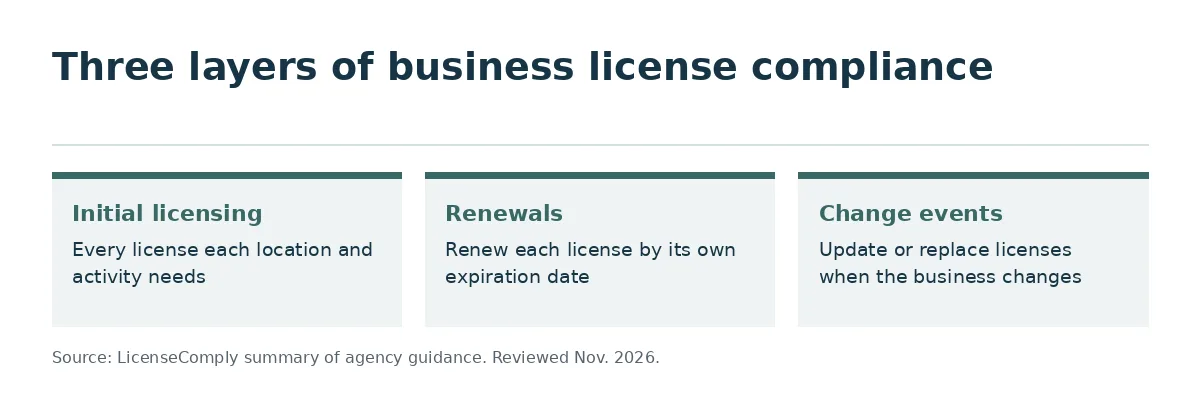
- Business license compliance means holding every required license for each location and activity, renewing each one on time, and updating or replacing licenses when the business changes.
- In Washington, renewals received after the expiration date are charged a late penalty of half the endorsement fees, up to $150, under RCW 19.02.085.
- Alabama state and county business privilege licenses must be renewed in October, and licenses not renewed by October 31 face a non-waivable 15 percent penalty plus interest.
- California contractors who renew late pay a higher delinquent fee, and any work performed while the license is expired is considered unlicensed by the Contractors State License Board.

Business license compliance means holding every license your business needs for each location and activity, renewing each one before it expires, and updating or replacing licenses when the business changes. For a company operating in multiple states, that usually means tracking state, county and city licenses that each follow their own calendar, fees and change rules.
Most problems come later: a renewal notice goes to an old address, a new location opens unlicensed, or an ownership change voids a permit.
This guide covers what license compliance management involves, real consequences of lapses from official sources (reviewed November 2026), and a business compliance checklist. Rules vary by jurisdiction, so confirm every requirement with the issuing agency.
What does business license compliance cover?
Compliance has three layers. Each one needs its own process to maintain compliance over time.
Initial licensing requirements
Before you conduct business, you need to register with the right agencies and obtain every license that applies to your location, business structure and industry. That can include a state registration, a sales tax permit, county and city licenses, and industry permits.
Triggers vary by state. Washington requires a state business license if any one of several conditions applies, including planning to hire employees within 90 days, using a name other than your full legal name, or collecting sales tax, per the Washington Department of Revenue.
Renewals
Many business licenses expire annually, some every two years. Others never expire but stay valid only while you keep filing returns or reports.
Change events
When you move, open a new location, change ownership, rename the business or add business activities, a license may need an update. Sometimes it stops being valid altogether.
If you are expanding into a new state, our guide to the registration sequence when opening in a new state shows how licensing fits with entity registration and tax accounts.
How do renewal dates vary across multiple states?
There is no national renewal calendar. Each agency sets its own cycle, so a multi-location business can have dozens of renewal dates.
Washington: annual renewals by endorsement
Licenses with state or city endorsements renew annually. A license with several endorsements may carry several expiration dates, one next to each endorsement.
You can renew up to two months early, and the Business Licensing Service sends a courtesy reminder one month ahead. The renewal is still due by the expiration date whether or not the reminder arrives, per the Department of Revenue licensing FAQs.
Alabama: an October renewal season
State and county business privilege licenses must be renewed during October each year, according to the Alabama Department of Revenue. They are administered through the local county office, and municipalities may require their own separate license.
Our Alabama business license renewal guide covers that process in detail.
California contractors: a two-year cycle
Active contractor licenses expire every two years and inactive licenses every four. The Contractors State License Board (CSLB) mails a renewal application about 60 days before expiration, but renewing is the licensee’s responsibility even if no form arrives, per CSLB renewal information.
Why reminders are not enough
Agency notices are a courtesy; the deadline is yours to track. For a broader walkthrough, see our business license renewal guide.
What happens after missed renewals?
Consequences range from a modest late fee to costly fines or losing the right to operate. These penalties come directly from statutes and agency guidance.
Flat late fees
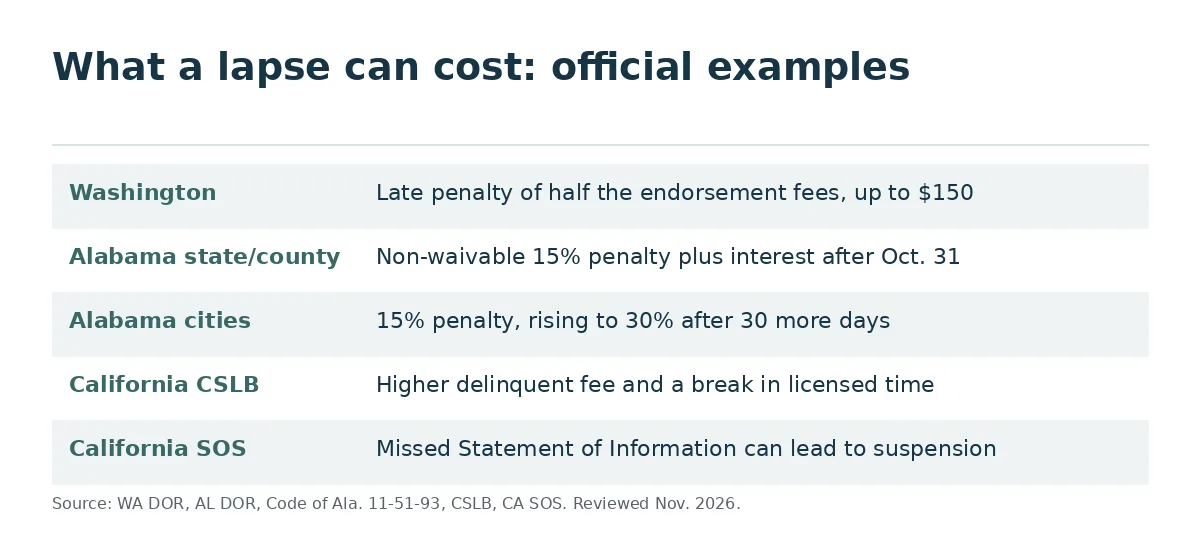
Washington charges a late penalty of half the endorsement fees, up to $150, on renewals received after the expiration date, per the Department of Revenue penalty waiver page.
Under RCW 19.02.085, the fee must be paid before the license is renewed. It can be waived if the business renewed all licenses on time for the preceding 24 months or the department caused the delay. Other agencies may add their own delinquency fees.
Percentage penalties and costly fines
In Alabama, state and county licenses not renewed by October 31 face a non-waivable 15 percent penalty plus interest, according to the Alabama Department of Revenue.
City licenses follow Code of Alabama Section 11-51-93. A late municipal license tax draws a 15 percent penalty, rising to 30 percent if still unpaid 30 days after the due date. Operating without a required city license can also bring a fine of up to $500 per offense, and each day counts as a separate offense.
Higher fees and unlicensed time
The CSLB charges a delinquent fee when a renewal arrives after expiration. A timely active renewal costs $450 for a sole owner and $700 for other entities, versus $675 and $1,050 when late, per the CSLB fee schedule.
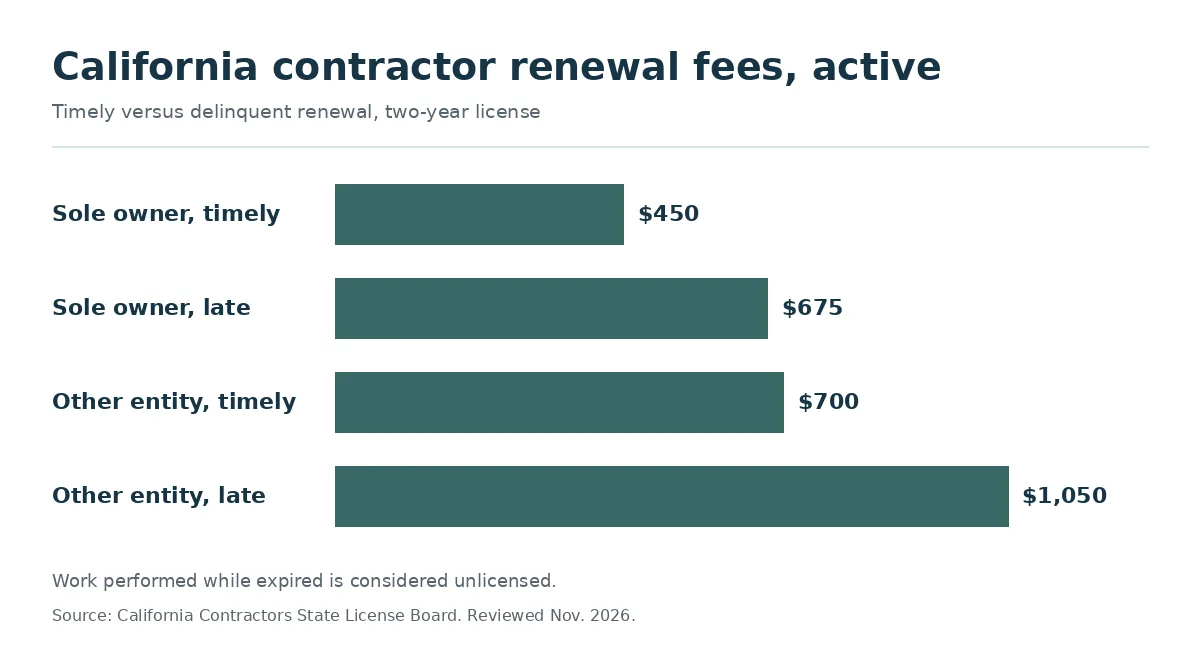
The bigger risk is the break in licensing time. Work performed while the license is expired is considered unlicensed, which can create legal issues on active jobs. The registrar must retroactively reinstate the license if a completed renewal with fees arrives within 90 days of expiration.
Loss of good standing
Entity filing requirements matter too, because many states expect an entity to stay in good standing through periodic filings. In California, corporations and limited liability companies (LLCs) file a Statement of Information every year or every two years, which works much like annual reports in other states.
If an entity misses the filing, it gets a notice of delinquency and 60 more days. After that, the Franchise Tax Board assesses a penalty, and the entity’s powers, rights and privileges can be suspended or forfeited, including the right to use its name in California, per the California Secretary of State.
Why business license compliance matters beyond fines
Late fees are the visible cost. A lapse can also slow expansion, complicate deals and, in some cities, close a location.
Registering in a new state
Expanding into a new state usually means registering the entity there as a foreign entity. In Texas, a foreign entity must register with the Secretary of State to transact business. One that fails to register cannot maintain a lawsuit in a Texas court until it registers and may owe a late filing fee for each year of delinquency, per the Texas Secretary of State.
California requires foreign corporations and LLCs to attach a valid certificate of good standing from their home jurisdiction, per the California Secretary of State. A lapse at home can hold up registration elsewhere.
Proof of status for deals
Proof of an entity’s status is often requested by lenders, landlords and contracting partners. In Texas, a certificate of fact (status) “serves as official evidence of an entity’s existence or authority to transact business,” according to the Texas Secretary of State.
Closure orders
In Chicago, the business affairs commissioner may close a business operating without a required license until one is obtained, and failing to renew is also grounds for closure after a 30-day notice of violation, under Municipal Code Section 4-4-015. Operating after a closure brings fines of $500 to $1,000 per offense, with each day a separate offense.
Which changes affect your business licenses?
Change events often create potential gaps, because the change happens in one department and the license sits with another.
Opening a new location
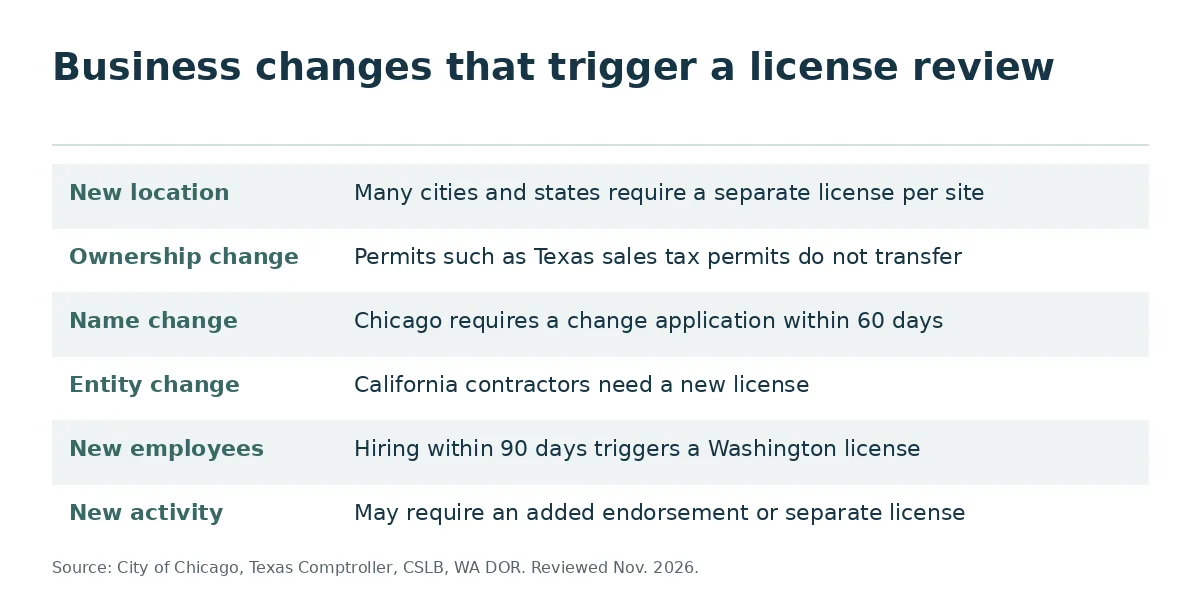
In Chicago, a business license is issued for a specific location and is not transferable, so every distinct location needs its own license, per the City of Chicago.
Texas requires a sales tax permit for each active place of business, and a permit is valid only for the physical address shown on it, according to the Texas Comptroller. Physical locations with separate permits share one taxpayer number but get separate outlet numbers.
Ownership and business structure changes
The Texas Comptroller requires a new permit after any change in ownership, and treats a sole proprietor who incorporates or forms an LLC as a change of ownership.
The CSLB requires a new license whenever the business entity changes. Licenses belong to the entity, not the qualifier, and any change to a license must be reported within 90 days.
Name and officer changes
Chicago requires a legal or DBA name change application within 60 days of the change, with a $40 fee. Ownership and officer changes go through an Update Ownership/Officers application, and some license types require fingerprinting, per the City of Chicago.
Adding employees or business activities
New hires or products can create new obligations. In Washington, planning to hire within 90 days is itself a registration trigger, and the Business License Application is how you add an endorsement or change a location, per the Department of Revenue.
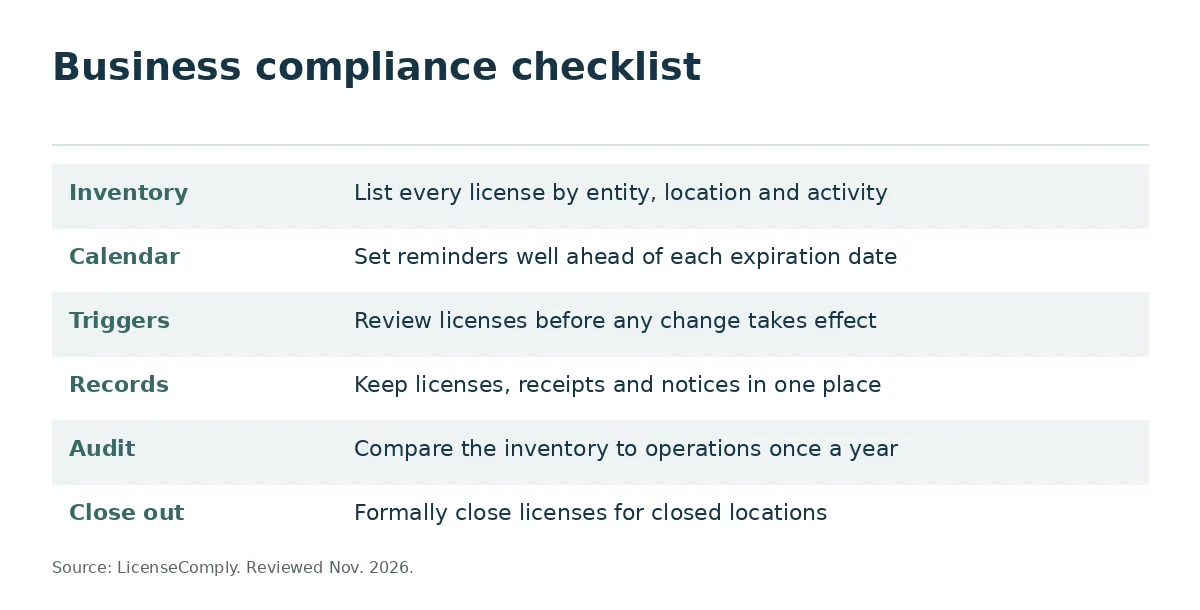
Business compliance checklist
A checklist turns these rules into a routine that can reduce risk. It works for one location and scales across other states.
Build a master inventory
List every license, permit and registration by entity, location and business activities. Record the license type, issuing agency, number, expiration date, fee and owner.
Set a renewal calendar
Set reminders well ahead of each expiration date, allowing for processing time. Treat agency notices as a backup.
Define change-event triggers
Require a license review before any new location, move, ownership or officer change, name change, hiring in a new jurisdiction, or new product line takes effect.
Keep records and addresses current
Maintaining accurate records supports compliance, so store licenses, renewal confirmations, receipts and correspondence in one shared place. Keep mailing addresses current with every agency, since California notes that missing a reminder does not excuse a late filing.
Run an annual audit
Compare the inventory against actual operations and confirm each license is active. Formally close licenses you no longer need; the Texas Comptroller notes that an active permit still requires returns even with no sales.
Our business license lookup guide explains how to confirm license status in official records.
How to track licenses in multiple jurisdictions
Tracking across multiple jurisdictions is mostly a data problem.
Organize by location
Sort the inventory by location first, then by layer: state, county, city and industry.
Flag licenses tied to a person, such as a contractor qualifier, and review entity filings alongside location licenses. A lapsed entity can undermine every license it holds.
Spreadsheets or license management software
Some teams use a spreadsheet and shared calendar. Others use license management software, a general category of tracking tools, or hand tracking and filing to an outside provider such as our renewal and management service. Whatever supports your compliance efforts, the inventory and calendar remain the foundation.
Frequently asked questions
What is business license compliance?
Business license compliance is the ongoing work of holding every license your business needs for each location and activity, renewing those licenses on time, and updating them when the business changes. It covers state, county and city business licenses, tax permits and industry licenses. Requirements vary by jurisdiction, so confirm each license with the agency that issues it.
What happens if I renew my business license late?
It depends on the agency. Washington charges a late penalty of half the endorsement fees, up to $150. Alabama state and county licenses renewed after October 31 face a non-waivable 15 percent penalty plus interest. California contractors pay a higher delinquent fee, and work done while expired is considered unlicensed. Check the rules for each license you hold.
Do I need a new business license if I change ownership?
Often, yes. The Texas Comptroller requires a new sales tax permit after any ownership change, including when a sole proprietor incorporates. California’s contractor board requires a new license when the business entity changes. Chicago handles ownership and officer changes through an update application. Review every license before the change closes.
How do I manage a multi state business license portfolio?
Start with a master inventory organized by location, listing each license, issuing agency, renewal date and responsible person. Add a calendar with reminders set ahead of agency deadlines, and require a license review before any new location, ownership change, name change or new activity. An annual audit comparing the inventory to operations helps catch gaps early.
Does every business license renew every year?
No. Washington licenses with endorsements renew annually, Alabama business privilege licenses renew each October, and active California contractor licenses expire every two years. Some registrations do not expire but must be kept current through returns or periodic reports. The expiration date on each license, or the issuing agency, is the authoritative source.
Tracking licenses across many locations?
LicenseComply tracks renewal deadlines across your state, county and city licenses and prepares and files the renewals for you.
Official sources and further reading
- Washington Department of Revenue: Apply for a business license
- Washington Department of Revenue: Business licensing and renewals FAQs
- Washington Department of Revenue: Business Licensing Service penalty waiver
- RCW 19.02.085: Business license delinquency fee
- Alabama Department of Revenue: Operating a business in Alabama, business privilege licenses
- Code of Alabama Section 11-51-93: Municipal license violations and penalties
- California Contractors State License Board: General renewal information
- California Contractors State License Board: Change in business entity
- California Secretary of State: Business entities FAQs
- City of Chicago: Update your business license information
- Texas Comptroller: Sales tax permit FAQs
- Texas Secretary of State: Foreign LLC registration instructions (Form 304)
- Texas Secretary of State: Copies and certificates
- City of Chicago Municipal Code Chapter 4-4: General licensing provisions
Disclaimer: LicenseComply provides professional business licensing and compliance services. However, the informational content on this site (including articles, guides, tools, and videos) is provided for general educational purposes only and does not constitute legal, tax, or accounting advice. Laws and regulations change frequently, and we cannot guarantee that all information is accurate, complete, or up to date for your specific circumstances. Your use of this website and its content does not create an attorney-client, accountant-client, or other advisory relationship. You should consult with a qualified attorney, accountant, or other appropriate professional for advice tailored to your business.