
Key points
- The federal hemp ban in Section 781 of Public Law 119-37 takes effect in two stages: November 12, 2026 for cannabinoids the cannabis plant cannot naturally produce, and December 11, 2026 for most other provisions.
- From December 11, 2026, final hemp-derived cannabinoid products with more than 0.4 milligrams of total THC and similar cannabinoids per container fall outside the federal definition of hemp.
- As of late October 2026, the Congressional Research Service reported that the FDA had not yet published the cannabinoid lists or container guidance the law requires.
- State hemp licenses in Texas, Minnesota and California do not change automatically on the federal dates, so multi-state operators must review products and licenses location by location.

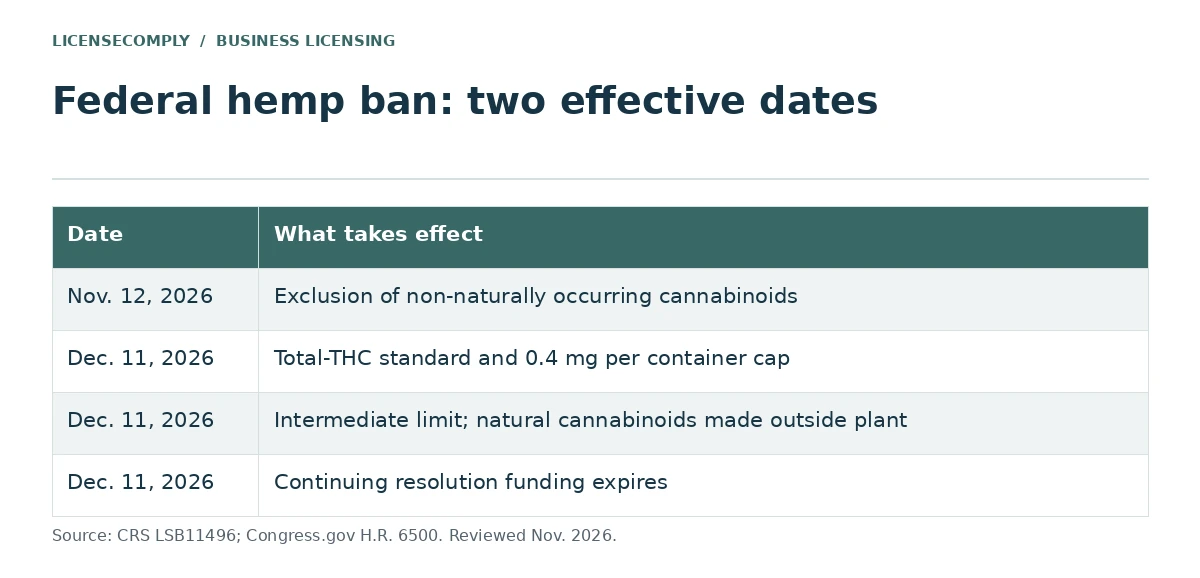
The federal hemp ban of 2026 takes effect in two steps. On November 12, 2026, hemp products containing cannabinoids the cannabis plant cannot naturally produce lose their federal hemp status, and on December 11, 2026, most of the rest of the new definition applies, including a cap of 0.4 milligrams of total tetrahydrocannabinol (THC) per container. As of this review (November 2026), Congress has not changed either date, according to the Congressional Research Service (CRS).
This is the “THC ban” retailers have been hearing about. For multi-state operators, the harder problem is that state law runs on its own calendar. A product can be legal under one state’s rules, banned under another’s, and outside the federal definition of hemp on December 11, all at once. Each of those states also licenses hemp sales on its own terms, usually per location and with its own renewal cycle.
Below: what changes federally, where Congress stands, how Texas, Minnesota and California interact with the change, and practical steps for multi-state operators. Rules vary and change quickly, so confirm current requirements with each issuing agency.
What does the 2026 federal hemp ban change?
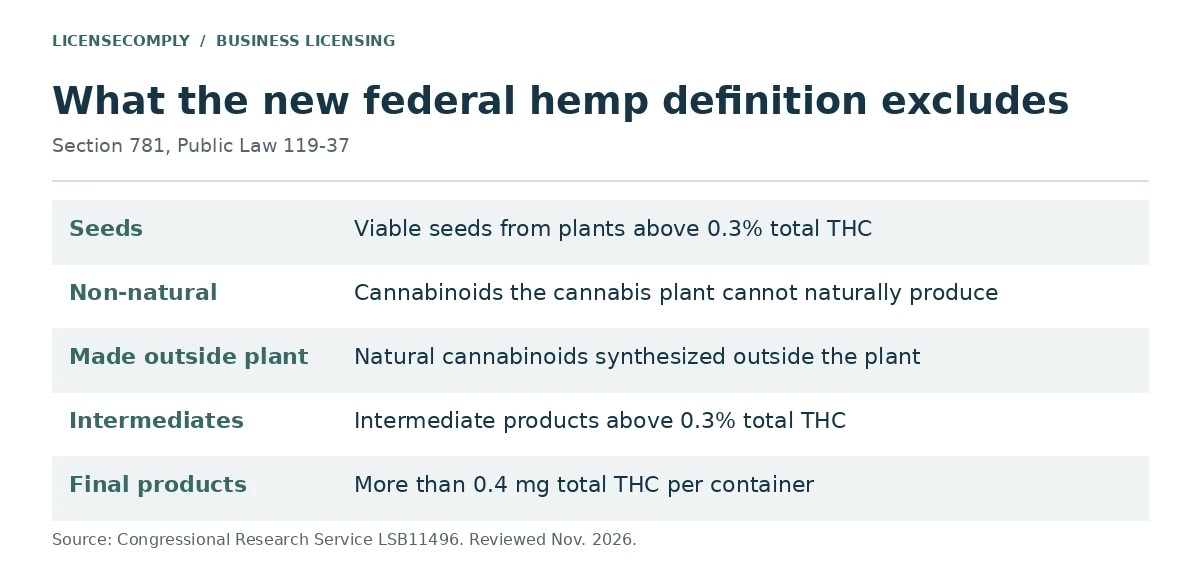
Section 781 of the fiscal year 2026 agriculture appropriations law (Public Law 119-37), signed in November 2025, rewrites the federal definition of hemp. According to a CRS Legal Sidebar dated October 28, 2026, the new definition measures total THC concentration (not just delta-9 THC) against the 0.3% limit, and it excludes:
- viable seeds from plants above 0.3% total THC;
- hemp-derived cannabinoid products containing cannabinoids the cannabis plant cannot naturally produce;
- products containing naturally occurring cannabinoids that were synthesized or manufactured outside the plant;
- intermediate products above 0.3% total THC and similar-effect cannabinoids; and
- final products with more than 0.4 milligrams combined per container of total THC and cannabinoids with similar effects.
Products that fall outside the definition are no longer hemp and are treated as controlled substances to the extent they fall within the Controlled Substances Act (CSA) definitions of marijuana or THC (CRS).
Two effective dates, not one
The change was originally set for November 12, 2026. The Continuing Appropriations and Extensions Act, 2027 (H.R. 6500), which became Public Law 119-103 on September 2, 2026, delayed portions of the new definition to December 11, 2026 (Congress.gov). CRS explains that the delay does not cover the exclusion for products containing cannabinoids that cannot be naturally produced by the plant, which still takes effect November 12 (CRS). CRS gives THC acetate ester (THC-O) as an example of a cannabinoid that does not occur naturally in cannabis (CRS).
Everything else, including the total-THC standard, the per-container cap, the intermediate-product limit and the exclusion for naturally occurring cannabinoids made outside the plant, follows on December 11. December 11 is also the date the same law’s continuing government funding runs out unless Congress acts sooner (Congress.gov), which is why the next funding bill is the most likely vehicle for any further hemp change.
Why the FDA lists still matter
The law directed the Food and Drug Administration (FDA) to publish, within 90 days of enactment, lists of cannabinoids the plant can naturally produce, THC-class cannabinoids and cannabinoids with similar effects, plus more detail on what counts as a “container.” As of October 28, 2026, CRS reported that FDA had not published any of these items (CRS). Without those lists, the line between a November 12 product and a December 11 product is not officially drawn, so treat edge cases conservatively.
Is Congress likely to delay the THC ban again?
No delay beyond December 11 had been enacted as of this review. CRS lists bills that would push the definition back two more years (H.R. 7024, H.R. 7010 and S. 3686) and one that would repeal the change (H.R. 6209), and it notes Congress may also simply let the new definition take effect (CRS).
The Lawful Hemp Protection Act (H.R. 9830), introduced July 22, 2026, would replace the ban with a federal framework: a 1% total THC hemp definition, FDA product rules, a minimum age of 21, permits for manufacturers and beverage wholesalers, and new taxes (Congress.gov bill text). Its latest action is still its July 22 referral to four House committees (Congress.gov). Minnesota’s cannabis regulator notes that neither it nor the Beverage Regulatory Parity Act has received a vote in either chamber (Minnesota Office of Cannabis Management).
A rewrite in a December funding package is possible, but compliance plans should assume both dates hold.
Why is this a multi-state licensing problem?
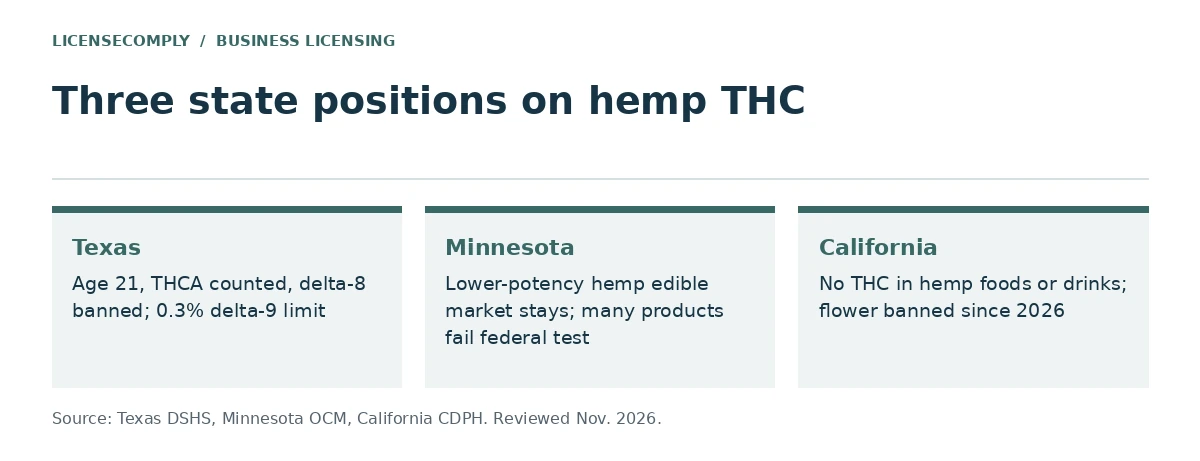
The federal change does not rewrite state definitions, licenses or renewal dates. The three states below show three distinct positions: tighter state rules without the federal cap (Texas), a licensed market federal law will not recognize (Minnesota), and a standard already stricter than the federal cap (California). Run the same analysis for every state where you hold hemp licenses or ship products, and if you are entering a new state, follow a deliberate registration sequence for opening in a new state.
Texas: tighter state rules, separate from the federal cap
Texas has tightened hemp rules mostly through agency action. Executive Order GA-56 directed the Texas Alcoholic Beverage Commission (TABC) and the Department of State Health Services (DSHS) to ban sales to minors and adopt other regulations (Texas State Law Library). Key changes now in place:
- Age 21: DSHS emergency rules adopted October 2, 2025 bar its licensees and registrants from selling to anyone under 21 and require government-issued identification (Texas DSHS). TABC Rules 35.5 and 35.6, effective January 21, 2026, apply the same age limit and ID checks to TABC license holders (Texas State Law Library).
- THCA counted: DSHS rules effective March 31, 2026 count tetrahydrocannabinolic acid (THCA) along with delta-9 THC toward the 0.3% limit, which effectively bans nearly all smokable hemp. The rule is being challenged in court, and the Fifteenth Court of Appeals has allowed it to stay in effect while the case is pending (Texas State Law Library).
- Delta-8: a Texas controlled substance schedule change affecting delta-8 THC took effect July 31, 2026, and only trace amounts naturally produced by the plant are permitted (Texas DSHS).
- Vapes: a 2025 Texas law makes marketing or selling e-cigarette products containing any cannabinoids a Class A misdemeanor (Texas State Law Library).
Texas consumable hemp products may still contain up to 0.3% delta-9 THC on a dry-weight basis under Health and Safety Code chapter 443 (Texas DSHS). That is not the federal per-container standard, so a delta-9 gummy that is legal in Texas today can still fall outside the federal definition on December 11. The 90th Texas Legislature convenes January 12, 2027 (Texas Legislative Reference Library), so state law could change again next year, but not before the federal dates.
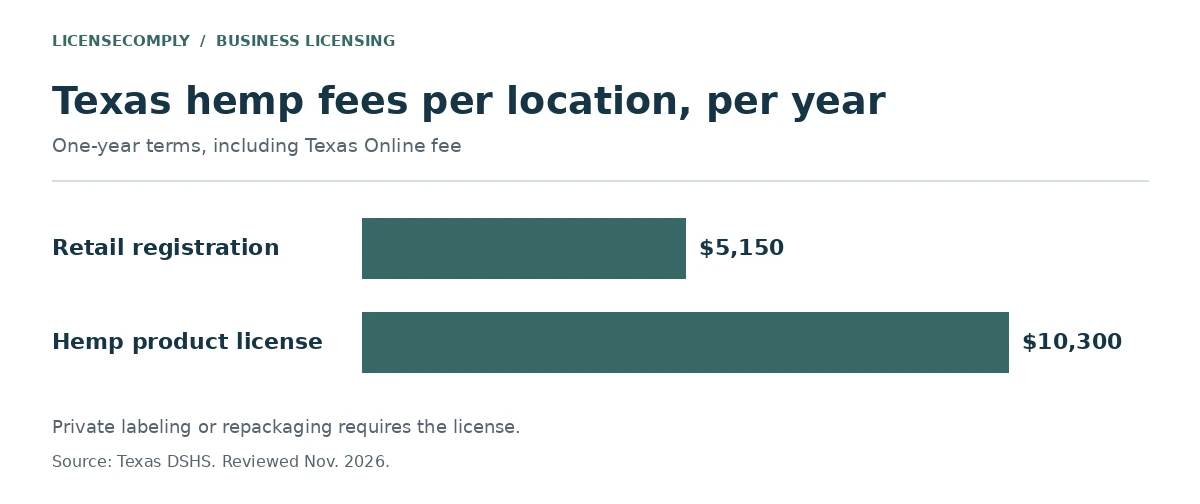
The licensing structure is per location and expensive. A DSHS Retail Hemp Registration costs $5,150 per location for one year, and a Consumable Hemp Product License costs $10,300 per location. Private labeling, repackaging or relabeling counts as manufacturing and requires the license (Texas DSHS). Storage locations need their own registration, mobile units need a registration for every address where they park, and online retailers based outside Texas need a registration to sell into the state (Texas DSHS FAQ).
For TABC licensees such as convenience stores, the risk extends beyond hemp. Selling a consumable hemp product to someone under 21, or failing to verify age, means the alcohol license or permit will be temporarily suspended or canceled (TABC).
Minnesota: a licensed market federal law will not recognize
Minnesota’s Office of Cannabis Management (OCM) is direct about the gap. The federal change does not alter Minnesota’s definition of lower-potency hemp edibles (LPHEs) or its licenses for retailers, manufacturers and wholesalers, but many state-compliant products, including packages above 0.4 milligrams of THC, will become federally noncompliant on December 11. OCM flags likely effects on banking, payment processing, federal tax deductions and interstate commerce (Minnesota OCM).
OCM lays out four licensing paths (Minnesota OCM):
- Renew: licenses last one year, and OCM sends notice 90 days before expiration, with reminders at 60 and 30 days.
- Surrender: licenses cannot be transferred, and after surrender the business cannot buy or sell LPHE products. A conditional surrender lets a business moving to a new entity surrender only once the new entity’s license is issued.
- Let it expire: all LPHE activity must stop at expiration.
- Consider cannabis licensing: Minnesota now allows holding cannabis and hemp licenses at the same time, though there is no open cannabis application window.
California: already stricter than the federal cap
California’s Assembly Bill 8 (AB 8), signed October 2, 2025, took effect for most provisions on January 1, 2026. Hemp extract used in food, beverages and dietary supplements cannot contain THC or synthetic cannabinoids, and hemp flower, hemp pre-rolls and inhalable products with hemp-derived THC cannot be sold in California (California Department of Public Health). Starting January 1, 2028, intoxicating hemp must be manufactured, tested, taxed and sold like licensed cannabis, and until new rules are adopted, Department of Cannabis Control (DCC) licensed retailers cannot sell hemp products (California DCC).
Federal and state hemp standards side by side
| Jurisdiction | THC standard for consumer products | Licensing model | Key dates |
|---|---|---|---|
| Federal | 0.3% total THC; 0.4 mg per container for final products; synthetics excluded (CRS) | No federal retail license; excluded products fall under the CSA | Nov. 12, 2026 and Dec. 11, 2026 |
| Texas | 0.3% delta-9 THC with THCA counted for sale; delta-8 trace only; age 21 (DSHS) | DSHS per-location registration or license; TABC rules for its licensees | Mar. 31, 2026 rules; July 31, 2026 delta-8 schedule |
| Minnesota | State LPHE definitions unchanged (OCM) | Annual, non-transferable OCM licenses | Federal change applies Dec. 11, 2026 |
| California | No THC in hemp food, drinks and supplements; no hemp flower or inhalables (CDPH) | CDPH authorization now; DCC licensing from 2028 | Jan. 1, 2026 and Jan. 1, 2028 |
What should multi-state operators do before December 11?
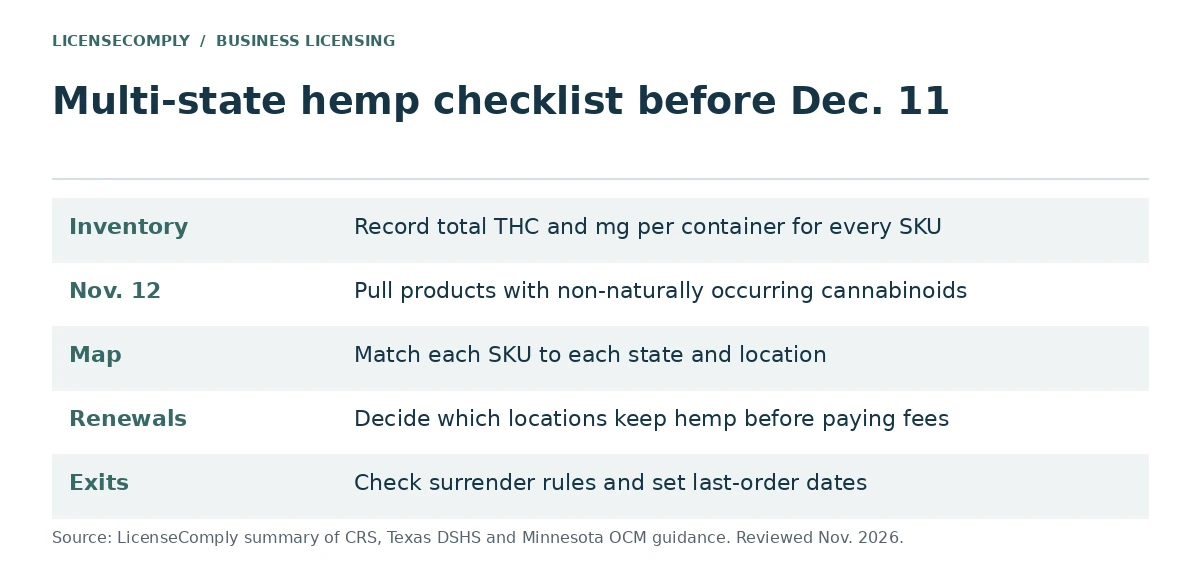
- Inventory at the stock keeping unit (SKU) level. For every product, record total THC including THCA, milligrams per container, whether any cannabinoid is synthesized or converted, and the certificate of analysis. Per-container math decides federal status after December 11.
- Pull non-naturally occurring cannabinoid products for November 12. Products built on cannabinoids such as THC-O face the earlier date. Where classification is unclear because FDA has not published its lists, ask counsel.
- Map each SKU to each location. The same product can be compliant in Texas, banned in California and outside the federal definition everywhere on December 11.
- Decide renewals deliberately. Before paying per-location fees, such as $5,150 per Texas retail location, decide which locations will keep selling hemp. Our business license renewal guide covers how to track expiration dates across jurisdictions.
- Protect adjacent licenses. In Texas, a hemp age-verification failure can cost a retailer its TABC license, so train staff and document ID checks wherever both are sold.
- Plan exits cleanly. Check whether each state allows conditional surrender, as Minnesota does, and set last-order dates and return terms with suppliers to limit stranded inventory.
- Watch the funding deadline. Any change will most likely ride on the bill that replaces the continuing resolution expiring December 11.
What to watch through December
| Item | Where to watch |
|---|---|
| Non-naturally occurring cannabinoid exclusion, November 12 | CRS Legal Sidebar |
| Remaining federal definition and funding deadline, December 11 | H.R. 6500 on Congress.gov |
| Lawful Hemp Protection Act committee action | H.R. 9830 on Congress.gov |
| Texas THCA litigation and DSHS or TABC changes | Texas DSHS |
| Minnesota license guidance | Minnesota OCM |
| California hemp integration rulemaking | California DCC |
Frequently asked questions
When does the federal hemp ban take effect?
The federal hemp ban takes effect in two stages. On November 12, 2026, hemp-derived products containing cannabinoids the cannabis plant cannot naturally produce lose federal hemp status. On December 11, 2026, the rest of the new definition applies, including the total-THC standard and the 0.4 milligram per container cap. Public Law 119-103 set the December date, and no further delay had been enacted as of early November 2026.
Is the THC ban the same in every state?
No. The federal definition applies nationwide, but each state keeps its own hemp definitions, licenses, age limits and testing rules. Texas allows up to 0.3% delta-9 THC with THCA counted for sales, Minnesota keeps its lower-potency hemp edible market, and California already bans THC in hemp foods and drinks. A product can be legal under state law and still fall outside the federal definition, so check each state separately.
Has FDA published the cannabinoid lists the law requires?
Not as of late October 2026. The law told FDA to publish lists of naturally occurring cannabinoids, THC-class cannabinoids and similar-effect cannabinoids, plus guidance on what counts as a container, within 90 days of enactment. A CRS Legal Sidebar dated October 28, 2026 reported that FDA had published none of these items. Operators should check FDA directly and get legal advice before relying on any classification.
Should I renew my state hemp license before December 11?
It depends on what each location will sell after December 11. In Texas, retail registrations cost $5,150 per location per year, so renewing locations that will no longer sell hemp may not make sense. Minnesota licenses cannot be transferred, but a conditional surrender option helps businesses moving to a new entity. Review each license’s expiration date and the state’s surrender rules before deciding.
Does the federal change affect my alcohol or tobacco licenses?
It can, depending on the state. In Texas, TABC license holders that sell a consumable hemp product to someone under 21 or skip age verification face temporary suspension or cancellation of their alcohol license or permit. California has barred DCC-licensed cannabis retailers from selling hemp products until new rules are adopted. Review how hemp sales interact with every other license held at the same location.
Selling hemp products in more than one state?
LicenseComply researches and verifies the licenses, registrations and renewal dates each of your locations holds, so you can decide what to renew, surrender or let expire.
Explore Research & Verification Talk to a licensing specialist
Official sources and further reading
- CRS Legal Sidebar LSB11496: Delay in Changes to Hemp Definition (Oct. 28, 2026)
- CRS In Focus IF13136: Changes to the Statutory Definition of Hemp
- H.R. 6500, Continuing Appropriations and Extensions Act, 2027 (Public Law 119-103)
- H.R. 9830, Lawful Hemp Protection Act
- Texas DSHS Consumable Hemp Program
- Texas DSHS hemp licensing and registration
- Texas DSHS consumable hemp FAQ
- TABC consumable hemp products rules
- Texas State Law Library: Consumable hemp products
- Minnesota Office of Cannabis Management: Federal hemp changes
- California Department of Public Health: AB 8 FAQ
- California Department of Cannabis Control: Hemp
Disclaimer: LicenseComply provides professional business licensing and compliance services. However, the informational content on this site (including articles, guides, tools, and videos) is provided for general educational purposes only and does not constitute legal, tax, or accounting advice. Laws and regulations change frequently, and we cannot guarantee that all information is accurate, complete, or up to date for your specific circumstances. Your use of this website and its content does not create an attorney-client, accountant-client, or other advisory relationship. You should consult with a qualified attorney, accountant, or other appropriate professional for advice tailored to your business.