
Key points
- There is no single federal online business license; online sellers usually need a local business license, a state sales tax permit, and any permits their specific products require.
- Texas charges no fee for a sales tax permit, and California’s tax agency offers free online registration for seller’s permits.
- After South Dakota v. Wayfair, states can require remote sellers to register based on sales volume alone, such as more than $100,000 in sales into South Dakota or more than $500,000 into Texas or California.
- California and Texas generally do not require a seller to register when all of its sales go through a marketplace that collects the tax, but direct sales from your own website can create a registration requirement.

Do I need a business license to sell online? In most cases, yes, though not a single “internet license.” Most online sellers need a general business license from their city or county, a sales tax permit from each state where they must collect tax, and any special permits their products require.
The exact mix depends on where you are based, what you sell, how much you sell into each state, and whether you sell through your own ecommerce store, a marketplace like Etsy, or social media. A part-time seller working from a spare bedroom can trigger registration rules the same way a storefront does, because local laws generally treat home businesses as businesses.
This step by step guide explains each layer for new sellers, with state and city examples from official sources reviewed November 2026. Rules vary by jurisdiction, so confirm every requirement with the agency that issues the license. If you sell mainly on Amazon, see our guide to the business license to sell products on Amazon.
Do I need a business license to sell online?
Selling online does not exempt a business from licensing. The U.S. Small Business Administration (SBA) notes that most small businesses need a combination of licenses and permits, and that the ones you need from the state, county or city “will depend on your business activities and business location,” according to the SBA licensing guide.
There is no single online business license
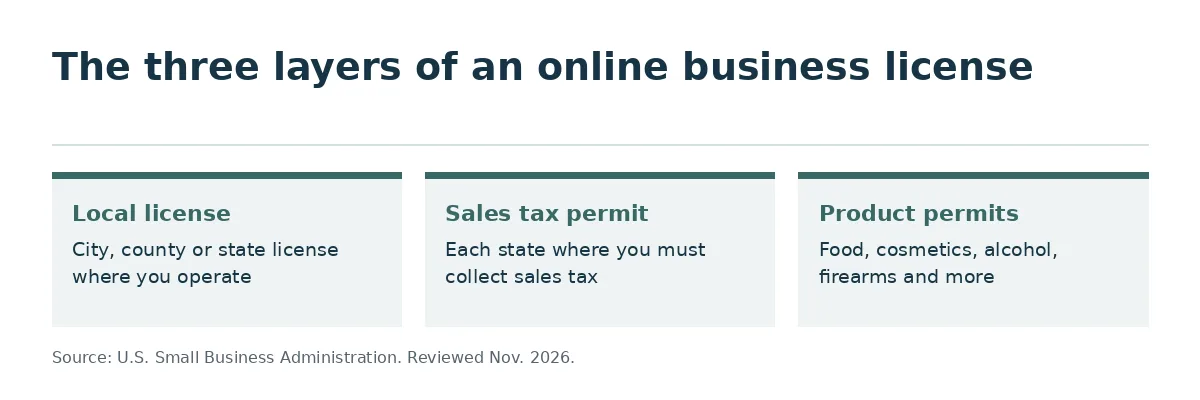
No federal agency issues a general online business license. Instead, an online business license is usually a combination of three layers.
- A basic business license or tax registration from your city, county or state, based on where you operate.
- A sales tax permit (also called a seller’s permit, sales tax license or certificate of authority) if you sell taxable goods or services.
- Special licenses for regulated products such as food, cosmetics, alcohol or firearms.
Your home base usually sets the local license
Local licensing usually follows where the business is run, not where the customers are. Many local governments require a license for anyone doing business inside city limits, including home-based and ecommerce business owners, so local requirements depend on your business address.
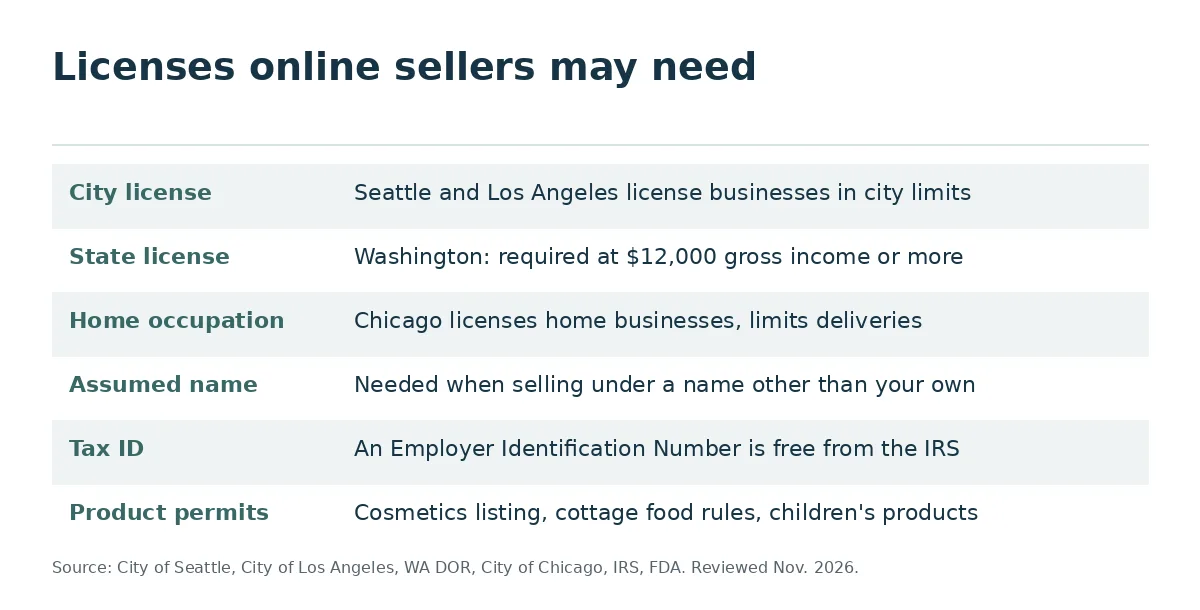
Seattle requires anyone doing business in the city to hold a business license tax certificate, renewed by December 31 each year. The city says an online-only business may need one “if your business originates from Seattle or has servers within city limits,” per the City of Seattle. Starting in 2026, a business with $4,000 or less in annual gross income in Seattle and no place of business there is exempt from the general certificate.
Los Angeles requires all businesses doing business in the city to obtain a Business Tax Registration Certificate, and its application asks for your California seller’s permit number if you sell taxable goods, per the City of Los Angeles business portal.
Before applying, check the licensing requirements for your specific jurisdiction. For a broader look at when a license is required, see our guide to whether you need a business license.
What licenses do online sellers usually need?
Beyond the local license, the list depends on your state and your products.
A state-level business license in some states
A few states issue a general business license at the state level. Washington requires a state business license if any one of several conditions applies, including selling a product that requires collecting sales tax, using a name other than your full legal name, or having gross income of $12,000 per year or more, according to the Washington Department of Revenue.
Home occupation permits
If you run your shop from home, your city may require a home occupation license or home occupation approval under its zoning rules. Chicago requires a city business license to operate a business from your home. Its home occupation rules allow no more than one bulk delivery per day, between 8 AM and 6 PM, and licenses run for two years, per the City of Chicago.
Product-specific permits
Some products need permits no matter where you sell them. The SBA lists federally regulated activities, including the sale of alcoholic beverages (Alcohol and Tobacco Tax and Trade Bureau) and the sale of firearms and ammunition (Bureau of Alcohol, Tobacco, Firearms and Explosives), on its federal licenses page.
- Cosmetics: Under the Modernization of Cosmetics Regulation Act, manufacturers and processors must register facilities with the Food and Drug Administration (FDA) and renew every two years, and each marketed product must be listed, although certain small businesses are exempt, per the FDA.
- Homemade food: Texas cottage food operators may sell online only when the operator, an employee or a household member personally delivers the food and required label information is posted before payment, according to the Texas Department of State Health Services.
- Children’s products: Domestic manufacturers and importers must certify compliance in a written Children’s Product Certificate, per the Consumer Product Safety Commission.
Legal structure, trade name and tax ID
Your legal structure affects which registrations come first. The SBA says a sole proprietorship “is easy to form,” and if you do business under your own legal name, “you won’t need to register anywhere” for the business itself, although licenses and permits may still apply, per the SBA business structure guide. Sole proprietorships do not need a limited liability company (LLC) or corporation to sell online, but entity formation can offer liability protection.
If you sell under a brand name or trade name rather than your legal name, most states or counties require a “doing business as” (DBA) or assumed name filing. In Los Angeles County, a person doing business under a fictitious name that does not include their surname files a Fictitious Business Name Statement with the county clerk, publishes it once a week for four consecutive weeks, and refiles because statements expire five years from filing, per the Los Angeles County Registrar-Recorder/County Clerk. Many sellers also get an Employer Identification Number (EIN), which you will need if you plan to hire employees, and the Internal Revenue Service says “you never have to pay a fee for an EIN,” per the IRS.
Do online sellers need a sales tax permit?
For sellers of physical goods, the sales tax permit is often the most important registration. Most states with a sales tax require a permit before you make taxable sales, and many issue it free.
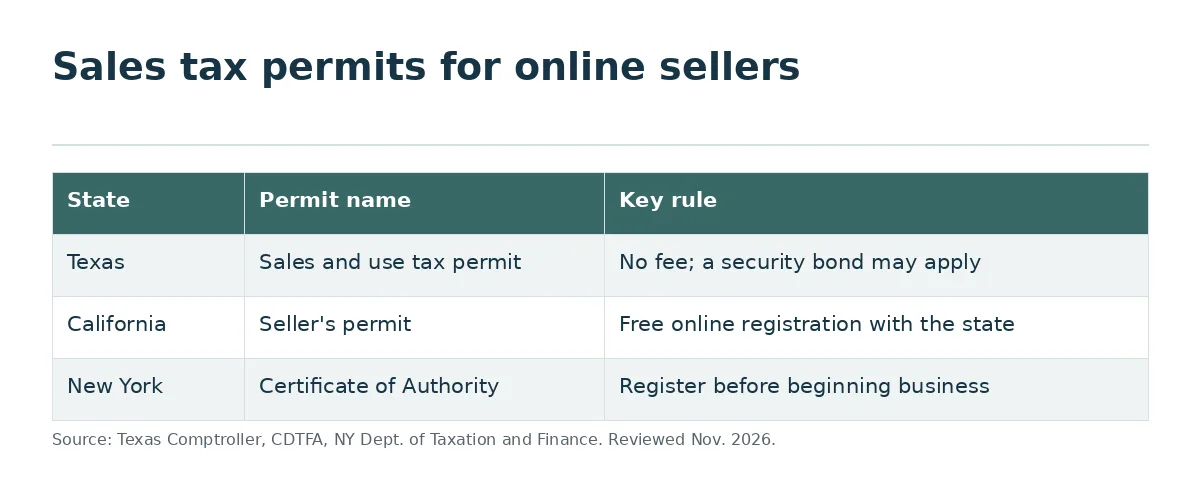
- Texas requires a sales and use tax permit for anyone engaged in business in Texas who sells tangible personal property in the state. “There is no fee for the permit, but you may be required to post a security bond,” per the Texas Comptroller.
- California requires a seller’s permit for businesses doing business in the state that “intend to sell or lease tangible personal property subject to sales tax sold at retail,” and the California Department of Tax and Fee Administration (CDTFA) offers a “free way to register online,” per the CDTFA.
- New York requires every person selling taxable goods or services to register “before beginning business,” even if they sell from home or only once a year, per the New York Department of Taxation and Finance.
Once registered, you collect and remit sales tax and file returns on the schedule your state assigns, which makes accurate tax reporting part of your ongoing tax obligations. A sales tax permit also lets you give suppliers a resale certificate to buy inventory for resale without paying tax in many states. Our guide on the seller’s permit vs. resale certificate explains the difference.
Does Etsy or another marketplace handle sales tax for me?
Often, but only for sales made through that marketplace. Under marketplace facilitator laws, the platform collects and remits tax on the sales it processes.
California says a marketplace seller does not need a seller’s permit if all of its retail sales are facilitated by a registered marketplace facilitator. A seller that also makes direct sales to California customers, such as through its own website, is generally required to register, per the CDTFA marketplace guide.
Texas takes a similar approach for remote sellers: one who sells only through a marketplace provider that certifies it is collecting tax does not need a Texas permit, but must keep marketplace sales records for at least four years, per the Texas Comptroller. Marketplace rules do not replace your local business license, and sales you make outside the marketplace are still your responsibility.
Digital products follow their own rules. Taxability of downloads and other electronic goods varies by state, and South Dakota counts “products transferred electronically” toward its remote seller threshold, per the South Dakota Department of Revenue.
How do I get a business license to sell online?
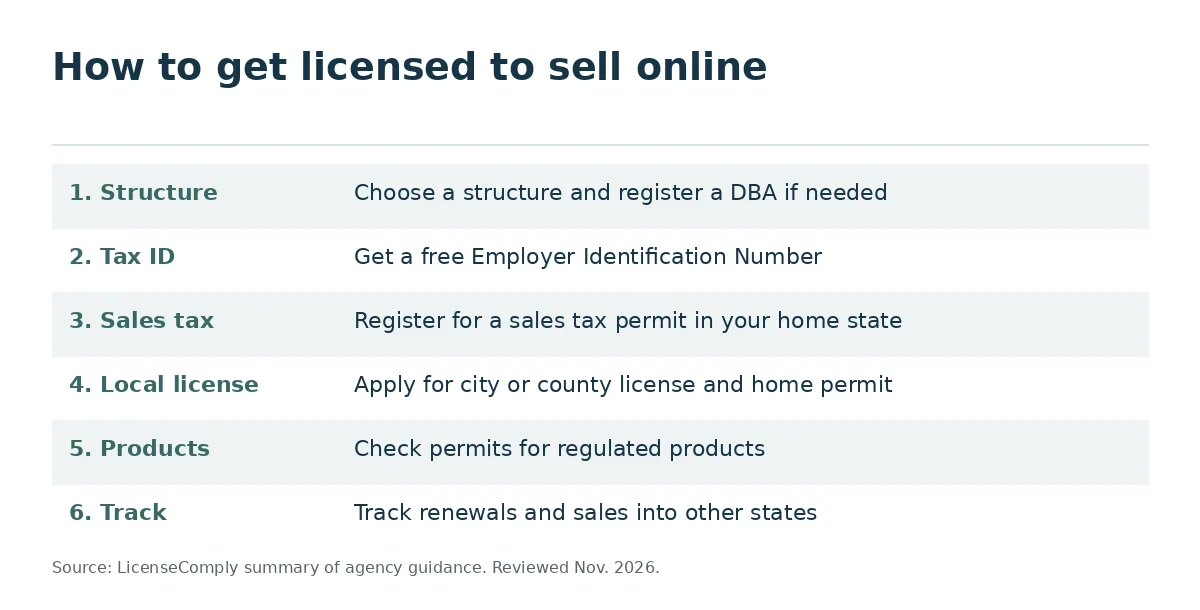
The steps below work for most new online sellers who want to be properly licensed before launch. The order matters, because later applications often ask for numbers from earlier ones.
- Choose your legal structure and name. Register a DBA if you sell under a name other than your own.
- Get a tax ID. Sole proprietors can sometimes use a Social Security number, but an EIN is free.
- Register for a sales tax permit in your home state if you sell taxable items.
- Apply for your city or county business license, plus a home occupation permit if required.
- Check product rules for food, cosmetics, children’s products, alcohol, firearms or other regulated goods.
- Track renewals and sales into other states, which can trigger new registrations. Seattle certificates, for example, expire every December 31, and late renewals elsewhere can cost extra: Washington’s business license delinquency fee is the lesser of $150 or 50 percent of the renewal fee base, under RCW 19.02.085.
What changes when you sell in several states or cities?
A business that started with one local license and one sales tax permit can owe registrations in many states.
Economic nexus after Wayfair
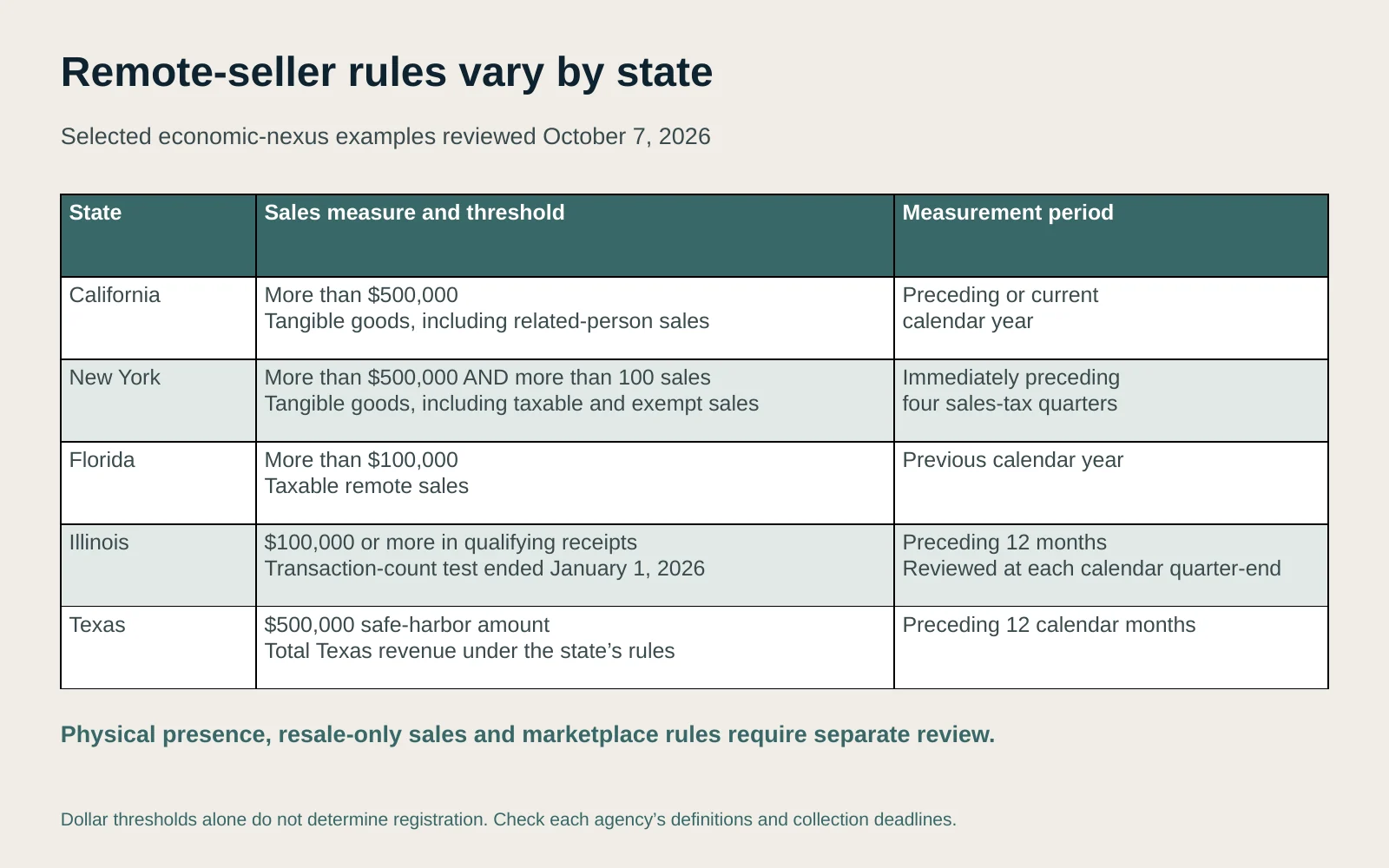
Since the U.S. Supreme Court decided South Dakota v. Wayfair on June 21, 2018, overruling the physical presence rule, states can require out-of-state sellers to register based on sales into the state, even with no physical presence. Thresholds differ.
| State | Remote seller threshold | Measurement period |
|---|---|---|
| South Dakota | More than $100,000 in gross sales | Previous or current calendar year |
| Texas | $500,000 in total Texas revenue | Preceding 12 calendar months |
| California | More than $500,000 in sales of tangible goods | Preceding or current calendar year |
| New York | More than $500,000 and more than 100 sales | Preceding four sales tax quarters |
These figures come from the South Dakota Department of Revenue, Texas Comptroller, CDTFA and New York Department of Taxation and Finance. Texas requires a seller that exceeds its threshold to start collecting no later than the first day of the fourth month after the month it exceeds it.
Registering in many states at once
The Streamlined Sales Tax Registration System lets sellers register in its 24 full member states through one free application, though “a state may charge a fee if you are legally required to register in that state,” and returns are still filed with each state, per Streamlined Sales Tax. States outside the program, such as California, Texas and New York, need separate registrations.
Physical presence still counts
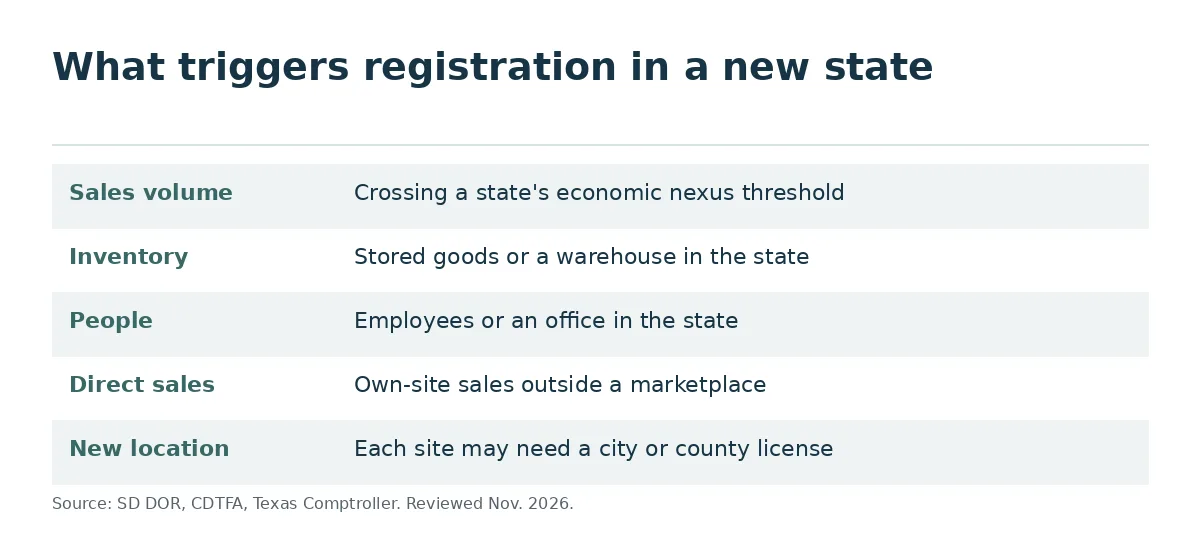
Economic thresholds apply to sellers without a physical presence. Employees, an office, a warehouse or stored inventory in a state can create a registration requirement at any sales level. South Dakota notes that its minimum thresholds “do not apply to any business with a physical presence” in the state, per the South Dakota Department of Revenue.
Local licenses multiply with locations
Each new office, warehouse or pop-up location can need its own city or county license. An entity expanding into a new state may also need to register there with the Secretary of State. Our guide to the registration sequence when opening in a new state walks through the order.
What other rules apply to online sellers?
Licensing is only part of selling online legally. Several federal rules apply to most online stores, and operating without the proper licenses has its own costs.
Penalties for operating without a license
Penalties come from local laws and vary widely. In Alabama, operating in a municipality without a required license can bring a fine of up to $500 per offense, with each day a separate offense, and late business license tax carries a 15 percent penalty that rises to 30 percent after 30 days, under Code of Alabama Section 11-51-93.
Shipping promises
Under the Federal Trade Commission’s Mail, Internet, or Telephone Order Merchandise Rule, if you state no shipping time you must be able to ship within 30 days, and late orders need the customer’s consent or a refund, per the Federal Trade Commission (FTC).
Marketplace seller verification
Under the INFORM Consumers Act, a high-volume third party seller generally has 200 or more sales of new or unused consumer products and $5,000 or more in gross revenue on one marketplace in a continuous 12-month period during the past 24 months. Marketplaces must then collect the seller’s bank account, tax ID and contact information. If the seller does not provide it within 10 days, the marketplace must “suspend any future sales activity” until the seller complies, per the FTC.
Income reporting
Payment processors, payment apps and online marketplaces must report payments on Form 1099-K when the total exceeds $20,000 in more than 200 transactions, according to the IRS. You must report income whether or not you receive the form, including personal items such as clothing or furniture sold at a gain.
Frequently asked questions
Do I need a business license to sell on Etsy?
Usually, yes. Etsy does not issue business licenses, and selling through a marketplace does not exempt you from city, county or state licensing where you run the business. Marketplace facilitator laws may cover sales tax on Etsy orders, so California and Texas generally do not require a permit if all your sales go through a marketplace that collects the tax. Direct sales through your own site or social media can still require a sales tax permit.
Is there an ecommerce business license I can apply for?
No single online or ecommerce business license exists. An online business typically holds a local business license or tax registration, a sales tax permit in each state where it must collect, and any product permits. Some states, such as Washington, also issue a state business license. Your city or county business licensing office and your state tax agency are the best places to confirm which apply to you.
Do I need a sales tax permit if I sell online from home?
If you sell taxable goods, generally yes. New York requires registration before beginning business, even for sellers working from home or selling only once a year. Texas issues its permit at no fee, and California offers free online registration. Selling only digital services or nontaxable items may change the answer, so check your state tax agency’s rules for your products.
Do I need a business license to sell online as a hobby?
It depends on whether you are in business and how much you sell. Some places set income thresholds: Seattle exempts businesses with $4,000 or less in city gross income and no place of business there, and Washington’s state license applies at $12,000 or more per year or when collecting sales tax. Many cities have no hobby exemption, so ask your local licensing office.
What licenses do I need to sell online in multiple states?
You need a sales tax registration in each state where you have physical presence or meet the economic nexus threshold, such as more than $100,000 into South Dakota or more than $500,000 into Texas or California. You may also need foreign entity registration and local licenses where you keep employees, offices or inventory. Track sales by state, because thresholds are measured over set periods.
Selling online in more than one state?
LicenseComply researches the licenses, sales tax permits and registrations your online business needs in each state and city, then files the applications for you.
Explore Research & Verification Talk to a licensing specialist
Official sources and further reading
- U.S. Small Business Administration: Apply for licenses and permits
- City of Seattle: Business licenses
- City of Los Angeles: Business Tax Registration Certificate
- U.S. Small Business Administration: Choose a business structure
- Los Angeles County Registrar-Recorder/County Clerk: Fictitious business name FAQ
- RCW 19.02.085: Business license delinquency fee
- Code of Alabama Section 11-51-93: Municipal license violations and penalties
- City of Chicago: Home based business license
- Washington Department of Revenue: Apply for a business license
- U.S. Food and Drug Administration: Registration and listing of cosmetic product facilities and products
- Texas Department of State Health Services: Texas cottage food production
- Consumer Product Safety Commission: Children’s Product Certificate
- Internal Revenue Service: Get an Employer Identification Number
- Texas Comptroller: Sales tax permit FAQs
- Texas Comptroller: Remote sellers
- California Department of Tax and Fee Administration: Permits and licenses
- California Department of Tax and Fee Administration: Tax guide for Marketplace Facilitator Act
- California Department of Tax and Fee Administration: Use tax collection requirements after Wayfair
- New York Department of Taxation and Finance: Register as a sales tax vendor
- New York Department of Taxation and Finance: Registration requirement for businesses with no physical presence
- Supreme Court of the United States: South Dakota v. Wayfair, Inc. (2018)
- South Dakota Department of Revenue: Sales and use tax for businesses
- Streamlined Sales Tax: Sales tax registration system
- Federal Trade Commission: Mail, Internet, or Telephone Order Merchandise Rule
- Federal Trade Commission: INFORM Consumers Act
- Internal Revenue Service: Understanding your Form 1099-K
Disclaimer: LicenseComply provides professional business licensing and compliance services. However, the informational content on this site (including articles, guides, tools, and videos) is provided for general educational purposes only and does not constitute legal, tax, or accounting advice. Laws and regulations change frequently, and we cannot guarantee that all information is accurate, complete, or up to date for your specific circumstances. Your use of this website and its content does not create an attorney-client, accountant-client, or other advisory relationship. You should consult with a qualified attorney, accountant, or other appropriate professional for advice tailored to your business.