
Key points
- Amazon does not require sellers to form a limited liability company or register a business, and individuals can register by selecting None, I am an individual as their business type.
- Amazon states that every US state with a sales and use tax has enacted marketplace facilitator laws as of January 1, 2023, so Amazon collects and remits sales tax on most third-party orders.
- Texas requires sellers located in Texas to hold a sales and use tax permit even if all their sales go through Amazon, while California does not require a seller’s permit if all sales are facilitated by a registered marketplace facilitator.
- Under the federal INFORM Consumers Act, a high-volume third-party seller is one with at least 200 sales and $5,000 in gross revenue on a marketplace in any continuous 12-month period during the past 24 months.

Do I need a business license to sell on Amazon? Amazon itself does not require one: you can register as an individual without forming a limited liability company (LLC) or registering a business. Your state, county or city may still require a business license, a sales tax permit or a local tax registration based on where you live, where your inventory sits and what you sell.
Amazon collects and remits sales tax on most orders under marketplace facilitator laws, but that does not cancel every registration duty. Texas, for example, still requires sellers located in Texas to hold a sales tax permit even when all their sales go through Amazon.
Rules below were reviewed November 2026 against official sources and vary by jurisdiction, so confirm each requirement with the issuing agency. For other channels, see our guide to getting a business license to sell online.
Do I need a business license to sell on Amazon?
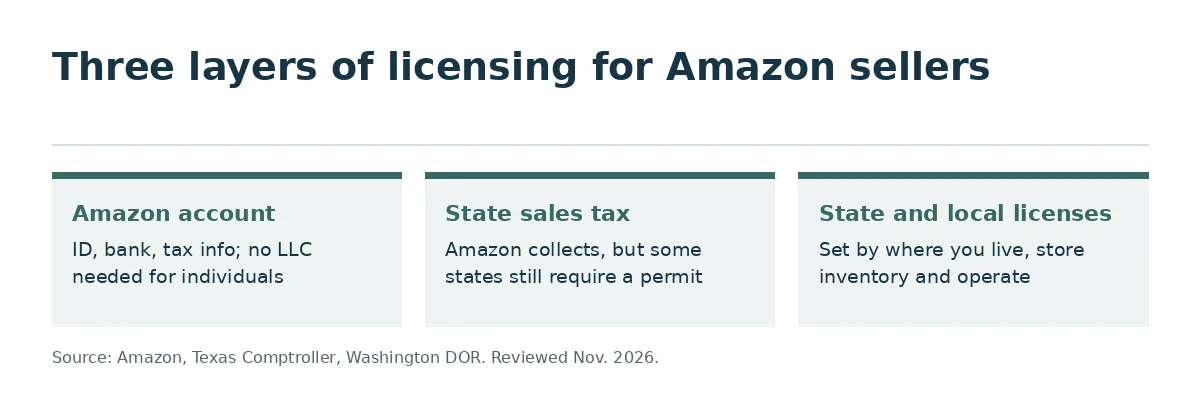
The answer has three layers, and each one is decided by a different authority.
- Amazon decides what it needs to open and keep your Amazon seller account.
- State tax agencies decide whether you must register for sales tax, even when Amazon collects it.
- States, counties and other local government offices decide whether your activity requires a general business license or local tax registration, usually based on your business location.
Amazon says plainly that “You don’t need to be an LLC or registered business, or be otherwise incorporated, to sell in the Amazon store,” according to its seller registration guide. That answers the platform question only. It says nothing about what your city or state requires, and an Amazon business is treated like any other online business for licensing purposes.
What do you need to start selling on Amazon?
Amazon’s checklist lists a government-issued ID, an email address, an internationally chargeable credit card, a bank account and routing number, a business license or registration, proof of residential address from the last 180 days, and tax information, per Sell on Amazon. Amazon says that in many cases you can complete registration in just a few hours, and identity verification usually takes three business days or less.
Is an Amazon seller business license required?
Not for individuals. The same registration guide tells sellers who are not incorporated to select “None, I am an individual” as the business type, and Amazon then adjusts what it collects. A registered business is asked for business details, including its business name, company registration number and registered address.
During identity verification, Amazon asks for business information, a government-issued photo ID, a bank account or credit card statement if applicable, and a business license if applicable, according to Amazon’s seller identity verification page. Entity sellers may be asked for documents such as a certificate of good standing or a recently issued business license, per Amazon’s global identity verification help.
What do the selling plans cost?
The Individual plan costs $0.99 per item sold and the Professional plan costs $39.99 per month, plus referral and other selling fees, per Amazon’s pricing page. Professional sellers also pay a one time fee at registration, after which the monthly subscription is waived until the first product is listed, according to Sell on Amazon.
Does Amazon require liability insurance?
Yes, once sales grow. Under section 9 of the Amazon Services Business Solutions Agreement, sellers must obtain commercial liability insurance within 30 days after exceeding $10,000 in gross proceeds in one month on Amazon.com, with at least $1 million of coverage per occurrence and in aggregate, per Amazon’s insurance requirements.
Since November 2, 2026, sellers in categories with enhanced safety listing requirements, such as children’s products, cosmetic and ingestible products, and lithium battery products, must carry that coverage regardless of sales volume, per Amazon’s program policy changes.
What does the INFORM Consumers Act require?
The Integrity, Notification, and Fairness in Online Retail Marketplaces for Consumers Act (INFORM Consumers Act) took effect June 27, 2023.
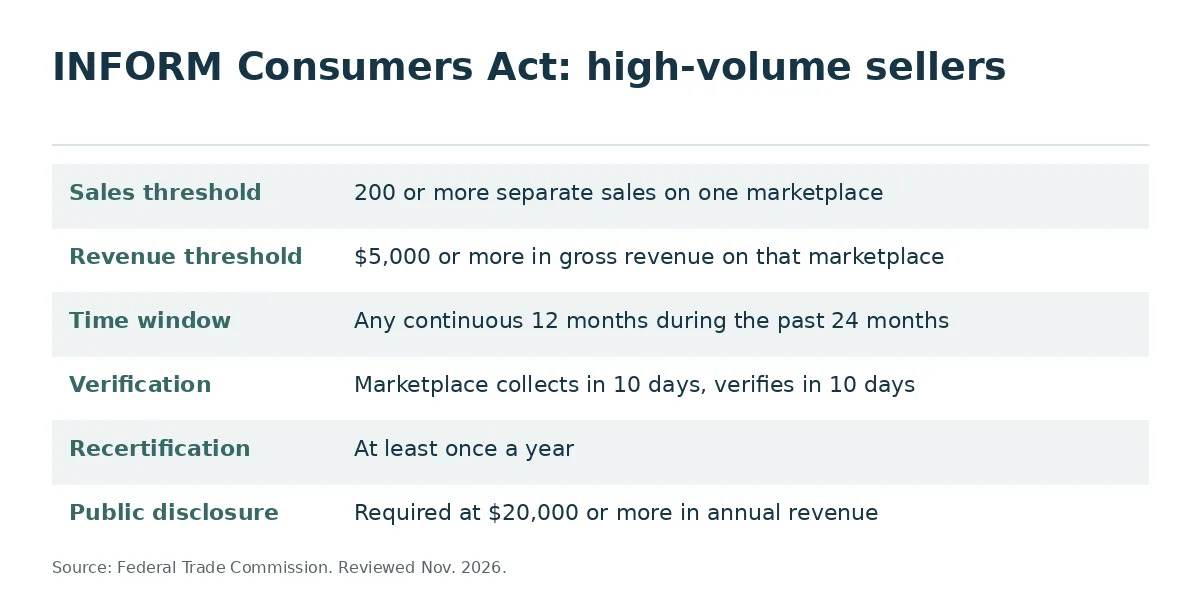
A high-volume third-party seller has at least 200 separate sales and $5,000 or more in gross revenue on one marketplace in any continuous 12-month period during the past 24 months, according to the Federal Trade Commission (FTC).
Once you qualify, the marketplace has 10 days to collect your bank account, tax identification number and contact information, then 10 days to verify it. You must recertify at least once a year. Sellers with $20,000 or more in annual gross revenue on a marketplace must have their name, physical address and contact information disclosed to buyers, with a limited exception for sellers operating only from home.
How does Amazon seller sales tax work?
For most orders, Amazon handles sales tax: it calculates the tax, collects it from customers and remits it on your behalf as the marketplace facilitator. Your registration duties still depend on your state, and so does whether you must pay sales tax yourself on other channels.
Why does Amazon collect sales tax for you?
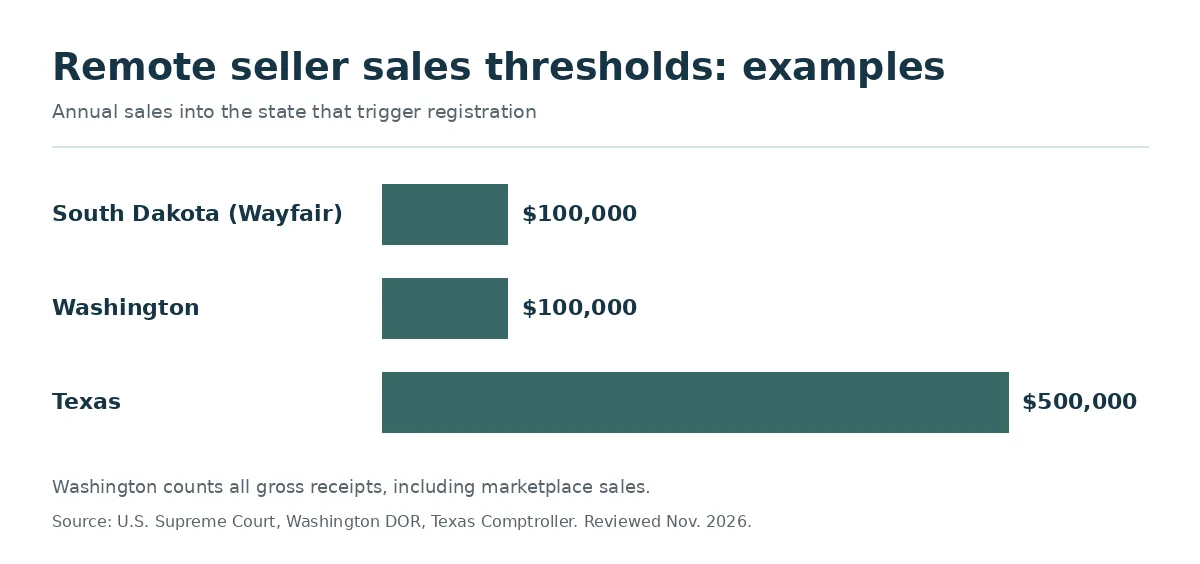
In South Dakota v. Wayfair (2018), the Supreme Court overruled the physical presence rule and upheld a law reaching sellers with more than $100,000 in sales or 200 or more transactions into the state, per the Supreme Court opinion. States then passed marketplace facilitator laws that make platforms collect tax on third-party sales.
Amazon states that every US state with a sales and use tax had enacted these laws as of January 1, 2023, according to Amazon’s marketplace tax collection FAQ. Exceptions include Colorado home rule cities and some Alaska localities.
Amazon also notes it does not file taxes for you, including income or gross receipts taxes on your sales into a state. Sellers remain responsible for sales into jurisdictions where marketplace collection does not apply.
Do you still need a sales tax permit?
It depends on the state. Three large states show how differently the same Amazon sales can be treated.
| State | Seller selling only through Amazon | Official source |
|---|---|---|
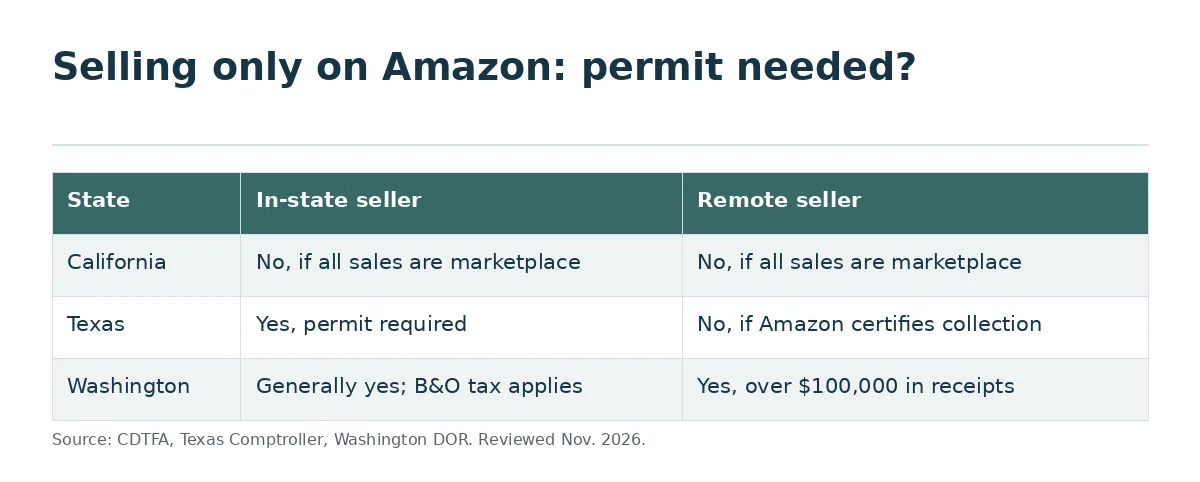
| California | No seller’s permit needed if all sales go through a registered marketplace facilitator | California Department of Tax and Fee Administration |
| Texas | Texas-based sellers need a permit; remote sellers do not if Amazon certifies collection | Texas Comptroller |
| Washington | Remote sellers over $100,000 must register and pay business and occupation tax | Washington Department of Revenue |
In California, a marketplace seller that also makes direct sales, such as through its own website or at craft fairs, may need a seller’s permit. The permit itself is free, though the California Department of Tax and Fee Administration (CDTFA) may require a security deposit, per its seller’s permit FAQ.
In Texas, the Comptroller answers yes to whether a Texas resident selling only through a certified marketplace needs a permit: “As a Texas seller, you have physical presence in Texas and must have an active sales and use tax permit.” There is no fee for a Texas permit, though a security bond may be required, per the Texas sales tax permit FAQ.
In Washington, marketplace sellers that meet nexus criteria must report and pay business and occupation (B&O) tax even if they sell only through marketplace facilitators. Washington’s B&O tax is a gross receipts tax, so Amazon’s sales tax collection does not cover it.
Our guide to seller’s permits versus resale certificates explains how a permit is used when buying inventory for resale.
What happens if you sell without a required permit?
Penalties can be significant. In California, a business that should have held a seller’s permit can be billed for back taxes plus a 10 percent penalty for each late return, and an added 50 percent penalty if it knowingly failed to get a permit to evade tax, according to the CDTFA compliance program FAQ. Operating without a permit can also bring a misdemeanor citation under Revenue and Taxation Code section 6071.
Which state and local licenses does an Amazon seller need?
Sales tax is only one piece. General business licenses and local tax registrations are triggered by where you operate, not by which platform you use.
State business licenses
Washington requires a state business license if any of several conditions apply, including gross income of $12,000 per year or more, collecting sales tax, or using a name other than your full legal name, according to the Washington Department of Revenue.
City and county registrations
Many cities require registration even for home-based sellers. In Los Angeles, all persons engaged in business in the city must obtain a Business Tax Registration Certificate unless specifically exempted, per the Office of Finance tax booklet. The city confirms that home-based businesses are subject to its business tax, per its AB63 program FAQ.
The Office of Finance’s retail sales compliance guide says a business with a location in the city, or that sells tangible products in the city, must register by the second month of operation.
Federal tax identification
You can sell as a sole proprietor using your Social Security number, but many sellers get an Employer Identification Number (EIN). An EIN is free from the Internal Revenue Service (IRS), per the IRS EIN application page.
Platforms report payments on Form 1099-K when a seller’s total payments exceed $20,000 in more than 200 transactions, according to the IRS.
Should your Amazon business be an LLC or corporation?
Amazon does not require a legal entity, so business structure is your choice. It affects taxes, paperwork and personal liability more than it affects licensing.
Sole proprietorship
You are automatically a sole proprietorship if you do business but do not register as any other kind of business, according to the U.S. Small Business Administration (SBA). A sole proprietorship is not a separate entity, so your business liabilities are not separate from your personal assets, and profits are taxed on your personal income tax return.
LLC or corporation
The SBA says an LLC offers limited liability protection in most instances, so personal assets such as your house and savings are generally not at risk if the LLC faces bankruptcy or lawsuits. LLC profits and losses can pass through to your personal income without corporate tax, though members pay self-employment tax.
An LLC or corporation will probably need to register in any state where it conducts business activities, per the SBA, and forming one does not replace any license or permit described above.
Business name and DBA
If you sell under a name other than your own or your entity’s legal name, you may need to register a doing business as (DBA) name, also called a trade name or fictitious name. The SBA notes that most states require DBA registration if you use one, and some counties and cities do too. For most small businesses, it adds that registering is as simple as registering the business name with state and local governments.
Do some products need extra licenses or approvals?
Amazon requires approval before listing in categories such as grocery and gourmet foods, health and personal care, jewelry and watches, and approval can require invoices, safety certifications or insurance documentation, per Amazon’s categories requiring approval. Alcohol, dietary supplements and pesticides appear on Amazon’s restricted products list.
Federal rules apply too, especially for federally regulated products such as food. Facilities that manufacture, process, pack or hold food for consumption in the United States must register with the Food and Drug Administration (FDA) before operating, unless exempt. Registrations must be renewed between October 1 and December 31 of each even-numbered year, and the 2026 window closes December 31, 2026, per the FDA.
What changes when you sell from several states or cities?
Multi-state Amazon sellers face more registrations because each office, warehouse, employee and inventory location can create obligations.
Inventory stored in other states
In Texas, a remote seller under the $500,000 safe harbor with inventory temporarily stored at a marketplace provider’s facility does not need a permit if Amazon certifies collection. Above $500,000, that seller must obtain a permit and collect tax, and a taxable entity storing inventory there also has franchise tax responsibility, per the Texas Comptroller.
In Washington, marketplace sellers with physical presence nexus must register for B&O tax starting on the date that presence begins, per the Washington Department of Revenue.
Each location can need its own registration
Texas requires a sales tax permit for each active place of business, per the Texas Comptroller. Los Angeles requires a separate registration certificate for each business activity and each location in the city, according to the Office of Finance tax booklet.
Other sales channels
Adding a website, wholesale accounts or event sales can trigger sales tax permits that marketplace-only sellers could skip. See our guide to licenses for buying and selling wholesale.
When you expand into a new state, our registration sequence for opening in a new state shows how entity, tax and license filings fit together.
How to get a business license for Amazon selling
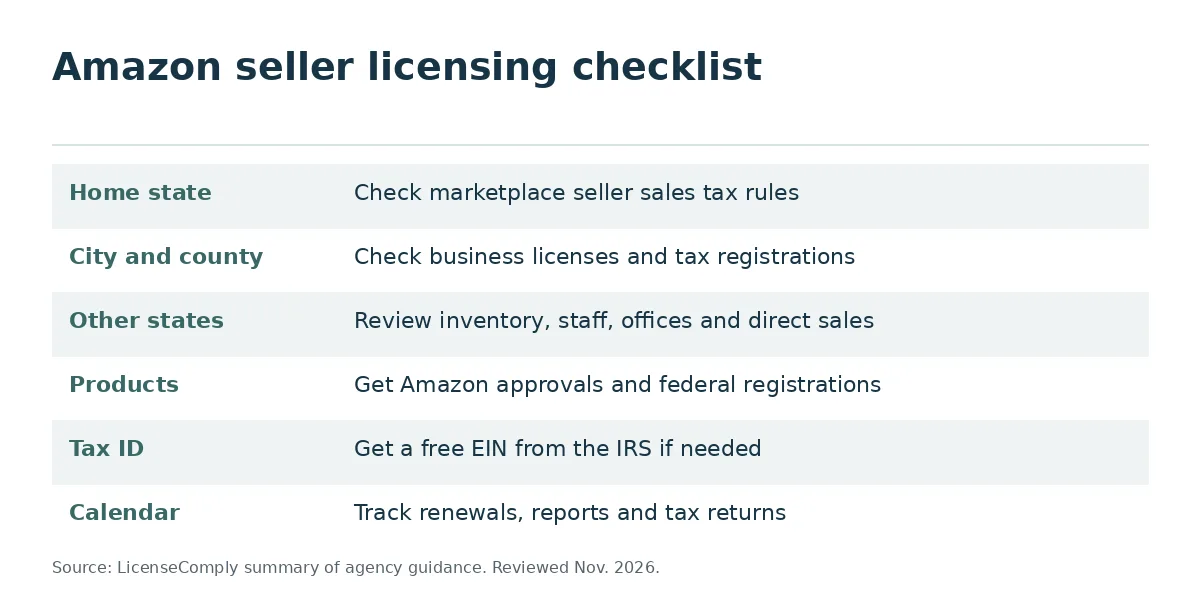
Most Amazon sellers can work through the following steps before they sign up, then repeat them as the business grows.
- Check your home state’s sales tax rule for marketplace sellers.
- Check your city and county for general business licenses or tax registrations, including home-based rules.
- List every state where you have inventory, employees, offices or direct sales, and check each one.
- Confirm product approvals with Amazon and any federal or state product registrations.
- Get an EIN if you plan to form an entity, hire or separate business and personal tax identification.
- Calendar renewals, annual reports and tax returns, and keep Amazon’s tax reports for your records.
The details matter most when you add channels, inventory locations or staff, so a written list of every registration makes compliance easier to manage.
Frequently asked questions
Do I need a business license to sell on Amazon as an individual?
Amazon does not require one. Its registration guide lets individuals select None, I am an individual and sell without an LLC or registered business. Your state, county or city may still require a business license or tax registration based on where you operate. Washington, for example, requires a state business license once gross income reaches $12,000 per year or you collect sales tax.
Does Amazon collect sales tax for third-party sellers?
Yes, in most cases. Amazon states that every US state with a sales and use tax had enacted marketplace facilitator laws as of January 1, 2023, so Amazon calculates, collects and remits sales tax on orders shipped to those states. Exceptions include Colorado home rule cities and some Alaska localities. Some states still require sellers to register.
Do Amazon sellers need a sales tax permit?
It depends on the state. California does not require a seller’s permit if all sales go through a registered marketplace facilitator. Texas requires sellers located in Texas to hold a permit even if they sell only on Amazon. Washington requires remote sellers with more than $100,000 in Washington gross receipts to register for business and occupation tax. Direct sales outside Amazon usually need a permit.
Do I need an LLC to sell on Amazon?
No. Amazon says you do not need to be an LLC or registered business to sell in its store. Some sellers form an LLC or corporation for limited liability protection of personal assets, which adds state formation and annual filing requirements. Entity sellers may be asked during verification for documents such as a certificate of good standing or a recently issued business license, so keep entity records current with your state.
What is a high-volume seller under the INFORM Consumers Act?
Under the INFORM Consumers Act, a high-volume third-party seller makes at least 200 separate sales and earns $5,000 or more on one online marketplace in any continuous 12-month period during the past 24 months. Amazon must then collect and verify bank account, tax identification and contact details and require yearly certification. Sellers with $20,000 or more in annual gross revenue must have identifying information disclosed to buyers.
Selling on Amazon from more than one state?
LicenseComply researches the state and local licenses and tax registrations your Amazon business needs in each location and files the applications for you.
Explore Research & Verification Talk to a licensing specialist
Official sources and further reading
- Amazon: Seller registration guide
- Amazon: How to sell on Amazon
- Amazon: Selling plan pricing
- Amazon Seller Central: Seller identity verification
- Amazon Seller Central: Global seller identity verification
- Amazon Seller Central: US marketplace tax and regulatory fee collection FAQ
- Amazon Seller Central: Categories and products that require approval
- Amazon Seller Central: Restricted products
- Amazon Seller Central: Commercial liability insurance requirements
- Amazon Seller Central: Changes to program policies
- Federal Trade Commission: Informing businesses about the INFORM Consumers Act
- Supreme Court of the United States: South Dakota v. Wayfair, Inc. (2018)
- California Department of Tax and Fee Administration: Tax guide for the Marketplace Facilitator Act
- California Department of Tax and Fee Administration: Obtaining a seller’s permit
- California Department of Tax and Fee Administration: Statewide Compliance and Outreach Program FAQs
- Texas Comptroller: Remote sellers and marketplace FAQ
- Texas Comptroller: Sales tax permit FAQ
- Washington Department of Revenue: Marketplace sellers
- Washington Department of Revenue: Apply for a business license
- Los Angeles Office of Finance: AB63 program FAQ
- Los Angeles Office of Finance: Retail sales tax compliance guide
- Los Angeles Office of Finance: Tax information booklet
- U.S. Small Business Administration: Launch your business
- Internal Revenue Service: Apply for an EIN online
- Internal Revenue Service: Understanding your Form 1099-K
- Food and Drug Administration: Food facility biennial registration renewal
Disclaimer: LicenseComply provides professional business licensing and compliance services. However, the informational content on this site (including articles, guides, tools, and videos) is provided for general educational purposes only and does not constitute legal, tax, or accounting advice. Laws and regulations change frequently, and we cannot guarantee that all information is accurate, complete, or up to date for your specific circumstances. Your use of this website and its content does not create an attorney-client, accountant-client, or other advisory relationship. You should consult with a qualified attorney, accountant, or other appropriate professional for advice tailored to your business.