
Key points
- Whether you need a business license depends on your activity, your location and how the business is set up. There is no single nationwide license.
- Forming an LLC registers the entity. It does not complete federal, state or local licensing.
- States differ: Washington runs a state business licensing system, while Texas has no general state business license but still has activity and local requirements.
- Budget for government fees, inspections and renewals separately from any service-provider fees.
You need a business license when the rules governing your activity and location require one. There is no single license that covers every business in the United States, and forming an LLC does not finish the licensing process. A business could need a city registration, a sales tax permit, a professional license, or several approvals issued by different agencies.
The U.S. Small Business Administration identifies business activity, location, and government requirements as the factors behind licensing obligations and fees. That means a useful answer starts with what you actually do and where you do it, rather than a generic list for “small businesses.”
This guide walks through those checks, explains the application process, and compares official fee examples. It also separates government charges from service-provider fees so you can budget for the complete process.

Start with your activity, location and setup
Describe the business in ordinary language before searching for forms. “Retail” is a starting point, but an agency also needs to know whether you sell prepared food, alcohol, cosmetics, secondhand merchandise, or other regulated products. “Consulting” is not enough if the work includes a regulated professional service.
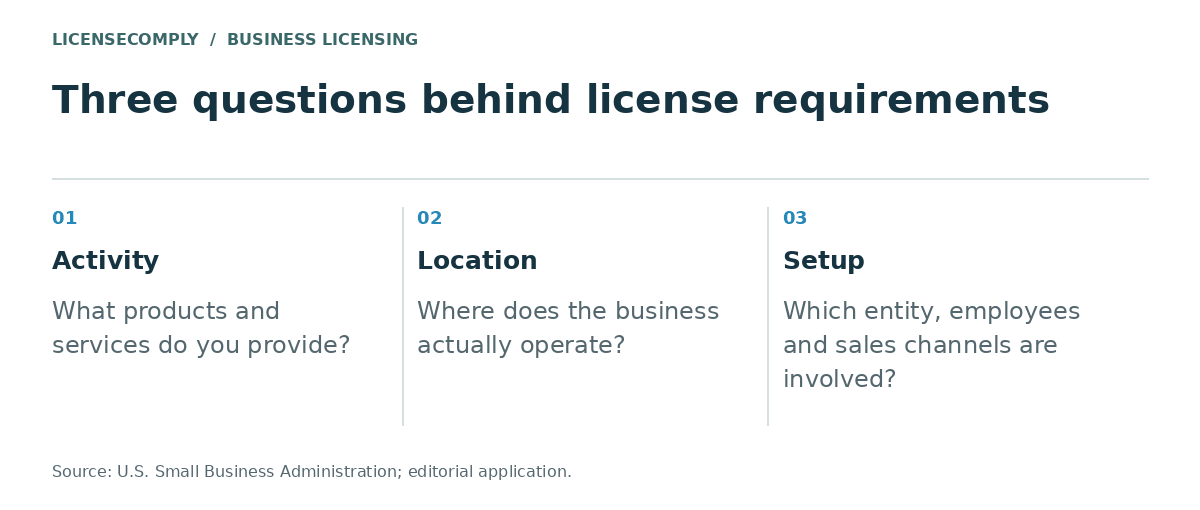
Write down each operating address and how it is used. Include a shop, office, home workspace, warehouse, or mobile operation where relevant. Identify the city and county as well as the state. For an expansion, describe the activities at the new location rather than copying the first location’s checklist.
Then record the entity name, trade names, ownership, employee plans, and sales channels. Hiring employees introduces employer registration questions. Selling taxable products introduces sales tax questions. These are related compliance tasks, but they are not interchangeable with a general business license.
A practical starting worksheet has four fields: activity, address, agency to contact, and result of the inquiry. Record the date and the source of each answer. That makes it easier to resolve conflicting information and update the research when the business changes.
Check federal requirements for regulated activities
Federal licensing is tied to regulated activities. Do not confuse an IRS tax identifier with a federal operating license. The SBA’s licenses and permits guide directs readers to the federal agencies responsible for specific activities.
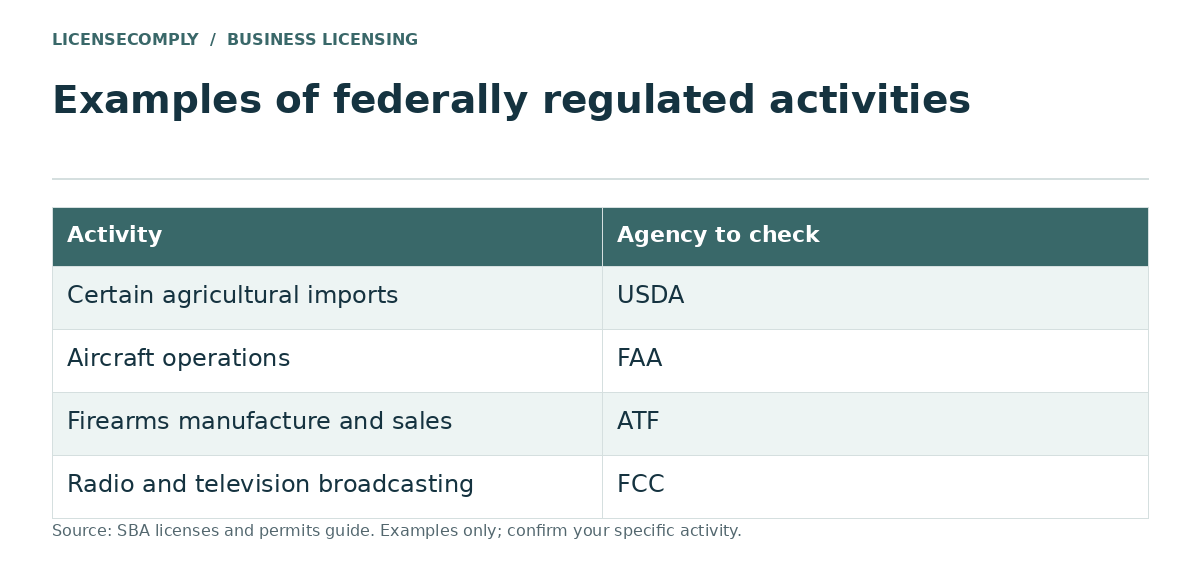
Examples include certain agricultural imports handled by the U.S. Department of Agriculture, aircraft operations regulated by the Federal Aviation Administration, firearms activities regulated by ATF, and broadcasting regulated by the Federal Communications Commission. Alcohol businesses also require careful review of federal and state authority for the specific activity.
Use this as a screening step, not as permission to operate. The business activity determines whether a federal approval is needed and which application applies. A local business license does not replace that approval. If your activities do not fall into a federally regulated licensing category, continue with the state and local checks.
State requirements differ
Some states have a broad business licensing system. Others focus on professional, industry, and tax registrations without issuing a general statewide business license.
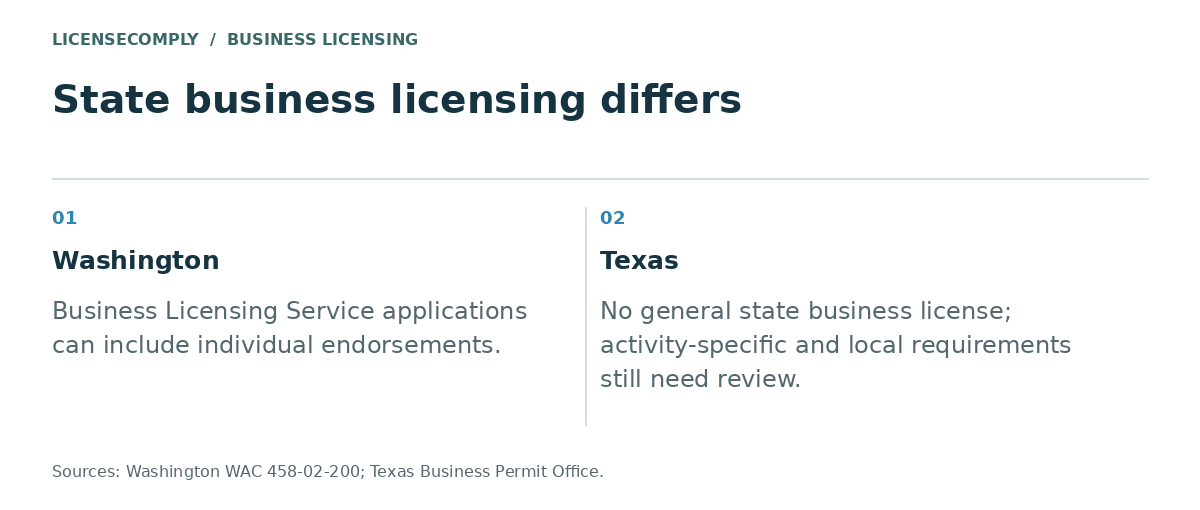
Washington’s Business Licensing Service handles business license applications and endorsements. Its business licensing rule distinguishes application handling fees from the charges for individual licenses. A business application can therefore involve more than one authorization and more than one fee.
Texas takes a different approach. The Governor’s Business Permit Office says the state does not require a general business license. An owner still needs to identify activity-specific authorizations, tax registrations, and applicable local requirements. “No general state license” is not a blanket exemption from licensing.
Professional work needs a separate review. The individual doing the work, the business offering it, or both could need a regulated credential. For an explanation of the terminology, see What Is an Occupational License.
City and county rules also matter
Look up the requirements at the actual operating location. Cities and counties can have different responsibilities, and businesses outside city limits should not simply use the nearest city’s forms.
Florida provides one example of local business tax requirements. Chapter 205 authorizes local business taxes subject to its provisions. A local business tax receipt is distinct from a professional or regulatory license. Confirm the requirements and any exemption with the relevant local tax office.
In California, the City of San Diego explains that its Business Tax Certificate does not replace required health, zoning, building, or state licensing approvals. The city also states that separate business locations require separate certificates.
Check whether the planned use is allowed at the property before committing to a lease or build-out. A favorable licensing answer cannot fix an unsuitable site. Our certificate of occupancy guide explains how building-use approval fits into opening a physical location.
Situations that deserve another licensing check
Opening a business is not the only trigger. Revisit your requirements when you add a location, introduce a regulated product, change ownership, start performing work in another jurisdiction, or substantially change the way a site operates.
Selling taxable goods or services warrants a sales tax review. Texas, for example, requires a sales and use tax permit for covered businesses selling taxable items or services under its permit guidance. Read Seller’s Permit vs Resale Certificate for the difference between registering to sell and documenting purchases for resale.
Hiring creates another review point. The IRS EIN guidance lists employees among the reasons a business needs an EIN. Employer tax accounts and payroll requirements should be checked separately from operating licenses.
Food service, childcare, regulated trades, and other specialized activities require more detailed agency research. Avoid relying on the license held by a prior tenant or seller of a business. A certificate associated with a different owner, address, or activity might not cover your operation.
Common situations owners ask about
I already formed an LLC
Entity formation establishes the business’s legal structure. It does not establish that the LLC has every license required for its services or location. Use the LLC’s exact legal name on applications where requested, and identify any trade name separately.
I work from home
A home address does not automatically remove local business or land-use requirements. San Diego’s business tax FAQs, for example, state that home businesses require a Business Tax Certificate. The applicable answer elsewhere depends on that jurisdiction and the activity. Customer visits, inventory, employees, and food preparation are useful facts to disclose when asking the agency.
I sell online only
Online selling still involves a business location and sales into particular jurisdictions. Review state sales tax rules, including remote-seller and marketplace rules where relevant, as well as requirements at your operating location. Do not assume that a marketplace’s tax collection handles every registration or license obligation.
I am a freelancer or sole proprietor
Working alone and operating without an LLC do not create a general licensing exemption. The City of San Diego expressly includes self-employed people and independent contractors in its business tax guidance. Elsewhere, check the local rules and any professional licensing requirements for the actual services.
I rent property for short stays
Check local short-term rental rules, zoning, and applicable tax registrations for the address. Permission from a listing platform or a property owner does not establish government approval. A city-specific answer is more useful than a nationwide assumption about hosts.
Apply for a business license in seven steps
1. Describe every activity and location
Create a complete operating description, including products, services, customer access, equipment, and the intended start date. For multiple sites, identify which activities occur at each address. Include activities planned for the near future so an agency can explain whether a later amendment will be needed.
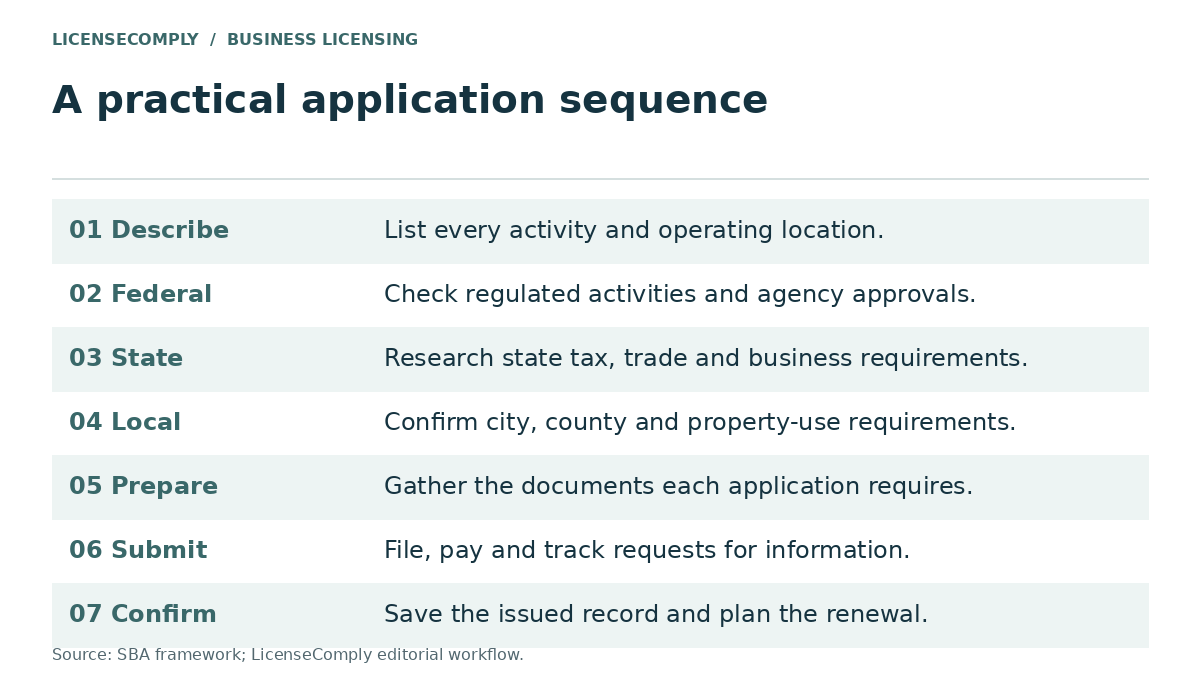
2. Identify federal approvals
Use the SBA’s agency list to screen for federally regulated activities. Where a category applies, follow the responsible agency’s application instructions. Record dependencies that affect your schedule, such as an approval needed before another filing can be completed.
3. Research state requirements
Start with official state business, revenue, and professional licensing resources. Permit-finder tools are useful starting points, but the issuing agency’s instructions determine the application. Record whether a requirement applies to the entity, an individual, a vehicle, or a particular location.
4. Confirm local requirements
Contact the city and county offices responsible for business licensing and property use. Ask about zoning, occupancy, health, fire, signage, and home-business requirements as relevant. Explain your specific activity rather than asking only whether the city has a “business license.”
5. Gather the requested information
Use the application checklist to collect entity documents, owner information, tax identifiers, premises information, and supporting approvals. Not every agency requires every item. Keep names and addresses consistent, and resolve discrepancies before submission rather than hoping the agency will infer the correct details.
6. Submit the application and pay the charges
Review the final application before filing. Separate the government application fee, inspection charges, and any optional service-provider fee. Save the submitted form and receipt. Track requests for additional information; payment alone does not necessarily mean the license has been issued.
7. Confirm issuance and plan renewal
Check the issued certificate for the correct business, address, activity, and term. Save it with the application record. Record renewal dates, update obligations, and any conditions. Assign someone to monitor the account so the work does not end with a certificate buried in an email inbox.
How much does a business license cost?
There is no nationwide price. The amount depends on the license, location, business category, and application stage. The following are agency-specific examples, reviewed October 26, 2026; they are not quotes for a complete business launch.
| Government charge | Published example | What the amount leaves out |
|---|---|---|
| Washington first location application handling fee | $50 | Individual license and endorsement fees |
| Texas sales and use tax permit | No permit fee | A security bond if required and other approvals |
| California seller’s permit | No permit fee | A security deposit if required and local approvals |
| East Baton Rouge initial occupational license payment | $50 for January-June openings; $25 for July-December openings | Possible additional tax after the first 30 days and other approvals |
| Texas mobile food vendor application | Type I $309; Type II $618; Type III $876 | Type II $400 or Type III $500 pre-licensing inspection fee and other applicable charges |
Sources: Washington WAC 458-02-200, Texas Comptroller, California CDTFA, Baton Rouge Revenue Division, and Texas DSHS.
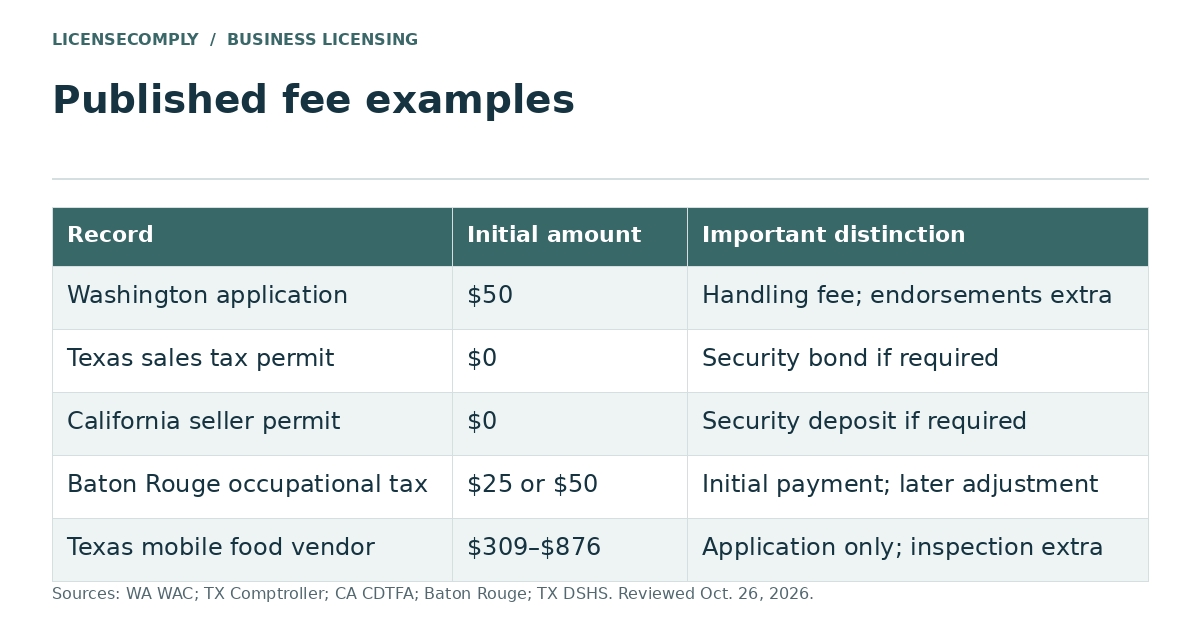
Baton Rouge’s initial payment deserves particular attention. The city explains that the temporary license is followed by a calculation using the first 30 days of receipts to determine whether additional occupational license tax is due. Presenting the initial payment as the full annual cost would understate the possible expense.
Build a budget for inspections, renewals, endorsements, and necessary prerequisite approvals. If you hire a provider, its service fee is separate from government charges. Ask for an itemized scope so you know which research, filings, follow-up, and renewals are included.
Budget for the full application sequence
Consider a retailer opening a second shop. A state sales tax registration might have no permit fee, while the city requires a separate business record and the premises need occupancy review. The opening budget should list each approval separately, with its government charge, required supporting work, and expected payment date. A single line labeled “business license” hides those differences.
Record whether each amount is an initial payment, a recurring charge, a deposit, or an estimate awaiting agency confirmation. Keep construction and equipment spending separate from filing fees. This makes it easier to compare service-provider proposals and prevents a low application fee from being mistaken for the complete cost of opening.
Also identify who pays and who follows up. An application can stall when the site manager assumes accounting paid an invoice and accounting assumes the manager is still checking the amount. Assigning a payment owner and saving the agency receipt closes that gap.
What happens if you operate without a required license?
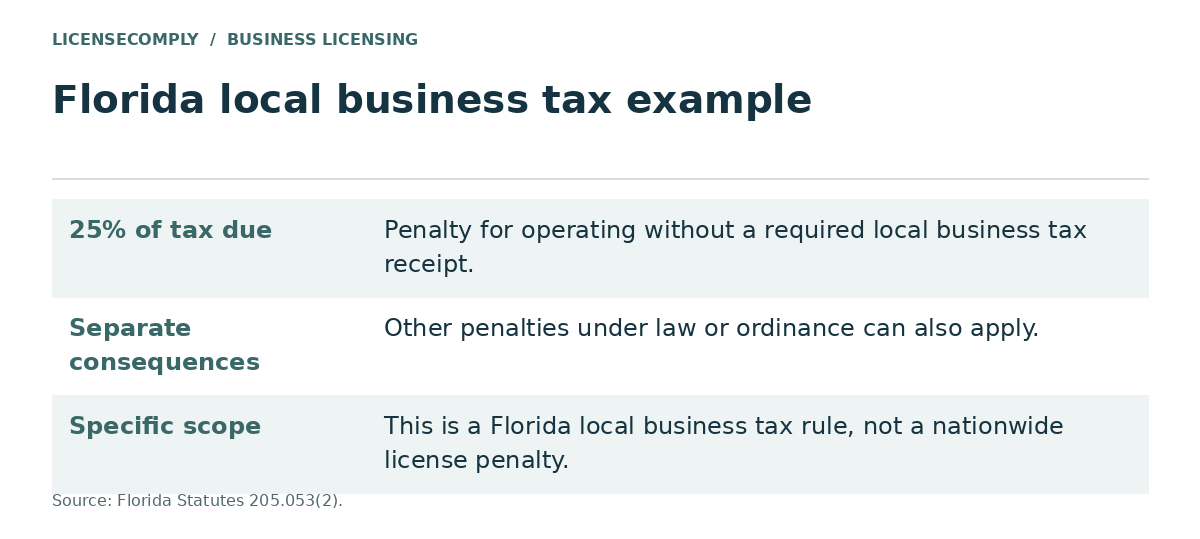
Consequences depend on the requirement and the jurisdiction. Avoid treating one city’s penalty as a national rule. Under Florida Statutes section 205.053, operating without a required local business tax receipt is subject to a penalty of 25% of the tax due, in addition to other applicable penalties.
If you discover a missing approval, contact the issuing office about the correct application and whether the activity must pause while it is resolved. Do not assume a late payment retroactively authorizes operations. Keep written agency instructions and the resulting filing record together.
When licensing help is useful
A single straightforward application might be manageable in-house. Multiple locations, regulated activities, acquisitions, and frequent openings create more dependencies and more opportunities for inconsistent records.
LicenseComply can help you start with business license research and identify the filing and renewal support appropriate to your operation. Provide the actual activities and locations so the research addresses your business rather than a generic checklist.
Frequently asked questions
Can I get one license for every state?
Do not assume so. State and local requirements must be checked for each applicable activity and jurisdiction. Some authorizations have special recognition rules, but those rules must be confirmed for the particular license.
Can I start while the application is pending?
Only when the responsible agency’s rules allow it. A submitted application or payment receipt is not a universal temporary operating authorization.
Do business licenses expire?
Many do, while some registrations remain active subject to other obligations. Check the actual certificate and agency instructions. Track tax returns and information updates separately from license renewal dates.
Where can I check a license I already have?
Start with the issuing agency’s portal or public lookup. See How to Look Up a Business License for the steps to locate and verify the correct record.
Not sure which licenses apply?
LicenseComply identifies the federal, state and local licenses your activity and locations require, then files the applications for you.
Explore Research & Verification Talk to a licensing specialist
Official sources and further reading
- U.S. Small Business Administration
- business licensing rule
- Governor’s Business Permit Office
- Chapter 205
- City of San Diego
- permit guidance
- IRS EIN guidance
- California CDTFA
- Baton Rouge Revenue Division
- Texas DSHS
- Florida Statutes section 205.053
Related guides



Disclaimer: LicenseComply provides professional business licensing and compliance services. However, the informational content on this site (including articles, guides, tools, and videos) is provided for general educational purposes only and does not constitute legal, tax, or accounting advice. Laws and regulations change frequently, and we cannot guarantee that all information is accurate, complete, or up to date for your specific circumstances. Your use of this website and its content does not create an attorney-client, accountant-client, or other advisory relationship. You should consult with a qualified attorney, accountant, or other appropriate professional for advice tailored to your business.