
Key points
- Any person or entity conducting a trade or business in Delaware must obtain a Delaware business license from the Division of Revenue at the time business begins.
- The annual Delaware business license fee is generally $75 for a first location, a separate license is required for each separate business activity, and each additional branch location adds $25.
- Delaware business licenses expire on December 31, and after the first year a business may buy a three-year license at three times the annual fee, with no discount.
- Delaware has no sales tax but imposes a gross receipts tax on sellers and service providers, with rates from 0.0945 percent to 1.9914 percent depending on the business activity.

To get a Delaware business license, register with the Delaware Division of Revenue through the state’s One Stop Business Licensing and Registration Service before you start doing business. The license fee is generally $75 per year for a first location, each separate business activity needs its own license, and every license expires on December 31. You may also need a city or county license, industry specific licenses, and gross receipts tax filings.
Delaware is unusual in two ways: it has no sales tax but taxes the gross receipts of most businesses, and it licenses by activity rather than issuing one general license. Because there is no sales tax, there is no seller’s permit to apply for, and the Division of Revenue notes that sales tax exemption and reseller certificates do not apply in Delaware.
This guide is written for small business owners and multi-state operators alike. It covers who needs a license, how to apply, what it costs, how the gross receipts tax works, how to run a Delaware business license lookup, and what changes for multi-state companies. Fees and rules were reviewed November 2026 against official sources, but requirements change, so confirm details with the issuing agency.
Who needs a Delaware business license?
The rule is broad. Any person or entity conducting a trade or business in Delaware must obtain a state business license from the Division of Revenue, and the license must be in place when business begins, according to the Division of Revenue business license FAQs. The same page notes that this business license requirement also includes entities located in Delaware that conduct their business outside the state.
The state’s One Stop registration portal describes three common triggers. You will need to register and apply for a license if you:
- have property or a business location in Delaware,
- have employees working in Delaware, or
- generate sales in Delaware.
If you are unsure whether you have substantial presence in Delaware, submit the Division of Revenue’s Nexus Questionnaire, and the Division will provide guidance on whether your business qualifies for licensing and taxation.
Does a professional license replace the business license?
No. Certain professions must also hold a license from the Division of Professional Regulation, but the State of Delaware business license is needed in addition to any professional license, per the Division of Revenue. Our guide to whether you need a business license explains how general and occupational licenses fit together nationally.
How to get a business license in Delaware, step by step
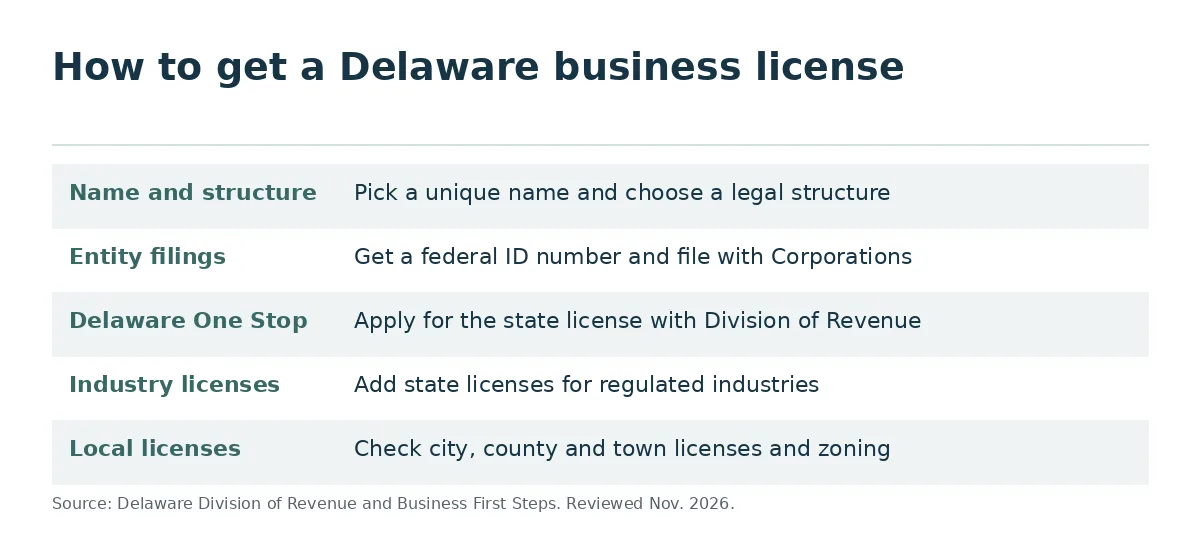
The Division of Revenue registration chart lays out the order. Sole proprietors can skip step 2.
- Choose a business name and legal structure. Common structures are a sole proprietorship, partnership, corporation or limited liability company, and the Division of Revenue cannot advise you on which to pick, per its FAQs. Your name must be unique, and you can check availability with the Division of Corporations. Reserving a name you will not file right away is voluntary and costs $75, according to Business First Steps.
- If you are not a sole proprietor, obtain a Federal Employer Identification Number (FEIN) from the Internal Revenue Service and file your entity with the Delaware Division of Corporations.
- Register on Delaware One Stop and complete the license application (the CRA form) to obtain a Delaware business license from the Division of Revenue. One Stop lets you register with several state agencies and the federal government in one session. If you will have employees, the same session registers you with the Division of Unemployment Insurance and the Division of Workers’ Compensation.
- Obtain other state licenses for regulated industries, such as food establishment, contractor trade or salon licenses.
- Obtain any federal license that applies to your industry, then check licenses and zoning at the county level and local level with your county, city or town.
How long does it take?
Most businesses receive their license within a month of registering, according to the Division of Revenue. You can print a temporary license at the end of the online registration, and permanent licenses are generally sent within 10 working days. The One Stop FAQ states that temporary licenses printed online are valid for up to 60 days.
Which industries need industry specific licenses?
Business First Steps publishes checklists by business type. Food establishments, including restaurants, food trucks and caterers, start by calling the Delaware Division of Public Health’s Office of Food Protection, and salons and barber shops need licenses from the Division of Professional Regulation.
Construction businesses need the most extra approvals before starting business operations. The same checklist lists professional licenses for electricians, plumbers and HVACR (heating, ventilation, air conditioning and refrigeration) firms, plus plumbing permits and, where applicable, permits from the Delaware Department of Natural Resources and Environmental Control (DNREC), the Delaware Department of Transportation (DelDOT) and the Fire Marshal. In unincorporated New Castle County, contractors also need a county contractor license, and the 2026 building contractor requirements list a $410 total fee and require a current state business license.
How much does a Delaware business license cost?
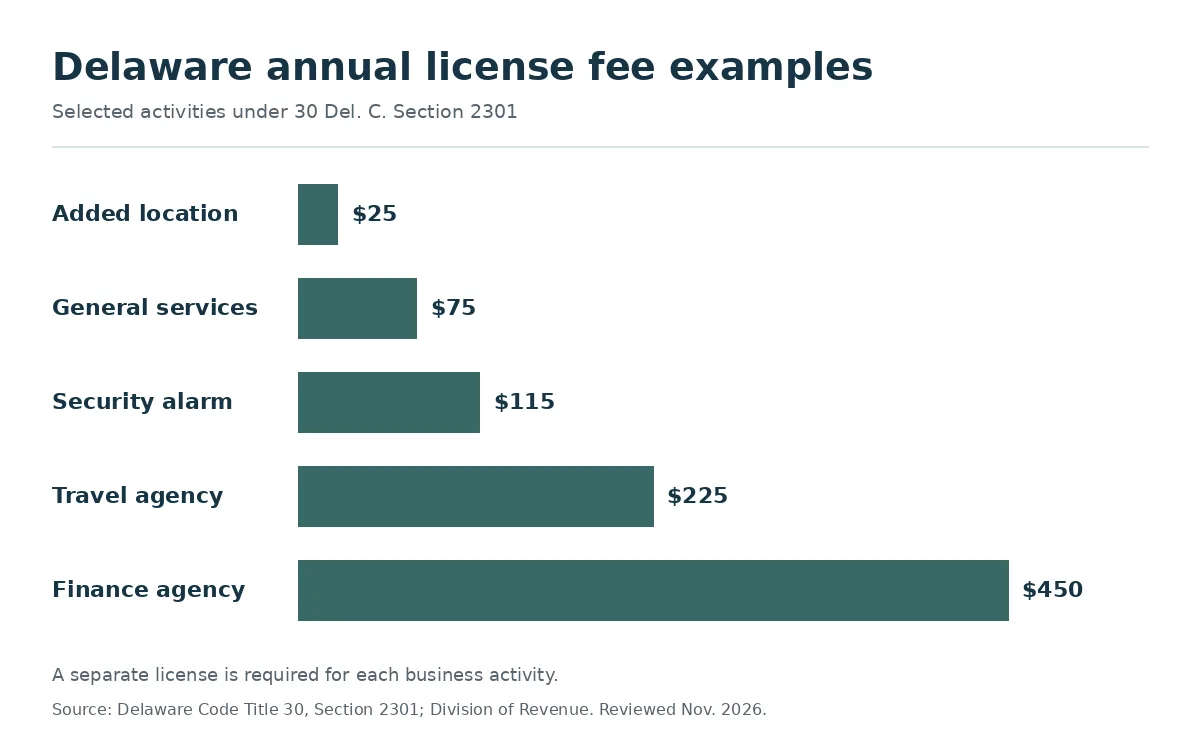
The annual license fee varies, but the rate is generally $75 for a first location, and a separate license is required for each separate business activity, per the Division of Revenue. Under 30 Del. C. Section 2301, most listed occupations and the general service category pay $75, and each additional branch or business location adds $25.
Some activities are priced differently. The statute sets examples such as these:
| Business activity | Annual license fee under Section 2301 |
|---|---|
| General services and most listed occupations | $75 |
| Each additional branch or location | $25 |
| Security alarm business | $115 |
| Travel agency | $225 |
| Finance or small loan agency | $450 (per place of business) |
| Hotel | $25 per room and $30 per suite |
Three other fee rules matter:
- Proration. Most licenses are pro ratable for the first year of activity, according to the Division of Revenue FAQs. 30 Del. C. Section 2121 reduces the initial annual fee by the full calendar months that have already passed.
- One or three years. After the first year, a business may pay for one or three years at a time. A three-year license costs three times the annual fee, is not discounted, and means fewer renewals.
- Senior discount. Delaware offers a 75 percent discount on annual license fees for individuals 65 or older on or before January 1 of the license year, if specific requirements are met, per the Division of Revenue.
What are the penalties for operating without one?
Under 30 Del. C. Section 2119, anyone who carries on a business requiring a license without first obtaining one is liable for the license fees and may be fined up to $3,000, imprisoned up to two years, or both. Section 2109 also requires licensees to display the license conspicuously, with a fine of up to $100 for failing to do so.
How does the Delaware gross receipts tax work?
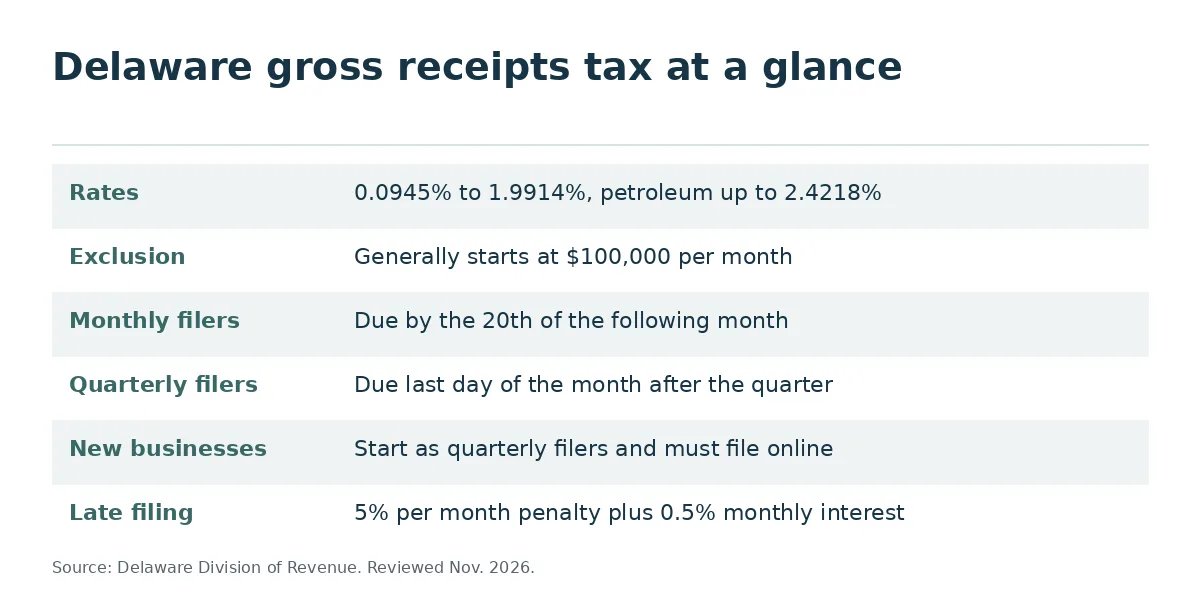
Delaware does not impose a state or local sales tax, but it does impose a gross receipts tax on the seller of goods or provider of services in the state, according to the Division of Revenue. There are no deductions for cost of goods, labor, interest, delivery costs or other expenses. Your business license activity determines your rate, exclusion and filing frequency, so tax requirements vary depending on what you sell.
Key facts from the gross receipts tax FAQs:
- Rates range from 0.0945 percent to 1.9914 percent, or up to 2.4218 percent for petroleum products, depending on the business activity.
- Most businesses get an exclusion that generally starts at $100,000 per month and can be as high as $1,250,000.
- Monthly filers pay by the 20th of the following month. Quarterly filers pay by the last day of the month after the quarter ends.
- All new businesses are automatically set up as quarterly filers.
- Online filing through the Delaware Taxpayer Portal has been mandatory since January 1, 2021, with limited exceptions.
If you earn income from more than one type of activity, separate gross receipts tax reporting is required for each.
What happens if you file late?
Late returns are charged a penalty of 5 percent per month plus interest of 0.5 percent per month from the original due date. An additional penalty of 1 percent per month, up to 25 percent, applies when tax shown on a timely return is not paid, citing 30 Del. C. Sections 533 and 534, per the Division of Revenue.
Retail goods shipped directly to customers outside Delaware are not taxed if you keep shipping documentation, but goods picked up in Delaware are taxable.
How does the renewal process work?
Licenses follow the calendar year. All state business licenses expire on December 31, or December 31 of the third year for three-year licenses, and licenses for the coming year must be renewed by December 31, according to the Division of Revenue. You can renew online through Delaware One Stop or the portal at tax.delaware.gov, and the online registration or renewal process lets you print a temporary license immediately.
The Division mails renewal coupons, but the deadline does not move if one never arrives. If you have not received a coupon by December 1, contact a Delaware office of the Division of Revenue (a Public Service Office) before the December 31 expiration. For a broader approach to calendars and reminders, see our business license renewal guide.
When do you need a new license instead?
A state business license cannot be transferred to a new owner, so a buyer must file a new application (Form CRA) through One Stop. Any change of legal entity, such as a sole proprietorship becoming a corporation, also requires a new license, and the owner must tell the Division of Revenue that the former entity is out of business, per the Division of Revenue FAQs. A license tied to a specific place of business may be transferred to a new location during its term under 30 Del. C. Section 2107.
How to do a Delaware business license lookup
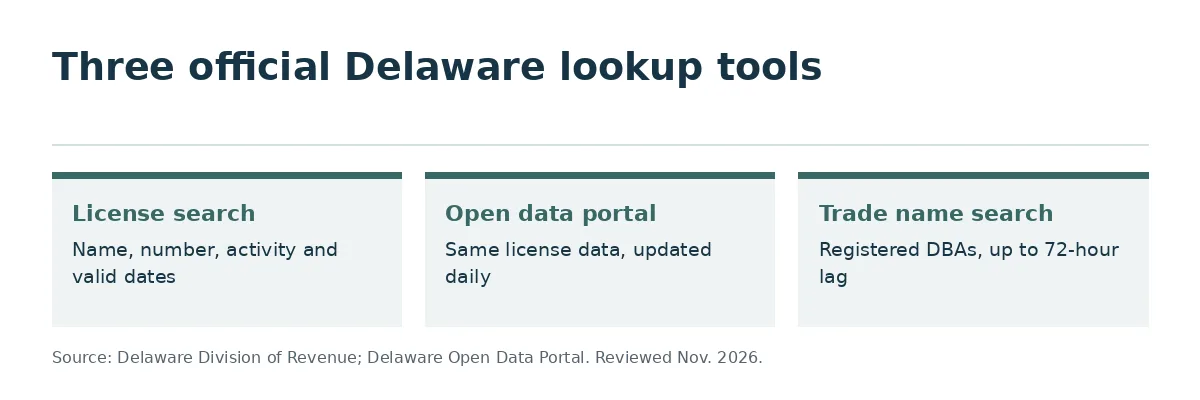
The Division of Revenue publishes a free Delaware Business Licenses Search with information for businesses currently licensed in Delaware. You can filter by business activity and address, and each result shows the business name, license number, business activity, valid from and valid to dates, and location.
The same data is available as a daily updated public dataset on the Delaware Open Data Portal, provided by the Division of Revenue, which is useful for checking vendors or subcontractors in bulk. To check whether a trade name (DBA) is registered, use the separate Trade, Business and Fictitious Names Search, which notes a data lag of up to 72 hours from One Stop.
Entity status for corporations and limited liability companies (LLCs), including whether an entity is in good standing, is a separate record kept by the Division of Corporations. Our business license lookup guide explains how state, entity and local records differ across the country.
Do Delaware cities and counties require their own licenses?
Some do. Depending on location, your city or county may require its own license in addition to the state license, per the Division of Revenue.
- Wilmington. Business owners operating within city limits must have both a state business license and a city business license. The city also charges a head tax of $15 per month for every employee beyond five employed in the city, according to the City of Wilmington.
- Dover. The City of Dover business license application lists a minimum $128 fee for contractors and manufacturers and $64 for merchants and bottlers, with renewal fees calculated on gross receipts or purchases. Fees not paid by August 1 incur a penalty of 10 percent per month.
Fees differ by town, so check each municipality where you will operate. County rules matter too: New Castle County, for example, licenses contractors working in its unincorporated areas.
What changes if you operate in several states?
License by activity, not just by company
Because Delaware requires a separate license for each business activity and charges $25 per additional location, one company can hold several Delaware licenses, each with its own gross receipts tax reporting.
Forming in Delaware is not the same as licensing
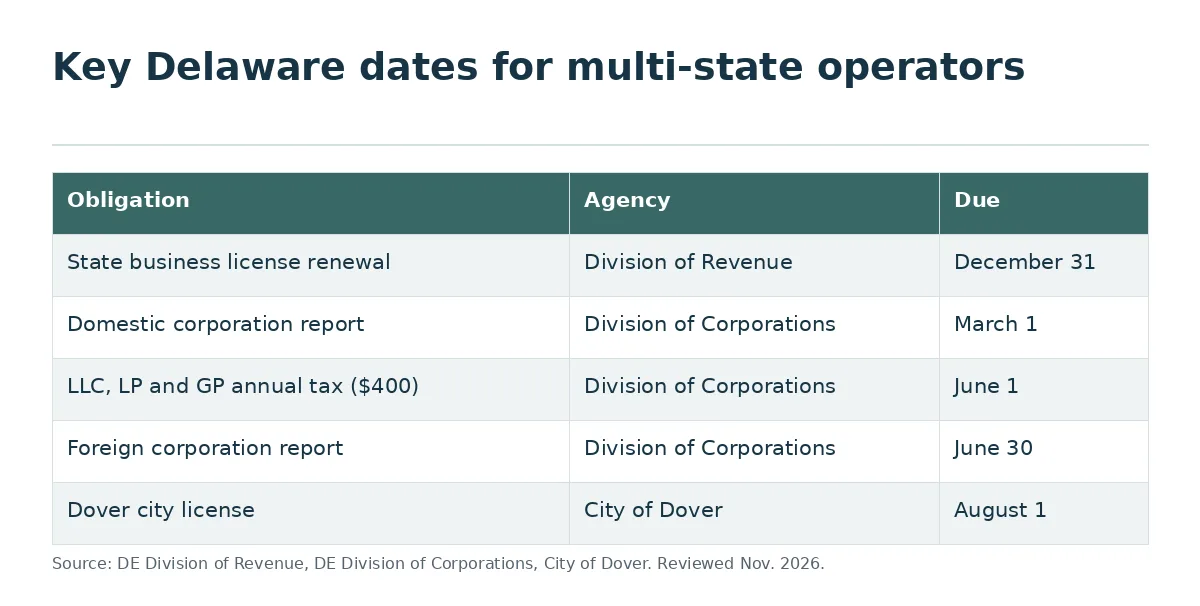
Many companies are formed in Delaware but operate elsewhere. Entity obligations run through the Division of Corporations: domestic corporations file an annual report and pay franchise tax by March 1, foreign corporations file by June 30, and LLCs, limited partnerships and general partnerships pay an annual tax, now listed at $400, by June 1, per the Division of Corporations. Missing it brings a $200 penalty plus 1.5 percent monthly interest. The Division of Revenue business license depends on business activity and presence, so use the Nexus Questionnaire if you are unsure.
Out-of-state companies entering Delaware
A corporation formed elsewhere that does business in Delaware must file a Foreign Qualification with the Division of Corporations, along with a Certificate of Existence from its home state, per the Division of Corporations FAQs. Nonresident contractors also face bond requirements through the Division of Revenue’s contractor registration package.
Calendars that do not line up
State business licenses renew every December 31, LLC taxes are due June 1, and Dover city licenses are due by August 1. Put them on one master calendar with your other states. Our guide to the registration sequence when opening in a new state shows how licensing fits with entity and tax registrations.
Frequently asked questions
How much is a Delaware business license?
It generally costs $75 per year for a first location, according to the Division of Revenue. Each additional branch or location adds $25, and some activities cost more, such as $225 for a travel agency or $450 for a finance or small loan agency. First-year fees are usually prorated, and a three-year license costs three times the annual fee. Confirm your exact fee on Delaware One Stop.
Does an LLC formed in Delaware but operating elsewhere need a DE business license?
Forming an LLC in Delaware creates obligations with the Division of Corporations, including an annual tax due June 1. The Division of Revenue business license is a separate requirement that depends on conducting business in Delaware, such as having property, employees or sales in the state. If your situation is unclear, submit the Division of Revenue’s Nexus Questionnaire for guidance.
How do I do a Delaware business license lookup?
Use the Division of Revenue’s free Delaware Business Licenses Search, which lists businesses currently licensed in Delaware. Results show the business name, license number, business activity, valid dates and location, and you can filter by activity and address. The same data is published as a daily updated dataset on the Delaware Open Data Portal. Registered trade names have their own search tool.
What is the Delaware gross receipts tax rate?
Delaware gross receipts tax rates range from 0.0945 percent to 1.9914 percent depending on business activity, with a variable rate of up to 2.4218 percent for petroleum products. Most businesses receive an exclusion that generally starts at $100,000 per month. New businesses file quarterly, and returns must be filed online. The tax is imposed on the seller, not the customer.
When does a Delaware business license expire?
Every state business license expires on December 31, and three-year licenses expire on December 31 of the third year. Renewals for the coming year are due by December 31. The Division of Revenue mails renewal coupons, but if one has not arrived by December 1, contact a Public Service Office or renew online through Delaware One Stop.
Adding Delaware to a multi-state footprint?
LicenseComply researches the state, county and city licenses each Delaware location needs, files the applications and tracks December renewals alongside your other states.
Explore License & Permit Filing Talk to a licensing specialist
Official sources and further reading
- Delaware Division of Revenue: Business licenses FAQs
- Delaware Division of Revenue: Step 2, requirements for Delaware businesses
- Delaware Division of Revenue: Step 4, gross receipts taxes
- Delaware Division of Revenue: Gross receipts tax FAQs
- Delaware Division of Revenue: Delaware Business Licenses Search
- Delaware Division of Revenue: Trade, Business and Fictitious Names Search
- Delaware Division of Revenue: Exemption certificates
- Delaware Division of Revenue: Contractors, resident and nonresident
- Delaware One Stop: Register and license your business
- Delaware One Stop: Frequently asked questions
- Delaware Business First Steps: Get your license
- Delaware Code Title 30, Chapter 21: General licensing provisions
- Delaware Code Title 30, Chapter 23: Occupational and business license fees
- Delaware Open Data Portal: Delaware Business Licenses dataset
- Delaware Division of Corporations: LLC, LP and GP tax instructions
- Delaware Division of Corporations: Frequently asked questions
- City of Wilmington: Doing business in the city
- New Castle County: Contractor licensing
- New Castle County: 2026 building contractor requirements
- City of Dover: Business license application
Disclaimer: LicenseComply provides professional business licensing and compliance services. However, the informational content on this site (including articles, guides, tools, and videos) is provided for general educational purposes only and does not constitute legal, tax, or accounting advice. Laws and regulations change frequently, and we cannot guarantee that all information is accurate, complete, or up to date for your specific circumstances. Your use of this website and its content does not create an attorney-client, accountant-client, or other advisory relationship. You should consult with a qualified attorney, accountant, or other appropriate professional for advice tailored to your business.