
Key points
- A seller’s permit registers your business with the state tax agency to collect and report sales tax.
- A resale certificate is a document the buyer gives a supplier to claim that a qualifying purchase is for resale.
- A copy of your permit is not a substitute for a completed resale certificate, and neither replaces a local business license.
- Rules differ by state. Check the destination state’s rules and the Streamlined Sales Tax framework before using a certificate across state lines.
A seller’s permit and a resale certificate serve different purposes. A seller’s permit registers a business with the relevant tax agency for its sales tax obligations. A resale certificate is documentation a buyer gives a supplier to claim that a qualifying purchase is for resale rather than the buyer’s own use.
If you are opening a shop, buying wholesale inventory, or adding online sales, you might encounter both documents during the same week. That does not make them interchangeable. Giving a supplier a copy of your permit is not necessarily enough to support a tax-free resale purchase, and receiving a resale certificate from a customer does not settle your own registration obligations.
The rules also vary by state. This guide uses California and Texas examples to explain the distinction, then shows what to check before using a certificate across state lines.

What a seller’s permit does
States use names such as seller’s permit, sales and use tax permit, sales tax license, or sales tax registration. The name matters less than the issuing agency and the obligations attached to the account.
The California Department of Tax and Fee Administration requires a seller’s permit for businesses engaged in business in California that intend to sell or lease tangible personal property ordinarily subject to sales tax at retail. Its guidance covers wholesalers and retailers and applies across business structures, including individuals, partnerships, corporations, and LLCs.
The Texas Comptroller describes the Texas permit requirement for covered sales and rentals of tangible personal property and taxable services. It also directs remote sellers and marketplace sellers to rules specific to those sales models.
Registering creates ongoing responsibilities. Texas permit holders must keep records, collect and remit applicable tax, and file required returns. The Comptroller states that a return is required even for a filing period with no taxable sales or purchases to report. A permit with no annual renewal charge is therefore not an account you can forget after opening.
What a resale certificate does
A resale certificate documents why a seller did not collect sales tax on a qualifying transaction. The buyer supplies the information and gives the completed certificate to the seller, who keeps it with the transaction records.
The Texas resale certificate FAQ makes the distinction explicit: a permit number or permit copy is not a substitute for a resale certificate. The certificate is evidence supporting the seller’s treatment of the transaction. Texas instructs sellers to retain it for four years.
Think of a retailer buying mugs for its store shelves. If the purchase qualifies for resale treatment, the retailer provides the proper certificate to its wholesaler. The retailer then addresses sales tax when it sells the mugs to customers. The result is different if the retailer buys mugs for employees to use in the break room: those mugs are for the retailer’s consumption, not inventory intended for resale.
The label “business purchase” is not enough. What matters is the applicable exemption and what will happen to the particular items or services purchased.
Compare the two documents
Question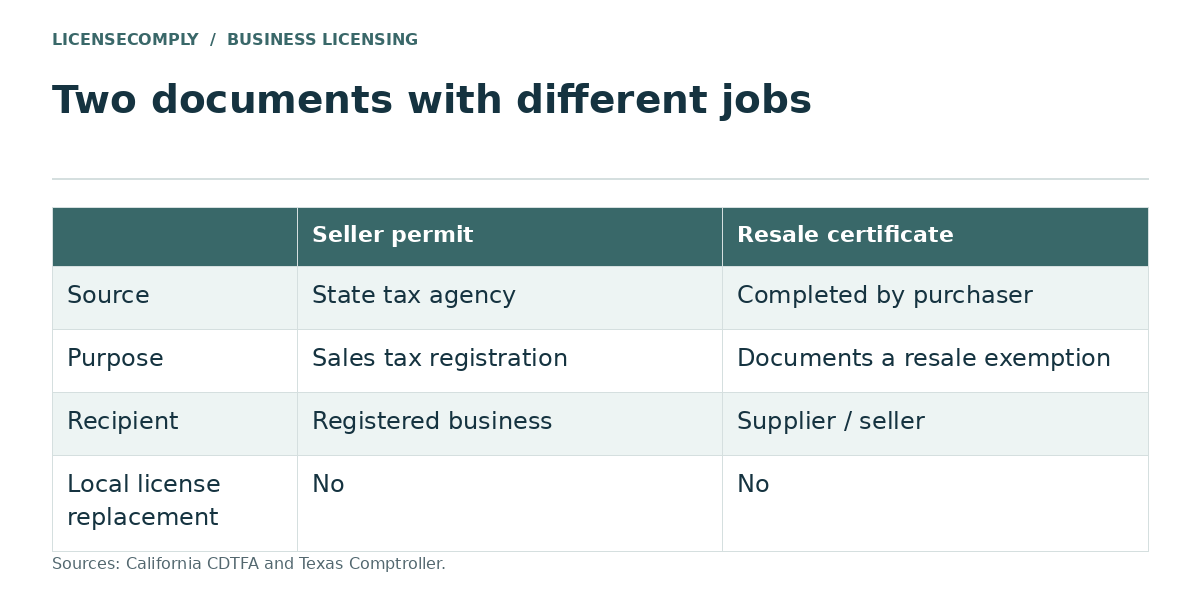 | Sellers permit | Resale certificate |
|---|---|---|
| Where does it come from | State tax or revenue agency | Buyer completes an accepted certificate form |
| What does it establish | Sales tax registration under the state’s rules | A claim that a particular purchase qualifies for resale treatment |
| Who receives it | Registered business | Supplier or seller accepting the certificate |
| Who keeps the record | Business and issuing agency | Seller, with a copy retained by the buyer |
| Does it replace local operating approvals | No | No |
| How is it maintained | Follow the agency’s account and filing rules | Follow the destination state’s certificate and record rules |
This is a general comparison. Some states use special reseller authorization systems or different terminology. Always check the actual document required for the purchase, rather than assuming every state follows the Texas form process.
How to get a seller’s permit
Start with the state where registration is required
Use the official tax department’s registration page. Identify the legal entity, business locations, products or services, and expected sales activity. If you sell into other states, separately evaluate whether those sales create registration obligations there. An out-of-state customer alone does not supply enough information to determine the answer.
Gather the information requested by the agency. Common application topics include ownership, business addresses, start date, and business activity. Use the legal name consistently with supporting records. If a form asks for a tax ID you cannot locate, see How to Find Your Business Tax ID Number.
California example
Apply through CDTFA’s registration resources. CDTFA does not charge a seller’s permit fee, although a security deposit is required in some circumstances. Temporary sellers should use the applicable temporary permit process; the agency describes temporary operations lasting no longer than 90 days at one location.
A seller’s permit does not replace a city or county business license. CDTFA specifically tells businesses to check those local requirements. Confirm both before treating the permit as a complete opening checklist.
Texas example
The Texas Comptroller offers an online registration application and a paper application route. There is no permit fee, but the agency can require a security bond. The absence of a permit fee does not eliminate tax returns, recordkeeping, or other license costs.
Check the current application instructions for the information relevant to your ownership structure and activity. Do not assume a third-party application’s service charge is a government fee. If you use assistance, separate the provider’s charge from any agency charges and security requirements.
How to get and use a resale certificate
First identify the state rules governing the transaction. Download the current form from that state’s tax agency, or confirm that it accepts the multistate form you intend to use. Read both the form and its instructions before filling it out.
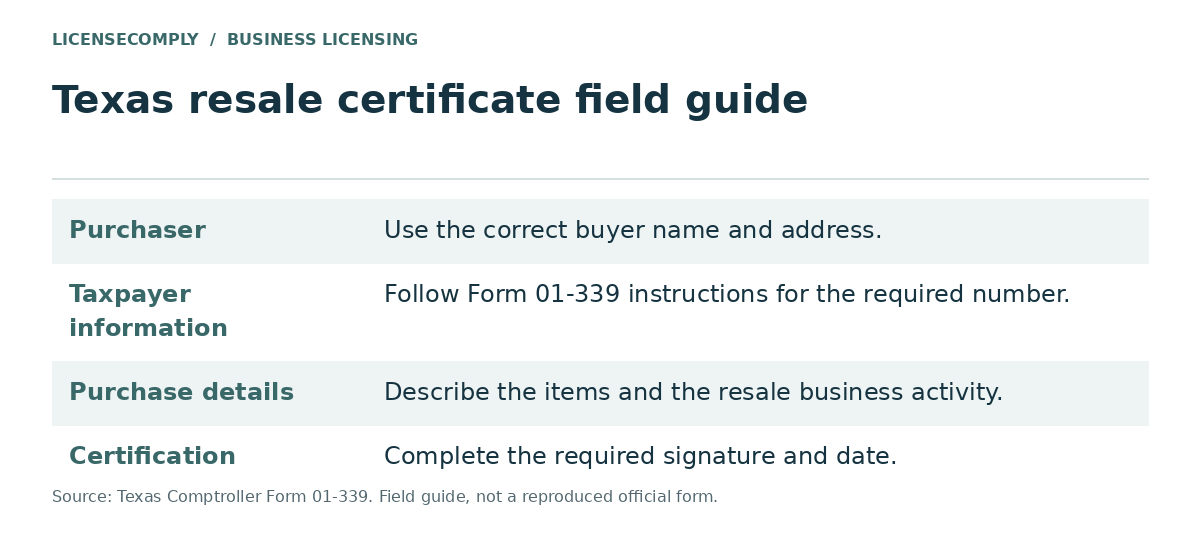
For Texas transactions, the Comptroller links to Form 01-339. Use the resale certificate portion for a resale claim rather than assuming another exemption section fits. Supply the purchaser and seller information, the relevant taxpayer identification information, an adequate description of the items, and the required certification and signature.
Describe what you buy accurately. A vague description such as “all supplies” is less useful than one connecting the inventory to the business’s resale activity. Confirm that the identifying number belongs to the purchaser making the claim, not an affiliated company or the prior owner of the business.
Give the certificate to the supplier through its accepted process and keep a copy. The Streamlined Sales Tax Governing Board similarly instructs purchasers to provide completed exemption certificates to suppliers, not send them to the board or to states.
An accepted certificate is not permission to make unrelated tax-free purchases. If your purchasing team uses a blanket certificate, explain which purchases are covered and how exceptions will be handled.
Buying and selling across state lines
A home-state permit is not a universal resale exemption. The state governing the transaction determines which forms, identification numbers, and conditions apply.
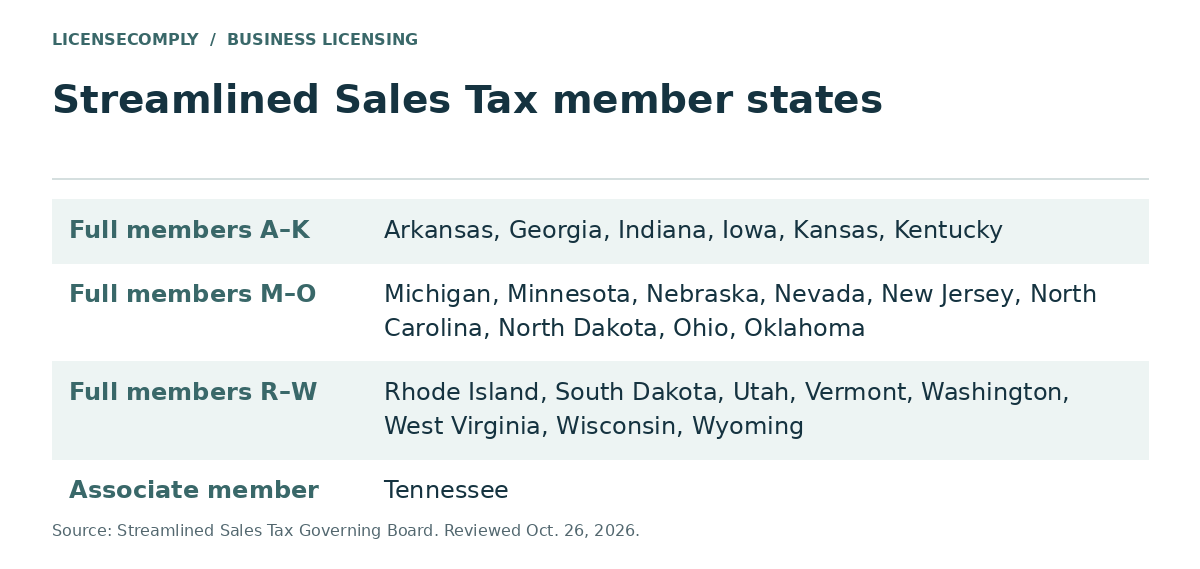
The Streamlined exemption certificate is accepted by the 24 Streamlined member states, subject to their rules. The board warns that not every exemption listed on the form is available in every state and that some exemptions require a state-specific ID number. Its member listing distinguishes full members from Tennessee’s associate-member status.
The Multistate Tax Commission’s Uniform Sales and Use Tax Resale Certificate is another option for qualifying transactions in the states identified by its instructions. Read the state notes instead of treating the form’s title as nationwide acceptance.
These forms simplify documentation; they do not remove the need to determine registration obligations. Before expanding, list the states involved, the sales channels, inventory locations, and fulfillment arrangements. Have a qualified tax adviser resolve nexus or exemption questions that depend on those facts.
Drop-shipping arrangements deserve particular attention because the purchaser, supplier, and delivery destination can be in different states. The Streamlined guidance expressly tells sellers and drop shippers to check the relevant states’ requirements.
What sellers should check before accepting a certificate
Build a review step into customer onboarding rather than discovering missing documentation during an audit. Check that the certificate is complete, identifies the correct purchaser, and describes purchases consistent with the buyer’s stated resale activity.
Use the state’s official permit verification tool when appropriate. In Texas, the Comptroller’s databases page includes Sales Taxpayer Search. A permit check supports your review, but the permit record does not replace the certificate itself.
Store the certificate where it can be connected to the customer and covered transactions. Record when it was received and who reviewed it. If a customer changes ownership, taxpayer number, or the scope of purchases, evaluate whether updated documentation is required under the applicable state rules.
Do not assume that collecting an incomplete form automatically protects the seller. Follow the state’s standards for accepting exemption documents, and ask the agency or your tax adviser when the proposed purchase does not fit the exemption claimed.
Common mistakes to avoid
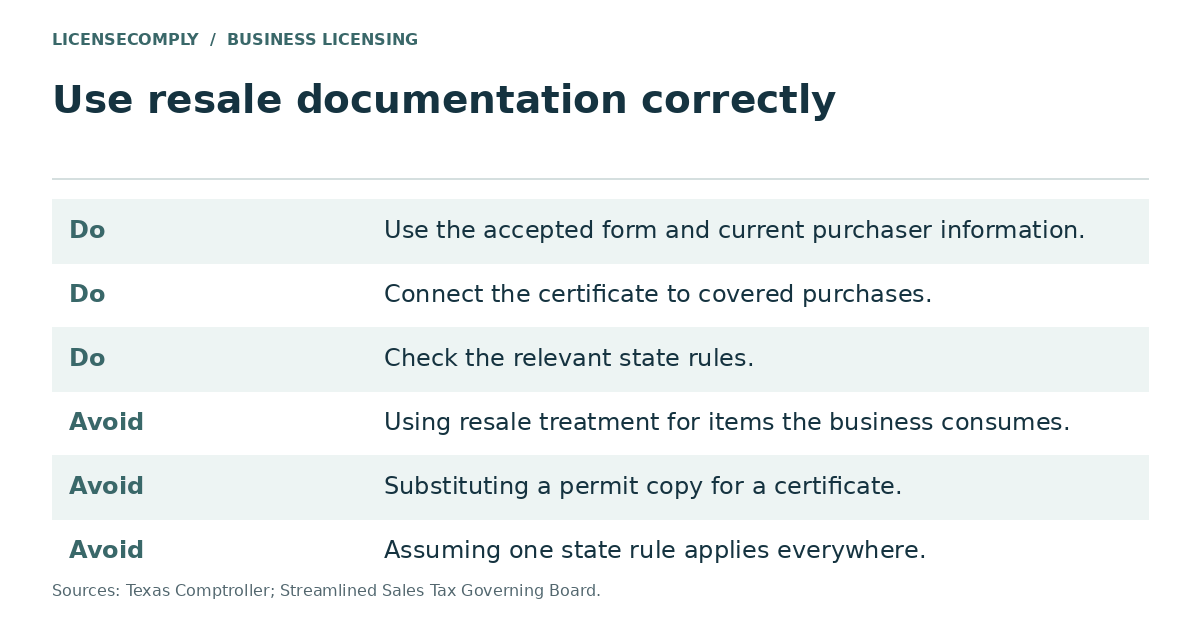
Using resale treatment for items the business consumes
Equipment, office supplies, and employee-use items are not inventory merely because a business buys them. Distinguish stock bought for resale from items used in operating the company. A different exemption might exist for a particular purchase, but that requires its own legal basis and documentation.
Treating the permit as the certificate
The Texas Comptroller expressly rejects that substitution. Keep the permit information and the completed resale certificate as separate records, and give suppliers the document they actually require.
Treating the certificate as a general license
Neither document proves that a shop meets zoning, occupancy, health, or professional licensing requirements. Review Do I Need a Business License for the broader operating approvals.
Assuming one state’s rules apply everywhere
Acceptance, identification requirements, certificate duration, and record retention vary. Do not apply Texas’s four-year retention rule as a nationwide maximum or assume that a form accepted by one supplier is valid for every delivery state.
Leaving tax accounts open without monitoring them
An inactive sales channel does not automatically close a tax account. Follow the agency’s closure process when the business stops the relevant activity, and keep filing required returns until the account obligations are resolved.
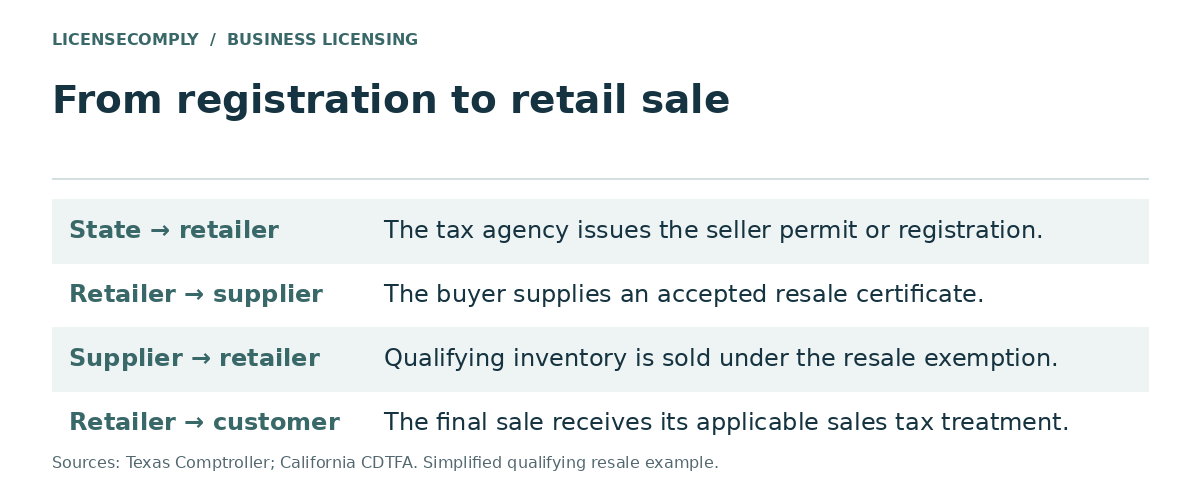
A simple example from purchasing to sale
Imagine a Texas retailer ordering a batch of lamps for resale. Before placing the order, the retailer confirms its sales tax account information and completes the appropriate resale certificate for the wholesaler. The wholesaler reviews the certificate and retains it with its records.
The retailer also orders a desk lamp for its own checkout counter. The purchasing team separates that item because the intended use is different. Treating both purchases identically just because they appear on one purchase order would obscure the distinction between inventory and business consumption.
When the retailer sells an inventory lamp to an end customer, it applies the tax treatment required for that retail sale. The original resale certificate supported the earlier inventory purchase; it did not make the entire supply chain tax-free.
Frequently asked questions
Does a resale certificate expire?
There is no single national expiration rule. Follow the relevant state’s instructions and keep the information current. A business should not continue relying on a certificate that no longer accurately identifies the purchaser or the exemption claimed.
Can I use a sales tax number from another state?
Sometimes, under the receiving state’s rules. The Streamlined instructions explain when a state-specific number is necessary and when other identification is accepted. Verify the particular transaction rather than assuming your home-state number always works.
Do online sellers need a seller’s permit?
The answer depends on the applicable state’s registration rules and the seller’s activities. Marketplace-only sales, direct website sales, inventory storage, and physical locations can lead to different analyses. Check the official remote-seller and marketplace guidance for each relevant state.
Do craft fairs count?
They require their own review. The Texas guidance for fairs, festivals, markets, and shows addresses taxable event sales. Do not assume that a temporary event or an organizer’s approval eliminates your sales tax responsibilities.
Who can help identify the permits my business needs?
LicenseComply can assist with business license research and filing support. For questions about whether a transaction is taxable, whether an exemption applies, or where sales create tax nexus, work with your tax adviser alongside the licensing research.
Selling in more than one state?
LicenseComply researches the sales tax permits and business licenses each location needs and handles the filings.
Explore License & Permit Filing Talk to a licensing specialist
Official sources and further reading
- California Department of Tax and Fee Administration
- Texas Comptroller
- Texas resale certificate FAQ
- Form 01-339
- Streamlined Sales Tax Governing Board
- Multistate Tax Commission’s Uniform Sales and Use Tax Resale Certificate
- Comptroller’s databases page
- Texas guidance for fairs, festivals, markets, and shows
Related guides



Disclaimer: LicenseComply provides professional business licensing and compliance services. However, the informational content on this site (including articles, guides, tools, and videos) is provided for general educational purposes only and does not constitute legal, tax, or accounting advice. Laws and regulations change frequently, and we cannot guarantee that all information is accurate, complete, or up to date for your specific circumstances. Your use of this website and its content does not create an attorney-client, accountant-client, or other advisory relationship. You should consult with a qualified attorney, accountant, or other appropriate professional for advice tailored to your business.