
Key points
- First identify which number the form wants. A federal EIN, a state sales tax account, an employer account and a license number are different identifiers.
- An existing EIN is usually on the IRS assignment notice, prior tax returns, bank records or past license applications.
- Official IRS confirmation options include an entity transcript, a digital CP575 for eligible accounts and Letter 147C.
- A missing EIN is usually a records problem. Do not apply for a new EIN just because you cannot find the old one.
Before searching for a business tax ID number, identify which number the form requests. A federal Employer Identification Number, or EIN, is different from a state sales tax account number. An employer withholding account, unemployment account, and business license number can also be separate identifiers.
The quickest way to find the right number is usually to check the original notice or the account maintained by the issuing agency. If you cannot locate an EIN, the IRS provides a recovery process for authorized people and several ways to obtain official confirmation.
This guide focuses on business identifiers: where to look, how to confirm a number, and how to avoid using the wrong record on an application. It also explains why a missing number is usually a records problem to resolve rather than a reason to submit a new EIN application.

Identify the number the form needs
Read the field label and instructions together. “Federal tax ID” usually points to the federal identifier appropriate for that taxpayer. “State sales tax number” points to a state account. A field labeled “business registration number” needs further context because that phrase is used for different records.
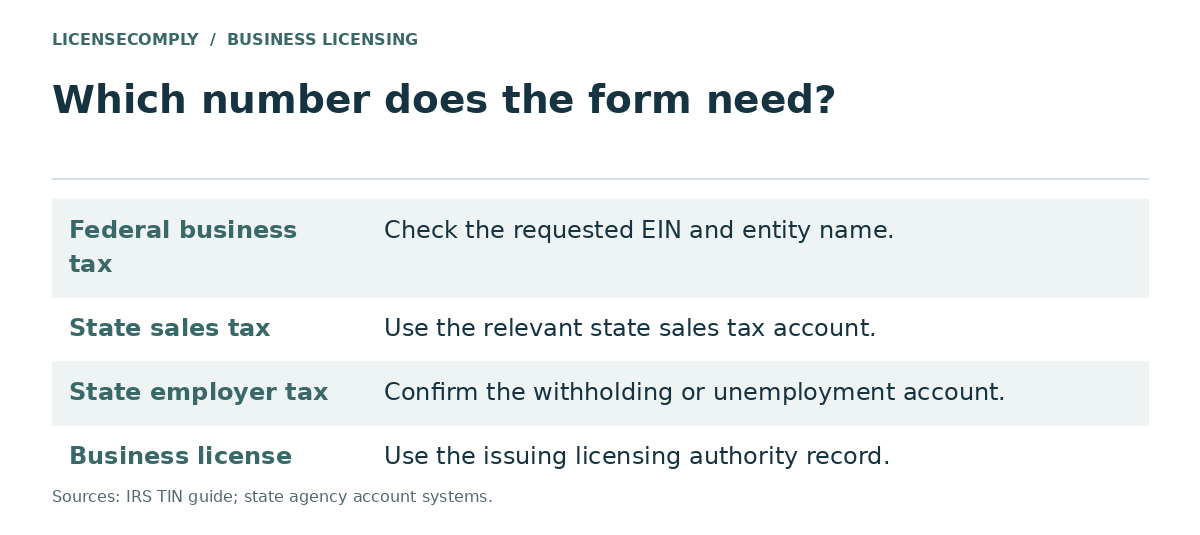
The IRS taxpayer identification number guide lists several federal TINs. An EIN identifies a business entity for federal tax administration. Other TINs include Social Security numbers, Individual Taxpayer Identification Numbers, adoption-related ATINs, and tax preparer PTINs. These are not alternate numbers to use interchangeably on business forms.
State identifiers come from the relevant state agencies. Washington’s business lookup, for example, covers records associated with its Department of Revenue licensing and tax systems. Texas has separate public searches for sales taxpayers and taxable entities. A number found in one system should not be assumed to satisfy a form associated with another.
If the instructions are unclear, ask the requesting organization for the issuing agency and the exact document it expects. Do that before transmitting an SSN or a complete tax return to solve what might only be a request for a license number.
Find your EIN in existing records
The IRS EIN page identifies several places to look for a lost or forgotten EIN: the original notice, previously filed business tax returns, the bank where you opened a business account, and agencies where you used the number for state or local licensing.
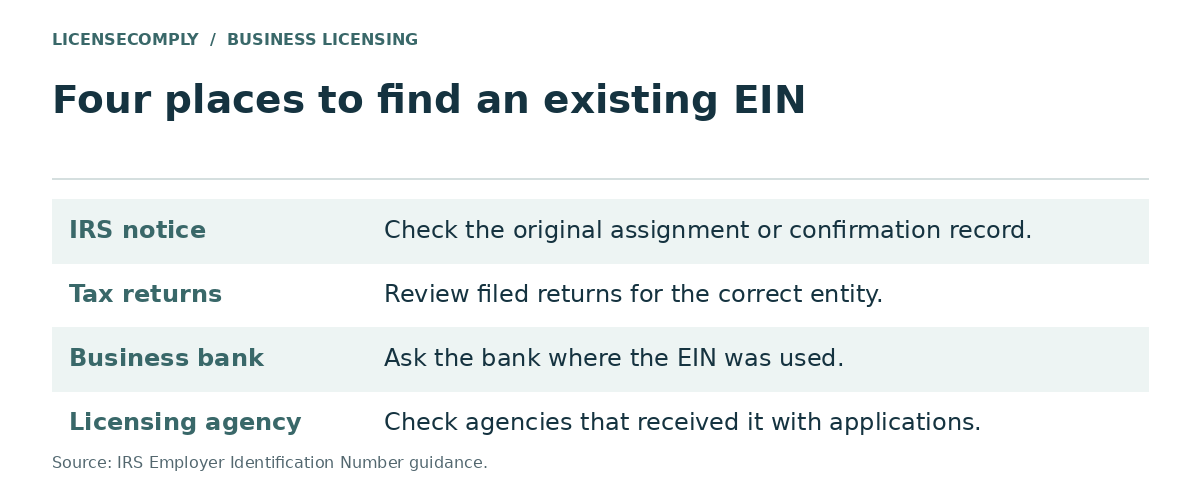
Start with the IRS notice issued when the EIN was assigned. Search the company’s permanent records, formation folder, and secure correspondence archive. The person who organized the entity or prepared its tax returns might have a copy, but confirm that the notice belongs to the correct legal entity.
Next, review a previously filed return for that same business. Groups with several entities should be particularly careful. A parent company, operating subsidiary, and acquired business can have different numbers even if employees use one brand name in everyday conversation.
If internal records do not resolve the question, contact the business’s bank or the agency that previously received the EIN. Follow its authorized access process. An old loan application or license filing is a useful lead, but reconcile the number with authoritative records if there is a discrepancy.
Avoid relying on a number copied into an informal spreadsheet without a source. Finding nine digits is not the same as confirming that they belong to the entity named on the current application.
Contact the IRS when the number is still missing
The IRS Business and Specialty Tax Line is 800-829-4933. The IRS lists service hours as Monday through Friday, 7 a.m. to 7 p.m. local time, subject to its published location-specific instructions. Confirm the current details on the official EIN page before calling.
The IRS verifies the caller’s identity and authority before disclosing the number. Prepare the legal business name, address information, and details needed to explain your relationship to the entity. Do not assume any employee or outside vendor can retrieve the EIN merely by knowing the company name.
If a representative will handle the inquiry, establish the appropriate authorization through the IRS process. Keep the resulting confirmation in the business’s secure records. This provides a better foundation for future applications than repeatedly asking staff to recover the number from memory.
Do not apply for another EIN simply because the original notice is missing. Recover and confirm the existing number first. If you discover more than one EIN associated with the same entity and do not know which to use, the IRS directs businesses to contact its Business and Specialty Tax Line.
Obtain official EIN confirmation
A lender, bank, or licensing agency might need proof of the EIN rather than just the number. The IRS currently identifies three confirmation routes: an entity transcript, a digital CP575 for eligible Business Tax Account users, or Letter 147C requested through its business tax line.
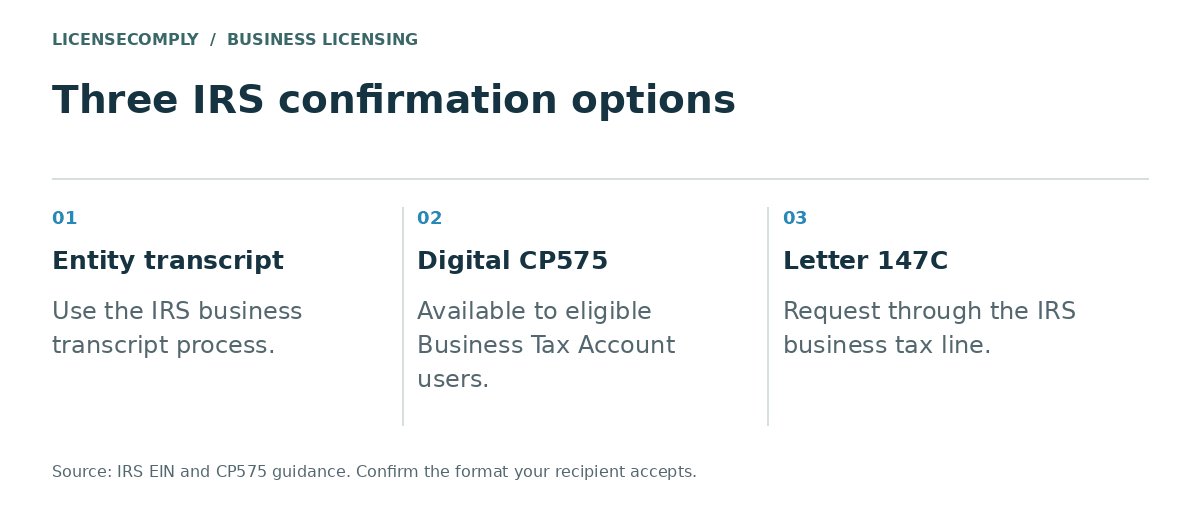
Entity transcript
Use the IRS business transcript process when an entity transcript is suitable for the request. Ask the recipient whether this format meets its requirements before ordering a document. Different onboarding processes can ask for different forms of evidence.
Digital CP575
Eligible Business Tax Account users can download the digital CP575. The IRS CP575 explanation says this verification notice can substitute for the original CP575A-J notice series and Letter 147C.
This is an important distinction from older advice stating that no online confirmation is available. It does not mean every user has access, nor that the IRS recreates the original notice. The IRS specifically says the original CP575A-J series cannot be duplicated or recreated.
Letter 147C
Call the IRS business tax line to request Letter 147C, EIN Previously Assigned. Follow the identity and authorization process. Confirm the available delivery method and timing with the IRS rather than relying on a third-party promise of immediate issuance.
Once you have the document, check the entity name and number before submitting it to the recipient. Store the complete original securely and share only the document needed for the particular business purpose.
Find a state tax account number
Start with the state agency that administers the tax. Review registration notices, issued permits, account correspondence, and filed state returns. If you have authorized online access, sign in through the agency’s official website and select the appropriate entity and tax account.
Distinguish sales tax accounts from employer withholding and unemployment accounts. These can involve different agencies and different identifiers. The fact that payroll software contains a “state ID” does not establish that it is the number needed for a sales tax registration or resale purchase.
For Texas sales tax records, use the Comptroller’s official database directory to locate Sales Taxpayer Search. Match the legal name and other available details rather than choosing the first similar name returned.
For Washington, the Department of Revenue business lookup searches business licenses, tax accounts, and reseller permits. Use the relevant record and confirm what the requesting form means by UBI or account number. Do not replace a specifically requested identifier with a different number shown in the same search.
If the account was opened by a former employee, recover access through the agency. Keep credentials in an approved shared-access process rather than leaving the company dependent on one person’s email account.
Looking for a personal tax ID instead?
For an individual, a tax identification number could be an SSN or, where applicable, an ITIN. The IRS TIN guide explains those categories. A business EIN is not a replacement for a person’s identifier when a form specifically requests personal information under its instructions.
If a business form asks an owner for personal identification as part of an application, use the agency’s secure process. Do not publish personal tax identifiers in a business directory or send them through an unnecessary public records request.
If the business does not have an EIN yet
Apply directly through the IRS EIN service when an EIN is needed. The IRS does not charge for issuing the number. A private provider’s assistance fee is separate from the government’s free application.
The IRS instructs people creating a legal entity to form it with the state before applying for its EIN. Use the final legal name and the correct responsible-party information. Check eligibility and the current application method on the official page rather than assuming every applicant can use the online route.
An EIN does not grant operating approval. After obtaining it, continue the licensing and registration research appropriate to your activity and location. Conversely, finding a business license number does not establish that the business already has the federal tax identifier it needs.
Tax IDs, license numbers and registration numbers
Identifier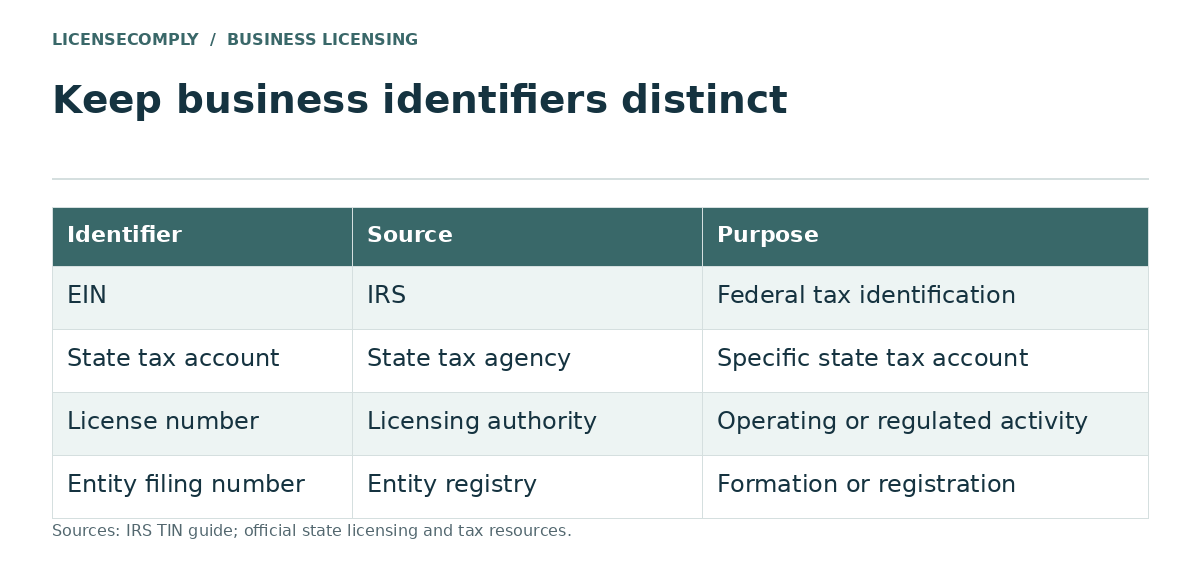 | Issuing source | Typical purpose |
|---|---|---|
| EIN | IRS | Federal business tax identification |
| State tax account number | Relevant state tax agency | A particular state tax account or registration |
| Business license number | Licensing authority | An operating or regulatory license record |
| Entity filing number | State entity registry | Formation or registration record |
When an application asks for several of these numbers, label your supporting records clearly. A simple internal reference sheet can list the legal entity, issuing agency, identifier type, and location of the authoritative document. Keep sensitive records restricted to people who need them.
For license records, use How to Look Up a Business License. LicenseComply can help research business license requirements; EIN recovery and tax-account determinations should follow the relevant agency’s instructions.
Frequently asked questions
Can I look up an EIN for another company?
There is no universal public IRS EIN directory for every private business. For a legitimate onboarding or reporting purpose, request the appropriate documentation directly from the business. Public records for some organizations are not a substitute for a general authorized verification process.
Is a tax ID always an EIN?
No. “Tax ID” is a broader phrase. Federal TIN categories and state tax account numbers serve different purposes. Identify the agency and the field instructions before choosing a number.
Does moving to another state require a new EIN?
An address change alone does not require a new EIN under the IRS guidance. Changes in ownership or structure can require one. A move can also create new state and local registration questions even when the federal EIN stays the same.
Should I buy a replacement EIN?
Recover the existing number and request the appropriate IRS confirmation. A missing notice does not itself create a need for a new EIN, and the IRS provides the number without an application fee.
Need the right numbers on your license applications?
LicenseComply researches the licenses your business needs and prepares the filings with the correct identifiers.
Explore License & Permit Filing Talk to a licensing specialist
Official sources and further reading
- IRS taxpayer identification number guide
- IRS EIN page
- IRS CP575 explanation
- Comptroller’s official database directory
- Department of Revenue business lookup
- IRS EIN service
Related guides


Disclaimer: LicenseComply provides professional business licensing and compliance services. However, the informational content on this site (including articles, guides, tools, and videos) is provided for general educational purposes only and does not constitute legal, tax, or accounting advice. Laws and regulations change frequently, and we cannot guarantee that all information is accurate, complete, or up to date for your specific circumstances. Your use of this website and its content does not create an attorney-client, accountant-client, or other advisory relationship. You should consult with a qualified attorney, accountant, or other appropriate professional for advice tailored to your business.