
Key points
- “Occupational license” has two common meanings: a credential to perform regulated work, or a local business license or tax record.
- Professional occupational licenses come from state boards and regulators. CareerOneStop’s License Finder helps locate the right one.
- In East Baton Rouge Parish, Louisiana, the occupational license is a local tax. Florida renamed its local occupational license to local business tax in 2007.
- A business can need both a professional license and a local authorization, so check the practitioner, the entity and the premises separately.
An occupational license can mean a credential required to perform regulated work, or a local business license or tax record. The correct meaning depends on the jurisdiction and the issuing office. A state board asking for exam results is addressing a different requirement from a city revenue office asking for business receipts.
That difference matters when starting a business, hiring a professional, or receiving a renewal notice. Paying a local business tax does not establish professional qualifications. Holding a professional license does not automatically satisfy every local requirement for operating a business.
This guide explains the two meanings, using official Louisiana and Florida examples alongside professional licensing resources. Start by identifying the agency named on the application or notice, then confirm what the document actually authorizes.

Occupational licensing for regulated work
In the professional sense, an occupational license is a government-required credential for specified work. Depending on the occupation and state, the application can involve education, experience, an examination, or other qualifications. The exact requirements come from the regulator for that credential.
Examples of regulated fields include electrical work, cosmetology, contracting, and nursing, although the applicable agency and license category differ. Do not assume that a license held by one employee automatically covers the business offering the services or every person working there.
The Texas Department of Licensing and Regulation provides a search for the licenses it administers. California’s Contractors State License Board provides contractor license checks and related disclosures. Those tools help verify records within their own programs; neither is a nationwide directory for all occupations.
When reviewing a credential, match the holder, classification, and current status to the proposed work. A familiar job title is not enough to establish that a specific license covers a specific service.
How to find the responsible professional regulator
CareerOneStop’s License Finder, sponsored by the U.S. Department of Labor, is a starting point for finding state occupational license information. Search by occupation, license, or agency name and choose the relevant state.
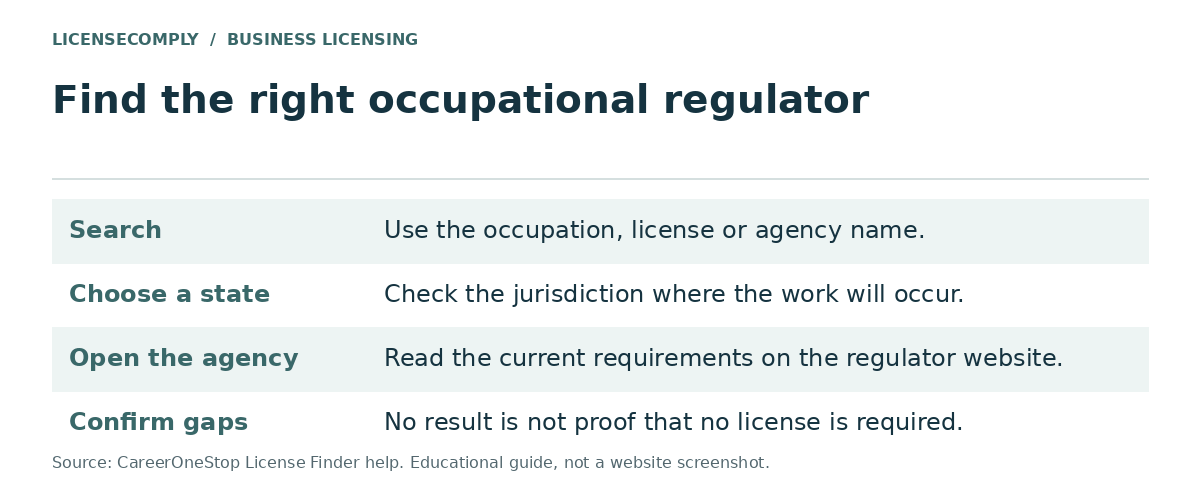
Its help page explains that results identify license information and the agency that issues the credential. It also warns that not all states submit data and that complete coverage cannot be guaranteed. A search returning nothing is therefore not proof that the occupation is unregulated.
Use the result to reach the responsible board or agency, then check its current application and renewal instructions. If your service description does not fit a clear category, explain the planned work to the regulator. Avoid selecting the least demanding category based only on a similar-sounding title.
The same approach applies when expanding into another state. Confirm that state’s route for the credential instead of assuming a home-state license transfers automatically. Special recognition or reciprocity rules, where available, depend on the particular profession and jurisdiction.
A license is different from a voluntary certification
CareerOneStop distinguishes required occupational licenses from voluntary certifications. A certification can demonstrate training or competence, but it is not automatically the government authorization required to practice. Some licensing systems incorporate a certification as one of their requirements.
For hiring or contracting, ask separately about the government license and any professional certifications. A badge from a training provider does not answer whether the person or business holds the applicable state authorization.
For an applicant, check the regulator’s list of accepted education, experience, and examinations before paying for a program. A course advertised as “industry recognized” is not necessarily accepted for the license you intend to obtain.
Occupational license as a local business tax
In some places, “occupational license” refers to a local tax or business registration rather than permission to practice a regulated profession. The agency might be a city or parish revenue department, and the payment could depend on the business category or receipts.
The title alone does not tell you whether qualifications are being evaluated. Read the purpose of the application and the agency’s explanation. If the form asks about business location and gross receipts, it likely addresses a different issue from a professional board’s education and examination process.
A local tax record also has limits. It should not be represented as proof that every regulatory approval has been obtained. Research professional credentials, land-use approvals, and industry permits separately where they apply.
Louisiana example from East Baton Rouge Parish
The Baton Rouge Finance Department collects occupational license taxes from businesses in East Baton Rouge Parish. Its instructions tell new businesses to obtain their occupational license one month before opening.
The published initial payment is $50 for businesses opening from January through June or $25 for those opening from July through December. That is not necessarily the final annual tax. The city describes issuing a temporary certificate, then using the first 30 days of gross receipts to calculate whether more occupational license tax is due.
The same page explains that some businesses need other approvals and that zoning clearance or occupancy documentation can involve a separate fee. This is a useful example of how a tax-based occupational license fits into a broader opening process.
Apply this example to the specified jurisdiction, not to every Louisiana city or parish. Check the actual local tax schedule, classification, and instructions for your business. A comparison with another business’s payment can be misleading if its activity or receipt basis differs.
Florida terminology changed
The City of Sarasota explains that Florida changed the name from Occupational License to Local Business Tax in 2007. Old leases, checklists, or informal conversations can still use the former name.
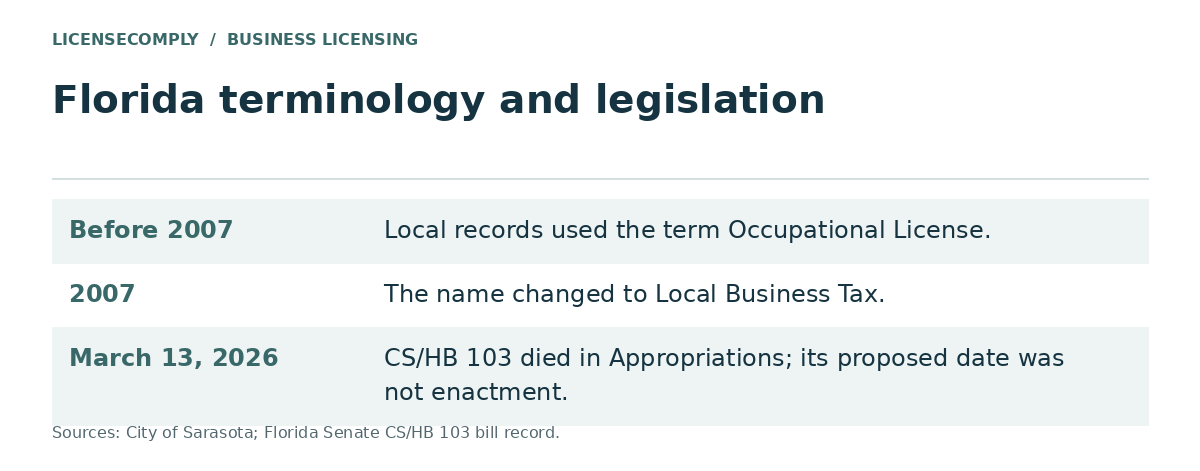
Sarasota describes the tax as applying to operating a business within its city limits and separately tells applicants to acquire a state occupational license when required. That distinction is the useful part: the local tax and the professional authorization address different obligations.
Florida’s Local Business Tax Act remains the statutory framework to consult alongside the local requirements. Do not assume an older term means the requirement disappeared.
A related source of confusion is proposed legislation. The Florida Senate’s record for CS/HB 103 in 2026 lists its last action as dying in Appropriations on March 13, 2026. The proposed effective date shown on a bill page does not establish that the proposal became law.
Compare the terms on your paperwork
Term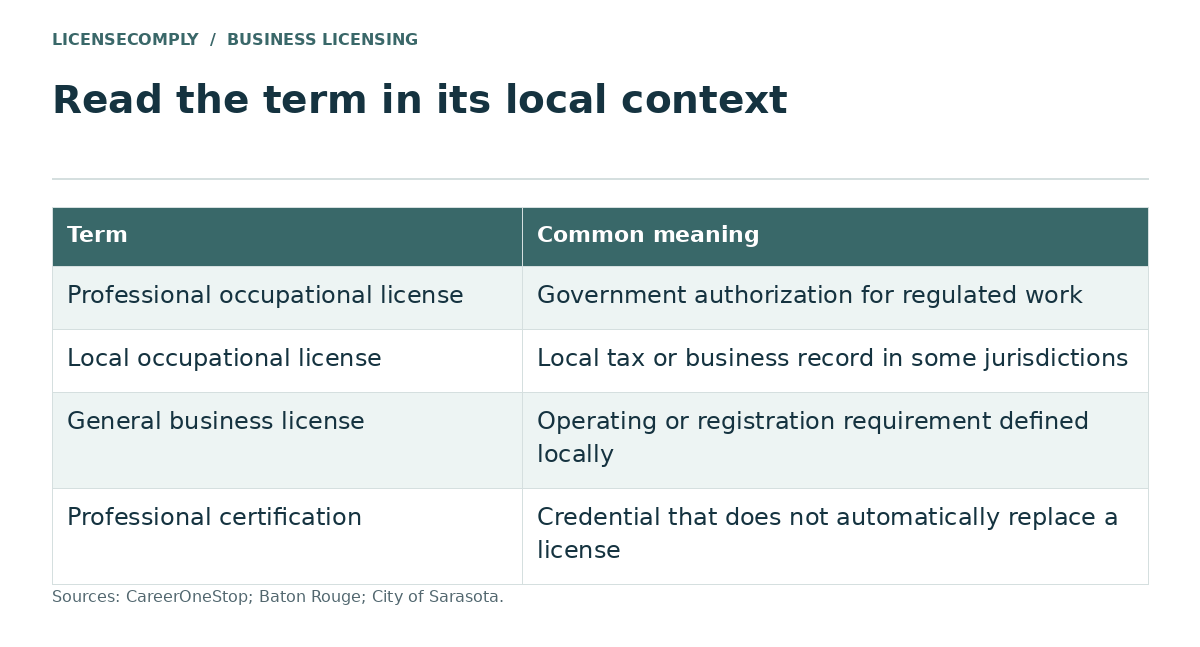 | What it commonly refers to | Best first contact |
|---|---|---|
| Occupational license for a profession | Authorization to perform regulated work | State board or occupational regulator |
| Occupational license as a local tax | Tax-based business record in the relevant jurisdiction | Local revenue or tax office |
| General business license | Business authorization or registration defined by local or state rules | Issuing licensing office |
| Professional certification | Credential demonstrating specified training or competence | Certification organization and, if relevant, the licensing board |
The table is a guide to interpreting terminology, not a substitute for the issuing authority’s definition. When a form uses more than one term, ask which document satisfies each field.
Do you need both a professional and a local authorization?
Possibly. The requirements address different parts of the operation. A professional credential concerns the regulated work, while a local business tax or business license concerns the business under that jurisdiction’s rules.
Sarasota provides a concrete example: its local business tax guidance tells applicants to obtain a state license if their occupation requires one and separately explains local tax obligations. The exact result for another business depends on its jurisdiction and any applicable exemptions.
Check the individual practitioner, the entity offering the services, and the premises as separate research questions. For an overview of operating approvals, read Do I Need a Business License.
How to apply through the correct route
For a professional license, begin with the responsible board. Confirm the license class, eligibility requirements, accepted qualifications, application procedure, and permitted scope of practice. Plan around examination or experience requirements if they apply.
For a local occupational tax or business record, begin with the city, county, or parish office. Identify the location, business classification, ownership, and tax basis the application requires. Determine whether zoning or other approvals must be completed first.
For either route, use the exact legal name and keep a copy of the submitted application. Track any request for information and obtain the final issued record. A payment receipt or pending application is not automatically permission to begin regulated work.
When there are several requirements, put them in dependency order. For example, a local office might require evidence of a state credential. Knowing that before filing helps avoid an incomplete local application.
Renewal and changes need separate attention
Record the renewal date and prerequisites for each credential or tax record. Do not combine a professional license and a local business tax into one calendar entry unless you have verified that their deadlines and procedures truly align.
Changes in ownership, the licensed individual, location, or service scope deserve review. Ask the issuing authority whether the proper process is an amendment, renewal, transfer, or new application.
Our business license renewal guide explains how to assign responsibility and track completion. LicenseComply can help research business licensing requirements and coordinate the filing or renewal support appropriate to your operation.
Frequently asked questions
Is an occupational license the same as a business license?
Sometimes the terms refer to the same local record, but not always. A professional occupational license addresses regulated work. Identify the agency and the document’s purpose before treating the terms as interchangeable.
Does every worker need one?
No universal rule applies to every occupation. Check the particular work and state requirements. The obligations of an individual worker and the business employing that person can differ.
Does a local tax receipt prove professional competence?
No. Check the relevant professional regulator for the credential and its scope. A local tax record addresses the local requirement described by the issuing office.
Does occupational license refer to driving privileges?
The phrase also appears in other legal contexts, including restricted driving privileges. This article concerns business and professional licensing. If your notice relates to driving, use the responsible transportation or court authority’s guidance.
Unsure which license your notice refers to?
LicenseComply researches the professional and local licenses your business needs and coordinates the filings and renewals.
Explore Specialized Licensing Talk to a licensing specialist
Official sources and further reading
- Texas Department of Licensing and Regulation
- Contractors State License Board
- CareerOneStop’s License Finder
- Baton Rouge Finance Department
- City of Sarasota
- Local Business Tax Act
- Florida Senate’s record for CS/HB 103 in 2026
Related guides



Disclaimer: LicenseComply provides professional business licensing and compliance services. However, the informational content on this site (including articles, guides, tools, and videos) is provided for general educational purposes only and does not constitute legal, tax, or accounting advice. Laws and regulations change frequently, and we cannot guarantee that all information is accurate, complete, or up to date for your specific circumstances. Your use of this website and its content does not create an attorney-client, accountant-client, or other advisory relationship. You should consult with a qualified attorney, accountant, or other appropriate professional for advice tailored to your business.