
Key points
- A cottage food license is a state or local permit or registration that lets a person make certain lower-risk foods in a home kitchen and sell them, usually directly to consumers and under an annual sales cap.
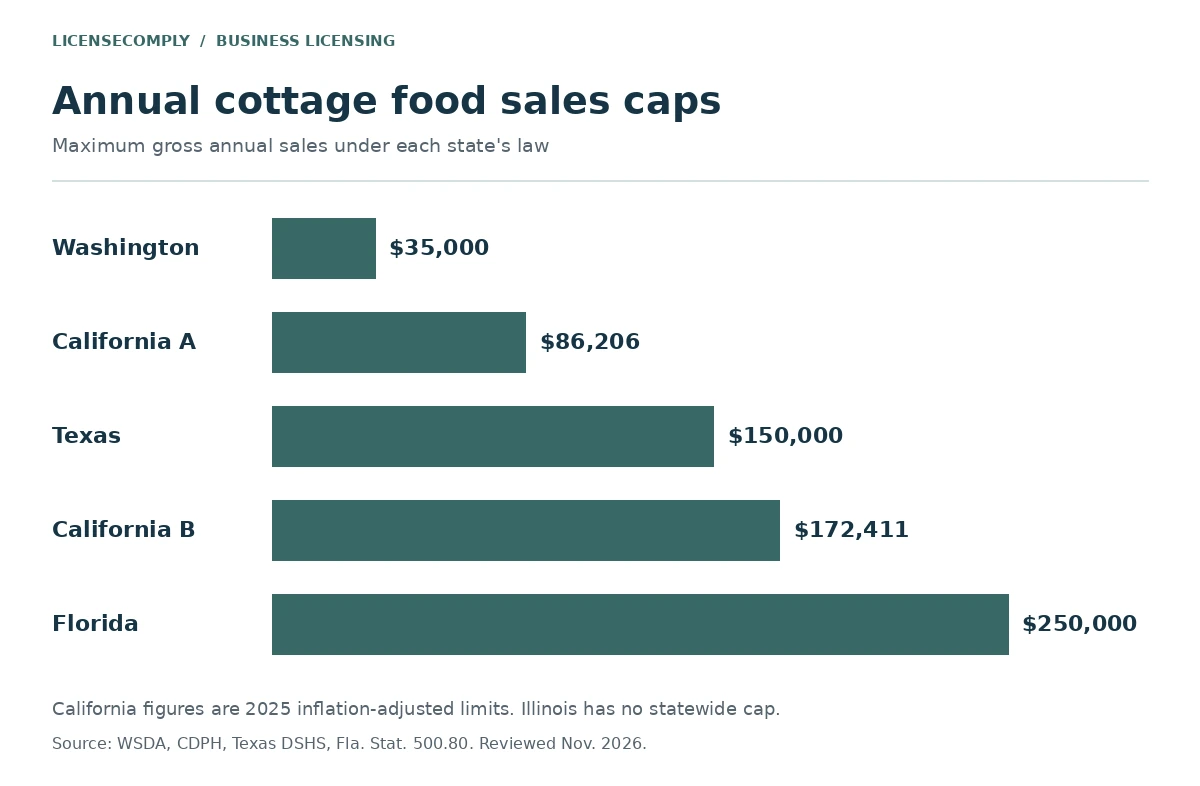
- Washington requires a $355 two-year cottage food permit from the Washington State Department of Agriculture and caps gross cottage food sales at $35,000 per year.
- Florida does not require a permit for cottage food operations with annual gross sales of $250,000 or less, and it allows online and mail-order sales delivered by the United States Postal Service or a commercial carrier.
- California splits cottage food operations into Class A (direct sales only, registered locally) and Class B (direct and indirect sales, permitted locally), with sales caps adjusted each year for inflation.
A cottage food license is the permit or registration some states require before you can make certain lower-risk foods, such as cookies, breads and fruit jams, in your home kitchen and sell them to the public. Whether you need one depends on your state: some issue a state permit, some require registration with the local health department, and some exempt cottage food from permits entirely as long as you follow the labeling and sales rules.
Every state sets its own allowed foods, sales cap, labeling statement and selling channels, and these laws change often. This guide walks through six state examples based on official sources reviewed November 2026. Always confirm current rules with the agency that regulates cottage food where you live.
What is a cottage food operation?
A cottage food operation is a home-based food business that is exempt from the licensing and inspection rules that apply to commercial kitchens, restaurants and food manufacturers. In exchange for that exemption, the operator accepts limits. The food must come from the operator’s own home kitchen, it must be a food the state considers lower risk, it usually must be sold directly to the end consumer, and total sales must stay under a dollar cap.
California’s definition is typical. Under California Health and Safety Code section 113758, a cottage food operation runs from the private home where the operator lives, may have no more than one full-time equivalent employee (not counting family or household members), and makes nonpotentially hazardous foods for sale. Washington’s law, RCW 69.22.010, likewise limits production to the home kitchen of the operator’s primary residence and excludes outbuildings, sheds and barns.
The phrase “cottage food license” is used loosely. Depending on the state, the actual credential may be a permit, a registration, an exemption or nothing at all.
Do you need a cottage food license in your state?
States generally fall into three groups. Permit states require an application, a fee and often a home kitchen inspection before you sell. Registration states ask you to file with the state or local health department, sometimes with a small fee, but usually do not inspect unless there is a complaint. No-permit states let you operate without filing anything, provided you stay within the law’s food list, labeling rules and sales cap.
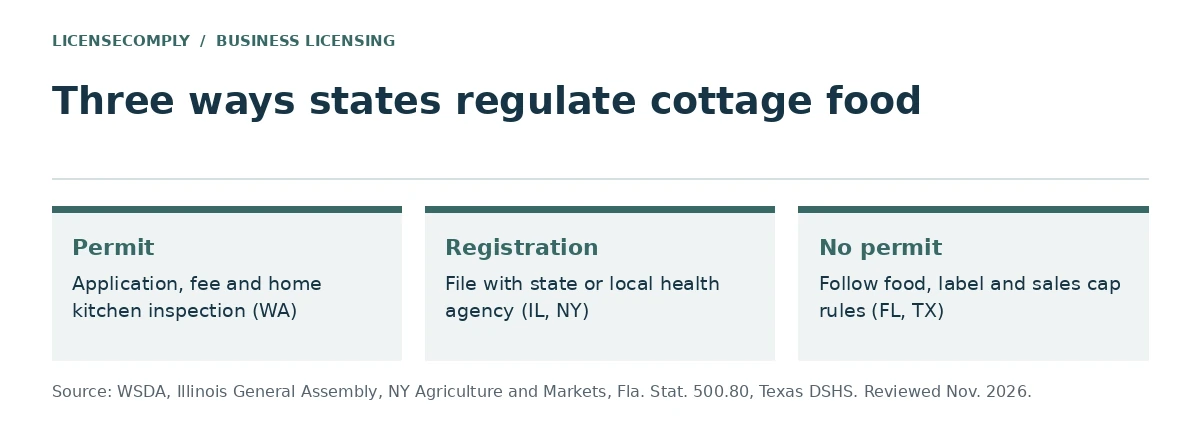
Some states mix the models, as Texas and California do. The table below summarizes the six examples in this guide.
| State | What you file | Annual sales cap | Online or shipped sales |
|---|---|---|---|
| Texas | No permit; registration for refrigerated (TCS) foods | $150,000 | Online orders, personal delivery |
| California | Class A registration or Class B permit (county) | $86,206 / $172,411 (2025) | Mail delivery allowed in state |
| Florida | Nothing (exempt from food permit) | $250,000 | Mail and carrier delivery allowed |
| Washington | $355 state permit, every two years | $35,000 | Not by internet or mail order |
| New York | Home processor registration (state) | Not stated by agency | Internet sales within New York |
| Illinois | Annual local registration, fee up to $50 | None in statute | Shipping in state only |
How cottage food rules work in six states
Texas: no permit, with registration for some products
Texas does not license cottage food production operations. According to the Texas Department of State Health Services (DSHS), local health departments may not require a cottage food operator to obtain a license or permit or pay a fee to produce or sell directly to consumers. Senate Bill 541, effective September 1, 2025, raised the annual gross income threshold to $150,000 and expanded allowable foods to everything except meat and poultry, seafood, ice and frozen desserts, low-acid canned goods, products containing cannabidiol or tetrahydrocannabinol (THC), and raw milk.
Registration on the DSHS Online Licensing Registry is now required if you sell time and temperature control for safety (TCS) foods, such as items that must be refrigerated. Operators may also register voluntarily so they can print a DSHS identification number on labels instead of their home address. Every Texas operator must complete an accredited food handler training program, per the same DSHS cottage food page.
California: Class A registration and Class B permit
California regulates cottage food at the county level. The California Department of Public Health (CDPH) states that all cottage food operations are registered or permitted by the local environmental health department, not by CDPH. A Class A operation may sell only directly to consumers and registers with the county. A Class B operation may also sell indirectly through permitted shops, restaurants and markets and must obtain a county permit.
Sales caps are set in statute at $75,000 for Class A and $150,000 for Class B, adjusted every year for inflation. CDPH’s 2025 adjusted sales limit notice lists $86,206 for Class A and $172,411 for Class B. Check with your county for the current year’s figure and fee. Allowed products must appear on the CDPH Approved Cottage Food List.
Florida: no permit up to $250,000
Florida is a no-permit state. Under section 500.80, Florida Statutes, a cottage food operation is exempt from the state food permit if its annual gross sales of cottage food products do not exceed $250,000. The law preempts local governments from prohibiting or regulating cottage food production, although operators still must follow the state’s home-based business conditions. The Florida Department of Agriculture and Consumer Services may inspect a home kitchen only after receiving a complaint.
Washington: a state permit and inspection
Washington is a permit state. The Washington State Department of Agriculture (WSDA) charges $355 for a cottage food permit valid for two years and inspects the home kitchen before approving it. Gross sales may not exceed $35,000 per year, and RCW 69.22.030 requires everyone involved in preparing the products to hold a food worker card. Products are limited to nonpotentially hazardous baked goods, candies, jams, jellies, preserves, fruit butters and other foods WSDA approves by rule.
New York: home processor exemption
New York does not use the term cottage food. Instead, the New York State Department of Agriculture and Markets offers a Home Processor Exemption from Article 20-C food processing licensing. Applicants submit a registration request, and the department has warned that reviews may take up to 16 weeks. All products must be sold within New York State, prepackaged and labeled at home. The approved list includes breads, cookies, cakes without homemade buttercream, double-crust fruit pies and high-acid fruit jams. Anything that requires refrigeration is prohibited.
Illinois: annual local registration
Illinois requires registration with the local health department. Public Act 102-0633, effective January 1, 2022, removed the statewide sales cap, set annual registration with a fee of no more than $50, and requires the operator to be a certified food protection manager. Sales may happen at farmers markets, events, online, by delivery and by pickup from the home where local law allows it.
Which foods are allowed under cottage food laws?
Most states limit cottage food to foods that do not need refrigeration to stay safe. Regulators call these nonpotentially hazardous foods or non-TCS foods. Common examples are breads, cookies, cakes without cream fillings, candies, granola, dry mixes and high-acid fruit jams.
The most commonly prohibited items are meat, poultry, seafood, dairy products, low-acid canned vegetables, cream or custard pies, and foods with cannabis-derived ingredients. New York’s prohibited foods list also excludes pickles, salsas, sauces, beverages, nut butters and freeze-dried foods. Texas is now an outlier: it allows TCS foods if the operator registers, stores and delivers the food at safe temperatures, and labels it with a production date and safe handling instructions.
Texas also requires pickled and fermented products to follow a DSHS-approved recipe or be pH tested batch by batch under Health and Safety Code chapter 437.
What must a cottage food label include?
Labels are where most cottage food compliance happens. Nearly every state requires the product name, the operator’s name and address (or a registration number), an ingredient list in descending order by weight, allergen declarations, and a statement that the food was made in a home kitchen. Many also require net weight or volume.
The required home kitchen statement and type size differ by state. California requires “Made in a Home Kitchen” in 12-point type on the principal display panel, plus the registration or permit number and issuing county, according to CDPH’s cottage food labeling requirements. Florida requires its statement in at least 10-point type in a contrasting color. Washington requires at least the equivalent of 11-point type under RCW 69.22.020.
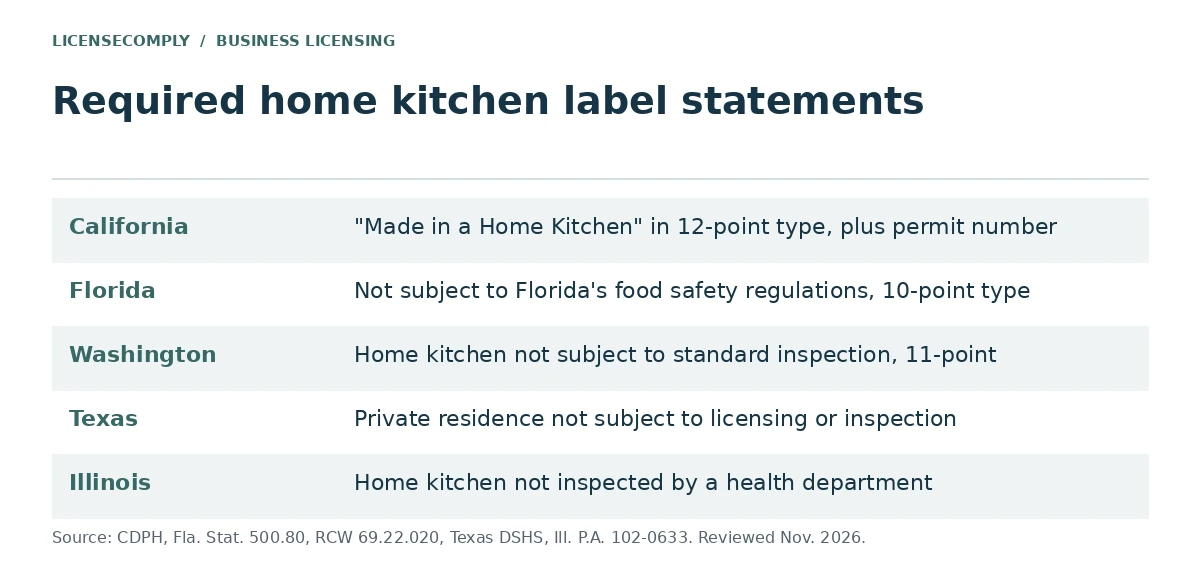
If you sell in more than one state, expect to maintain separate labels, because the disclosure wording and identifiers differ.
Where can you sell cottage food, and can you ship it?
Most laws allow sales at farmers markets, events, from the home and by delivery. The limits usually involve wholesale and shipping.
Wholesale to shops and restaurants is restricted in most states. California allows it only for Class B operations. New York allows home processors to sell wholesale to in-state restaurants, cafes and grocery stores, according to the department’s frequently asked questions. Florida prohibits cottage food wholesale outright. Texas allows wholesale of non-TCS foods only to a registered cottage food vendor, who must post a sign stating the product was made in a private residence that is not subject to governmental licensing or inspection.
Online sales are widely allowed, but shipping is not. Florida’s statute expressly permits delivery by the United States Postal Service or a commercial carrier. California allows direct sales to be fulfilled by mail within the state. Illinois allows shipping of nonpotentially hazardous foods but bans shipping out of state. Texas DSHS guidance says online orders must be personally delivered by the operator, an employee or a household member. Washington’s statute says cottage food products may not be sold by internet or mail order.
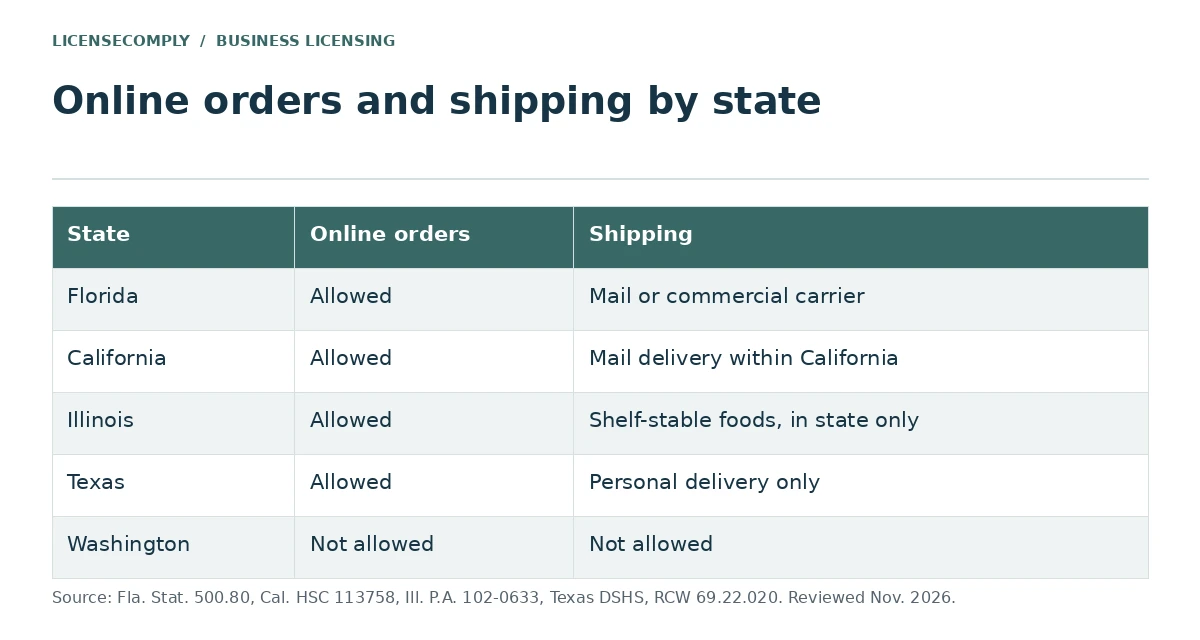
California, Illinois, New York and Washington expressly limit cottage food sales to their own state, and Texas ties sales to delivery within Texas. If you want to sell nationally, plan on a licensed commercial facility and review federal requirements such as Food and Drug Administration (FDA) food facility registration.
What other registrations does a cottage food business need?
Cottage food status only covers food safety rules. You may still need a city or county business license, a home occupation or zoning approval, and a sales tax permit. California’s CDPH cottage food infographic lists approval from the local city or county planning department as a requirement, and Florida’s statute says the exemption does not excuse operators from tax laws.
Our guide on whether you need a business license covers local licensing, and seller’s permit vs. resale certificate explains sales tax registration.
When do you outgrow cottage food?
You outgrow cottage food when you pass the sales cap, want to sell foods the law excludes, want to sell wholesale or across state lines, or need to produce outside your home. At that point, you generally move into a licensed commercial kitchen and obtain a food manufacturer, food processor or food establishment license.
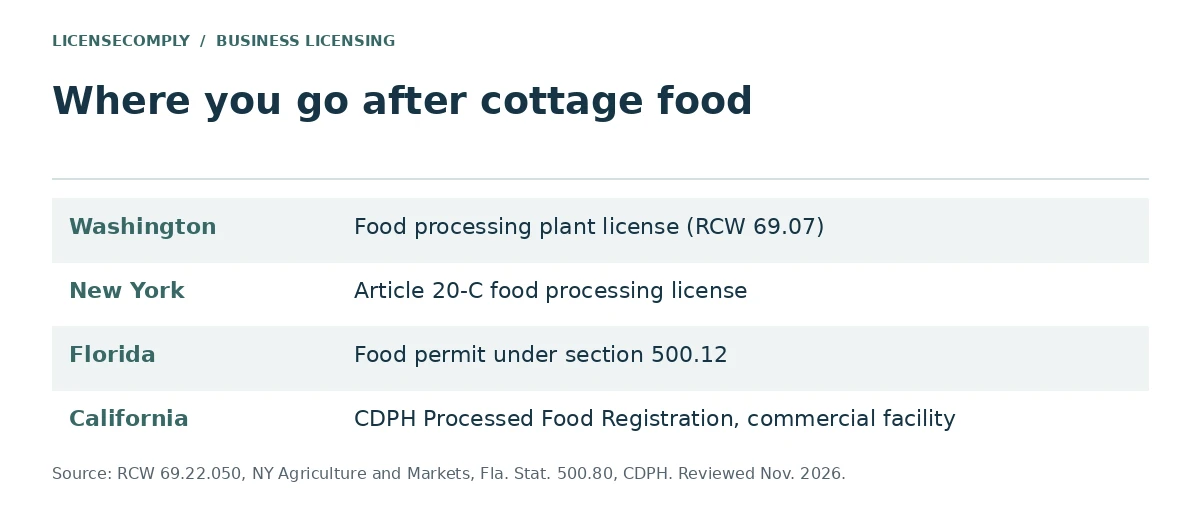
The path depends on the state. Washington’s law, RCW 69.22.050, says an operation that exceeds the sales cap must either obtain a food processing plant license or cease operations. In New York, leaving the home processor exemption means applying for an Article 20-C food processing license. Florida operators above $250,000 need a food permit under section 500.12. California’s CDPH notes that operations moving beyond the cottage food program go to a commercial facility and register under the Processed Food Registration program.
If you plan to sell prepared food from a truck, trailer or cart instead of a home kitchen, that is a separate retail food permit. Texas operators can see how that works in our Texas mobile food vendor license guide. Businesses expanding into several states often use License & Permit Filing to handle the commercial applications once cottage food no longer fits.
Frequently asked questions
Do I need a cottage food license to sell baked goods from home?
It depends on your state. Washington requires a state permit, California requires county registration or a permit, and Illinois requires annual local registration. Florida and Texas do not require a permit for most operators, although Texas requires registration for foods that need temperature control. Everywhere, you must still follow the allowed foods list, labeling rules and sales cap.
How much can I sell under a cottage food law?
Caps range widely. Washington allows $35,000 in annual gross sales, Texas $150,000, and Florida $250,000. California adjusts its caps each year for inflation, and the 2025 limits were $86,206 for Class A and $172,411 for Class B. Illinois removed its statewide sales cap in 2022. Exceeding the cap generally means moving to a licensed commercial facility.
Can I sell cottage food online and ship it?
Many states allow online ordering, but shipping rules vary. Florida allows delivery by mail or commercial carrier, California allows mail delivery for in-state direct sales, and Illinois allows in-state shipping of nonpotentially hazardous foods. Texas guidance requires personal delivery by the operator, an employee or a household member, and Washington bars internet and mail order sales. California, Illinois, New York and Washington expressly limit cottage food sales to in-state customers, so plan on a commercial license before selling nationally.
Can I sell cottage food to stores or restaurants?
Usually only in limited ways. California allows indirect sales through permitted retailers if you hold a Class B permit. New York home processors may sell wholesale to in-state restaurants, cafes and grocery stores. Texas allows wholesale of non-TCS foods only to registered cottage food vendors. Florida and Washington do not allow cottage food to be sold wholesale or through food service establishments. Selling to retailers in other cases requires a commercial food license.
Does a cottage food license replace a business license?
No. Cottage food laws address food safety, not general business licensing or taxes. Depending on your city and state, you may still need a local business license, a home occupation or zoning approval, and a sales tax permit. Confirm each with your city, county and state revenue agency.
Selling homemade food in more than one place?
LicenseComply researches the cottage food, food processor and local business licenses that apply to your products and locations, then files the applications for you.
Explore Research & Verification Talk to a licensing specialist
Official sources and further reading
- Texas DSHS: Texas Cottage Food Production
- Texas Health and Safety Code chapter 437
- California Health and Safety Code section 113758
- CDPH: Cottage Food Operations
- CDPH: Cottage Food Operation Adjusted Gross Annual Sales Limit 2025
- CDPH: Labeling Requirements for Cottage Food Products
- Florida Statutes section 500.80, Cottage food operations
- Washington State Department of Agriculture: Cottage Food
- Washington RCW chapter 69.22, Cottage food operations
- New York State Department of Agriculture and Markets: Home Processing
- Illinois General Assembly: Public Act 102-0633
Disclaimer: LicenseComply provides professional business licensing and compliance services. However, the informational content on this site (including articles, guides, tools, and videos) is provided for general educational purposes only and does not constitute legal, tax, or accounting advice. Laws and regulations change frequently, and we cannot guarantee that all information is accurate, complete, or up to date for your specific circumstances. Your use of this website and its content does not create an attorney-client, accountant-client, or other advisory relationship. You should consult with a qualified attorney, accountant, or other appropriate professional for advice tailored to your business.