
Key points
- Since July 1, 2026, Texas mobile food vendors are licensed statewide by the Department of State Health Services (DSHS) under House Bill 2844.
- DSHS uses Types I, II and III based on food preparation. Initial application plus pre-licensing inspection charges are $309, $1,018 and $1,376.
- Each food vending vehicle needs its own license, which expires one year after the successful pre-licensing inspection.
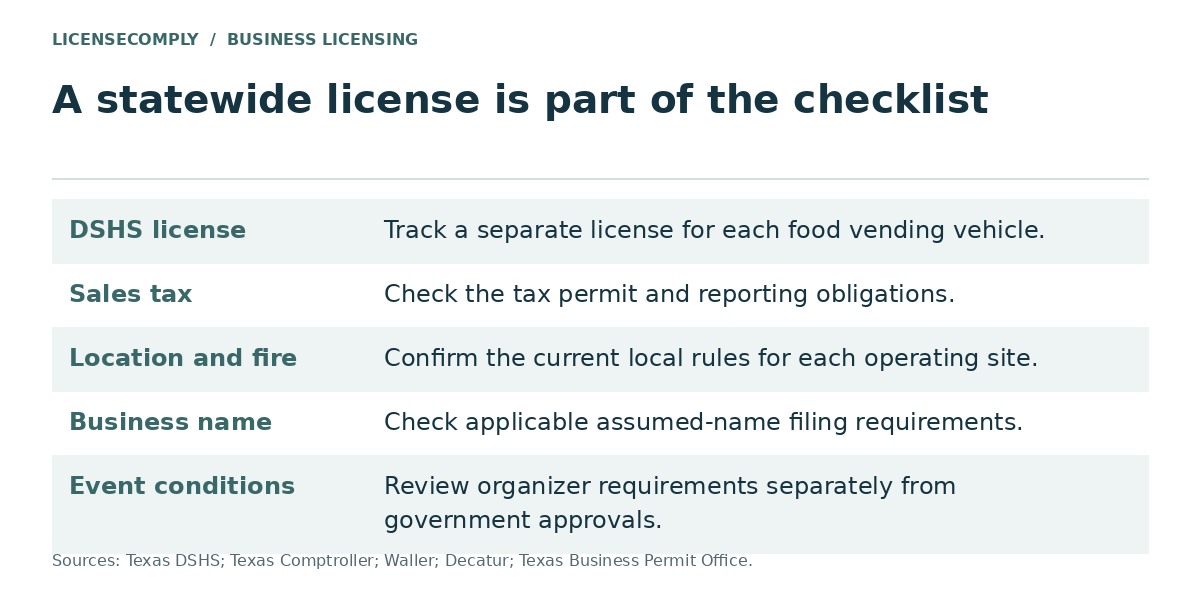
- Sales tax, local location and fire rules, and assumed-name filings still need separate checks.
Texas mobile food vendors now operate under a statewide licensing program administered by the Texas Department of State Health Services, or DSHS. The DSHS mobile food vendor page states that the change began July 1, 2026, under House Bill 2844.
For a food truck owner, the practical starting point is to identify the correct license type for the vehicle’s food preparation activities, complete the DSHS application process, and satisfy the applicable inspection requirements. The statewide health license does not mean every parking, zoning, fire, tax, or event question has disappeared.
This guide explains the license types, published fees, application sequence, and local checks that remain relevant. Figures and agency guidance were reviewed October 26, 2026. Use the current DSHS instructions for the vehicle and menu you intend to operate.

Who counts as a mobile food vendor
DSHS defines a mobile food vendor as someone dispensing food or beverages from a food vending vehicle for immediate service or consumption. Its definition of a food vending vehicle includes readily movable food service vehicles and pushcarts, with details in the agency’s program guidance.
The agency specifically distinguishes a food vending vehicle from a stand or booth. That matters for events: a booth selling food is not automatically licensed through the same route as a food truck simply because both operate at the same festival.
The DSHS Mobile Food Vendor Guide also states that a separate license is required for each food vending vehicle. A company adding a second truck should therefore research and budget for that vehicle’s licensing rather than treating the first truck’s certificate as company-wide approval.
If the setup falls between categories, contact DSHS with the menu, preparation methods, and vehicle description. Choosing a category based only on the brand name or appearance of the truck is not enough.
Choose the right food preparation type
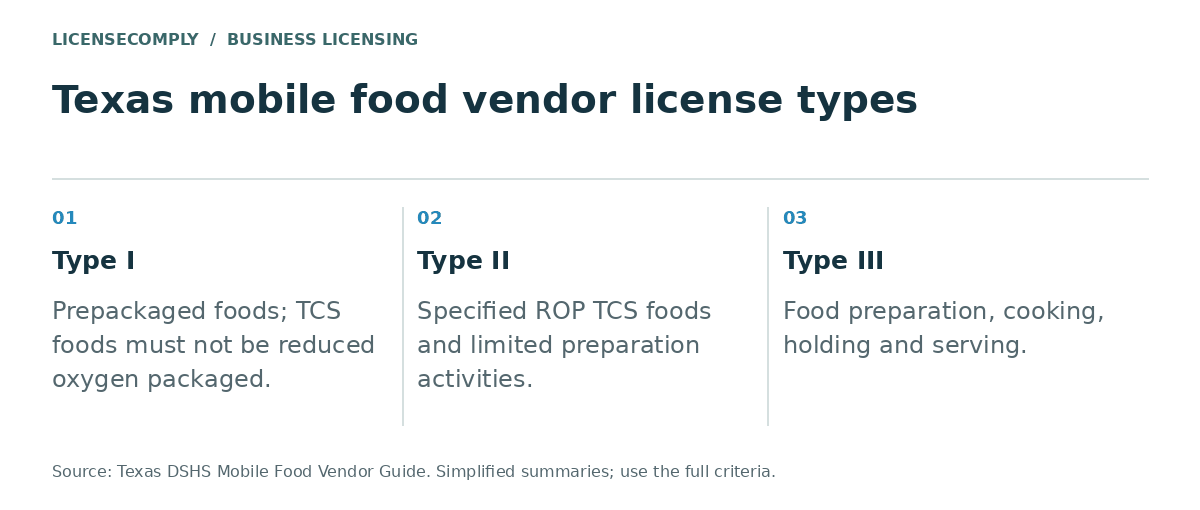
DSHS uses Types I, II, and III to distinguish operations by their activities. The official guide describes the categories and the corresponding physical requirements.
Type I
Type I covers prepackaged food items, including time/temperature control for safety food, where the TCS food is not reduced oxygen packaged. The guide lists examples such as vendors selling prepackaged products.
“TCS” concerns the need for time or temperature control for safety. Do not assume “prepackaged” means a product requires no temperature control or that every packaged product belongs in Type I. Reduced oxygen packaging is an important distinction in the DSHS classification.
Type II
Type II includes specified reduced oxygen packaged TCS foods and limited preparation activities such as cold holding, thawing, or reheating commercially processed products for immediate consumption. Use the guide’s full description when evaluating a proposed menu.
Adding a preparation step can change the analysis. Describe what happens on the vehicle, not just the name of the food sold. If you are uncertain whether the activity fits the category, obtain an agency answer before building the operation around the lower fee.
Type III
Type III covers vendors preparing, cooking, holding, and serving food, including processes described in the guide such as cooking, cooling, and reheating. A truck cooking food to order should review this category and its requirements carefully.
The category affects more than the application price. Equipment, water, waste, temperature control, and preparation arrangements need to fit the operation. Use the official checklist to plan the vehicle and inspection rather than discovering an equipment issue after the application is submitted.
Application and inspection fees
The DSHS guide separates application charges from inspection charges. The following table reproduces the published amounts and shows the arithmetic total of the listed application and pre-licensing inspection fees.
| License type | Application fee | Pre-licensing inspection fee | Total of those initial charges |
|---|---|---|---|
| Type I | $309 | Not applicable in the fee table | $309 |
| Type II | $618 | $400 | $1,018 |
| Type III | $876 | $500 | $1,376 |
Source: Texas DSHS Mobile Food Vendor Guide. Application fees include the Texas Online fee. The guide describes the pre-licensing inspection fee as a one-time charge paid with the initial application where applicable.
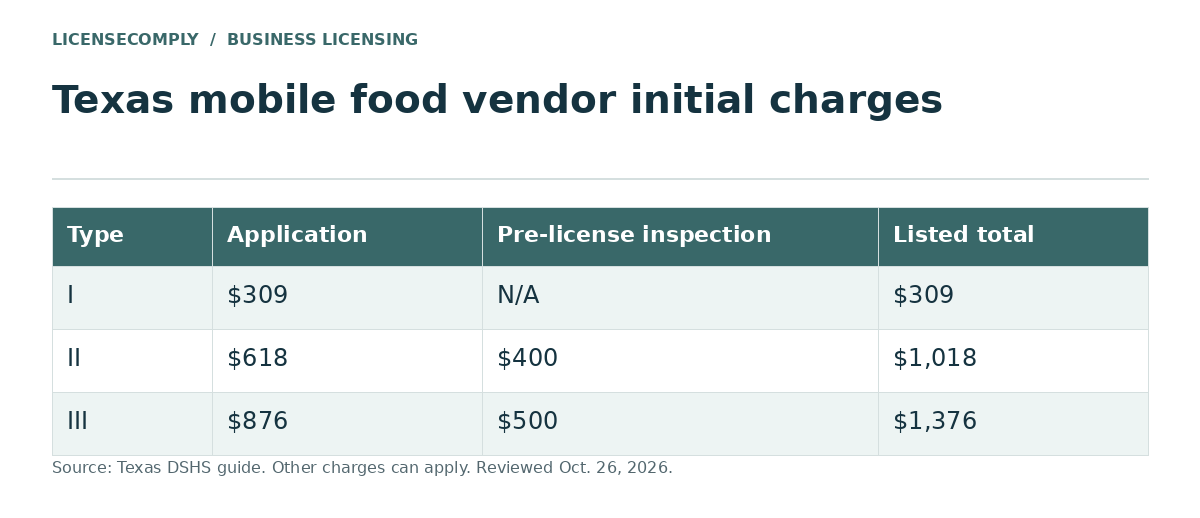
These totals are not the full cost of launching a food truck. The guide also lists routine inspection fees of $400 for Type II and $500 for Type III, and complaint/compliance inspection fees of $300, $400, and $500 for Types I, II, and III respectively. Equipment, other approvals, and operating expenses are separate.
The fee table’s “not applicable” entry for a Type I pre-licensing inspection charge should not be read as an exemption from all inspections. DSHS’s program page states that an initial inspection must occur before license issuance. Follow the agency’s instructions for the specific vehicle and application.
Apply in five steps
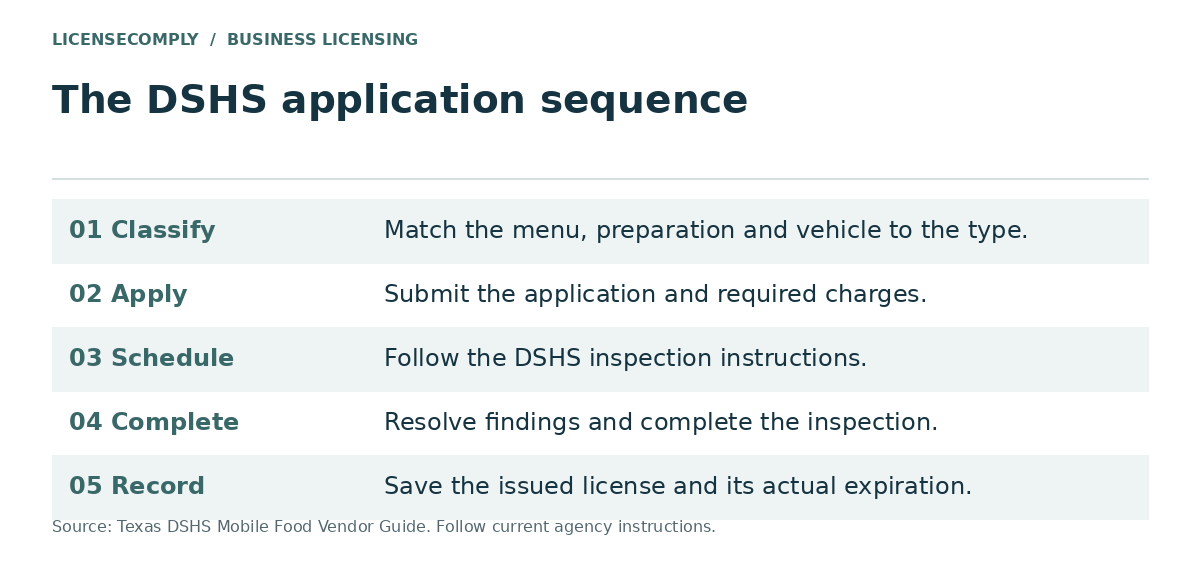
1. Confirm your type and vehicle requirements
Write down the menu, storage methods, food sources, and each preparation activity. Compare those facts with the DSHS type descriptions and physical requirements. Identify any central preparation facility or commissary arrangements that apply.
Use the guide’s commissary exemption checklist if you believe an exemption fits your operation. Do not assume every vehicle needs the same arrangement or that self-contained equipment automatically establishes an exemption. Get clarification before signing a long-term service contract or finalizing the build.
2. Submit the DSHS application
Start from the official mobile food vendor page, which links to application instructions and Online Licensing Services. Use the correct business and vehicle information and submit the required supporting documentation.
Pay the charges applicable to the type. If a service provider helps, separate its fee from DSHS charges. Keep the submitted application, summary, payment record, and any correspondence in a vehicle-specific file.
3. Follow inspection scheduling instructions
The DSHS guide says applicants receive a letter after application processing to arrange the pre-licensing inspection. Follow the current instructions in that correspondence and prepare the vehicle using the agency’s inspection checklist.
Confirm practical details before the appointment: the vehicle, equipment, documents, and preparation arrangements should be ready for the inspection process. An appointment is not a substitute for completing the underlying requirements.
4. Resolve findings and complete the inspection
Address any deficiencies through the process DSHS identifies. Keep the inspection record and any follow-up instructions. If the menu or equipment changes while the application is pending, tell the agency rather than allowing the submitted description to become inaccurate.
New operators should not treat an application receipt as permission to sell food. The guide says vendors without a current Texas license cannot operate until the pre-licensing inspection is completed. Follow the current DSHS direction on authorization and issuance for your situation.
5. Obtain the license and record its term
Review the issued record and connect it to the correct vehicle. The guide states that the license expires one year after successful completion of the pre-licensing inspection. Record the actual expiration rather than calculating a date from the payment receipt.
Keep the licensing record accessible to the people responsible for the vehicle. Add renewal planning and any ongoing inspection obligations to the operations calendar. Review the requirements again when the menu, ownership, or vehicle changes.
If you held a local license before July 2026
The rollout guide distinguishes existing locally licensed vendors from new vendors. For its Category One transition group, it describes continued operation when the applicant supplies proof of an existing Texas local health department license, applies and pays the charges, and keeps the application summary and payment receipt on the vehicle.
This is transition guidance tied to the described circumstances. It is not an indefinite substitute for completing the DSHS process, and it should not be extended to a new operator without the required prior license.
If your application is still in transition, contact DSHS about the current status and any instructions that apply to the vehicle. Keep the agency’s response with the original local license and application records. Do not rely only on what another vendor was told during an earlier phase of the rollout.
Other requirements to check
Sales and use tax
Review the tax treatment of your food and beverage sales and whether a Texas sales and use tax permit is required. The Texas Comptroller does not charge a permit fee but can require a security bond. Tax reporting and payment obligations are separate from the DSHS health license.
Our seller’s permit and resale certificate guide explains why sales tax registration and resale purchasing documentation are different records. Ask a tax adviser about transaction-specific taxability questions.
Local location and safety rules
Do not assume the statewide program grants permission to park and sell anywhere. The City of Waller’s mobile food vendor guidance states that it no longer charges its mobile vendor application fee or performs the former inspections after the transition, while still requiring an application and its mobile food fire certificate of occupancy process.
The City of Decatur’s transition notice likewise explains that local zoning, parking, and applicable municipal ordinances remain relevant. These examples demonstrate continuing local checks; they are not an identical permit list for every Texas city.
Before accepting an event or location, confirm the current requirements with that jurisdiction and the organizer. Identify which approvals concern the health license, which concern fire or location rules, and which are private event conditions.
Business and trade names
Use the legal business name consistently. If operating under another name, check the applicable assumed-name filing rules through the Texas Secretary of State or county clerk as appropriate to the entity. The Texas Business Permit Office is a starting resource for the state’s business registration and licensing framework.
A trade name filing does not replace the DSHS license, and a DSHS license does not by itself resolve the company’s other business records.
Build a vehicle-specific compliance file
Keep the application, issued license, inspection records, preparation-facility documents where applicable, tax permit information, and location-specific approvals together. Record who handles each item and where the authoritative version is stored.
For a fleet, use one record per vehicle and avoid copying a completed status from one truck to another. The menu and equipment can differ even when the trucks share a brand. Connect each record to its actual license and inspection dates.
LicenseComply can help research business licensing requirements and filing support for the operating locations. Coordinate technical food-safety and vehicle questions directly with DSHS and qualified professionals. See Business License Renewal for an approach to tracking deadlines.
Can a Texas food truck sell alcohol?
A DSHS food truck license in Texas does not authorize alcohol sales. The Texas Alcoholic Beverage Commission (TABC) says alcohol permits are issued only to a permanent physical address certified by local authorities, and gives a food truck that moves around a city as an example of a business without one.
If your plan includes an event, a licensed premises or alcohol service, take that specific arrangement to TABC before advertising it. Do not assume a food license, catering contract or event invitation supplies the missing alcohol authorization.
Frequently asked questions
Is a food booth the same as a food vending vehicle?
No. DSHS expressly excludes a stand or booth from the food vending vehicle definition. Confirm the correct food establishment or event route for that setup.
Does one license cover multiple trucks?
The DSHS guide requires a separate license for each food vending vehicle. Track the application, inspection, and renewal record for each vehicle.
Are local health licenses still the main application route?
The statewide DSHS framework began July 1, 2026. Check current DSHS instructions and any transition status, while separately confirming the local location and safety requirements that remain applicable.
Can I budget only the application fee?
No. Type II and Type III have listed pre-licensing inspection fees in addition to application charges. Other inspection charges and local or operational costs can also apply. Use an itemized budget for the specific vehicle and type.
Launching or adding a food truck?
LicenseComply researches the state and local licenses each vehicle and operating location needs and handles the filings and renewals.
Explore Research & Verification Talk to a licensing specialist
Official sources and further reading
- TABC License and Permit FAQs
- DSHS mobile food vendor page
- DSHS Mobile Food Vendor Guide
- Texas Comptroller
- City of Waller’s mobile food vendor guidance
- City of Decatur’s transition notice
- Texas Business Permit Office
Related guides



Disclaimer: LicenseComply provides professional business licensing and compliance services. However, the informational content on this site (including articles, guides, tools, and videos) is provided for general educational purposes only and does not constitute legal, tax, or accounting advice. Laws and regulations change frequently, and we cannot guarantee that all information is accurate, complete, or up to date for your specific circumstances. Your use of this website and its content does not create an attorney-client, accountant-client, or other advisory relationship. You should consult with a qualified attorney, accountant, or other appropriate professional for advice tailored to your business.