
Key points
- Washington issues its state business license through the Department of Revenue Business Licensing Service, which assigns each business a nine-digit Unified Business Identifier (UBI) number.
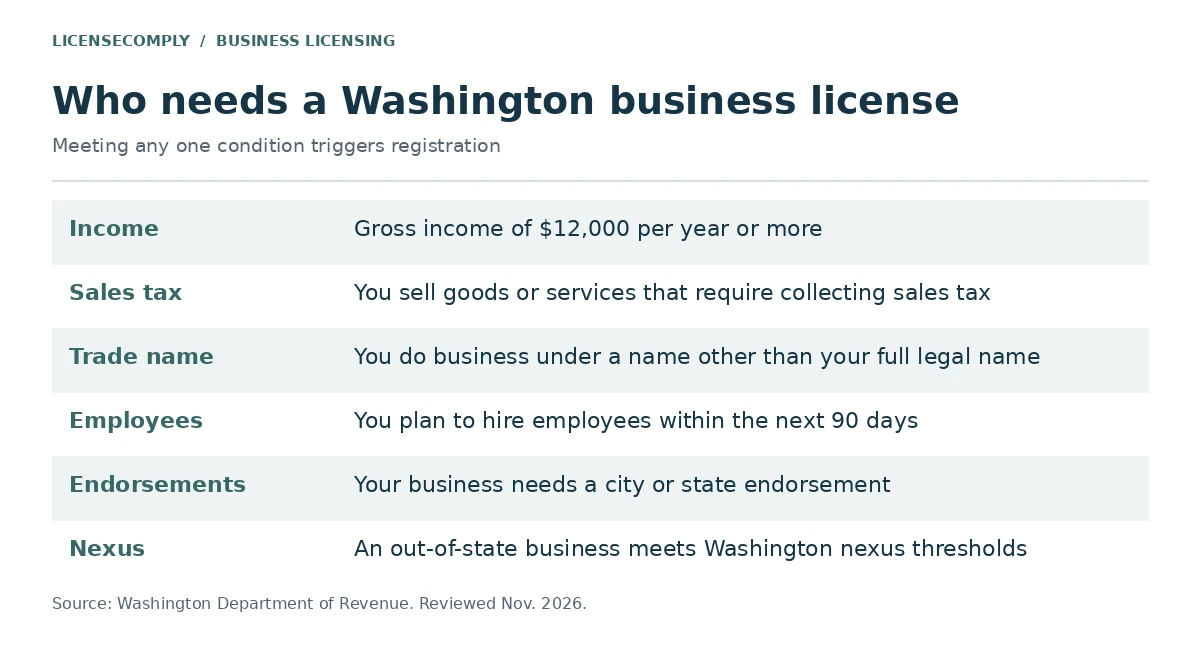
- A Washington business license is required if gross income is $12,000 per year or more, if the business collects sales tax, uses a trade name, plans to hire employees within 90 days, or needs a city or state endorsement.
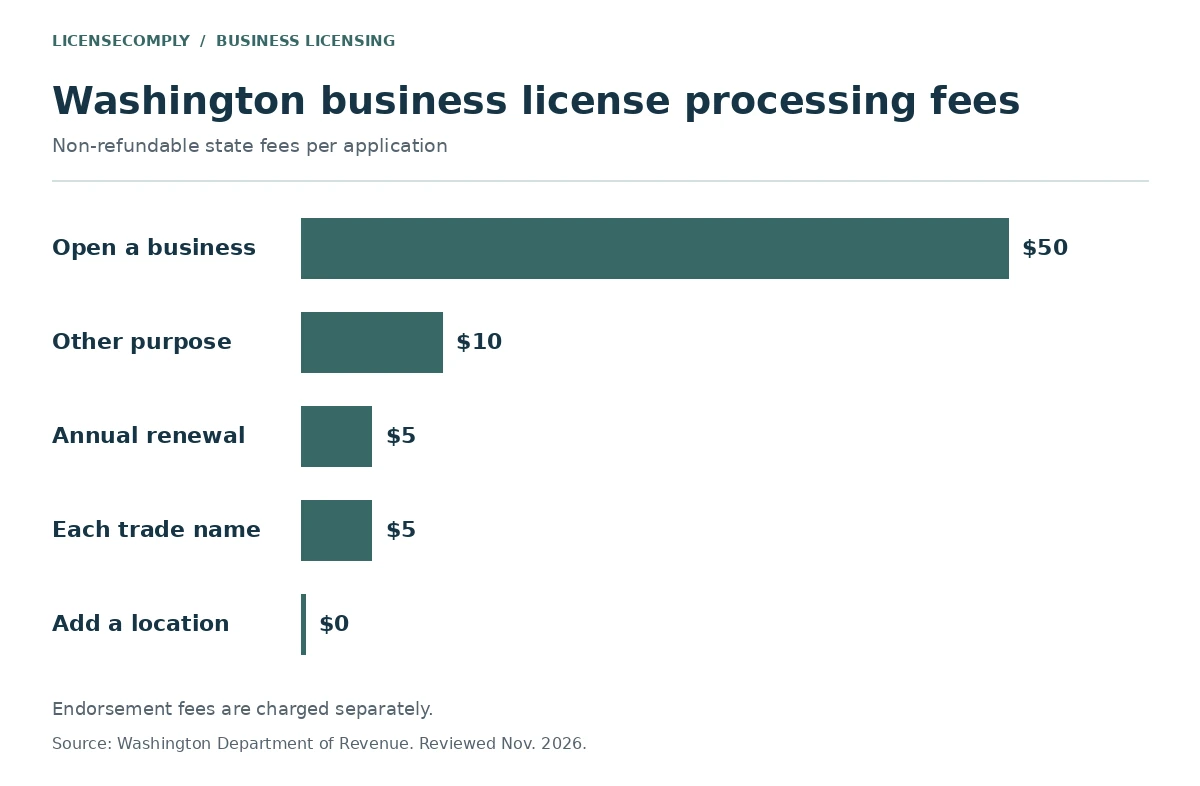
- The Business License Application processing fee is $50 to open a new business, $10 for most other filings, and $5 per location at annual renewal, plus any endorsement and trade name fees.
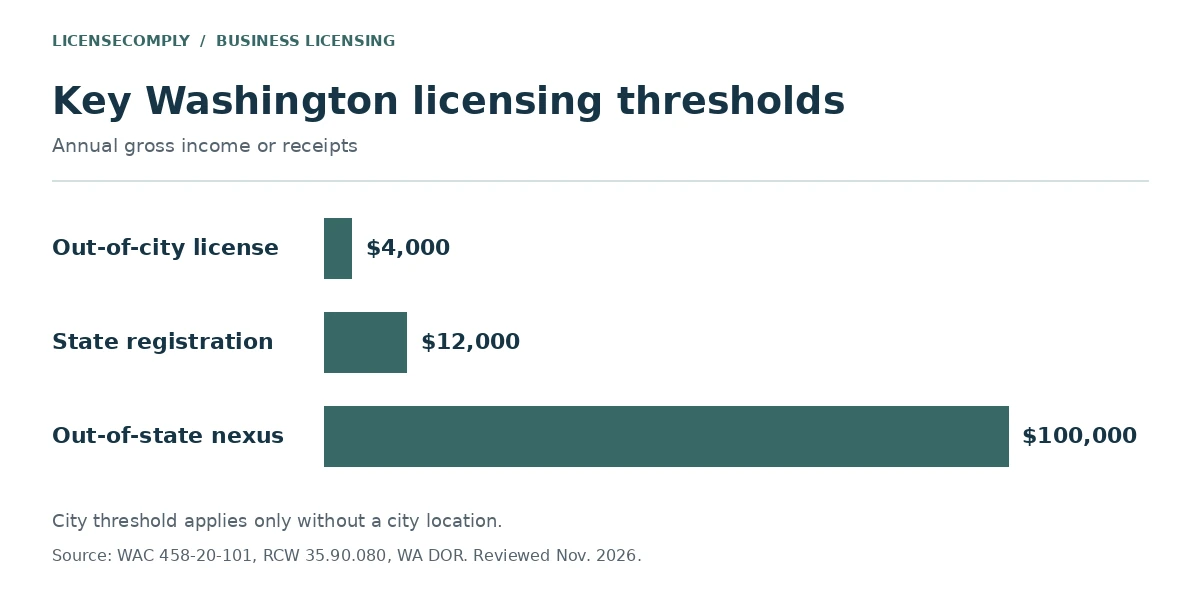
- Since January 1, 2026, the uniform minimum threshold for out-of-city businesses under the Washington model business license ordinance is $4,000 in annual gross income within a city.

A Washington business license is the state registration issued by the Department of Revenue’s Business Licensing Service (BLS), and it comes with a nine-digit Unified Business Identifier (UBI) number. Most businesses need one if they earn $12,000 or more a year, collect sales tax, hire employees, use a trade name, or need a city or state endorsement, according to the Department of Revenue registration requirements.
The state license is often only the first layer. Many cities add their own endorsement to the same license, a handful of larger cities license businesses separately through a portal called FileLocal, and regulated activities need their own permits. This guide walks through each piece, with fees and rules reviewed November 2026.
City requirements vary widely, so confirm details with the issuing agency before you file. If you are expanding from another state, our guide to the registration sequence when opening in a new state explains how the Washington steps fit into a broader rollout.
Who needs a Washington business license?
The Department of Revenue lists the conditions that trigger registration. You need to register and get a business license if any of the following apply, per the Department of Revenue business licensing FAQs:
- Your business requires city or state endorsements.
- You do business under a name other than your full legal name.
- You plan to hire employees within the next 90 days.
- You sell a product or provide a service that requires collecting sales tax.
- Your gross income is $12,000 per year or more.
- Your business must pay taxes or fees to the Department of Revenue.
- You buy or process specialty wood products.
The application page adds one more trigger: meeting the nexus thresholds that apply to out-of-state businesses, covered later in this guide.
The $12,000 threshold, in the rule’s own terms
The underlying rule is WAC 458-20-101, which sets out the tax registration endorsement. A person is exempt from registering only if all of these are true: gross income from business and occupation (B&O) taxable activities is less than $12,000 a year, gross income from public utility taxable activities is less than $12,000 a year, the person is not required to collect or pay retail sales tax or any other tax the department administers, and the person does not otherwise need a business license under chapter 19.02 of the Revised Code of Washington (RCW).
In practice, a small service provider earning under $12,000 with nothing taxable to collect may not need to register, while a seller of taxable goods at the same income does, as the rule’s examples in subsection (4) show.
What is a UBI number?
A UBI number is “a nine-digit number that registers you with several state agencies and allows you to do business in Washington State,” according to the Department of Revenue. It is sometimes called a tax registration number, business registration number, or business license number. The Secretary of State glossary notes that the same number identifies the business with the Department of Revenue, BLS and the Secretary of State, and with the Employment Security Department and the Department of Labor and Industries if you have employees.
How you get the number depends on your structure. Sole proprietors and general partnerships receive a UBI when their Business License Application is processed. Washington corporations, LLCs, limited partnerships and limited liability partnerships must file with the Washington Secretary of State before submitting the Business License Application, and the Secretary of State issues a UBI number on successful filing if the business does not already have one, per its LLC formation instructions.
Need to confirm an existing registration? Our business license lookup guide covers how to search state records, and Washington’s own Business Lookup tool lets you search by tax account, reseller permit or general business license.
How to apply for a Washington business license
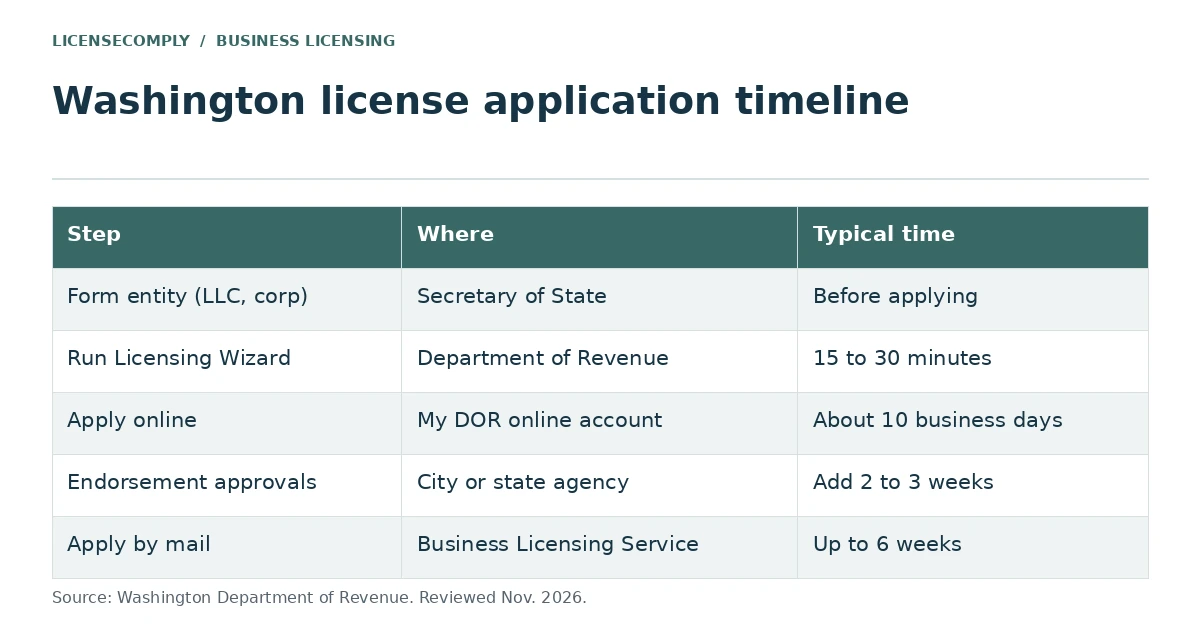
The Department of Revenue recommends starting with its Business Licensing Wizard, which generates a list of the agencies, endorsements and forms that apply to your business activity and location, according to the application instructions. From there you can apply in one of two ways:
- Online through My DOR, the department’s secure account system, which you will also use to file excise tax returns and update your business record.
- By mail, sending the Business License Application, any addenda and payment to Business Licensing Service, P.O. Box 9034, Olympia, WA 98507-9034, per the licensing FAQs.
The department estimates 15 to 30 minutes to complete the application. Online applications take approximately 10 business days to process, and city or state endorsements can add another 2 to 3 weeks for approval. Mailed applications can take up to six weeks, according to the application page.
Once processed, you receive your UBI number and license, and if you plan to hire, the Department of Labor and Industries and the Employment Security Department follow up about quarterly reports, per the FAQs.
How much does a Washington business license cost?
The state charges a non-refundable processing fee each time you submit a Business License Application, plus any endorsement or trade name fees. The current amounts are listed on the variable processing fees page:
| Filing purpose | Processing fee |
|---|---|
| Open a new business or reopen a business with no active locations | $50 |
| Add an additional location to an existing UBI | $0 |
| Add a city Non-Resident Business endorsement to an existing location | $0 |
| Any other purpose (hiring employees, adding a trade name or endorsement) | $10 |
| Annual renewal, per location | $5 |
The state tax registration itself carries no fee, and each trade name costs $5, per the tax registration endorsement page. Card payments made online carry a 2.96% service fee with a $1 minimum charged by the third-party processor, according to the department’s online application help.
City endorsements and local business licenses
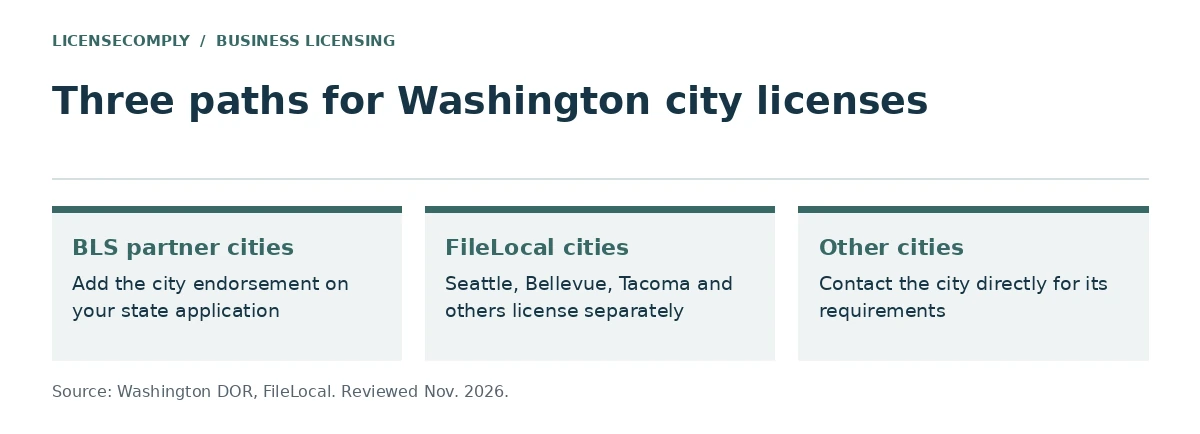
Washington cities with a general business license must issue it through one of two combined systems: the state’s BLS or the FileLocal portal, as described in the Department of Revenue’s report to the Legislature on local business licensing. Which one applies depends on where you operate.
Cities that partner with the Business Licensing Service
If your business is physically located in, or travels into, a partner city, you add that city’s endorsement on the same Business License Application. The department keeps a list of partner cities with each city’s rules and fees, and there are over 400 state and city endorsements available through the application, per the FAQs.
Fees vary by city. In Vancouver, for example, the city endorsement schedule charges $0 for businesses reporting up to $4,000 in gross annual income in the city, $53 for income above $4,000 through $53,000, and $347 plus $165 per calculated employee above $53,000.
FileLocal cities
Seattle, Bellevue, Tacoma, Everett and several other cities license businesses through FileLocal instead of BLS. The FileLocal platform FAQ lists Auburn, Bellevue, Des Moines, Everett, Kent, Lake Forest Park, Poulsbo, Renton, Seattle, Shoreline and Tacoma as participants, noting that general business licenses can be handled there for all of them except Auburn.
You still need your state license and UBI first. Seattle tells applicants to get a state UBI number before starting in FileLocal if the business is legally required to have one, and its business license tax certificate must be renewed by December 31 each year, per Seattle City Finance. Rules differ even within FileLocal: Bellevue charges a $119 registration fee in 2026 and its licenses do not need annual renewal, while Tacoma requires renewal payment by January 31 to avoid a late penalty.
County endorsements
Most counties do not license general businesses, but some do for unincorporated areas. The department currently lists Asotin County and Franklin County on its county endorsements page and directs businesses working in other unincorporated areas to contact the county directly.
Minimum thresholds for out-of-city businesses
State law requires every city with a general business license to adopt a model ordinance that includes “a uniform minimum licensing threshold” below which a business does not need the city’s general license. A city may set a higher threshold but not a lower one, under RCW 35.90.080. The same statute lets cities require a no-fee registration from businesses under the threshold.
The threshold was $2,000 from 2019 through 2025 and rose to $4,000 on January 1, 2026. Seattle’s rule, for example, exempts a person whose gross income in the city is $4,000 or less and who does not maintain a place of business there, according to Seattle Director’s Rule 5-002. Seattle notes that the exemption does not apply to regulatory licenses or activities that require a specialized permit.
The threshold applies to businesses without a location in the city, so a shop or office inside city limits generally needs the license regardless of revenue.
Registering a trade name
Washington requires anyone doing business under a trade name to register it with the Department of Revenue under RCW 19.80.010. That covers a sole proprietor or partnership using anything other than the owners’ full legal names, and an LLC, corporation or limited partnership operating under a name different from the one on file with the Secretary of State, per the trade name page.
You register a trade name through the Business License Application, paying $5 per name plus the processing fee. A business can register an unlimited number of trade names, and each stays registered until the owner cancels it, which is free. Registration does not protect the name from use by others, so the department points businesses to the Secretary of State or the U.S. Patent and Trademark Office for trademark protection.
Renewing a Washington business license
If your license includes a state or city endorsement handled by BLS, you renew annually. The expiration date is set when you apply and appears under the UBI number on your license, and BLS sends a courtesy reminder one month before expiration, according to the renewal FAQs. You can renew up to two months early, online through My DOR or by requesting a paper form.
Late renewals cost more. Under RCW 19.02.085, the delinquency fee is the lesser of $150 or 50% of the renewal fee base. The department may waive it only for an undisputable department error, or on request if you renewed all licenses on time for the preceding 24 months.
For a multi-state view of renewal cycles, see our business license renewal guide.
Rules for out-of-state businesses
An out-of-state business must register with the Department of Revenue, report B&O tax and collect applicable sales tax if, in the current or prior year, it has physical presence nexus in Washington, has more than $100,000 in combined gross receipts sourced or attributed to Washington, or is organized or commercially domiciled in Washington, per the department’s nexus guide. Registration happens through the same Business License Application.
Physical presence can come from an employee working in the state, inventory stored in Washington (including inventory held by a marketplace facilitator), owning or leasing property, or soliciting sales through representatives, according to the physical presence nexus page. Remote sellers who cross the $100,000 threshold must begin collecting sales tax on the first day of the month that starts at least 30 days after meeting it, per the remote sellers guidance.
Foreign LLCs and corporations that are transacting business in Washington also file a Foreign Registration Statement with the Secretary of State. The filing fee is $180, an expedited option costs $100 more, and you must attach a certificate of good standing from your home state issued within 60 days, according to the Secretary of State instructions. If you are structuring this as an LLC, our guide on getting a business license for an LLC covers the general sequence. Multi-location operators who want a full map of state and city requirements before filing can use our research and verification service.
Frequently asked questions
Do I need a Washington business license if I make less than $12,000?
Possibly not. Under WAC 458-20-101, you can skip state tax registration only if B&O and public utility income are each below $12,000 a year, you do not collect sales tax or owe any other Department of Revenue tax or fee, and you do not otherwise need a business license. Using a trade name, hiring employees, or needing a city endorsement all require a license regardless of income.
How much does it cost to get a Washington business license?
The Department of Revenue charges a non-refundable $50 processing fee to open a new business, plus fees for any endorsements and $5 for each trade name. Adding a new location to an existing UBI has no processing fee, and most other filings cost $10. City endorsement fees vary widely, so a business with several city endorsements will pay more than a sole proprietor with none.
Is a UBI number the same as a business license?
Not exactly. The UBI number is the nine-digit identifier assigned to your business, and it stays the same as long as the business exists. The business license is the document that lists your active endorsements and their expiration dates. Washington agencies use the UBI to link your tax account, endorsements, Secretary of State filing and employer accounts.
Does a Seattle business need a separate city license?
Yes. Seattle does not issue its license through the state Business Licensing Service. Businesses doing business in Seattle need a Seattle business license tax certificate, applied for through FileLocal or by mail, and renewed by December 31 each year. Since 2026, businesses without a Seattle location that gross $4,000 or less in the city are exempt from the general license.
How long does it take to get a Washington business license?
Online applications take about 10 business days to process, according to the Department of Revenue. If your application includes city or state endorsements that need approval, add another 2 to 3 weeks. Mailed applications can take up to six weeks. Some licenses must be posted before you open to the public, so build that time into your launch plan.
Licensing in Washington across several cities?
LicenseComply researches the state and city endorsements your Washington locations need and prepares and files the applications for you.
Explore License & Permit Filing Talk to a licensing specialist
Official sources and further reading
- Washington Department of Revenue: Apply for a business license
- Washington Department of Revenue: Business licensing and renewals FAQs
- Washington Department of Revenue: Variable business license processing fees
- Washington Department of Revenue: City endorsements
- Washington Department of Revenue: Register trade names
- Washington Department of Revenue: Out-of-state businesses reporting thresholds and nexus
- WAC 458-20-101: Tax registration and tax reporting
- RCW 35.90.080: Model ordinance and minimum licensing threshold
- RCW 19.02.085: Business license delinquency fee
- RCW 19.80.010: Trade name registration
- Washington Secretary of State: Register a foreign LLC
- Seattle City Finance: Business licenses
- FileLocal platform FAQ
Disclaimer: LicenseComply provides professional business licensing and compliance services. However, the informational content on this site (including articles, guides, tools, and videos) is provided for general educational purposes only and does not constitute legal, tax, or accounting advice. Laws and regulations change frequently, and we cannot guarantee that all information is accurate, complete, or up to date for your specific circumstances. Your use of this website and its content does not create an attorney-client, accountant-client, or other advisory relationship. You should consult with a qualified attorney, accountant, or other appropriate professional for advice tailored to your business.