
Key points
- Forming a limited liability company creates a legal entity but does not by itself license the business to operate, so most LLCs still need at least one state, county, city or industry license.
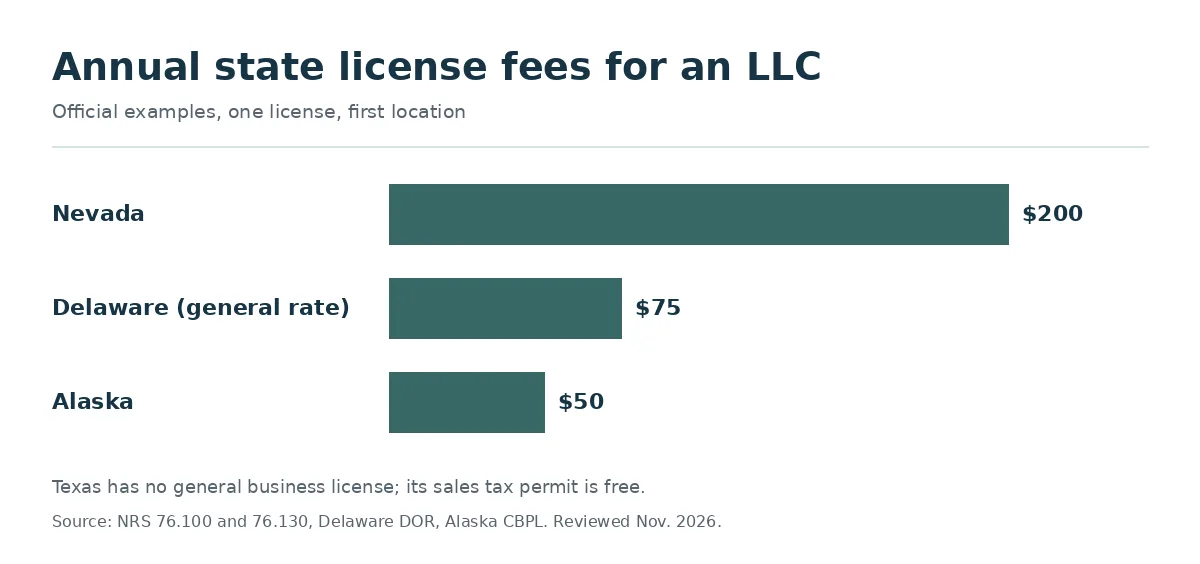
- Nevada requires a state business license for LLCs, issued with the initial or annual list, with a $200 fee at application and a $200 renewal fee each year under Nevada Revised Statutes 76.100 and 76.130.
- Texas does not require a general business license, but its sales tax permit is required for each active place of business, and an ownership change, including a sole proprietor forming an LLC, requires a new permit.
- An LLC that transacts business in another state usually must register there as a foreign entity, and Texas charges $750 to register a foreign LLC plus a $750 late fee for each year of delinquency after 90 days.

Does an LLC need a business license? In most cases, yes. Forming a limited liability company (LLC) creates the business entity, but it does not license the business to operate, so most LLCs still need at least one license or registration from the state, county or city where they work, plus any license tied to their industry.
So the real answer to does an LLC need a business license depends on where your LLC operates and what it does, not on its business structure. A marketing consulting LLC in Texas may need only its state formation and tax registrations, while the same LLC in Nevada needs a state business license and, often, a local business license too.
This guide is for owners who have already formed an LLC and want to know what comes next. LLC formation gives owners a legal structure that protects them “from personal liability in most instances,” according to the U.S. Small Business Administration (SBA) business structure guide, but it does not replace the required licenses that let the business operate legally. If you are still sorting out how an LLC differs from a license, start with our explainer on whether an LLC and a business license are the same thing. Fees and rules below come from official sources reviewed November 2026, and requirements change, so confirm each one with the issuing agency.
Does an LLC need a business license in every state?
No single rule covers every state, and licensing requirements come from many different government agencies. The SBA says the licenses and permits you need from the state, county or city “will depend on your business activities and business location,” and that an LLC “might need to file for licenses and permits from the county or city,” according to its licenses and permits guide.
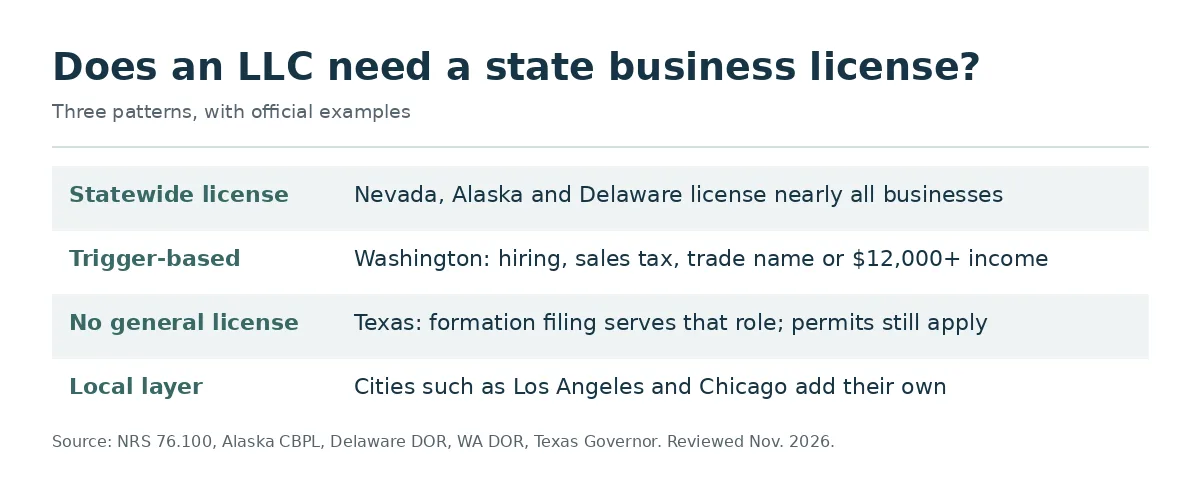
States generally fall into three patterns.
States with a statewide business license
Some states require nearly every business, including LLCs, to hold a state business license:
- Nevada: under Nevada Revised Statutes (NRS) 76.100, a person “shall not conduct a business in this State” without a state business license, and an LLC obtains it when filing its initial or annual list with the Secretary of State.
- Alaska: a business license “is required for the privilege of engaging in a business in the State of Alaska,” per the Alaska Division of Corporations, Business and Professional Licensing.
- Delaware: any person or entity conducting a trade or business in the state must obtain a Delaware business license from the Delaware Division of Revenue.
States where a license depends on triggers
Washington requires a state business license when certain conditions apply, such as hiring employees within 90 days, collecting sales tax, using a name other than your legal name, or earning $12,000 or more a year, per the Washington Department of Revenue. The department also notes that a Washington LLC must file with the Secretary of State before submitting the Business License Application.
States with no general business license
The State of Texas “does not require a general license,” according to the Texas Governor’s Business Permit Office. The certificate of formation from the Texas Secretary of State serves as the general business license requirement that exists in other states, but specific industries still need specific licenses, and local rules still apply.
What licenses does an LLC business typically need?
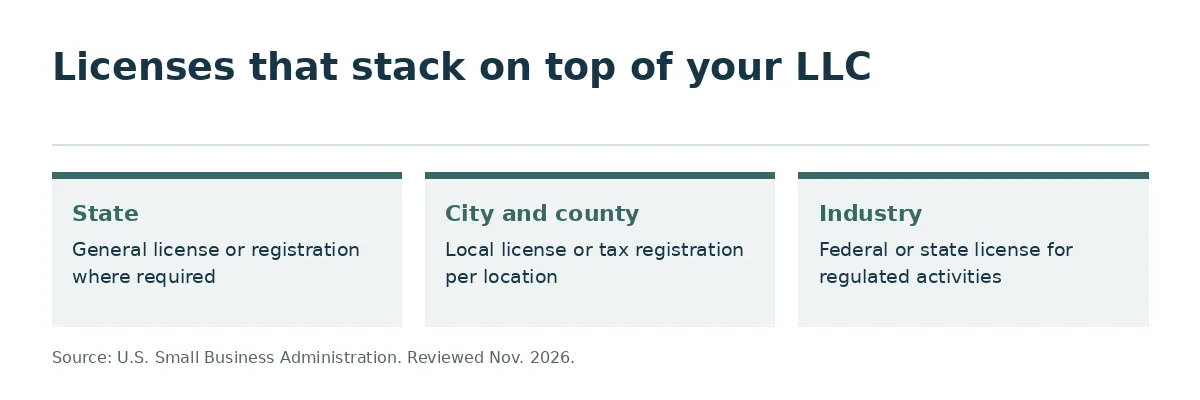
Most businesses, LLCs included, need a combination of licenses from different levels of government, and the mix depends on business type and physical location.
State business license or registration
Where a state has a general license, it usually applies to LLCs as soon as they start doing business. Nevada’s statute says the state license “is in addition to any license to conduct business that must be obtained from the local jurisdiction” (NRS 76.100).
City and county licenses
Many cities require businesses inside their limits to hold a local license or a business tax certificate. The City of Los Angeles requires all individuals or entities conducting business activities in the city to obtain a Business Tax Registration Certificate, per the Los Angeles Office of Finance. In unincorporated areas, the county government often handles local licenses instead; our guide to county business licenses explains when that happens.
Industry, occupational and professional licenses
Regulated activities need their own licenses regardless of entity type. That can mean an occupational license or other professional licenses held by individuals, such as a contractor license, as well as permits for food service, alcohol and similar activities. The SBA lists activities regulated by federal agencies, such as alcohol, firearms, aviation and commercial fishing, and notes that states regulate a broader range, including construction, plumbing, restaurants and retail.
Tax registrations
A sales tax permit (called a seller’s permit in some states) is not a business license, but an LLC that will sell products usually needs one before it can collect and pay sales tax. In Texas, “There is no fee for the permit, but you may be required to post a security bond,” according to the Texas Comptroller’s sales and use tax FAQs.
How to get a business license for an LLC
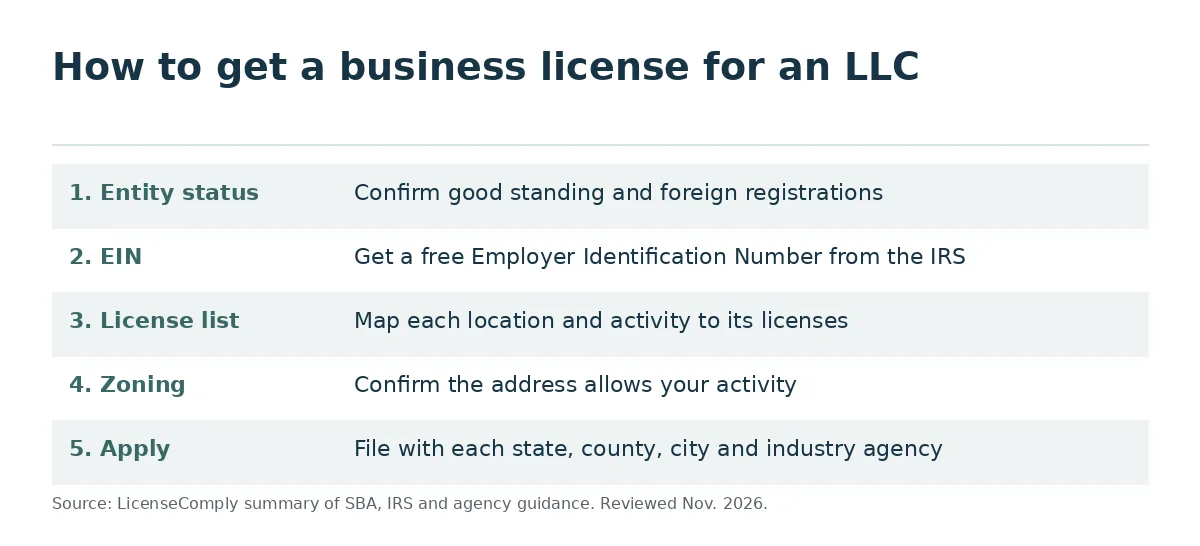
The process is similar everywhere, though forms and agencies differ.
Step 1: Confirm the LLC is active and registered where it operates
Check that your LLC is in good standing in its home state and registered in every other state where it does business. Several license applications ask for the entity number: Alaska says an entity “must provide your Alaska Entity Number on your business license application,” per its business licensing FAQs.
Step 2: Get an Employer Identification Number
Most LLC license applications ask for a federal Employer Identification Number (EIN), along with the legal business name, business type and start date. Los Angeles, for example, requires an EIN for an LLC on its registration checklist. The Internal Revenue Service (IRS) issues EINs free online through the IRS website, and “You never have to pay a fee for an EIN,” per the IRS.
Step 3: List every license by location and activity
Map each business address and each activity to the state, county, city and industry licenses it needs, including any professional certifications your team must hold. The Texas Governor’s office points owners to its 2026 to 2027 Texas Business Licenses and Permits Guide for state permits and to local county and city governments for local requirements.
Step 4: Check zoning and location rules
Before signing a lease or opening a home office, confirm the location is allowed for your activity under local zoning, and ask whether construction work will need a building permit. The SBA notes that local governments determine registration, licensing and permitting requirements, so check the city or county website for the address you plan to use.
Step 5: Apply with each agency
Submit each application to the agency that issues it, usually online. Licenses often post quickly: Alaska says new or renewing licenses filed online “post immediately” in its license search, per the Alaska business licensing page. Los Angeles issues a temporary certificate after an online application, and the permanent certificate should arrive by mail within four weeks, per the City of Los Angeles.
How much does an LLC business license cost?
Fees range from nothing to several hundred dollars per license, and they stack.
| License | LLC fee | Renewal | Official source |
|---|---|---|---|
| Nevada state business license | $200 | $200 each year with the annual list | NRS 76.100 and 76.130 |
| Alaska business license | $50 per year | Expires December 31 | Alaska licensing FAQs |
| Delaware business license | Generally $75 for a first location | Annual, with a three-year option | Delaware Division of Revenue |
| Texas sales tax permit | No fee (bond may apply) | Not stated | Texas Comptroller |
| IRS EIN | Free | Not applicable | IRS |
A few details matter for LLCs. In Nevada, the $500 application fee applies to certain corporations, while an LLC pays $200 under NRS 76.100. Alaska offers a $25 discounted fee to qualifying sole proprietors, but the discount “is NOT AVAILABLE to partnerships, corporations, LLCs,” even when the principal owner qualifies, per the Alaska FAQs. Delaware requires a separate license for each separate business activity, so a multi-activity LLC can pay more than one fee.
Is there a California business license for an LLC?
California has no single statewide general business license. The California Secretary of State “does not issue licenses or permits for business entities,” and once an LLC is formed or registered, “the entity must obtain the necessary licenses and/or permits,” per the Secretary of State FAQs. It points owners to CalGold, a state directory of permit requirements that, per CalGold, does not issue permits or licenses itself.
The general license comes from local government. “Most local governments require a business license,” obtained from the city in an incorporated area or from the county in an unincorporated area, according to the California Office of the Small Business Advocate. In San Francisco, every person engaging in business must register with the Treasurer and Tax Collector within 30 days of starting business and renew every year by the end of February, per SF.gov.
Two state registrations often apply to California LLCs as well:
- Seller’s permit: an LLC engaged in business in California that intends to sell or lease tangible personal property ordinarily subject to sales tax must obtain one, and there is no fee, though a security deposit may be required, per the California Department of Tax and Fee Administration.
- Annual LLC tax: this is a tax, not a license, but “Every LLC that is doing business or organized in California must pay an annual tax of $800,” due until the LLC is canceled, according to the Franchise Tax Board.
For reference, filing Articles of Organization (Form LLC-1) to form a California LLC costs $70, per the Secretary of State fee table.
What changes when your LLC operates in several states or cities?
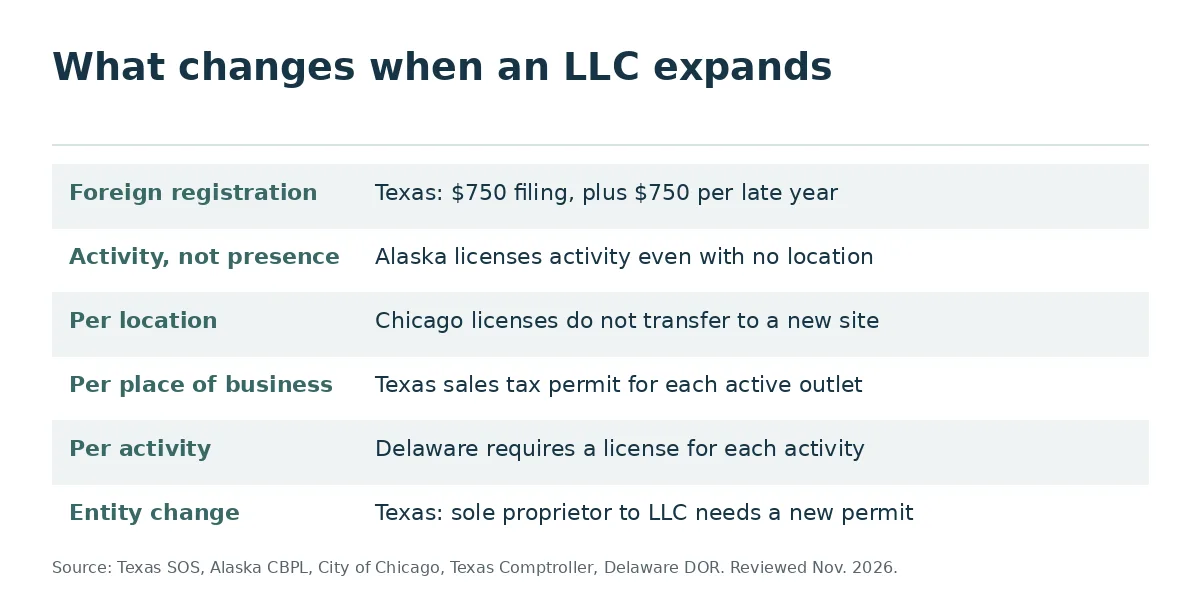
Expanding into other states or multiple cities multiplies the work, because you answer does an LLC need a business license separately for each state and city where it operates.
Foreign registration comes first
An LLC formed in one state usually must register as a foreign entity in each other state where it transacts business. The SBA says an LLC will “probably need to register with any state where you conduct business activities” (SBA). In Texas, the filing fee for a foreign LLC registration is $750, and an LLC that transacted business for more than 90 days before registering faces a $750 late filing fee for each year of delinquency, per the Texas Secretary of State. An unregistered entity also may not maintain a lawsuit in a Texas court until it registers.
Activity can trigger a license without a location
Alaska bases its requirement on business activity, not physical presence, which matters for an online business serving customers there, and expects a license if any portion of the activity occurs in the state, per the Alaska FAQs. Alaska also requires a separate license for each different name a business operates and advertises under.
Each location may need its own license
In Chicago, business licenses “are issued for a specific location and are not transferrable,” so every distinct location needs a new license, according to the City of Chicago. Texas requires a sales tax permit for each active place of business, with separate outlet numbers under one taxpayer number (Texas Comptroller).
Converting to an LLC can reset permits
If you ran the business as a sole proprietor and then formed an LLC, the Texas Comptroller treats that as a change of ownership, so the LLC needs a new sales tax permit and the old one should be closed (Texas Comptroller).
For the order in which to handle entity, tax and license filings in a new state, see our guide to the registration sequence when opening in a new state. Operators handling many locations at once sometimes hand the filings to an outside provider such as our license and permit filing service.
How do you keep an LLC business license current?
Most licenses expire, and renewal schedules vary by agency.
- Nevada: an LLC renews its state business license at the time it submits its annual list, with a $200 fee, under NRS 76.130.
- Delaware: most licenses are good for one year and expire each December 31, and after the first year a business may buy a three-year license at three times the annual fee, per the Delaware business license FAQs.
- Alaska: licenses expire on December 31 of the licensing period purchased, one or two years (Alaska FAQs).
The SBA advises owners to keep close track of renewal dates because “it’s often easier to renew than it is to apply for a new one.” Our business license renewal guide covers late fees and reminders in more detail.
Frequently asked questions
Does a single-member LLC need a business license?
Usually, yes. Licensing rules depend on location and activity, not on how many members an LLC has, so a single-member LLC follows the same rules as a multi-member one. Alaska’s $25 discounted license fee for qualifying sole proprietors, for example, is not available to LLCs, even with one owner. Check state, county and city requirements for each place you operate.
Is an LLC business license the same in every state?
No. Nevada, Alaska and Delaware require a statewide business license for LLCs doing business there, Washington requires one when certain triggers apply, and Texas has no general business license at all. Cities, counties and regulated industries add their own requirements on top.
Can one business license for an LLC cover all states?
No. There is no national general business license, so each state, county and city issues its own. An LLC operating in several states typically registers as a foreign entity in each one and then obtains the licenses each jurisdiction requires. Some licenses are tied to a single location, such as Chicago business licenses and Texas sales tax permits, so multiple sites can mean multiple licenses even inside one state.
Do I need a new license if I convert my sole proprietorship to an LLC?
Often, yes, because the LLC is a different legal owner from the sole proprietor. The Texas Comptroller treats forming an LLC as a change of ownership that requires a new sales tax permit. Review every license, permit and registration held in your own name before the LLC starts operating.
How long does it take to get a business license for an LLC?
It ranges from minutes to weeks. Alaska says licenses filed online post immediately in its license search, and Los Angeles issues a temporary Business Tax Registration Certificate online, with the permanent certificate arriving by mail within about four weeks. Licenses that involve inspections or exams usually take longer, so apply early.
Formed your LLC and unsure what licenses come next?
LicenseComply researches the state, county, city and industry licenses your LLC needs in each location and prepares and files the applications for you.
Explore Research & Verification Talk to a licensing specialist
Official sources and further reading
- U.S. Small Business Administration: Apply for licenses and permits
- Nevada Revised Statutes Chapter 76: State business licenses
- Alaska Division of Corporations, Business and Professional Licensing: Business licensing FAQs
- Alaska Division of Corporations, Business and Professional Licensing: Business licensing
- Delaware Division of Revenue: Requirements for Delaware businesses
- Delaware Division of Revenue: Business licenses FAQs
- Washington Department of Revenue: Apply for a business license
- Office of the Texas Governor: Business Permit Office
- Texas Comptroller: Sales tax permit FAQs
- Texas Secretary of State: Foreign LLC registration instructions (Form 304)
- Los Angeles Office of Finance: How to register for a Business Tax Registration Certificate
- City of Los Angeles: Business Tax Registration Certificate
- City of Chicago: Update your business license information
- U.S. Small Business Administration: Choose a business structure
- California Secretary of State: Business entities FAQs
- California Secretary of State: California LLC forms and fees
- CalGold business permit information
- California Office of the Small Business Advocate: Set up your business in California
- California Department of Tax and Fee Administration: Obtaining a seller’s permit
- California Franchise Tax Board: Limited liability company
- San Francisco: Learn about business registration
- Internal Revenue Service: Get an employer identification number
Disclaimer: LicenseComply provides professional business licensing and compliance services. However, the informational content on this site (including articles, guides, tools, and videos) is provided for general educational purposes only and does not constitute legal, tax, or accounting advice. Laws and regulations change frequently, and we cannot guarantee that all information is accurate, complete, or up to date for your specific circumstances. Your use of this website and its content does not create an attorney-client, accountant-client, or other advisory relationship. You should consult with a qualified attorney, accountant, or other appropriate professional for advice tailored to your business.