
Key points
- Most business licenses and state tax permits cannot be transferred to a new owner, so the buyer usually applies for its own license under its own legal entity.
- The Texas Comptroller states that a sales tax permit is valid only for the person to whom it was issued and cannot be transferred from one owner to another.
- In New York, a buyer must file Form AU-196.10 at least 10 days before paying for or taking possession of business assets to avoid liability for the seller’s unpaid sales tax.
- After a change in proprietorship, an alcohol importer or wholesaler must file a new federal basic permit application with TTB within 30 days or stop regulated operations.

In most cases you cannot transfer a business license to a new owner. Licenses and tax permits are issued to a specific legal entity, at a specific location, sometimes with named owners or qualifiers, so a sale, a new entity or a move usually means a new application, an amendment or an advance notice. A few local licenses can be transferred or reassigned when ownership stays substantially the same, but that is the exception.
The question comes up in more than straight sales. Converting a sole proprietorship to a limited liability company (LLC), merging corporations, changing partners and relocating can all change what an agency has on file, and some changes must be reported before they happen.
This guide uses official federal, state and city rules (reviewed November 2026) to show how these changes affect tax IDs, tax permits, local licenses and regulated licenses. Rules vary, so confirm requirements with each issuing agency before closing.
Why licenses usually do not transfer to a new owner
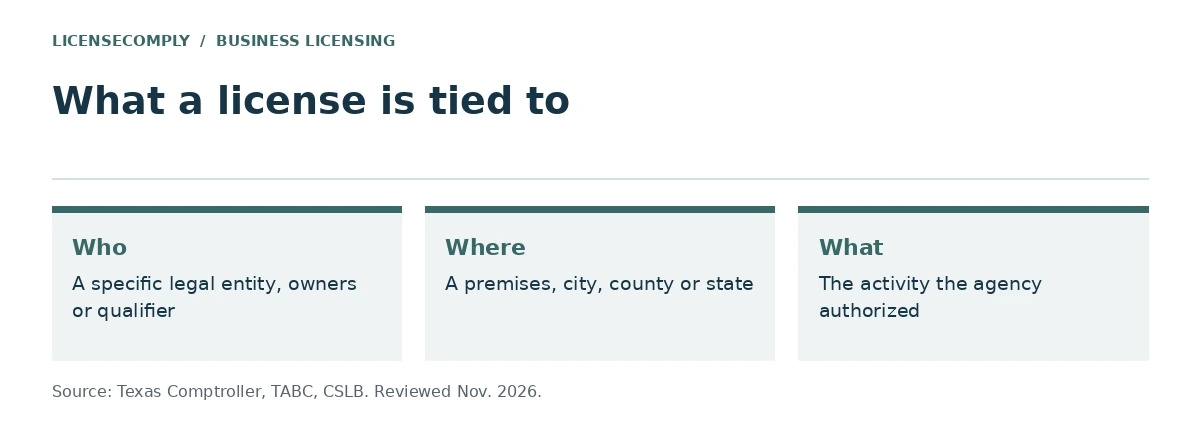
Nearly every license answers three questions: who holds it, where it applies and what activity it authorizes. A name change usually updates only the record. An asset purchase almost always creates a new holder, because the buyer is a different legal person. A relocation changes where.
Agencies say this directly. The Texas Comptroller states that a sales tax permit “is valid only for the person to whom it was issued and only for the business at the address shown on the permit” and “cannot be transferred from one owner to another” (Texas Comptroller sales tax permit FAQ). The Texas Alcoholic Beverage Commission (TABC) says that when ownership of a business changes hands, the new owner must apply for its own license or permit (TABC FAQs). California’s Contractors State License Board (CSLB) explains that licenses are associated with a business entity, not necessarily the qualifier, so they are not transferable from one business to another even when the qualifying individual is the same (CSLB change in business entity).
A buyer should plan to hold its own licenses on day one. Before signing, pull the seller’s actual records from each agency (see our business license lookup guide) so the inventory reflects what is on file.
Does a change of ownership require a new EIN?
The Employer Identification Number (EIN) is a useful first test, because many state tax accounts and license applications are keyed to it. The Internal Revenue Service (IRS) says businesses generally need a new EIN when ownership or structure changes, not when only the name or location changes (IRS: When to get a new EIN).
| Entity type | New EIN needed when you | No new EIN needed when you |
|---|---|---|
| Sole proprietor | Incorporate, form a partnership or declare bankruptcy | Change the business name or locations |
| Corporation | Get a new state charter, become a subsidiary, change to a partnership or sole proprietorship, or merge and create a new corporation | Change name or location, are the surviving corporation in a merger, elect S corporation status, or convert at the state level without changing structure |
| Partnership | Incorporate, have one owner take over as a sole proprietor, or end one partnership and begin another | Change name or location, or have an ownership change that does not terminate the partnership |
| LLC | Terminate the LLC and form a new corporation or partnership | Change name or location, convert a partnership to an LLC classified as a partnership, or change tax election |
A new EIN strongly signals that state tax accounts and licenses need to be reissued. Keeping the same EIN, though, does not mean a license can stay as it is. To confirm which number a target uses, see how to find a business tax ID number.
How state sales tax permits handle a new owner
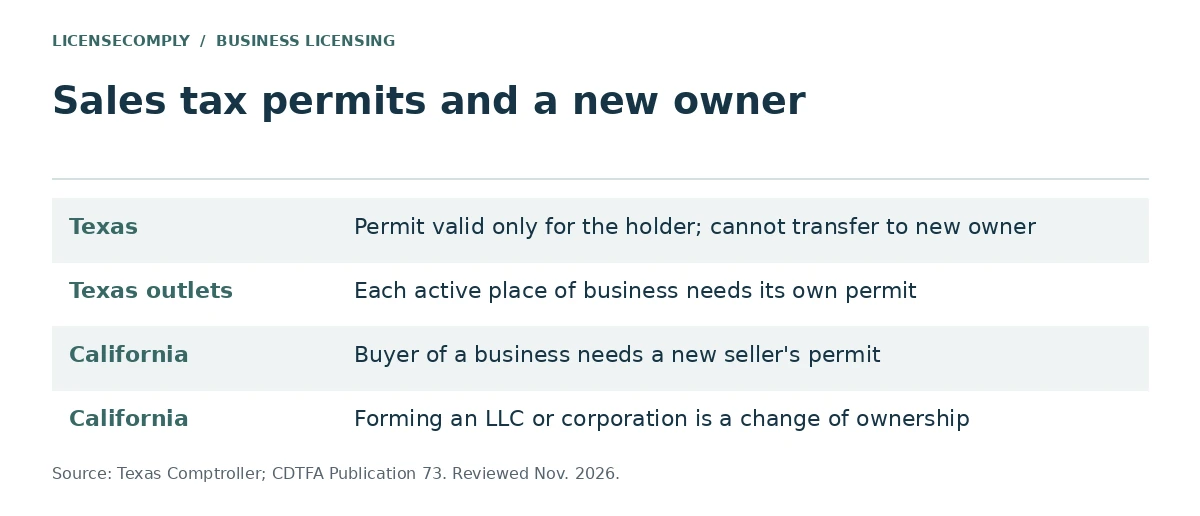
Sales tax permits belong to the legal entity that obtained them. In Texas, each new business, whether a corporation, partnership or sole proprietor, must apply for its own permit, and “the permit cannot be transferred from one business to another” (Texas Comptroller buying or selling a business FAQ). Texas also requires a permit for each active place of business, issued under one taxpayer number with separate outlet numbers, so a relocation is a location update, not just a mailing address change (Texas Comptroller permit FAQ). Address and location changes are handled through the Comptroller’s online account tools.
California takes the same position. The California Department of Tax and Fee Administration (CDTFA) says a buyer of another business needs a new seller’s permit to show it as the current owner, and that incorporating a business or forming a partnership or LLC is itself a change of ownership that must be reported directly to CDTFA (CDTFA Publication 73). A newspaper notice or report to another agency does not count.
For a multi-location retailer, one acquisition can mean new permits in every state where the seller collected tax, plus closing the seller’s accounts.
What buyers must do about the seller’s unpaid taxes
Asset buyers can inherit more than inventory. Several states make a buyer liable for the seller’s unpaid sales taxes unless the buyer follows a clearance or notice procedure, and the timing differs enough to affect a closing date.
| State | What the buyer does | Timing | If skipped |
|---|---|---|---|
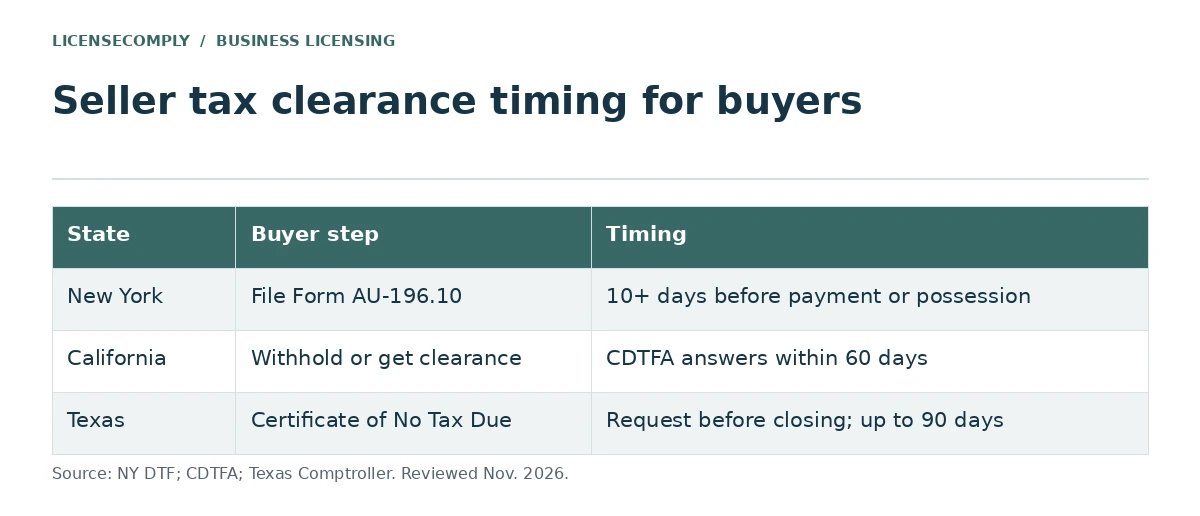
| New York | Files Form AU-196.10 to notify the Tax Department of a bulk sale | At least 10 days before paying for or taking possession of assets, whichever is first | Buyer may be liable for the seller’s unpaid sales and use taxes |
| California | Withholds from the purchase price or obtains a clearance certificate | CDTFA responds within 60 days of the latest of the request, sale date or records availability | Buyer is personally liable up to the purchase price |
| Texas | Withholds or obtains a Certificate of No Tax Due | Request before the sale closes | Buyer is liable up to the purchase price, including assumed debt |
Sources: New York bulk sales guidance, California Revenue and Taxation Code section 6812 and Texas Comptroller: Buying an Existing Business.
New York is the most time-sensitive. Send the notice by registered mail, certified mail with return receipt, or hand delivery, since other methods are not effective until received. Within five business days the department issues a release or a notice of claim, and a buyer with a notice of claim should not pay the seller until the review ends (New York Department of Taxation and Finance).
In Texas, seller and buyer jointly submit Form 86-114, with no charge. The certificate usually arrives within 10 business days, but an audit can stretch processing to 90 days (Texas Comptroller). The Comptroller advises requesting one even when buying only inventory or the name and goodwill (Texas Comptroller buying or selling FAQ).
Can a local business license be transferred to a new owner?
City and county licenses vary the most, and a few allow limited transfers.
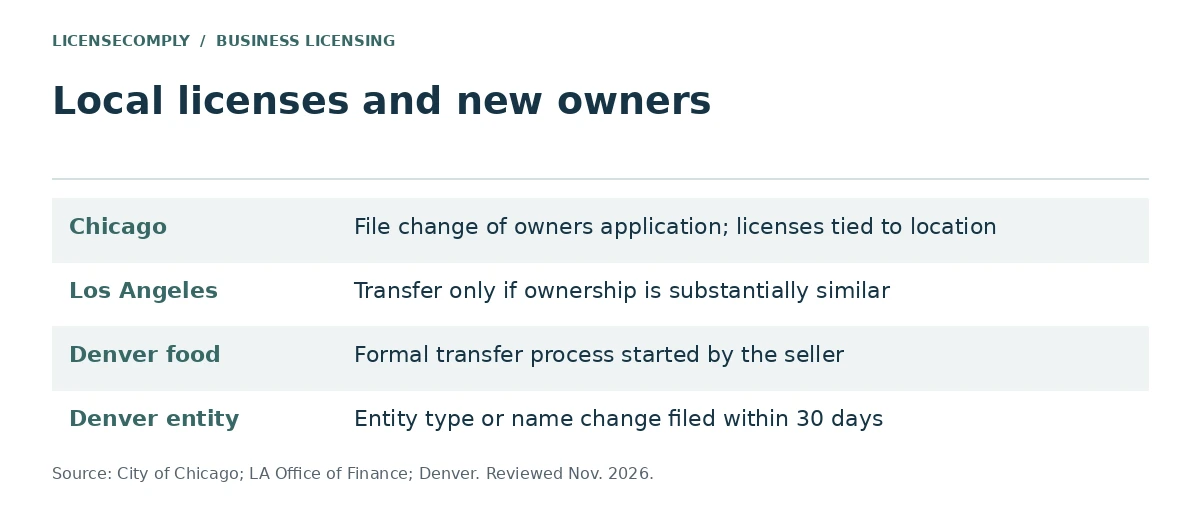
- Chicago: business licenses are issued for a specific location and are not transferable to a new location. A buyer files a change of owners or officers application upon purchase ($100, or $250 with a fingerprint-based background check), and the city warns that skipping a good standing check can leave a buyer responsible for the seller’s obligations (City of Chicago business licensing).
- Los Angeles: under Los Angeles Municipal Code section 21.11, a Business Tax Registration Certificate may be transferred only when ownership after the transfer is substantially similar to ownership before it. When ownership changes substantially, such as by sale, the new owner applies for a new certificate. A move within the city results in an amended certificate after you notify the Office of Finance (Los Angeles Office of Finance tax information booklet).
- Denver: retail food licenses have a defined transfer of ownership process that the seller starts online and the buyer completes, while a change in the legal entity type or true name of the license holder must be filed within 30 days (Denver retail food transfer of ownership).
Even where a transfer process exists, it is a filing with its own fees and review, not an automatic handoff.
How regulated licenses handle ownership and structure changes
Regulated licenses have the most specific rules, and several deadlines fall before the change.
Federal alcohol permits
For alcohol importers and wholesalers, the Alcohol and Tobacco Tax and Trade Bureau (TTB) lets a successor keep operating after a change in proprietorship if it files a new basic permit application within 30 days. The prior owner’s permit then stays in effect until TTB acts. A change in control also requires a new application within 30 days, or the existing permit terminates automatically. If the application is late, regulated operations must stop until TTB approves it (TTB changes in proprietorship and control). TTB notes that a change of entity type, such as sole proprietor to LLC, is a change in proprietorship.
State alcohol licenses: Texas
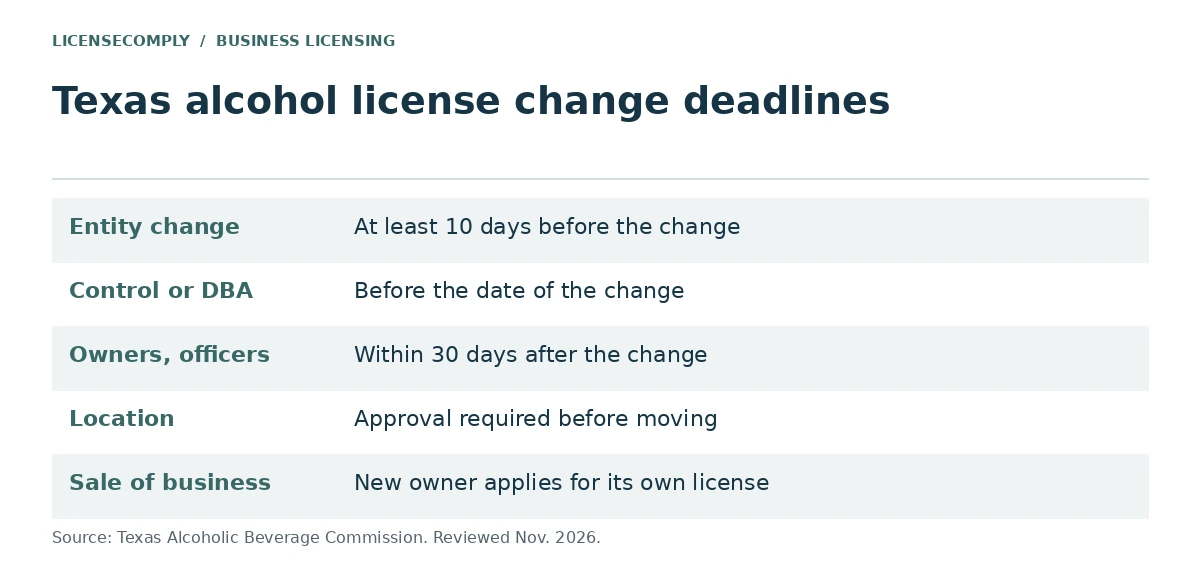
TABC sets different timing for different changes (TABC: Manage and Report Changes):
- Change of organization (altering the form of the business entity): report no less than 10 days before the change.
- Corporate control and trade name (DBA, or doing business as) changes: report before the change.
- Ownership or principal party changes, such as adding or removing officers or changing stock or memberships: notify within 30 days after.
- Change of location: apply and receive approval before moving. A beer license can move only within its original county, while a liquor permit can move elsewhere in Texas (TABC FAQs).
A corporate Mixed Beverage permit cannot be renewed if more than 50% of the stock has changed hands since the permit was issued. Death, bankruptcy, receivership and partnership dissolution follow a separate successor in interest process that lets the business operate for the unexpired term (TABC successor in interest). In Washington, a new business license application is required when buying a business that holds a liquor license, or when a licensed sole proprietorship forms a corporation or LLC (Washington State Liquor and Cannabis Board).
Contractor licenses: California
CSLB requires a new license whenever the business entity changes, and license changes must be reported within 90 days. If a corporation dissolves, merges or surrenders its right to do business in California, the license must be canceled, with limited reassignment for certain parent and subsidiary mergers (CSLB change in business entity). An entity change also blocks renewal of the old license (CSLB renewal information).
Hemp licenses: Minnesota
Minnesota hemp business licenses cannot be transferred under Minnesota Statutes section 342.44, but a conditional surrender lets the old license end only when the new entity’s license is issued (Minnesota Office of Cannabis Management).
What about name changes and new DBAs?
A name change does not create a new owner, but it changes the record that every other license depends on. In Texas, a legal name change is a certificate of amendment (Form 424), while operating under another name requires an assumed name certificate, $25 at the Secretary of State for corporations and LLCs (Texas Secretary of State name filings FAQ). Florida charges $50 for a fictitious name and requires a newspaper advertisement in the county of the principal place of business (Florida Division of Corporations). Each new name must then be updated with tax agencies and licensing boards.
A change of ownership checklist
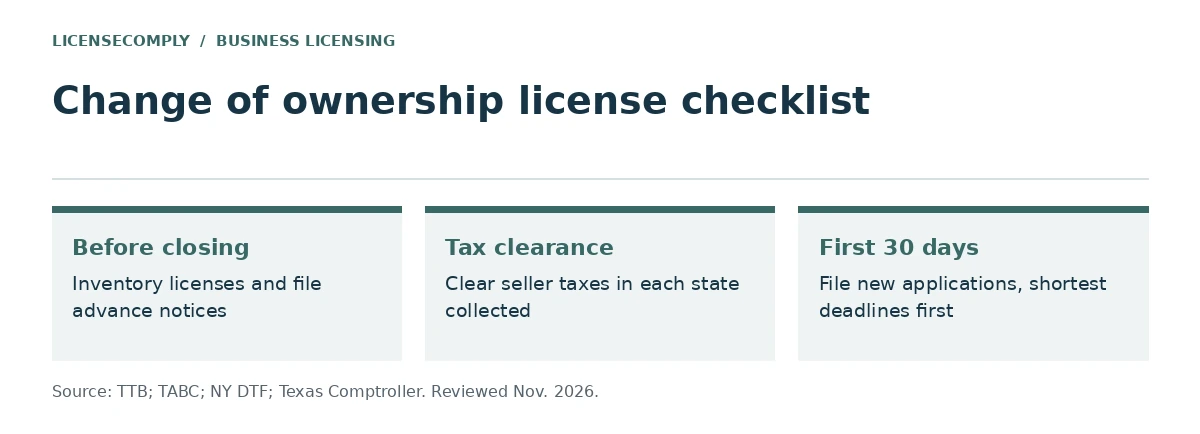
Before closing:
- Inventory every license, permit and registration by entity, location, jurisdiction and named individual.
- Classify each as transfers, notify, amend or reapply under that agency’s rules.
- Flag changes that must be reported or approved in advance, such as TABC entity, control, trade name and location changes.
- Request tax clearance or file bulk sale notices in each state where the seller collected tax.
- Ask agencies about successor, reassignment or conditional surrender options, as Minnesota and TABC offer.
First 30 days after closing:
- File the shortest deadlines first, including federal permit applications due within 30 days.
- Submit new license applications where reapplication is required and track any interim authority.
- Confirm bonds and insurance name the correct legal entity, and update DBAs and notice addresses.
- Close the seller’s accounts and add every new renewal date to one calendar (see our business license renewal guide).
Frequently asked questions
Can I transfer a business license to a new owner?
Usually not. Most business licenses and state tax permits are issued to a specific legal entity and cannot be transferred, so the buyer applies for its own. A few local licenses allow limited transfers, such as Los Angeles business tax certificates when ownership stays substantially similar, or Denver retail food licenses through a formal transfer process. Confirm with each issuing agency before closing.
Does converting my sole proprietorship to an LLC count as a change of ownership?
Often yes. The IRS requires a new EIN when a sole proprietor incorporates, CDTFA treats forming an LLC as a change of ownership that must be reported, and TTB treats a change of entity type as a change in proprietorship. California contractors need a new license when the entity changes. Even though the same person owns the business, the license holder is now a different legal entity in the agency’s eyes.
Do I need a new license if I buy a business at the same location?
In most cases, yes, because the owner is different even if the address is not. The Texas Comptroller says a business whose prior permit was canceled must reapply even at the same location, and TABC requires new owners to obtain their own license. Plan for new applications and any required inspections before you take over operations.
Can I be liable for the previous owner’s taxes?
Yes, in many states. New York, California and Texas can hold a buyer responsible for the seller’s unpaid sales taxes if the buyer skips the notice, withholding or clearance steps. New York requires notice at least 10 days before payment or possession, and Texas requires the Certificate of No Tax Due request before closing. Chicago also warns that buyers can become responsible for a seller’s city obligations.
Does a merger affect my licenses?
It depends on which entity survives. The IRS says a surviving corporation keeps its EIN, but licenses held by the disappearing entity may need to be canceled and reissued. CSLB cancels a California contractor license when the corporation merges, with limited reassignment for certain parent and subsidiary mergers. Review each license held by both companies before the merger is filed.
Buying, merging or restructuring a business?
LicenseComply can research the licenses and registrations tied to a business and file the new applications and updates each agency requires after a change.
Explore Research & Verification Talk to a licensing specialist
Official sources and further reading
- IRS: When to get a new EIN
- Texas Comptroller: Sales tax permit FAQ
- Texas Comptroller: Buying an Existing Business
- CDTFA Publication 73: Your California Seller’s Permit
- California Revenue and Taxation Code section 6812
- New York Department of Taxation and Finance: Bulk Sales
- City of Chicago: Update Your Business License Information
- Los Angeles Office of Finance: Tax Information Booklet
- Denver: Transfer of Ownership for a Retail Food License
- TTB: Changes in Proprietorship and Changes in Control
- TABC: Manage and Report Changes to an Existing License
- CSLB: Change in Business Entity
- Minnesota Office of Cannabis Management: Federal Hemp Changes
- Texas Secretary of State: Name Filings FAQs
Disclaimer: LicenseComply provides professional business licensing and compliance services. However, the informational content on this site (including articles, guides, tools, and videos) is provided for general educational purposes only and does not constitute legal, tax, or accounting advice. Laws and regulations change frequently, and we cannot guarantee that all information is accurate, complete, or up to date for your specific circumstances. Your use of this website and its content does not create an attorney-client, accountant-client, or other advisory relationship. You should consult with a qualified attorney, accountant, or other appropriate professional for advice tailored to your business.