
Key points
- There is no single home-based business license; most home businesses need some mix of a local home occupation permit, a state or city business license, a sales tax permit, a DBA filing and an EIN.
- A home occupation permit is a zoning approval from a city or county that lets you run a business from a residence, usually with limits on employees, customer visits, signs and retail sales.
- Home occupation permit fees vary widely, for example $55 in Durham, North Carolina, $120 in Colorado Springs, and $223 for a two-year permit in Portland, Oregon.
- Florida and, under a 2026 law, North Carolina limit how cities can regulate qualifying home-based businesses, but neither state law overrides HOA covenants or deed restrictions.

There is no single “home-based business license.” Most people who run a business from home need a combination of approvals: a home occupation permit or zoning clearance from their city or county, a general business license where the state or city requires one, a sales tax permit if they sell taxable goods, a DBA (doing business as) filing if they use a trade name, and sometimes an EIN (Employer Identification Number) from the IRS.
Which of those apply depends on your address and your activity. A freelancer working alone at a laptop may need little more than a city registration, while a home baker with customer pickups may face zoning limits, health rules and sales tax at once.
This guide covers each layer with official state and city examples, reviewed November 2026. Rules vary by location and change over time, so confirm current requirements with the agency that issues each approval.
What licenses does a home-based business need?
Each layer is a separate question answered by a different agency.
| Layer | What it covers | Who usually issues it |
|---|---|---|
| Home occupation permit | Permission to use a residence for business under local zoning | City or county planning or zoning office |
| General business license | Permission to do business in the state or city at all | Some states, many cities and counties |
| Sales tax permit | Authority to collect and remit sales tax on taxable sales | State revenue agency |
| DBA or assumed name | Public record of a trade name that differs from your legal name | County clerk or a state office |
| EIN | Federal tax identification number | IRS |
Activity-specific licenses sit on top of these. Texas, for example, has no general state business license, but the Governor’s office tells owners to check activity-specific licenses at every level of government and to look at area zoning ordinances (Office of the Texas Governor). Our guide on whether you need a business license covers the general test.
What is a home occupation permit?
A home occupation permit is a zoning approval that allows a business to operate from a dwelling as a secondary, or accessory, use. Cities issue them through planning or zoning departments, and the name varies: home occupation permit, home occupation license, home business permit or zoning permit for a home occupation.
What triggers the requirement differs from place to place:
- Denver requires a zoning permit for a home occupation if you intend to do business from your home and use your home address as a business address, and it gives examples ranging from a child daycare to a home office used for freelance work (City and County of Denver).
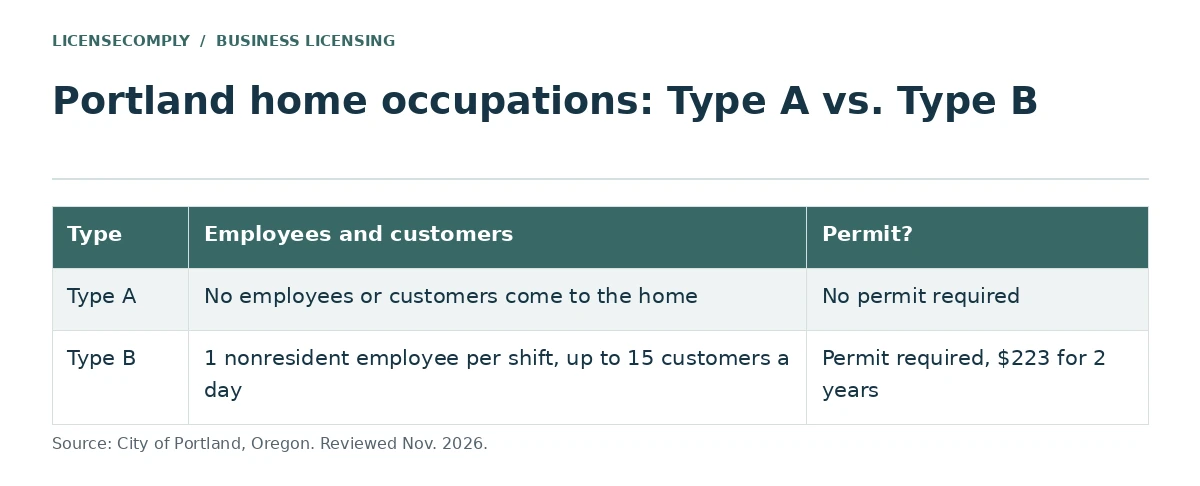
- Portland, Oregon, requires no permit for a Type A home occupation, where no employees or customers come to the site. A Type B home occupation, which allows one nonresident employee per shift and up to 15 customers a day, needs a permit (City of Portland).
- Durham, North Carolina, says a permit is not required for a home office used for teleworking (City of Durham).
How much does a home occupation permit cost?
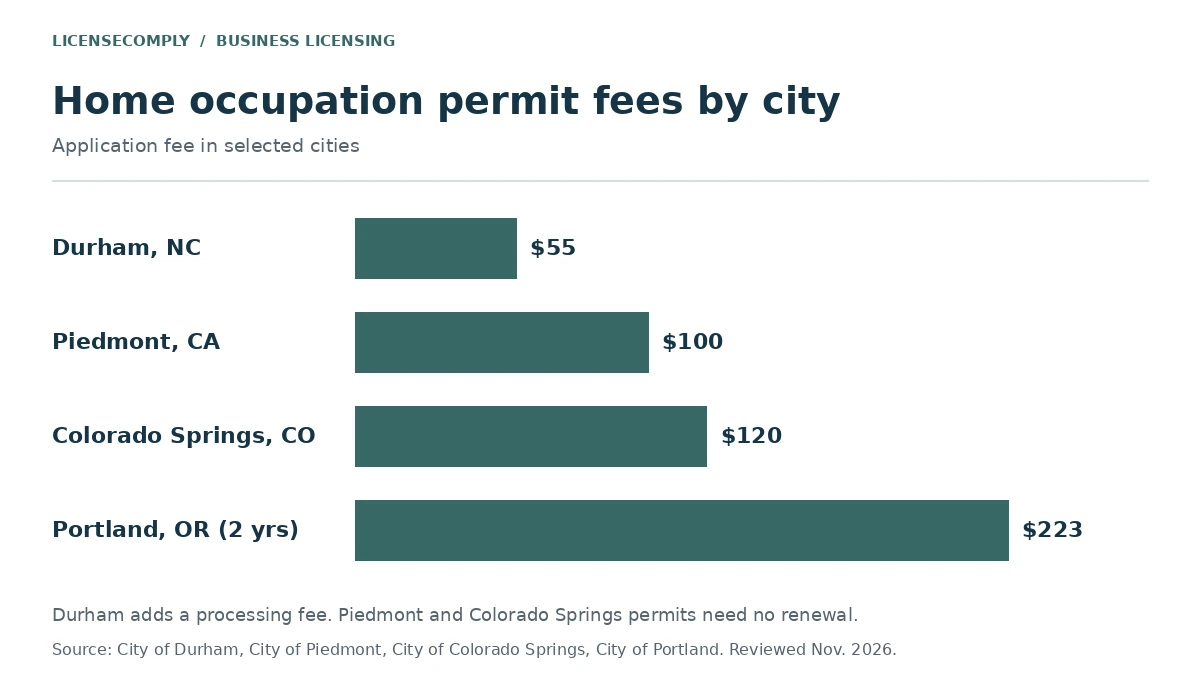
Fees are set locally and range widely. Durham charges $55 plus a processing fee (City of Durham). Piedmont charges $100 and requires no renewal (City of Piedmont). Colorado Springs charges a nonrefundable $120 application fee, and an approved home occupation does not need renewal, though moving to a new home requires a new application (City of Colorado Springs). Portland charges $223 for a two-year permit (City of Portland).
What conditions do home occupation rules set?
Codes differ in detail but regulate the same handful of things.
| Condition | City examples |
|---|---|
| Employees | Colorado Springs: no outside employees working at the home unless they live there |
| Customer visits | Austin: no more than three customer-related vehicle trips a day. Colorado Springs: appointments at least 15 minutes apart, one client vehicle at a time |
| Space used | Colorado Springs: no more than half of the home’s first-floor area |
| Signs | Colorado Springs: one unlit sign of up to 2 square feet attached to the home |
| Sales on site | Austin: selling merchandise directly to customers on the premises is prohibited |
| Prohibited uses | Austin: restaurants, auto repair, contractor yards and dance studios, among others |
Sources: City of Colorado Springs and the home occupation section of the City of Austin Land Development Code as published by the City.
Can you sell products from home?
Denver lists online retail sales as a home occupation when the transaction starts and finishes on your own website or a third-party marketplace, but goods may not be handed to buyers at the home (City and County of Denver). Denver also allows a home salon to cut hair for a fee while prohibiting retail sales of hair products there. Colorado Springs takes a different approach and allows residents to sell goods made in the designated home occupation area, plus plants grown on the property (City of Colorado Springs).
Can state law override local home occupation rules?
In a few states, yes, at least partly.
Florida law says local governments may not license or regulate a qualifying home-based business in a manner different from other businesses, and that such a business may operate in a residential zone (Fla. Stat. 559.955). To qualify, on-site employees must live there (up to two others are allowed), parking demand can’t exceed a typical residence’s, and the business must stay secondary to residential use. Local business taxes still apply.
North Carolina added a similar rule for cities in 2026. Session Law 2026-51, signed July 7, 2026, bars cities from requiring any permit, license or other approval for a “no-impact home-based business,” meaning one whose activities stay inside the home or yard, aren’t visible from the street, don’t generate on-street parking or a substantial increase in traffic, and whose on-site employees and clients stay within the city’s occupancy limit for the property (North Carolina General Assembly, H372; G.S. 160A-205.8). The statute applies to cities, not counties. Durham’s city page now reflects this exemption (City of Durham).
Some cities have no zoning at all, including Houston (City of Houston Planning and Development). Even there, the city notes that deed restrictions may legally prohibit certain types of businesses from operating out of a home (City of Houston).
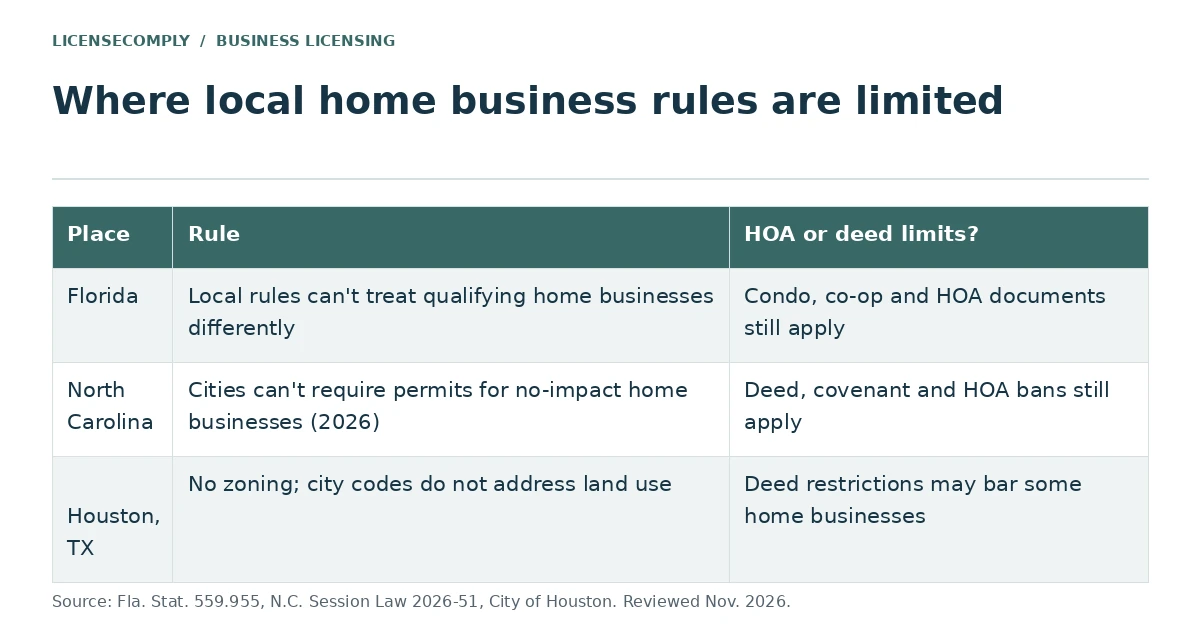
Neither the Florida nor the North Carolina law overrides homeowners association (HOA) or condominium documents, so read those, and your lease, before relying on a zoning approval.
Do you also need a general business license?
A home occupation permit is a zoning approval, not a license to do business. Many places require both, and some require a license even when you never leave your kitchen table.
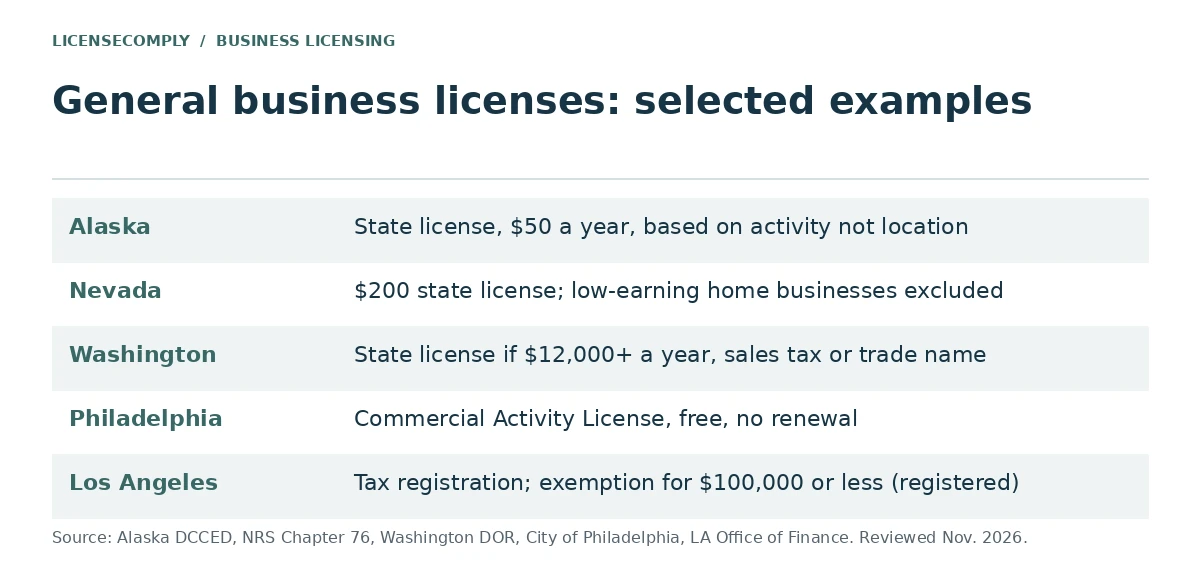
- Alaska requires a business license based on business activity, not physical presence, at a standard fee of $50 a year (Alaska Division of Corporations, Business and Professional Licensing).
- Nevada requires a $200 state business license for most businesses, but excludes a person operating a business from home whose net earnings are not more than 66 2/3 percent of the state’s average annual wage (NRS 76.020 and 76.100). Anyone claiming that exclusion must apply annually for a certificate of exemption under NRS 76.105.
- Washington requires a state business license if you meet any listed condition, including using a name other than your full legal name, collecting sales tax, planning to hire within 90 days, or earning $12,000 or more a year (Washington Department of Revenue).
- Philadelphia requires a free Commercial Activity License for anyone doing business in the city, with no renewal required (City of Philadelphia).
- Los Angeles requires a Business Tax Registration Certificate from anyone doing business in the city, including freelancers who also hold W-2 jobs, though businesses with $100,000 or less in gross receipts may qualify for a small business exemption (Los Angeles Office of Finance).
Some cities link the two. Piedmont lets you apply for both at once and issues the business license after the home occupation permit is approved (City of Piedmont). If you live in an unincorporated area, the county may issue the license instead; see our guide to county business licenses.
Do home-based sellers need a sales tax permit?
If you sell taxable goods or services, working from home doesn’t change your sales tax obligations. In Texas, anyone engaged in business who sells tangible personal property or taxable services in the state must hold a sales and use tax permit, which is free, though a security bond may be required (Texas Comptroller). Texas also says that a Texas-based seller using a marketplace provider must still hold an active permit because it has a physical presence in Texas (Texas Comptroller).
Other states draw these lines differently, especially for marketplace-only sellers. For how a seller’s permit differs from the resale certificate you give suppliers, see seller’s permit vs. resale certificate.
Do you need a DBA for a home business?
You generally need to file an assumed or fictitious name if you operate under anything other than your legal name, or your entity’s registered name. In Texas, sole proprietors file with the county clerk in each county where they keep a business office, while LLCs and corporations file with the Secretary of State for $25. A certificate lasts no more than 10 years, and filing does not stop others from using the same name (Texas Secretary of State). Florida registers fictitious names statewide for $50, requires the name to be advertised once in a newspaper in the county of the principal place of business, and keeps registrations valid for five years (Florida Division of Corporations).
Do you need an EIN?
The EIN follows the same rules nationwide. The IRS says you need one if you have employees, pay employment, excise or alcohol, tobacco and firearms taxes, or operate a partnership, corporation or LLC, and you can request one for banking or state tax purposes even when federal rules don’t require it (IRS). The IRS issues EINs free online and warns that you never have to pay a fee for one (IRS). A sole proprietor doesn’t need a new EIN after changing the business name or location (IRS).
If you need to locate an existing EIN or state tax account number, see how to find your business tax ID number.
What about food, child care and other regulated work?
Texas allows cottage food production operations with up to $150,000 in annual gross income, and local health departments may not require a permit or fee for direct sales to consumers. Registration with the Department of State Health Services is required in some cases, such as selling foods that need time and temperature control for safety (Texas DSHS). Zoning can still apply: Denver bars food preparation as a home occupation in districts governed by its older Former Chapter 59 code (City and County of Denver).
Home child care is similar. Denver notes that city and state licensing requirements apply to child care homes, and large child care homes (7 to 12 children) get an extra zoning review.
In what order should you apply?
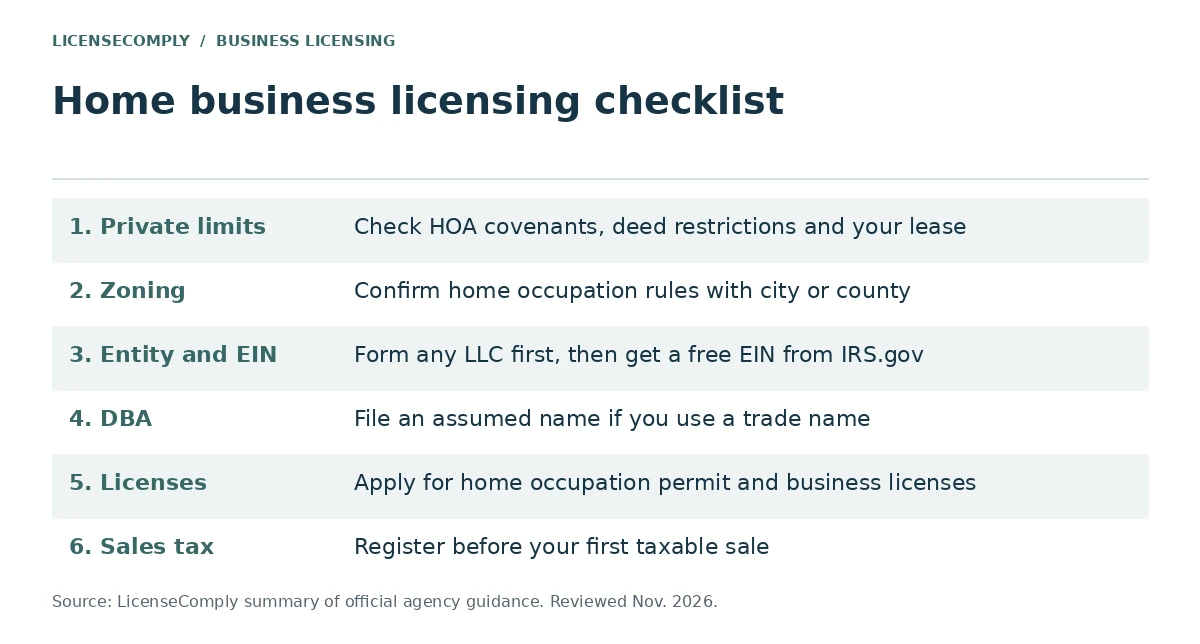
A practical sequence for most home businesses:
- Read your HOA covenants, deed restrictions or lease for limits on home businesses.
- Check your zoning district and home occupation rules with your city or county planning office.
- Form your LLC or corporation with the state, if you’re using one, before applying for an EIN, as the IRS advises.
- Get an EIN if the IRS requires one or your bank or state asks for it.
- File a DBA if you’ll use a trade name.
- Apply for the home occupation permit and any state, county or city business license.
- Register for sales tax before your first taxable sale.
- Add any activity-specific license, such as food, child care or cosmetology.
Frequently asked questions
Is a home occupation permit the same as a business license?
No. A home occupation permit is a zoning approval that lets you use a residence for business, usually issued by a planning or zoning office. A business license or business tax registration is a separate requirement to do business in a state, county or city. Many cities require both, and some, such as Piedmont, California, issue the business license only after the home occupation permit is approved. Check each requirement with the issuing office.
Do I need a home occupation permit if I only work on a computer?
It depends on the city. Portland, Oregon, requires no permit when no employees or customers come to your home. Denver requires a zoning permit if you do business from home and use your home address as a business address, even for freelance computer work. Durham, North Carolina, exempts telework. Look up your own city’s code or call its planning office before assuming you’re exempt.
Can my HOA stop me from running a business from home?
Often, yes. HOA covenants, deed restrictions and leases are private agreements that can be stricter than zoning. Florida’s home-based business statute does not override condominium, cooperative or homeowners association declarations, and North Carolina’s 2026 law does not apply where a deed, covenant or HOA document prohibits the business. Even in Houston, which has no zoning, deed restrictions may prohibit certain types of home businesses.
How much does a home based business license cost?
There’s no single price, because most home businesses need several approvals. In the examples in this guide, home occupation permits run from $55 in Durham to $223 for a two-year permit in Portland. Alaska’s state business license is $50 a year, Nevada’s is $200 for most businesses, and Philadelphia’s Commercial Activity License is free. Texas sales tax permits are free, while an EIN from the IRS is always free.
Do I need a new home occupation permit if I move?
Usually. Many permits are tied to the person and the property. Colorado Springs requires a new application when a home occupation moves to new premises, and Denver’s permit expires when the named resident operator stops running the business at that address. Your sales tax permit, business license and DBA may also need address updates, so contact each issuing agency when you move.
Running a business from home and unsure what applies?
LicenseComply researches the state, county and city licenses and permits that apply to your home address and activity, so you know what to file before you start.
Explore Research & Verification Talk to a licensing specialist
Official sources and further reading
- City and County of Denver: Home business and home occupation permits
- City of Colorado Springs: Home occupation permit
- City of Portland: Home occupation permit requirements and application
- City of Durham: Home occupation permit
- City of Piedmont: Home occupation permit
- City of Austin: Home occupation code section
- Florida Statutes 559.955: Home-based businesses
- North Carolina General Assembly: House Bill 372, Session Law 2026-51
- City of Houston Planning and Development: Development regulations
- Nevada Revised Statutes Chapter 76: State business licenses
- Washington Department of Revenue: Apply for a business license
- Texas Comptroller: Sales tax permit FAQs
- Texas Secretary of State: Name filings FAQs
- IRS: Employer identification number
- Texas DSHS: Cottage food production
Disclaimer: LicenseComply provides professional business licensing and compliance services. However, the informational content on this site (including articles, guides, tools, and videos) is provided for general educational purposes only and does not constitute legal, tax, or accounting advice. Laws and regulations change frequently, and we cannot guarantee that all information is accurate, complete, or up to date for your specific circumstances. Your use of this website and its content does not create an attorney-client, accountant-client, or other advisory relationship. You should consult with a qualified attorney, accountant, or other appropriate professional for advice tailored to your business.