
Key points
- State Unemployment Insurance (SUI) tax is a state payroll tax that employers pay on each employee’s wages up to a state taxable wage base, and states use it only to pay unemployment benefits.
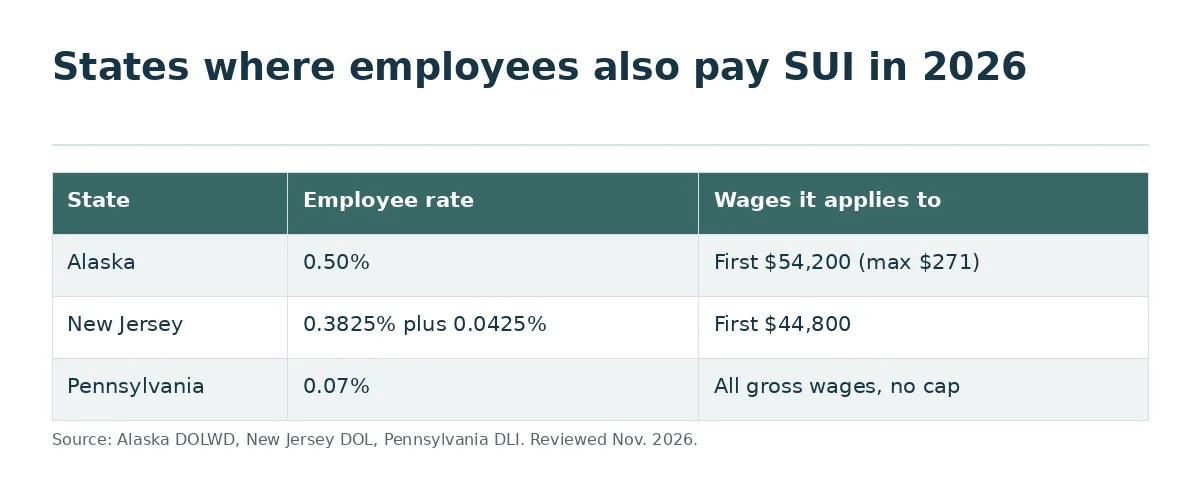
- Employees also contribute in three states: Alaska withholds 0.50 percent in 2026, New Jersey withholds 0.3825 percent for unemployment insurance, and Pennsylvania withholds 0.07 percent of all gross wages.
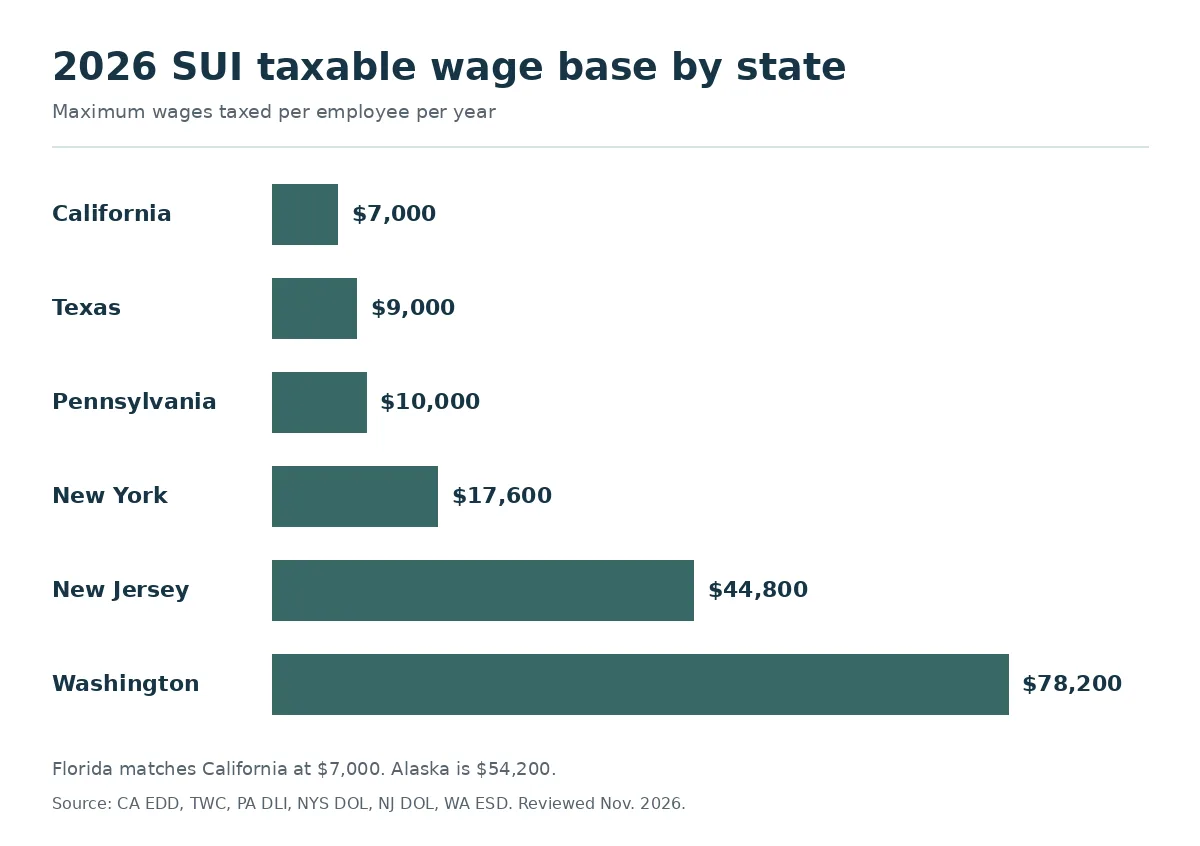
- 2026 SUI taxable wage bases range from $7,000 in California and Florida to $78,200 in Washington, according to each state’s labor or revenue agency.
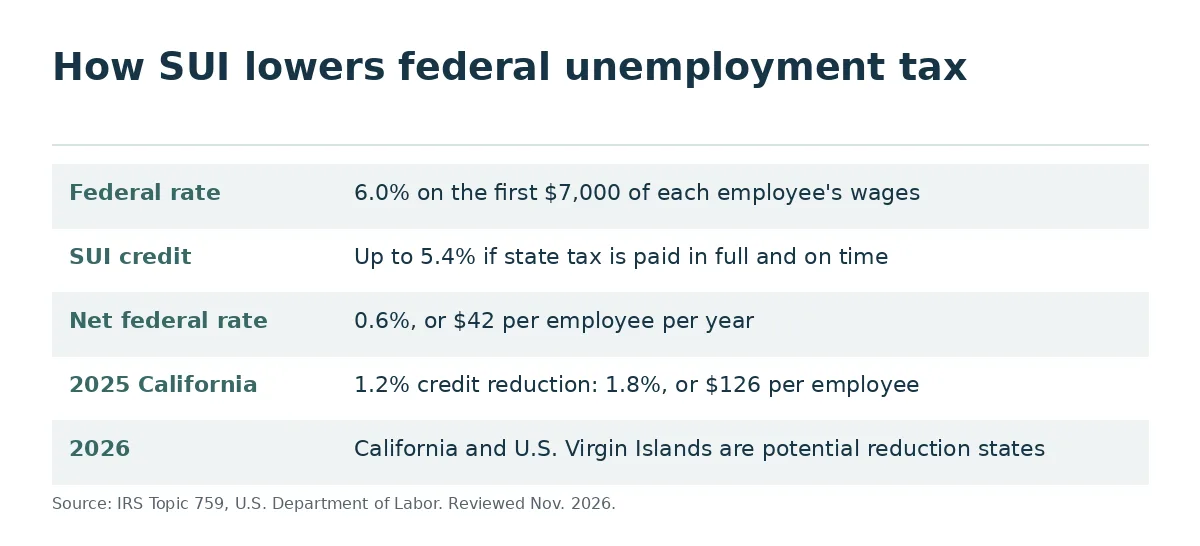
- Employers that pay state unemployment tax on time can take a credit of up to 5.4 percent against the 6.0 percent federal unemployment tax, unless the state is a credit reduction state such as California, which carried a 1.2 percent reduction for 2025.

What is SUI? SUI stands for State Unemployment Insurance, a payroll tax that employers pay to the state on each employee’s wages, up to a yearly cap called the taxable wage base. The state uses the money only to pay unemployment benefits to eligible workers who lose their jobs, and in most states the tax is paid entirely by the employer.
SUI tax goes by several names. Many agencies call it state unemployment tax or SUTA (State Unemployment Tax Act) tax, and Florida calls it reemployment tax. It works alongside the federal unemployment tax, and paying it on time lowers your federal bill.
This guide covers who pays, who can receive benefits, 2026 wage bases and rates, the federal credit, registration and multi-state rules. Figures come from official sources reviewed November 2026; state requirements vary, so confirm your numbers with each state agency.
What is SUI and how does it work?
Unemployment insurance (UI) is a federal and state program “jointly financed through Federal and state employer payroll taxes,” according to the U.S. Department of Labor (DOL). The DOL explains that state law sets each state’s tax rates, and the state unemployment tax “is used solely for the payment of benefits to eligible unemployed workers.”
The basic formula is simple: taxable wages multiplied by your assigned rate percentage. Taxable wages are each employee’s wages up to the state wage base for the calendar year. Wages above the base are still reported but not taxed, per Washington’s Employment Security Department.
Your rate depends on how long you have been an employer and on your layoff history. New employers get a set rate, and established employers get an experience rate that rises or falls with the benefits charged to their account.
Which employers must pay?
The DOL says employers generally owe both state and federal unemployment taxes if they pay wages of $1,500 or more in any calendar quarter, or have at least one employee on any day of a week during 20 weeks in a calendar year. It also notes that “some state laws differ from the Federal law.”
California is a clear example. You become a subject employer there when you pay more than $100 in wages in a calendar quarter, and you must register within 15 days, per the 2026 California Employer’s Guide.
Who can receive benefits funded by SUI?
SUI is intended to provide temporary financial assistance that supports workers between jobs, not to cover every job loss. The DOL says UI benefits go to eligible workers “who become unemployed through no fault of their own and meet certain other eligibility requirements.” In most states, no fault means the worker separated from the last job “due to a lack of available work,” per the DOL unemployment insurance page. Workers must also meet wage requirements during a base period, which in most states “is usually the first four out of the last five completed calendar quarters” before the claim.
State law spells out who is excluded. In Texas, most people who quit for personal reasons cannot receive benefits, and a worker fired for misconduct, such as violating company policy or the law, can be ineligible, per the Texas Workforce Commission. Claimants must also keep looking for a new job; New York requires them to be “ready, willing, and able to work” and “actively looking for work,” per its benefit calculation guide.
This matters to employers because benefits paid can be charged to your account and raise your rate. When a former employee files, Texas notifies the last employer, who has 14 days to respond, per its Unemployment Benefits Handbook.
Who pays SUI tax, the employer or the employee?
In most states, only the employer pays. Florida is typical: “Workers do not pay reemployment tax and employers must not make payroll deductions for this purpose,” per the Florida Department of Revenue.
Three states also require employee contributions, which the employer withholds from pay and sends in with its own tax:
- Alaska: the 2026 employee rate is 0.50 percent on the first $54,200 of wages, a maximum of $271, per the Alaska Department of Labor and Workforce Development.
- New Jersey: workers pay 0.3825 percent for unemployment insurance plus 0.0425 percent for the workforce development funds in 2026, on wages up to $44,800, per the New Jersey Department of Labor and Workforce Development.
- Pennsylvania: workers pay 0.07 percent, and “There is no cap on the gross wages upon which employee withholding is calculated,” per the Pennsylvania Department of Labor and Industry.
What are the 2026 SUI taxable wage bases?
The wage base is the most wages per employee that each employer pays SUI tax on in a calendar year. Federal guidelines require each state to have a taxable wage base of at least $7,000, the Florida Department of Revenue explains, and many states set theirs much higher.
| State | 2026 taxable wage base | Official source |
|---|---|---|
| California | $7,000 | California Employment Development Department |
| Florida | $7,000 | Florida Department of Revenue |
| Texas | $9,000 | Texas Workforce Commission |
| Pennsylvania | $10,000 | Pennsylvania Department of Labor and Industry |
| New York | $17,600 | New York State Department of Labor |
| New Jersey | $44,800 | New Jersey Department of Labor |
| Alaska | $54,200 | Alaska Department of Labor |
| Washington | $78,200 | Washington Employment Security Department |
Wage bases change. New York’s jumped from $12,800 in 2025 to $17,600 in 2026, and starting in 2026 it adjusts each January to 18 percent of the state average annual wage, per the New York State Department of Labor.
What is the SUI rate for a new employer?
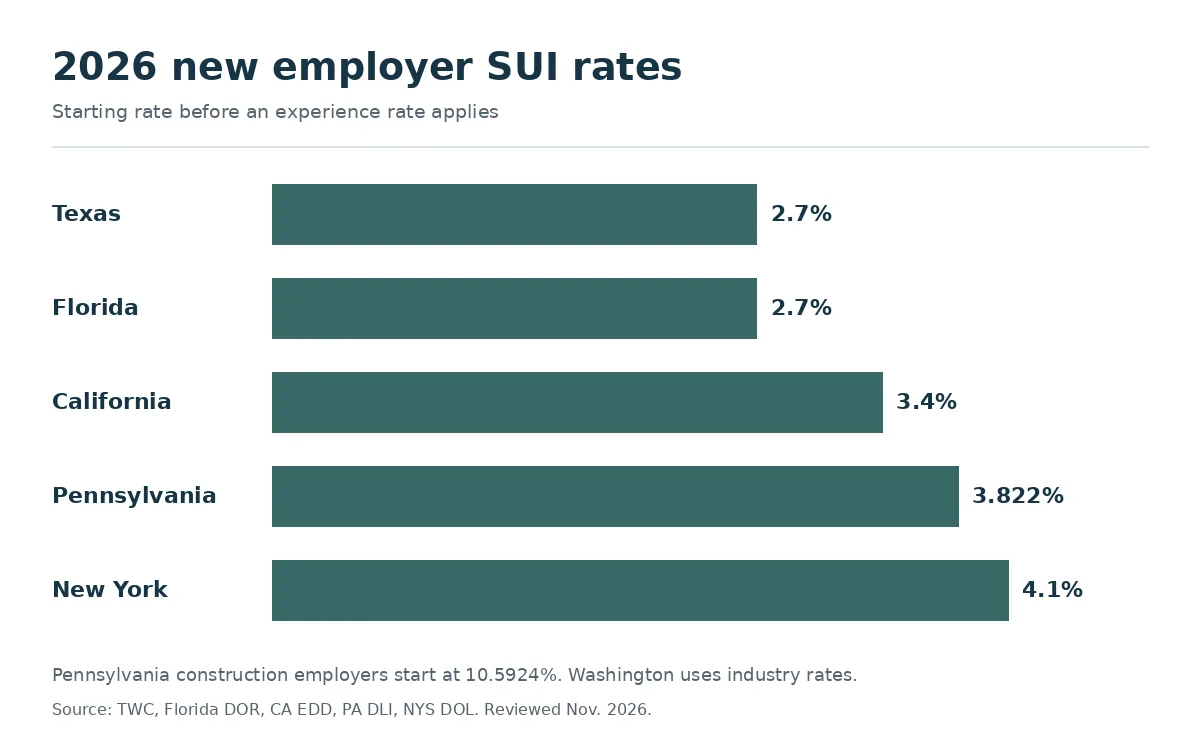
A new employer has no layoff history, so the state assigns a starting SUI rate until the account has enough history to be rated. Examples for 2026:
- California: 3.4 percent “for a period of two to three years,” per the Employment Development Department.
- Texas: “For 2026, the entry-level rate is 2.70% for all groups with no exceptions,” per the Texas Workforce Commission.
- Florida: 2.7 percent, which “remains in place until the employer has reported for 10 quarters,” per the Florida Department of Revenue.
- New York: a total new employer rate of 4.1 percent for 2026, per the New York State Department of Labor.
- Pennsylvania: 3.822 percent for most newly liable employers and 10.5924 percent for newly liable construction employers, per the Department of Labor and Industry.
- Washington: an industry-based rate equal to 115 percent of the average rate for your industry in 2026, per the Employment Security Department.
How does experience rating set your SUI rate?
After the new employer period, most states assign an experience rate based on how much in unemployment benefits former employees have collected compared with your payroll. Washington puts it plainly: “the more unemployment benefits your former workers collect, the higher your tax rate will be,” per its Employer Tax Handbook.
States use two main methods:
- Benefit ratio: Florida divides benefits charged to your account by your taxable payroll to get a percentage, then adds adjustment factors, per the Florida Department of Revenue. Florida’s 2026 rates run from 0.1 percent to 5.4 percent.
- Reserve ratio: New Jersey subtracts benefits charged from the contributions you have paid, then divides that reserve balance by your average annual payroll, per the New Jersey Department of Labor.
SUI tax rates vary by state and by each employer’s history. In 2026, Texas rates run from 0.32 percent to 6.32 percent (Texas Workforce Commission), New York rates run from 1.7 percent to 9.5 percent (New York State Department of Labor), and Pennsylvania experience rates run from 1.419 percent to 10.3734 percent (Pennsylvania Department of Labor and Industry).
States mail rate notices each year; Washington sends them in December, per its Employer Tax Handbook. Florida allows an appeal within 20 days of the date on the rate notice, per the Florida Department of Revenue.
How does SUI interact with the federal unemployment tax?
The Federal Unemployment Tax Act (FUTA) tax rate is 6.0 percent on the first $7,000 of each employee’s wages, per Internal Revenue Service (IRS) Topic 759. If you paid state unemployment taxes in full and on time, you can usually take a credit of up to 5.4 percent, which brings the federal rate to 0.6 percent. The DOL puts that at $42 per employee per year.
The credit shrinks in a credit reduction state, which the IRS describes as a state that “hasn’t repaid money it borrowed from the federal government to pay unemployment benefits.” Employers there owe more federal tax on Form 940 and must file Schedule A (Form 940).
For 2025, the DOL lists two credit reduction jurisdictions: California at 1.2 percent and the U.S. Virgin Islands at 4.5 percent, per its FUTA credit reduction data. That means a California employer paid 1.8 percent federal tax, or $126 per employee, for 2025 instead of $42.
For 2026, the DOL lists California and the U.S. Virgin Islands as potential credit reduction states. The final reduction “is not determined until Nov. 10” of the year, so 2026 amounts were not final when this guide was reviewed. Check the DOL page before you file Form 940, which is due January 31 (or February 10 if all federal unemployment tax was deposited on time), per the IRS.
How do you get an unemployment insurance account number?
You get an unemployment insurance account number by registering with the state workforce or revenue agency in each state where you have employees. Most states want your federal Employer Identification Number (EIN) first; our guide on how to find your business tax ID number explains where to look.
Deadlines are short:
- Texas: register within 10 days of becoming liable. The online process takes about 20 minutes and gives a liable employer a tax account number immediately, per the Texas Workforce Commission.
- California: register within 15 days of becoming a subject employer. The Employment Development Department assigns an eight digit employer payroll tax account number, “also called a State Employer Identification Number (SEIN) or State ID number,” per its registration page.
- Florida: register through the Florida Business Tax Application (Form DR-1). The state says quarterly reports alone are not enough to register, per its Employer Guide to Reemployment Tax.
- Washington: a new employer must apply for a license from the Department of Revenue before it can file a quarterly tax and wage report, per the Employment Security Department.
The SUI account is usually separate from the income tax withholding account. For the full sequence of federal and state payroll accounts, see our complete guide to payroll tax registration for new employers.
When are quarterly SUI wage reports due?
Most states require a quarterly wage report and payment by the last day of the month after each calendar quarter: April 30, July 31, October 31 and January 31. Texas follows that schedule and assesses penalties and interest on late reports and payments, per the Texas Workforce Commission.
The report lists each employee’s name, Social Security number and wages for the quarter.
Which state gets SUI tax for an employee who works in several states?
Each employee’s wages are reported to one state, chosen by four uniform tests applied in order. The California Employment Development Department says these tests “are used by all states to determine where a multistate employee’s wages should be reported,” per its multistate employment information sheet:
- Localization: the state where all or most of the work is done, with only incidental work elsewhere, such as temporary trips or isolated transactions.
- Base of operations: the more or less permanent place the employee starts from and returns to.
- Place of direction and control: the state from which the employer directs the employee’s work.
- Residence: the state where the employee lives, if some work is done there.
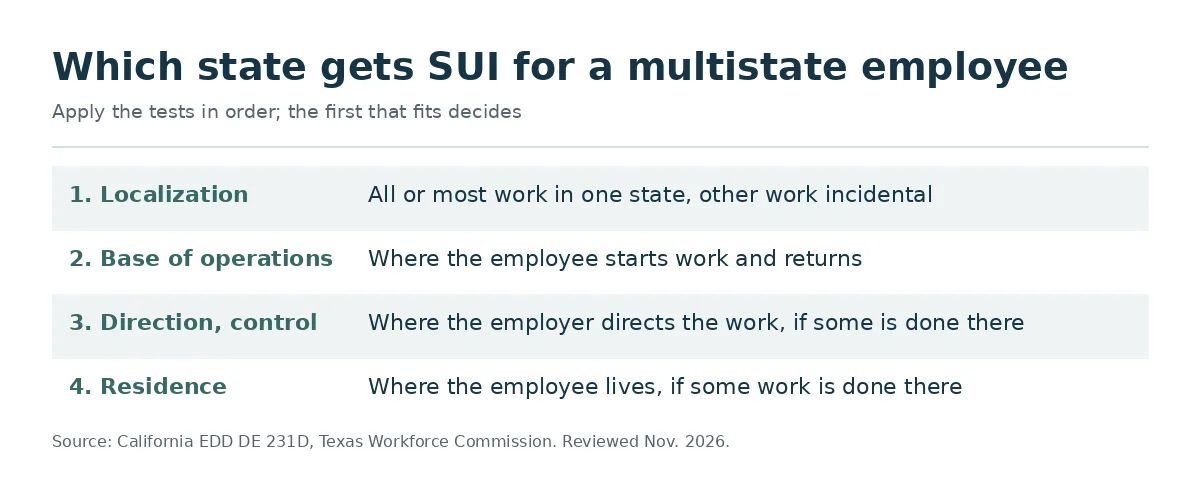
Texas lists the same order in its location of services checklist and in Texas Labor Code Section 201.043. When an employee’s work is not localized in any one state, most states take part in the Interstate Reciprocal Coverage Arrangement, which lets an employer ask to report all of a multistate worker’s wages to one state where the employee works or lives, or where the employer has a place of business.
These tests decide where unemployment tax goes, not where income tax is withheld. Income tax uses different residence and work location rules, covered in our state income tax withholding FAQs for employers.
What changes when you operate in several states?
- One account per state. Each state issues its own unemployment insurance account number, new employer rate and filing calendar, so a company hiring in five states files five sets of quarterly wage reports.
- Wage bases can restart. In Florida, each employer pays tax on the first $7,000 of each employee’s wages, per the Florida Department of Revenue, but some states credit wages already reported elsewhere. New York counts wages reported to another state in the same year for employees who transfer into New York, per its quarterly reporting page.
- Federal filing gets an extra schedule. You must file Schedule A (Form 940) if you paid wages in more than one state or in a credit reduction state, per the IRS.
- New employer rates apply again. Each state rates your account on its own claims history, so a new state account usually starts at that state’s new employer rate.
Expansion also brings registrations beyond payroll. Our guide to the registration sequence when opening in a new state covers the order. LicenseComply does not give tax advice or file payroll taxes. For SUI questions, contact your payroll provider or accountant, or visit each state agency’s employer resources to learn the current information for your account.
Frequently asked questions
What is SUI tax on a paycheck?
SUI tax is State Unemployment Insurance tax. In most states the employer pays all of it, so it does not appear as a deduction on an employee’s paycheck. Employees in Alaska, New Jersey and Pennsylvania do see a small withholding: 0.50 percent in Alaska, 0.3825 percent for unemployment insurance in New Jersey, and 0.07 percent in Pennsylvania for 2026, according to each state’s labor department.
Is SUI the same as SUTA?
Yes, in practice. SUTA stands for State Unemployment Tax Act, and payroll providers often use SUTA and SUI interchangeably for the state unemployment tax employers pay on wages. States also use their own names: Florida calls it reemployment tax, and Pennsylvania calls it unemployment compensation tax. The tax works the same way: an assigned rate applied to wages up to the state taxable wage base.
How is my SUI rate determined?
New employers get a starting rate set by the state, such as 2.7 percent in Texas and Florida or 3.4 percent in California for 2026. After about two to three years, most states assign an experience rate based on benefits charged to your account compared with your taxable payroll. More benefit claims from former employees generally mean a higher rate. States mail a new rate notice each year.
What happens if I pay SUI late?
Late SUI reports and payments usually bring penalties and interest; Texas, for example, assesses both. Paying late can also cost you federal money, because the IRS gives the full 5.4 percent credit against federal unemployment tax only if state tax was paid in full by the Form 940 due date. Some states also raise your rate; Pennsylvania adds 3 percentage points to the basic rate for delinquent accounts.
Do I need an unemployment insurance account number in every state where I have employees?
Generally, yes, in each state where an employee’s wages are reported under the localization rules. An employee who mainly works in one state is usually reported there, even if they travel. Each state sets its own registration deadline, such as 10 days in Texas and 15 days in California, and issues its own account number for quarterly wage reports and payments.
Hiring in a new state or city?
LicenseComply handles the state and local business license and permit filings a growing employer needs at each new location, so your registrations keep pace with your hiring.
Explore License & Permit Filing Talk to a licensing specialist
Official sources and further reading
- U.S. Department of Labor: Unemployment insurance tax topic
- U.S. Department of Labor: FUTA credit reductions
- Internal Revenue Service: Topic 759, Form 940 filing and deposit requirements
- California Employment Development Department: Contribution rates and withholding schedules
- California Employment Development Department: 2026 California Employer’s Guide (DE 44)
- California Employment Development Department: Register for a payroll tax account
- California Employment Development Department: Multistate employment information sheet (DE 231D)
- Texas Workforce Commission: Tax rates
- Texas Workforce Commission: Register a tax account
- Texas Workforce Commission: Tax report and payment due dates
- Texas Workforce Commission: Location of services checklist
- Texas Unemployment Compensation Act, Chapter 201
- Florida Department of Revenue: Reemployment tax
- Florida Department of Revenue: Reemployment tax rate information
- Florida Department of Revenue: Employer Guide to Reemployment Tax
- New York State Department of Labor: Unemployment insurance rate information
- New York State Department of Labor: Filing returns and paying contributions
- New Jersey Department of Labor and Workforce Development: Unemployment and disability rates
- Pennsylvania Department of Labor and Industry: Yearly tax highlights
- Alaska Department of Labor and Workforce Development: Wages and deductions FAQs
- Washington Employment Security Department: How we determine tax rates
- Washington Employment Security Department: Employers’ guide to paying taxes
- U.S. Department of Labor: Unemployment insurance
- Texas Workforce Commission: Unemployment benefits basics for employers
- Texas Workforce Commission: Unemployment Benefits Handbook
- New York State Department of Labor: How your weekly benefit is calculated
- Washington Employment Security Department: Employer Tax Handbook
Disclaimer: LicenseComply provides professional business licensing and compliance services. However, the informational content on this site (including articles, guides, tools, and videos) is provided for general educational purposes only and does not constitute legal, tax, or accounting advice. Laws and regulations change frequently, and we cannot guarantee that all information is accurate, complete, or up to date for your specific circumstances. Your use of this website and its content does not create an attorney-client, accountant-client, or other advisory relationship. You should consult with a qualified attorney, accountant, or other appropriate professional for advice tailored to your business.