
Key points
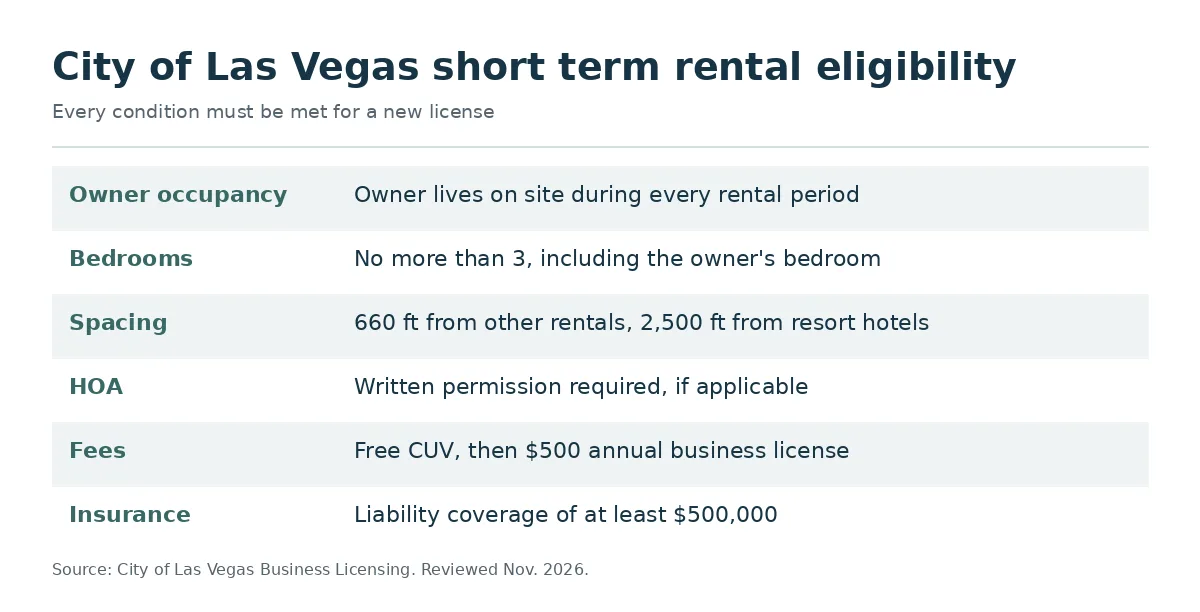
- In the City of Las Vegas, a new short-term residential rental must be owner occupied during every stay, have no more than three bedrooms, sit at least 660 feet from another short-term rental and 2,500 feet from a resort hotel, and pay a $500 annual business license fee.
- Unincorporated Clark County closed its only short-term rental application period on August 21, 2023, and caps licenses at 1% of housing units with a 1,000-foot separation between licensed rentals.
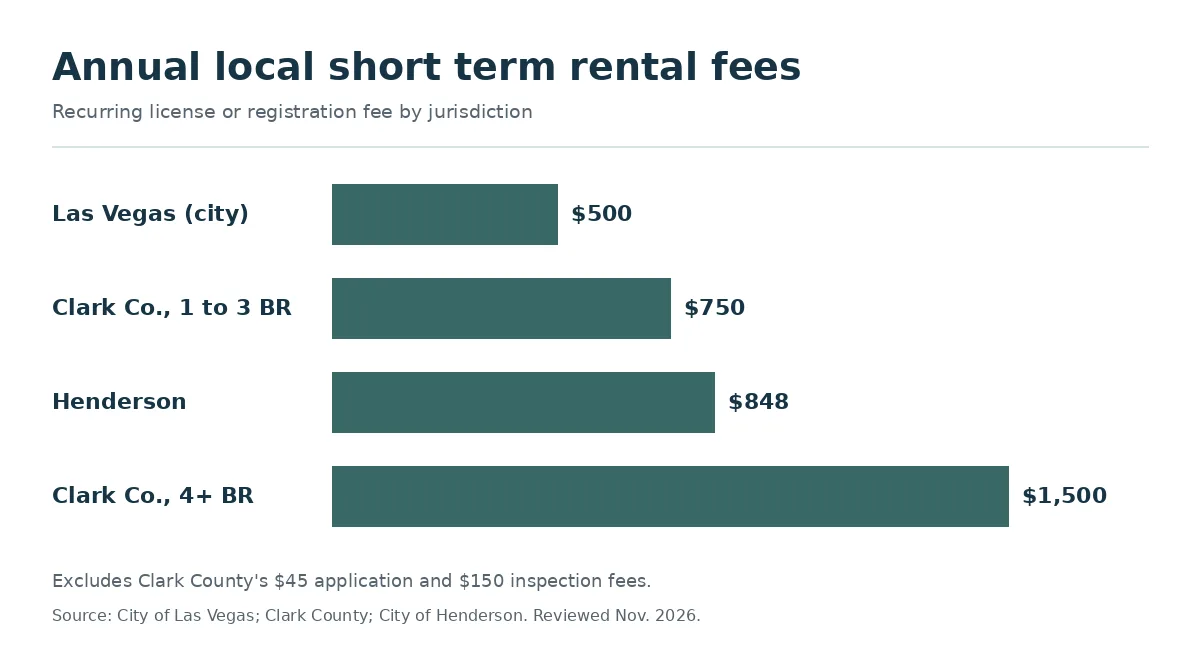
- Clark County charges a $45 application fee, a $150 inspection fee and a $750 annual fee for three or fewer bedrooms or $1,500 for more than three bedrooms.
- Nevada Assembly Bill 363 (2021) requires every short-term rental host in Clark County and its larger cities to hold both a local authorization and a state business license, and requires platforms such as Airbnb to collect and remit room tax.

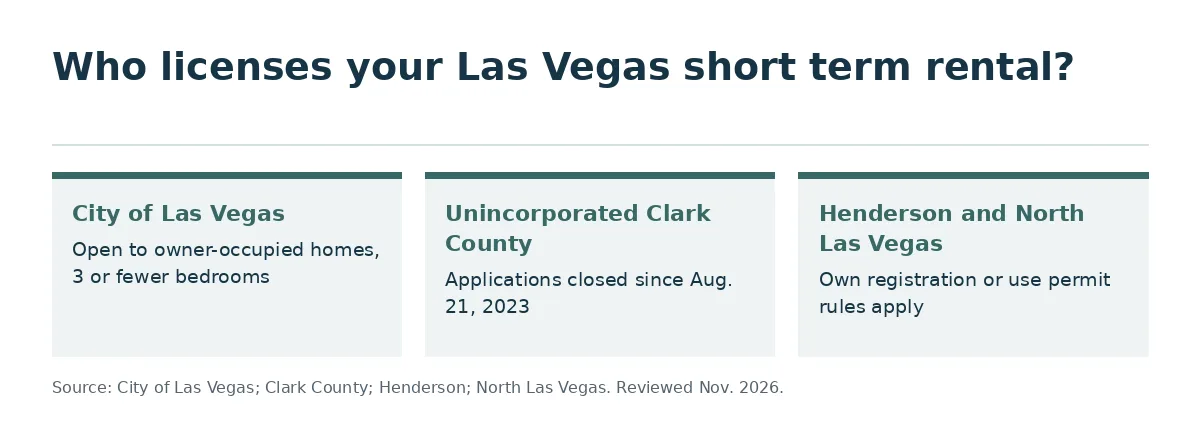
To run a Las Vegas short term rental legally, you need a local short term rental license from the government that controls your address, a Nevada state business license, and monthly transient lodging tax reporting. Which local license applies depends on whether the property is in the City of Las Vegas, unincorporated Clark County, Henderson or North Las Vegas, and the rules differ sharply.
The short version for 2026: the City of Las Vegas still accepts new applications, but only for owner-occupied homes with three or fewer bedrooms that meet spacing rules. Unincorporated Clark County closed its application period in 2023 and has not opened a new one, although a rewrite of its ordinance is pending before the County Commissioners.
This guide replaces our older post, which listed a 2023 deadline and a $1,000 fee that no longer apply. It was reviewed November 2026 against official sources. Local regulations change often, so confirm details with the issuing agency before you apply or list a property.
Why licensing matters for Las Vegas hosts
Operating without a license is expensive: unincorporated Clark County fines unlicensed operation $1,000 to $10,000 per day, according to its short-term rental FAQ. Under AB 363, every listing must show both the local license number and the state business ID number, so an unlicensed property cannot list legally on Airbnb or Vrbo. HOA governing documents matter too: Clark County will not license a home in a common-interest community unless those documents expressly allow transient lodging, and the City of Las Vegas requires written HOA permission. Condo-hotel units are a separate category, since Clark County’s Title 30 development code defines a condominium hotel as a commercial condominium meeting the criteria for a hotel and refers it to the County’s transient lodging chapter, so confirm with the County which rules apply to that type of unit.
Which short term rental regulations apply in the Las Vegas Valley?
A Las Vegas mailing address does not tell you who licenses your rental. The Clark County short-term rental FAQ states that Clark County’s ordinance applies only in unincorporated areas, not in Henderson, Las Vegas or North Las Vegas, and points owners to the County’s OpenWeb parcel viewer, where the “Jurisdiction” field shows the answer.
All of these programs exist because of Assembly Bill 363 from the 2021 Nevada Legislature, which required Clark County and its larger cities to adopt ordinances allowing and regulating short term rentals and accommodations facilitators (booking platforms). The bill set a floor, and each jurisdiction added its own conditions.
For background, see our overview of whether you need a business license to list a property on Airbnb and our guide to the county business license.
How do you get a City of Las Vegas short term rental license?
The city defines a short-term residential rental as a house or condominium rented to guests for less than 31 consecutive days, and it requires a business license. Under the city’s 2026 application instructions, a new license is available only if the home meets every conditional use regulation:
- The owner lives on the property throughout the rental period.
- The home has three or fewer bedrooms.
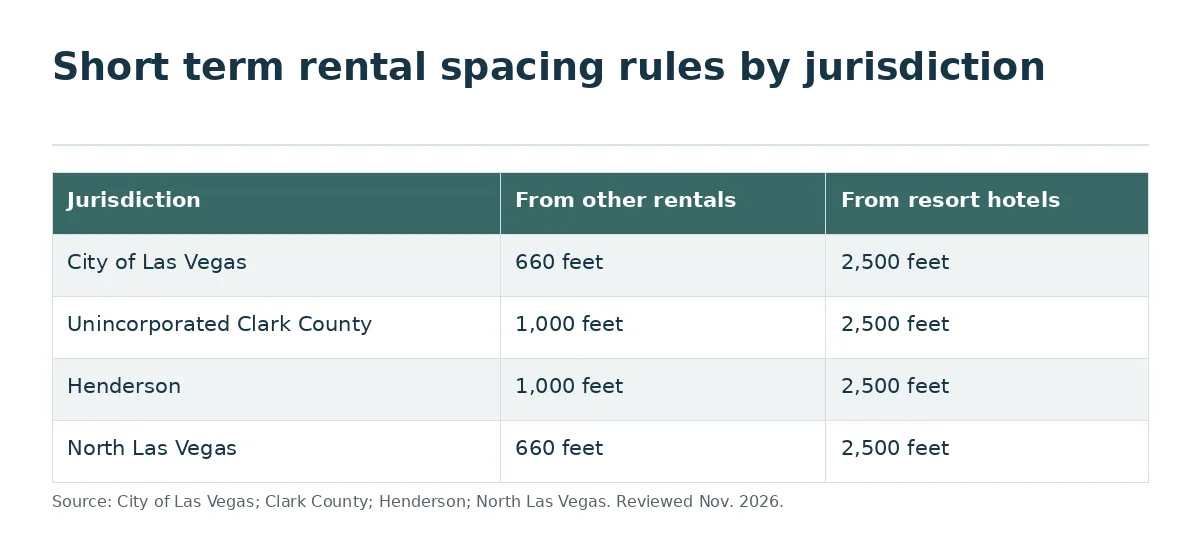
- It is at least 660 feet from any other short term rental and 2,500 feet from resort hotels.
- It is in a zoning location that allows short term rentals.
- It has written HOA (homeowners association) permission, if applicable.
The city’s eligibility overview adds that the bedroom limit includes the owner’s room and that owner occupancy must be clear in your listing. Short term rentals are also prohibited in several master planned areas, including Summerlin, Skye Canyon, Cliff’s Edge and Symphony Park.
Step 1: Conditional use verification
Apply through the Citizen Portal for a Conditional Use Verification (CUV), which has no fee. You submit a justification letter confirming owner occupancy, a site plan showing at least two parking spaces, and a floor plan labeling every room, the owner’s bedroom, fire extinguishers and egress markings.
Step 2: Home inspection
After the CUV passes initial review, Code Enforcement inspects the home, verifying the bedroom count, checking life safety items and looking for building permits covering any additions.
Step 3: Business license review
Once the CUV is approved, the owner applies for the business license with the $500 annual fee, liability insurance of at least $500,000, a list of hosting platforms, a 24-hour local contact, a signed affidavit, any LLC (limited liability company) or trust documents, and a Nevada ID whose address matches the rental.
A CUV does not guarantee a license. The instructions warn that a location can become ineligible before issuance if another rental is licensed within 660 feet, and you may not rent until the process is complete.
City operating rules and rental income tax
The city’s short-term rental page bans weddings, parties and other special events, lists noise, parking and trash as common violations, and runs a 24-hour complaint hotline.
Room tax applies to your rental income. The city’s room tax instructions set the rate at 13.00% outside the Primary Gaming Corridor and 13.38% inside it, due by the 15th of the following month. Even when a platform remits tax, the licensed owner must file a monthly report.
What are the Clark County short term rental rules?
Unincorporated Clark County regulates each short term rental unit under Chapter 7.100 of the Clark County Code, adopted June 21, 2022. That County page is clear: the application period is closed. A complete application had to be submitted by August 21, 2023, late applications are not being considered, and operating without a license is unlawful.
Is a new application period coming?
None has been announced. The Clark County Department of Business License published a proposed amendment to Chapter 7.100 (notification letter dated September 8, 2026) that would add short term rentals as a conditional commercial use in certain zoning districts. The introduced ordinance dated October 20, 2026 would delete the current application period and random selection language. It did not appear on the County’s adopted ordinances list at review, so treat it as pending.
Caps, spacing and HOA rules
The County FAQ summarizes current licensing requirements:
- Licenses are capped at 1% of eligible housing units in an unincorporated area.
- Licensed rentals must be 1,000 feet apart and 2,500 feet from resort hotels.
- Each person or entity may hold an interest in only one licensed rental.
- The applicant must be the owner of record with the County Assessor.
- HOA homes qualify only if governing documents expressly allow transient lodging.
- Apartments, mobile homes and homes on septic are ineligible.
Owner-occupied rentals still need a license. Occupancy is limited to the lesser of two people per bedroom or ten per unit, and pools, spas and fire pits cannot be used from 10 p.m. to 7 a.m.
Clark County fees and fines
Per the County FAQ, fees depend on the bedroom count on record:
| Bedrooms | Application fee | Inspection fee | Annual license fee | Year 1 total |
|---|---|---|---|---|
| Three or fewer | $45 | $150 | $750 | $945 |
| More than three | $45 | $150 | $1,500 | $1,695 |
Licenses renew annually. Unlicensed operation draws a fine of $1,000 to $10,000 per day, and other violations are fined at the nightly rental value or $500 ($1,000 for later violations), whichever is greater.
What about Henderson and North Las Vegas?
Henderson requires annual registration of short-term vacation rentals. Its program page lists an $848 nonrefundable fee, a Nevada business license in the owner’s name, a certification class, a self-inspection checklist and at least $1,000,000 in liability insurance. The city’s fee schedule shows $902 including records and technology fees, so confirm when you apply. Henderson’s FAQ applies 1,000-foot spacing between rentals, 2,500 feet from resort hotels and a two-night minimum for non-owner-occupied homes. Room tax is 13%, and a 24/7 hotline takes reports of an illegal short term rental.
North Las Vegas requires an approved conditional use permit before you can apply for a business license, according to its short-term rental page. The permit requires proof of ownership, a site plan showing noise monitoring equipment, a security plan, a notarized HOA letter, 660-foot spacing from other rentals and 2,500 feet from resort hotels. The city’s transient lodging tax page sets room tax at 13%.
What state business license rules apply to a Las Vegas Airbnb?
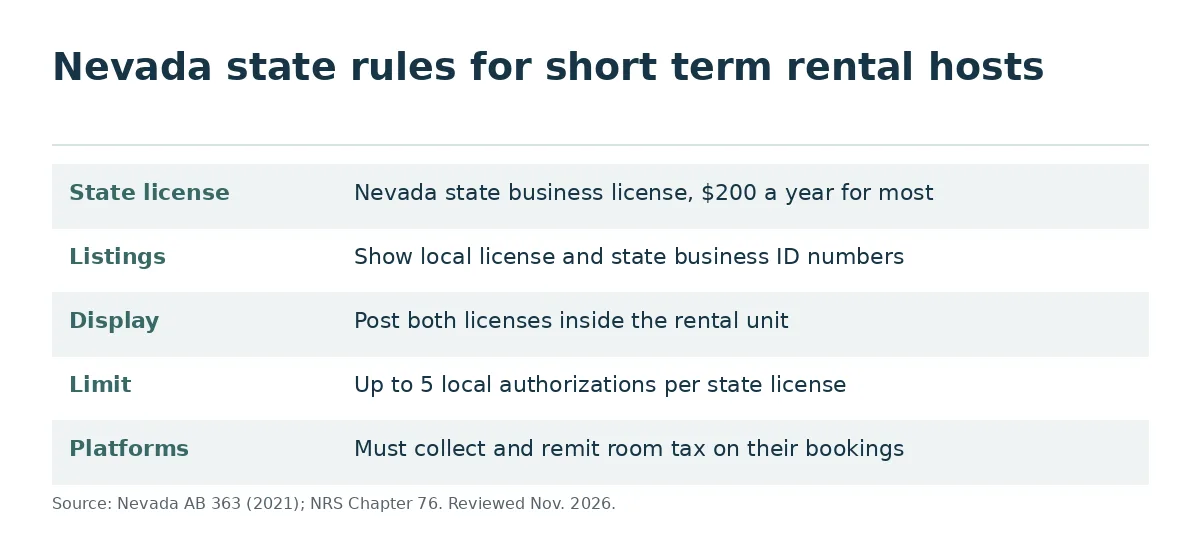
AB 363 requires every host in Clark County and its covered cities to hold both a local authorization and a state business license. Both must be displayed in the unit, and both numbers must appear in every listing, including platform listings. The bill caps authorizations at five per state business license.
Under Nevada Revised Statutes (NRS) Chapter 76, the state business license costs $200 a year for most applicants and $500 for corporations. The Secretary of State’s Business Hub directs filers to its ORION portal, though some County guides still reference SilverFlume. Our business license renewal guide covers staying current.
Platform obligations
AB 363 requires counties and covered cities to make platforms such as Airbnb and Vrbo collect and remit room tax on their bookings. The County FAQ says hosts remit tax themselves on direct bookings, and a County licensee notice requires licensed hosts to file monthly returns regardless. For a contrast with another capped market, see our Austin short-term rental permit guide.
Frequently asked questions
Can I get a new short term rental license in unincorporated Clark County in 2026?
Not under the current process. Clark County’s only application period closed on August 21, 2023, and late or incomplete applications are not being considered. A proposed rewrite of Chapter 7.100, introduced October 20, 2026, would change how licensing works, but it had not been adopted as of November 2026. Watch the County’s short-term rental and proposed amendments pages for any new process.
How much is a Las Vegas short term rental license?
In the City of Las Vegas, the business license is $500 a year and the conditional use verification is free. In unincorporated Clark County, year one costs $945 for three or fewer bedrooms or $1,695 for more, including application and inspection fees. Henderson lists an $848 annual registration. Every host also needs a Nevada state business license, $200 a year for most owners.
Can I rent my whole house in the City of Las Vegas if I live elsewhere?
Not under a new license. The City of Las Vegas requires the owner to live on the property during every rental period, and the home can have no more than three bedrooms, counting the owner’s room. Some older approved rentals continue as nonconforming uses, but new applicants must meet every condition without waivers.
Do I need a Nevada state business license for an Airbnb in Las Vegas?
Yes. AB 363 requires short term rental hosts in Clark County, Las Vegas, Henderson and North Las Vegas to hold a state business license in addition to the local license or registration. The state business identification number must appear in your listings with the local license number, and both licenses must be displayed in the unit. The state license renews annually.
Does Airbnb pay the transient lodging tax for me?
Partly. Nevada law requires platforms to collect and remit room tax on bookings made through them, but hosts still have filing duties. The City of Las Vegas and Clark County both require licensed hosts to file monthly room tax returns, and direct bookings are the host’s responsibility. Official rates are 13.00% to 13.38% in the City of Las Vegas and 13% in Henderson and North Las Vegas; Clark County rates vary by location, so confirm with the county.
Renting out property in more than one Nevada jurisdiction?
LicenseComply files the local short-term rental, state business license and related applications for each property, so every unit is licensed before it is listed.
Explore License & Permit Filing Talk to a licensing specialist
Official sources and further reading
- City of Las Vegas: Short-Term Residential Rental Application Instructions (2026)
- City of Las Vegas: Can My Home Become a Short-Term Rental?
- City of Las Vegas: Short-Term Rentals
- City of Las Vegas: Transient Lodging Room Tax Instructions
- Clark County: Short-Term Rental Units
- Clark County: Short-Term Rental Frequently Asked Questions
- Clark County: Proposed Amendments to Clark County Code
- City of Henderson: Short-Term Vacation Rentals
- City of North Las Vegas: Short-Term Rentals
- Nevada Legislature: Assembly Bill 363 (2021), enrolled text
- Nevada Revised Statutes Chapter 76: State Business Licenses
Disclaimer: LicenseComply provides professional business licensing and compliance services. However, the informational content on this site (including articles, guides, tools, and videos) is provided for general educational purposes only and does not constitute legal, tax, or accounting advice. Laws and regulations change frequently, and we cannot guarantee that all information is accurate, complete, or up to date for your specific circumstances. Your use of this website and its content does not create an attorney-client, accountant-client, or other advisory relationship. You should consult with a qualified attorney, accountant, or other appropriate professional for advice tailored to your business.