
Key points
- Airbnb does not issue licenses, but many cities and states require hosts to hold a business license, a short term rental license or registration, and a lodging tax account before listing.
- New York City requires short term rental hosts to register with the Mayor’s Office of Special Enforcement for a $145 fee, and only hosted stays with no more than two guests can be approved.
- Denver requires a short term rental business license with a $50 application fee and a $100 annual license fee, and the property must be the host’s primary residence.
- In Hawaii, operators of rentals under 180 consecutive days must hold both a general excise tax license and a transient accommodations tax registration, and must show the tax license number in every advertisement.

The short answer: yes, in many places you need an Airbnb business license, a short term rental license, or both before you list a property online. Airbnb itself does not license hosts; the requirement comes from your city, county or state, and it often includes a lodging tax account as well.
This guide explains the layers of approval hosts usually need under local laws, with 2026 fees and rules from official city and state sources (reviewed November 2026). Short term rental laws change often and vary block by block in some cities, so confirm the exact requirements with the local agency that issues the license before you list. For questions about your own situation, a local lawyer or tax professional can explain how applicable laws affect you.
Do I need a business license for Airbnb?
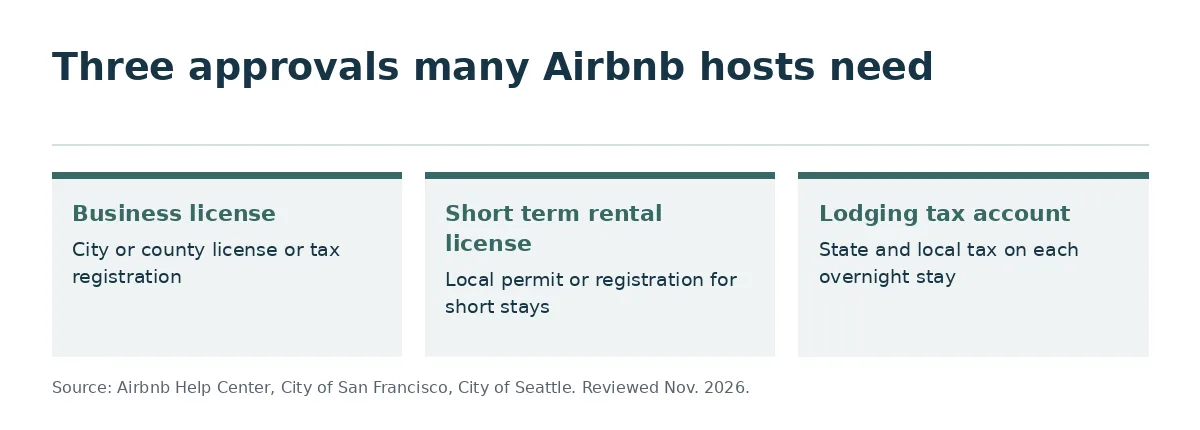
Most hosts face up to three separate license requirements, and each comes from a different office. Together they are the most common licenses for short term rental operators.
A general business license or registration
Many cities treat rental income as business income, just like other businesses operating within city limits. San Francisco states that earning income from a short term residential rental, regardless of the amount, is considered a business, so hosts must obtain a Business Registration Number before registering with the city’s short term rental office, according to the San Francisco guide to opening a short term residential rental. Seattle similarly requires a business license tax certificate on top of its rental license, per the City of Seattle.
There is generally no federal license for this activity; the Small Business Administration explains that federal licenses cover federally regulated activities such as aviation or alcohol.
A short term rental license, permit or registration
This is the approval specific to renting a home or vacation home for short stays, usually under 30 days. Cities call it a short term rental permit, a short term rental (STR) license, a registration or a certificate. It typically sets specific rules, such as whether the property must be your primary residence, the maximum number of nights you can rent it, and how many guests you can host.
A lodging tax account
Many states and cities tax overnight stays. Even where Airbnb collects some of these taxes, you may still need a tax registration of your own so you can file returns and remit taxes the platform does not cover.
Zoning sits underneath all three. Local zoning laws decide whether short term rentals are allowed at an address at all, and zoning restrictions can block a rental even when the paperwork is in order. Chicago, for example, bars shared housing in any Restricted Residential Zone, per the city’s eligibility criteria.
If you are not sure which general licenses apply to you, our guide on whether you need a business license walks through the basics.
What is a short term rental license or STR permit?
A short term rental license is a local approval that allows you to rent a dwelling unit to guests for short stays, usually fewer than 30 nights.
Many cities now require the license or registration number to appear on your Airbnb listing, so an Airbnb license number has become part of the listing itself. Los Angeles states that a host may not participate in Home-Sharing unless all listings clearly display the city-issued registration number, per the Los Angeles City Planning Home-Sharing FAQ. Denver says it is unlawful to advertise a short term rental without displaying a business file number, and tells Airbnb hosts to enter it in the Registration/License Number field, according to the Denver short term rental FAQ.
Airbnb business license rules in major cities
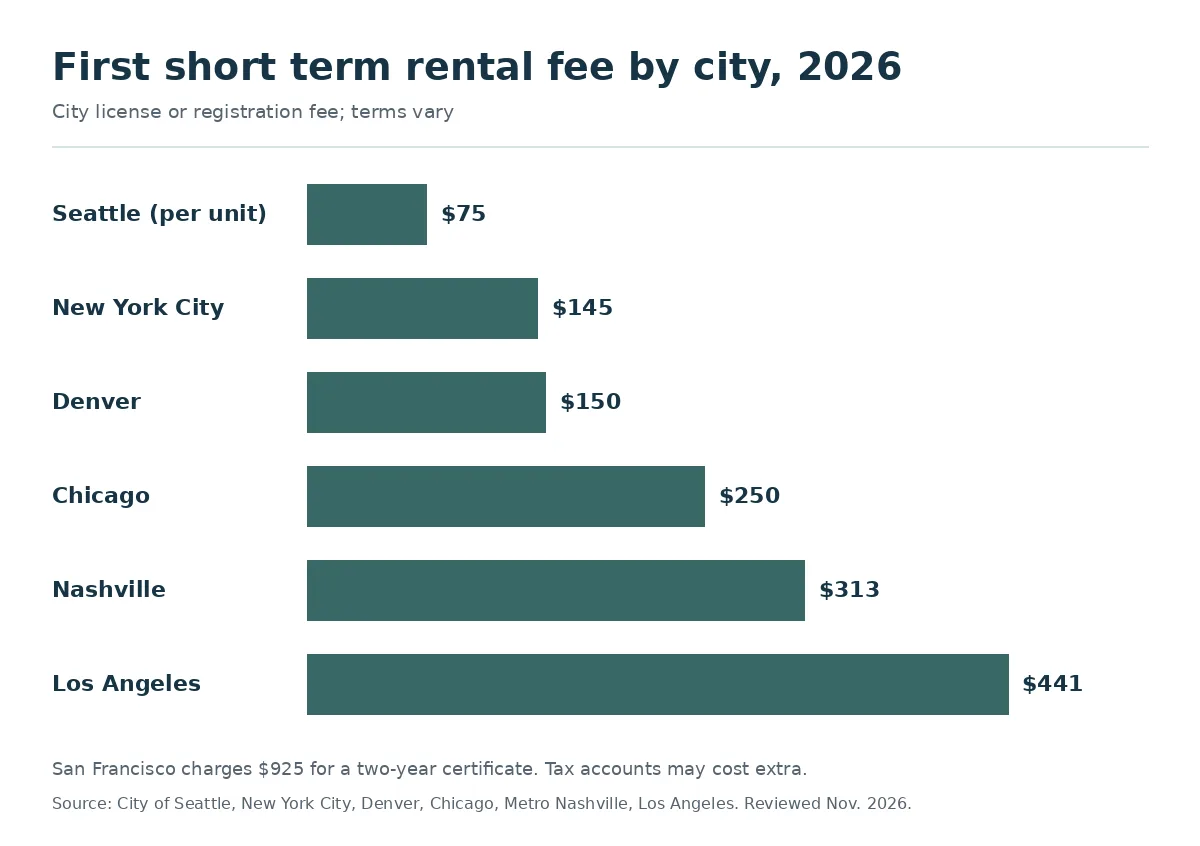
Short term rental regulations differ sharply by city. The table below compares 2026 local requirements in several large markets. Each city’s official page carries more detailed information.
| City | What hosts need | Fee and term |
|---|---|---|
| New York City | Short term rental registration | $145, four-year term |
| Denver | Short term rental business license plus lodger’s tax license | $50 application plus $100 per year |
| Chicago | Shared housing registration | $250 per year |
| San Francisco | Business registration plus short term rental certificate | $925 application, two-year term |
| Los Angeles | Home-Sharing registration | $441 (fiscal year 2026 to 2027) |
| Seattle | Business license tax certificate plus operator license | $75 per unit per year |
| Nashville | Short term rental property permit | $313 per year |
New York City
Hosts must register with the Mayor’s Office of Special Enforcement, and booking platforms including Airbnb may not process transactions for unregistered short term rentals, per the Office of Special Enforcement. The application fee is $145 and non-refundable, and the office cannot approve a listing that offers an unhosted stay, an entire unit, or more than two guests, according to its tips for hosts.
Registrations last four years, renewals cost the same as the application fee, and the registration number must appear in all advertisements, under the city’s final short term rental rules.
Denver
Denver requires a short term rental business license and a separate lodger’s tax license, and only a primary residence qualifies, according to the Denver short term rental tax guide. The Denver FAQ lists a $50 application fee and a $100 annual license fee, with renewal allowed up to 60 days before expiration.
Chicago
Every shared housing unit needs an approved registration number to operate or list short term rentals of 31 days or fewer, and the annual registration payment is $250, per the City of Chicago. In single-family homes and buildings with two to four units, the unit must be the host’s primary residence, according to Chicago’s eligibility criteria. Chicago’s older vacation rental license is an old license type that has since been replaced by the shared housing registration, per the City of Chicago.
San Francisco
Hosts must be permanent residents who spend at least 275 nights a year in the unit, unhosted rentals are capped at 90 nights per calendar year, and the application fee is $925 for a two-year certificate, per the San Francisco Office of Short-Term Rentals FAQ.
Los Angeles
A Regular Home-Sharing registration lets a host rent all or part of a primary residence for up to 120 days per calendar year. As of fiscal year 2026 to 2027, the application fee is $441 and a per-night fee of $3.42 applies, per the Los Angeles Home-Sharing FAQ.
Seattle and Nashville
Seattle’s operator license costs $75 per unit per year, and most operators may run only two dwelling units: their primary residence and one other unit they own, according to the City of Seattle. There are limited exceptions, including some legacy units legally operated before September 2017, and a rental that is not the operator’s primary residence must comply with the Rental Registration and Inspection Ordinance. Nashville requires a permit from the Metro Codes Department before listing, and the annual permit fee is $313, per the Nashville short term rental FAQ. Since March 11, 2026, hosts apply online through Nashville’s ePermits system.
We cover two other markets in detail in our Austin short term rental permit guide and our guide to the Las Vegas short term rental business license.
Does Airbnb collect lodging taxes for you?
Sometimes, but it rarely removes your own registration duties. Airbnb notes that it automatically collects and remits certain taxes only in certain jurisdictions, per its help center.
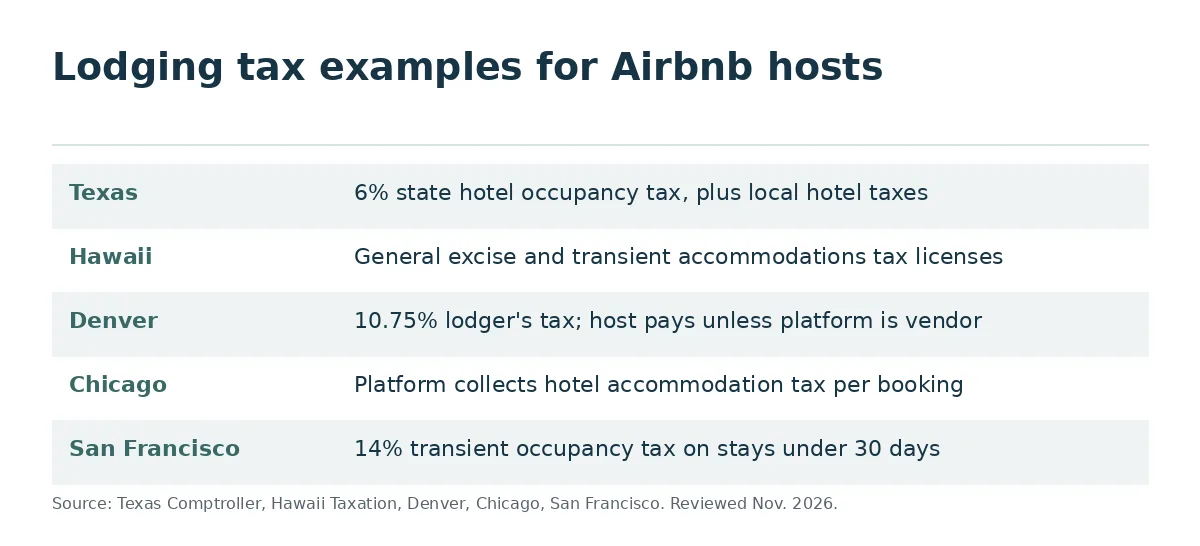
In Chicago, short term residential rental intermediaries, platforms that primarily list shared housing units, must collect the hotel accommodation tax on each booking they facilitate, per the City of Chicago. Denver’s lodger’s tax is 10.75 percent, and the platform collects it only when it acts as merchant of record; otherwise the host is responsible, according to the Denver tax guide. San Francisco requires anyone receiving rent for a stay of fewer than 30 days to collect a 14 percent transient occupancy tax, per the San Francisco short term rental guide.
State taxes can apply too. Texas requires people leasing their houses to collect the 6 percent state hotel occupancy tax the same way a hotel does, and cities may add local hotel taxes, per the Texas Comptroller. Hawaii requires operators of rentals under 180 consecutive days to register for both a general excise tax license and a transient accommodations tax license, according to the Hawaii Department of Taxation. Registration costs $20 for the general excise license and $5 for the transient accommodations registration for one to five units, per the department’s licensing page.
Are safety inspections or insurance required?
In some cities, yes. Health and safety rules are part of the licensing process in several markets, so plan for them before you pay fees.
Nashville requires a floor plan showing smoke detectors, and single- and two-family homes need a certification from a state-licensed architect, engineer or home inspector before a permit is issued. Multifamily buildings require a Fire Marshal inspection instead. Hosts must also show homeowner’s fire, hazard and liability insurance with liability limits of at least one million dollars per occurrence, per Metro Nashville Codes.
New York City requires hosts to post a diagram of normal and emergency exit routes and a copy of the registration certificate, under the city’s final short term rental rules. Austin, by contrast, no longer requires proof of insurance or a certificate of occupancy for new or renewing licenses, per the City of Austin. Check whether your rental property complies with current local rules before applying.
What happens if you host without a license?
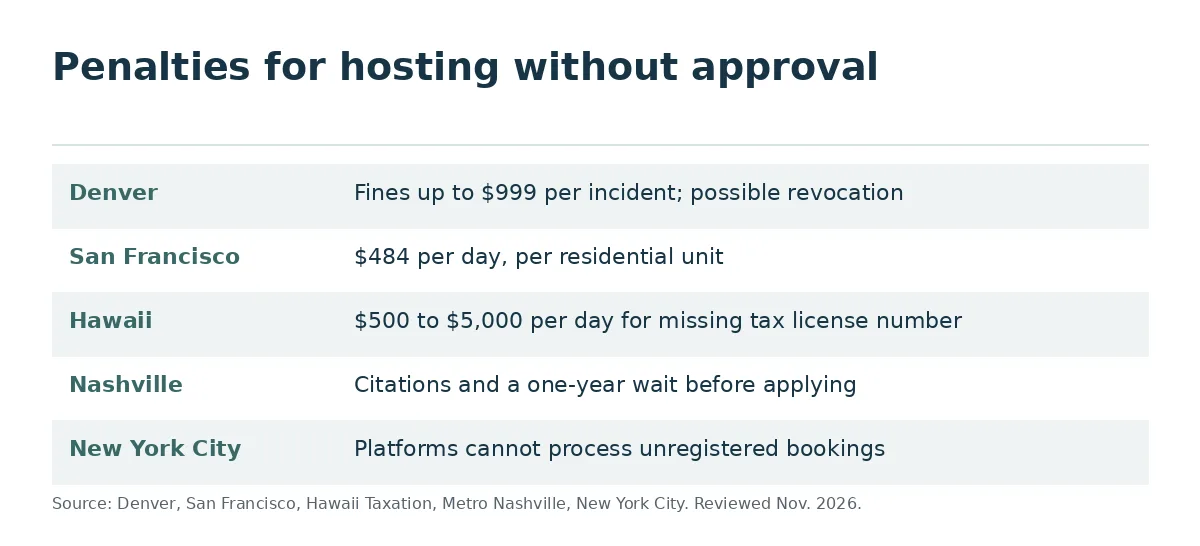
Penalties for non compliance range from listing removal to hefty fines charged by the day. These examples come straight from official sources:
- Denver fines can reach $999 per incident, and licenses can be revoked if the property is not the host’s primary residence (Denver FAQ).
- San Francisco can issue a notice of violation with penalties of $484 per day, per residential unit (Office of Short-Term Rentals).
- Hawaii fines operators who fail to display the tax license number on an advertisement at least $500 per day for a first violation, rising to $5,000 per day for a third (Hawaii Department of Taxation).
- New York City hosts who rent illegally face civil penalties of up to the lesser of $5,000 or three times the rental revenue for each violation (final rules).
- Nashville treats failure to register as operating without a permit, which brings citations and a mandatory one-year wait before applying (Nashville FAQ).
Platforms are part of enforcement actions too, and delisting can be as severe a penalty as a fine. Denver warns that a late renewal can lead the hosting platform to disable new reservations, per the City and County of Denver. Austin began asking platforms to remove unlicensed listings on July 1, 2026, according to the City of Austin. San Francisco warns that listing an incorrect number can get a listing removed and pending reservations cancelled, per its Office of Short-Term Rentals.
What changes when you operate in several states or cities?
A host with rentals in many locations is managing several unrelated rulebooks, and an Airbnb business license in one city does nothing for a listing in the next. Here is what typically changes.
Primary residence rules limit portfolios
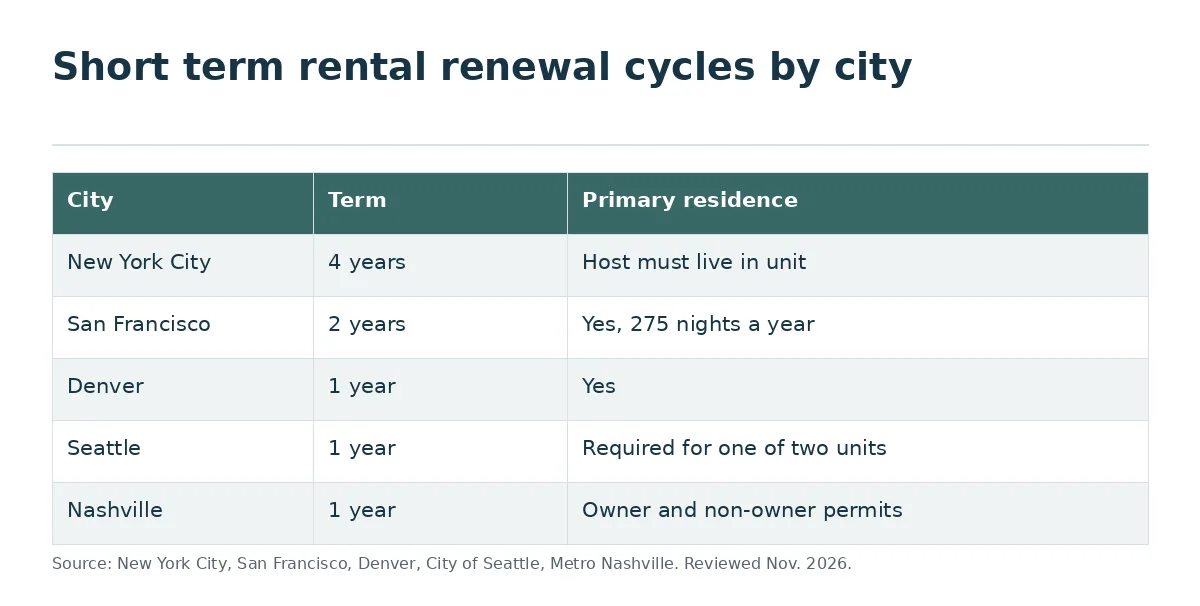
Denver, Los Angeles and San Francisco require the rental to be the host’s primary residence, and Chicago requires it in buildings with four or fewer units. An investor model that works in one city may be barred in the next.
Licenses are often per unit and not transferable
Seattle charges its operator license per unit, Austin operating licenses are non-transferable, and Nashville permits cannot be transferred to another person, entity or address, per the Nashville FAQ. Buying an existing rental or moving a property into a limited liability company (LLC) can mean starting a new application.
Renewal calendars differ
New York City registrations run four years, San Francisco certificates two years, and Denver, Seattle and Nashville licenses one year. Denver’s tax accounts renew every odd year.
Entity and tax setup in each state
If you hold rentals through a company, each state may require foreign registration and its own tax accounts before local licensing. Our guide to the registration sequence when opening in a new state explains the order.
How to get a business license for Airbnb, step by step
Getting an Airbnb business license usually follows the same order, and the steps below work in most jurisdictions:
- Confirm short term rentals are allowed at the address under zoning laws and residential zones, your lease and any homeowners association rules.
- Identify the city or county short term rental license or registration, and check primary residence, night limits and any safety inspections.
- Register for any general business license or tax certificate the city requires, often before the rental license.
- Open state and local lodging tax accounts, and confirm which taxes Airbnb collects for you.
- Add the license or registration number to your listing, and calendar each renewal date to ensure compliance over time.
For hosts with properties in many jurisdictions, our research and verification service identifies the requirements for each address.
Frequently asked questions
Do I need a business license for Airbnb if I only rent a room?
Often, yes. New York City only approves hosted stays where the host lives in the unit, and those hosts still must register. San Francisco considers any short term rental income a business regardless of amount. Some cities exempt or simplify rules for rooms; Seattle says rented rooms without their own kitchens and bathrooms do not count toward an operator’s two units. Check your city’s rules for room rentals.
What is the difference between an Airbnb business license and a short term rental license?
A business license covers doing business in a city at all and is often tied to local business taxes. A short term rental license, permit or registration is a specific approval to rent a dwelling for short stays, usually under 30 nights, with its own eligibility rules. Many cities, including San Francisco and Seattle, require both before you can list.
How much does a short term rental license cost?
It depends on the city. In 2026, New York City charges $145 for a four-year registration, Chicago $250 per year, Nashville $313 per year, Los Angeles $441 for a Regular Home-Sharing application, and San Francisco $925 for a two-year certificate. Denver charges a $50 application fee plus a $100 annual fee. Tax account fees may be extra.
Does Airbnb get the license for me?
No. Airbnb does not apply for licenses on a host’s behalf, and its help center tells hosts to contact their local government about licenses, permits and taxes. Airbnb does collect and remit certain taxes in some jurisdictions, and many cities require hosts to enter their license or registration number on the listing.
Can an LLC hold a short term rental license?
Sometimes. Seattle says an operator can be a single person, a married couple, a group or an entity such as an LLC. Cities with primary residence rules, such as Denver and Los Angeles, tie eligibility to where a person actually lives, which limits entity-owned rentals. Confirm entity rules with each city before transferring a property.
Hosting in more than one city?
LicenseComply researches the business licenses, short term rental registrations and tax accounts each of your rental properties needs, so you know what to file in every city.
Explore Research & Verification Talk to a licensing specialist
Official sources and further reading
- Airbnb Help Center: What regulations apply to my city?
- U.S. Small Business Administration: Apply for licenses and permits
- NYC Mayor’s Office of Special Enforcement: Registration law
- NYC Mayor’s Office of Special Enforcement: Tips for hosts
- NYC final rules governing short term rental registration
- Denver: Short term rentals
- Denver: Short term rental FAQ
- Denver Department of Finance: Short term rentals tax guide (2026)
- City of Chicago: Shared housing registrations
- City of Chicago: Shared housing eligibility criteria
- City of Chicago: Short term residential rental intermediaries
- San Francisco: Guide to opening a short term residential rental
- San Francisco Office of Short-Term Rentals: FAQs
- Los Angeles City Planning: Home-Sharing FAQ
- City of Seattle: Short term rentals
- Metro Nashville Codes: Apply for a short term rental property permit
- City of Austin: Short term rentals
- Metro Nashville Codes: Short term rental FAQ
- Texas Comptroller: Hotel occupancy tax
- Hawaii Department of Taxation: Rental income and transient accommodations
- Hawaii Department of Taxation: Licensing information
Disclaimer: LicenseComply provides professional business licensing and compliance services. However, the informational content on this site (including articles, guides, tools, and videos) is provided for general educational purposes only and does not constitute legal, tax, or accounting advice. Laws and regulations change frequently, and we cannot guarantee that all information is accurate, complete, or up to date for your specific circumstances. Your use of this website and its content does not create an attorney-client, accountant-client, or other advisory relationship. You should consult with a qualified attorney, accountant, or other appropriate professional for advice tailored to your business.