
Key points
- Nine states do not tax wage income in 2026: Alaska, Florida, Nevada, New Hampshire, South Dakota, Tennessee, Texas, Washington and Wyoming, although Washington has enacted a 9.9% tax on income over $1 million starting January 1, 2028.
- California requires an employer to register with the Employment Development Department within 15 days of paying more than $100 in wages in a calendar quarter.
- Most states use their own withholding certificate, such as California Form DE 4, New York Form IT-2104 and Illinois Form IL-W-4, and the federal Form W-4 alone is often not enough.
- Pennsylvania has reciprocal agreements with Indiana, Maryland, New Jersey, Ohio, Virginia and West Virginia, so a resident of those states working in Pennsylvania can file Form REV-419 and have home-state tax withheld instead.

State tax withholding is the employer’s duty to hold back state income tax from each employee’s paycheck and send it to the state revenue agency on a set schedule. If you pay wages for work performed in a state with an income tax, you generally need a state withholding account before your first payroll, a state withholding certificate from each employee, and a plan for deposits, quarterly returns and year-end W-2 filings.
State tax withholding rules are set state by state. Nine states do not tax wages at all, and the rest each have their own forms, thresholds and deadlines. Where an employee works, where they live and whether they work remotely can change which state gets the withholding.
This FAQ covers the employer side of state income tax withholding, using official agency sources reviewed November 2026. LicenseComply does not give tax advice, so confirm how these rules apply to your payroll with the state revenue agency or a payroll professional.
What is state tax withholding and who has to do it?
State withholding tax is income tax an employer deducts from the employee’s wages each pay period. The employer holds the amounts withheld in trust, deposits them with the state and reports them on periodic returns. It works alongside federal income tax withholding but uses separate forms, tax rates and accounts.
The duty usually follows where services are performed. Pennsylvania requires every employer “located or transacting business in Pennsylvania” to withhold from residents’ compensation and from nonresidents’ compensation for services performed in Pennsylvania, per the Pennsylvania Department of Revenue. Illinois requires withholding when you withhold federal income tax from compensation for services “localized” in Illinois, per the Illinois Department of Revenue’s Publication 130. A Texas company with an employee working from Illinois has Illinois withholding requirements for that employee.
Some workers are carved out. Pennsylvania does not require withholding for certain domestic service workers who are not employees for federal income tax purposes, or for agricultural labor whose pay is not subject to federal Social Security tax, per the same Pennsylvania guide.
Which states have no state income tax on wages?
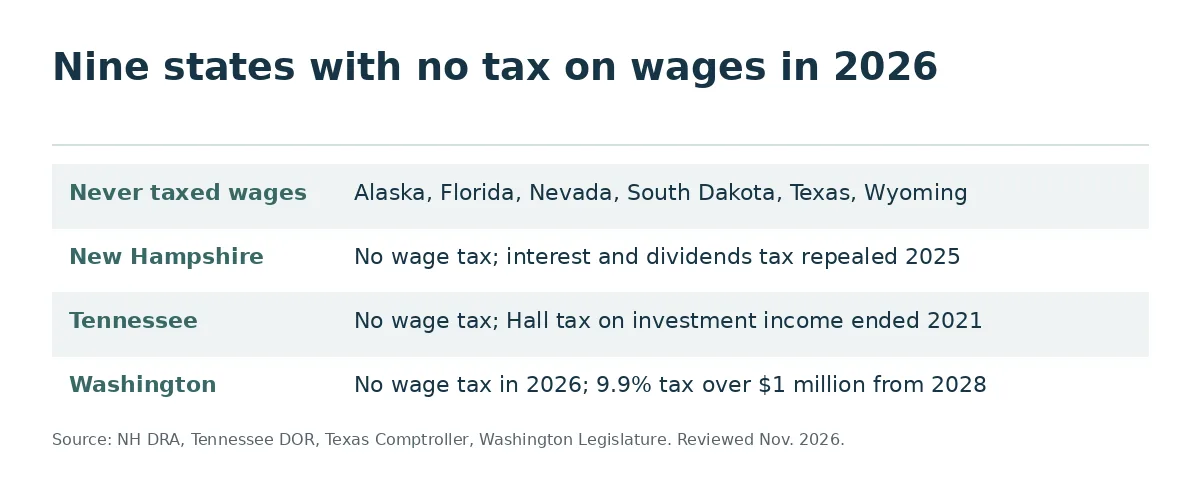
Nine states do not tax wage income in 2026: Alaska, Florida, Nevada, New Hampshire, South Dakota, Tennessee, Texas, Washington and Wyoming. Other payroll taxes, such as state unemployment insurance, still apply there.
Older lists differ because of recent changes:
- New Hampshire does not tax W-2 wages, and its Interest and Dividends Tax was repealed for taxable periods beginning after December 31, 2024, per the New Hampshire Department of Revenue Administration.
- Tennessee’s Hall income tax applied only to interest and dividends and was repealed for tax periods beginning January 1, 2021, per the Tennessee Department of Revenue.
- Texas has no state income tax, per the Texas Comptroller.
Washington needs a caveat. Senate Bill 6346, signed March 30, 2026, became Chapter 238, Laws of 2026. It imposes a 9.9% tax on Washington taxable income beginning January 1, 2028, with first payments in 2029, per the Senate bill report. The tax effectively applies only to income above $1 million, according to the Office of the Governor. Washington wages are not subject to state income tax withholding in 2026.
When do you need a state withholding account number?
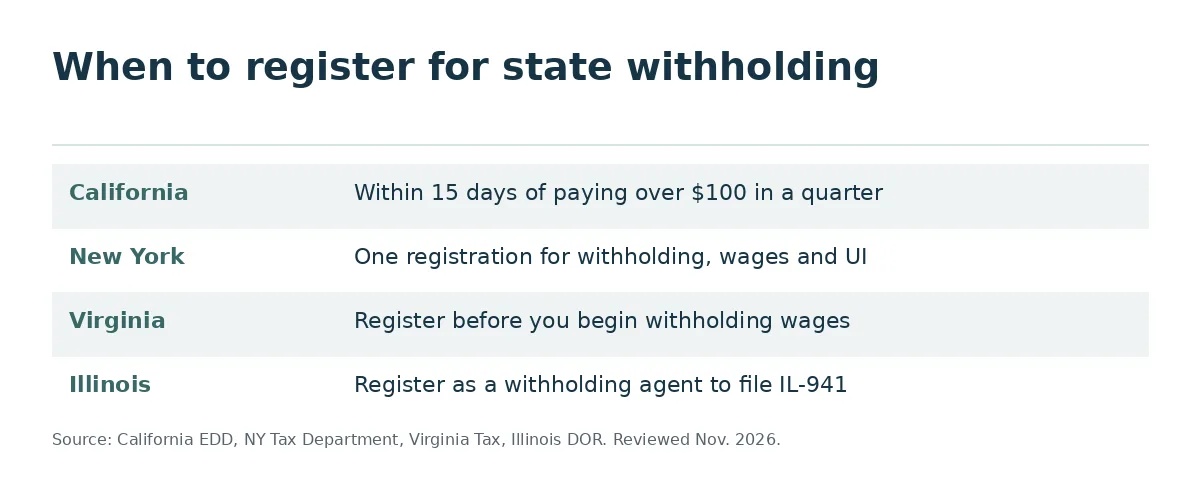
Register before your first payroll in each state where you will withhold. Withholding tax registration gives you the state withholding account number used on every deposit, return and W-2 filing:
- California: register with the Employment Development Department (EDD) within 15 days if you hire employees and pay more than $100 in wages in a calendar quarter, per the EDD employer registration page.
- New York: employers can register for unemployment insurance, wage reporting and withholding tax together online or with Form NYS-100, per Publication NYS-50.
- Virginia: “You should register your business before you begin withholding wages,” and you can register with the Virginia Employment Commission at the same time, per the Virginia employer withholding guide.
- Illinois: employers file Form IL-941 quarterly, which requires registration as a withholding agent, per Publication 130.
In many states the withholding account is separate from the state unemployment account, so you register twice, once with the revenue agency and once with the labor agency. Our guide to state unemployment insurance (SUI) explains that second account, and the complete guide to payroll tax registration for new employers covers the full federal and state sequence. You need a federal Employer Identification Number (EIN) first, which New York requires to register, per its household employer guidance.
Registration starts your filing obligations: Virginia requires a return for every period the account remains open, “even if there is no tax due,” per its withholding guide.
New hire reporting is a separate step. Federal law requires employers to report new and rehired employees to the state where they work within 20 days of hire, and some states require it sooner, per the federal Office of Child Support Services.
Which state withholding certificate does each employee fill out?
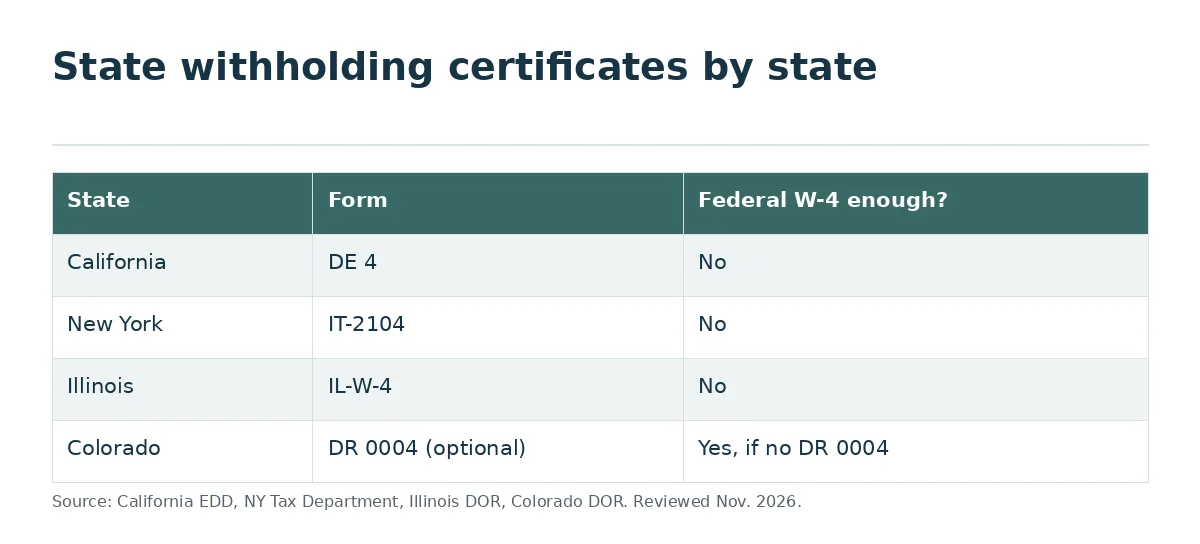
Most income tax states use their own state W-4 equivalent, because the federal Form W-4 no longer uses allowances. Collect the correct state form at hire and keep it on file:
| State | Employee form | If no form is on file |
|---|---|---|
| California | DE 4, Employee’s Withholding Allowance Certificate | Withhold as Single with zero allowances (EDD Form DE 4) |
| New York | IT-2104, covering New York State, New York City and Yonkers | See instructions (Form IT-2104) |
| Illinois | IL-W-4, Employee’s Illinois Withholding Allowance Certificate | Withhold with no allowances (Publication 130) |
| Virginia | VA-4, due when employment begins | See guide (Virginia Tax) |
| Colorado | DR 0004, optional | Employer uses the federal Form W-4 (Colorado DR 0004) |
California’s DE 4 says the federal Form W-4 is used for federal withholding only and that employees must file the DE 4 to determine California withholding.
Employees can change their withholding whenever their tax situation changes by submitting a new certificate, and New York asks them to review Form IT-2104 every year, per the IT-2104 instructions. Employees with other income can ask for more: line 2 of California’s DE 4 lets an employee request an additional amount withheld each pay period, if the employer agrees.
Military families have special rules. Illinois does not require withholding from a non-military employee whose military servicemember spouse is stationed in Illinois by the military and who shares the servicemember’s state of residence, if the employee files Form IL-W-5-NR, per Publication 130.
How much state income tax should you withhold?
The amount depends on the state’s tax rates, the employee’s certificate and the pay period. Flat tax states apply one rate to all taxable income, while graduated tax states use multiple brackets with higher rates as income rises.
- Flat rate: Illinois withholds at 4.95% in 2026, after subtracting exemption allowances of $2,925 each, divided by the number of pay periods in the year (26 for an employee paid biweekly), per the IL-700-T withholding tables. Pennsylvania’s personal income tax is a flat 3.07%, per the Pennsylvania Department of Revenue.
- Graduated rates: New Jersey “has a graduated Income Tax rate, which means it imposes a higher tax rate the higher the income,” per the New Jersey Division of Taxation. California’s withholding methods use the payroll period, filing status and withholding allowances, per the EDD California Employer’s Guide (DE 44).
Supplemental wages such as bonuses can be withheld differently. California allows a flat 10.23% on bonuses and stock options and 6.6% on other supplemental wages paid separately, per the DE 44. Virginia allows a flat 5.75% on supplemental payments when tax was already withheld from regular wages; otherwise you add them to gross wages and use the tables, per the Virginia withholding guide.
How often do employers deposit and file state withholding tax?
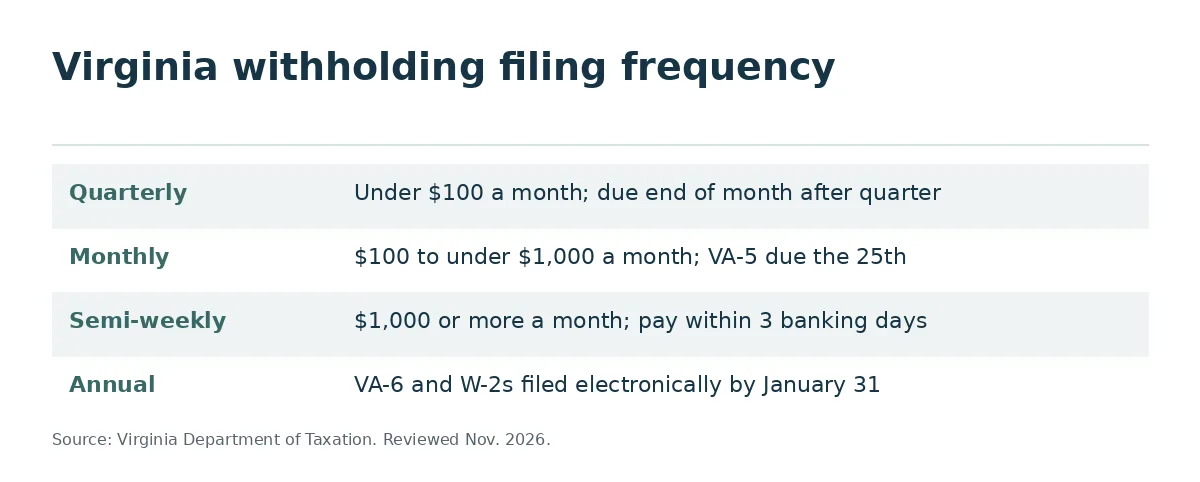
Your state tax withholding deposit and filing frequency usually depends on how much you withhold, and the state assigns it when you register. Two examples show how much this varies:
- Virginia: quarterly filers owe under $100 a month; monthly filers owe $100 to under $1,000 and file Form VA-5 by the 25th of the following month; at $1,000 or more a month, payments are semi-weekly, per Virginia Tax.
- New York: every employer files Form NYS-45 each quarter, due April 30, July 31, October 31 and January 31, with no extensions; a due date on a weekend or holiday moves to the next business day. When accumulated withholding reaches $700, the employer files Form NYS-1 within 3 business days if it withheld $15,000 or more in the calendar year preceding the previous calendar year, or 5 business days otherwise, per the New York due dates page.
Most states now require you to file electronically. Virginia says every withholding tax filer must file all returns and make withholding payments electronically, with payment options that include paying from your bank account online and ACH credit, per Virginia Tax. Its employer guide also offers ACH debit.
What is due at year-end?
At year-end, employers furnish Form W-2, Wage and Tax Statement, to employees and file it with the Social Security Administration by January 31, per the Internal Revenue Service (IRS) employment tax due dates page. Copy 1 of Form W-2 goes to the employee’s state or local tax department, per the IRS.
Many states add an annual return that ties withholding payments to the W-2 totals for the tax year:
- Virginia: all filers must file Form VA-6, Employer’s Annual Summary of Virginia Income Tax Withheld, by January 31 or within 30 days after the final payment of wages, and must submit the VA-6 and W-2s electronically (Virginia Tax).
- Illinois: electronic filing of Forms W-2 and W-2c is mandatory, paper W-2s are not accepted, and W-2s are due no later than January 31 (Illinois Department of Revenue).
How do reciprocity agreements work?
A reciprocity agreement lets an employee who lives in one state and works in another pay wage income tax only to their home state, so the employer withholds for the home state, usually after the employee files an exemption certificate.
Pennsylvania has reciprocal agreements with Indiana, Maryland, New Jersey, Ohio, Virginia and West Virginia. A resident of one of those states working in Pennsylvania can file Form REV-419, Employee’s Nonwithholding Application Certificate, with the employer, and the employer withholds the home state’s tax instead, per the Pennsylvania Department of Revenue.
Illinois has reciprocal agreements with Iowa, Kentucky, Michigan and Wisconsin covering wages earned by Illinois residents, per the IL-1040 Schedule CR instructions.
Reciprocity is not automatic. If the employee does not file the certificate, or the two states have no agreement, the employer generally withholds for the work state, and the employee claims a credit on the home state tax return.
Which state gets the withholding for remote or multi-state employees?
Generally, wages are sourced to the state where the employee physically works. For example, a nonresident who performs services partly inside and partly outside Pennsylvania is subject to Pennsylvania withholding only on the in-state share, unless a reciprocal agreement applies, per the Pennsylvania Department of Revenue.
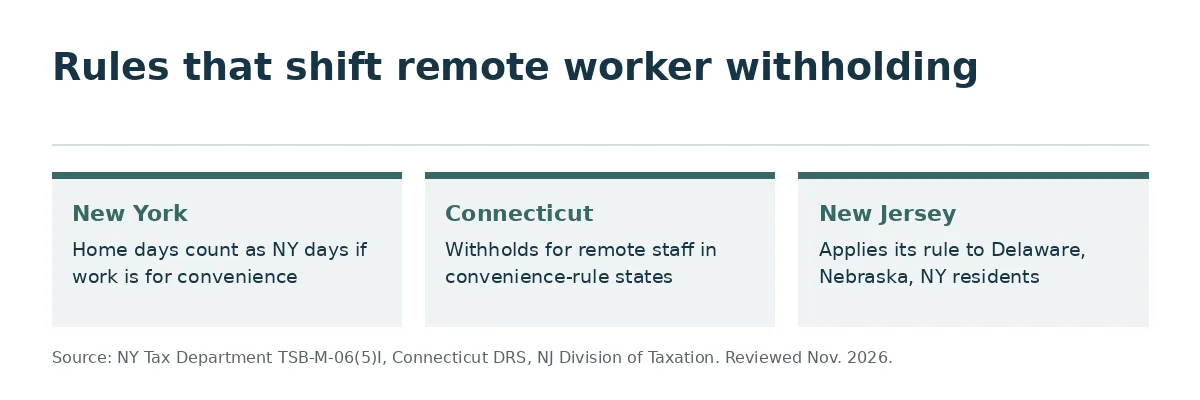
Some states use a convenience-of-the-employer rule that overrides physical location. New York is the main example. When an employee’s assigned or primary office is in New York State, normal work days spent at home outside the state count as New York work days unless the out-of-state work is done out of the employer’s necessity rather than the employee’s convenience, per New York’s TSB-M-06(5)I memorandum.
Other states mirror the rule for residents of convenience-rule states:
- Connecticut: nonresidents working remotely for a Connecticut employer who live in a state with a convenience test will have Connecticut income tax withheld (Connecticut Department of Revenue Services).
- New Jersey: a 2023 law applies a convenience test only to residents of states with a similar test, such as Delaware, Nebraska and New York (New Jersey Division of Taxation).
What are the penalties for late or missed withholding?
State tax withholding penalties stack quickly because withheld tax is the employee’s money held in trust. Virginia charges 6% of the tax due for each month or part of a month a withholding return is late, up to 30%, with a $10 minimum that applies even when no tax is due. The same rate applies to late payment, and interest accrues from the due date at the federal underpayment rate plus 2%, per the Virginia employer withholding guide.
Personal liability is possible at the federal level. The IRS Trust Fund Recovery Penalty can hold a responsible person, such as an officer, partner or sole proprietor, personally liable for the full amount of unpaid withheld taxes plus interest for a willful failure to pay, and paying other business expenses instead counts as willful, per the IRS. The penalty can also reach payroll service providers responsible for the deposits, per IRS Publication 5146.
What changes when you operate in several states?
Each new state where employees work adds its own filing requirements:
- One withholding account per state, plus a separate unemployment account in most states, each with its own account number and login.
- A different employee certificate in each state, and possibly local forms, such as the New York City and Yonkers lines on Form IT-2104.
- Reciprocity certificates for employees who cross state lines and convenience rules for remote staff tied to New York or similar states.
- Closing accounts properly. Virginia expects returns for every period an account stays open, so close accounts in states where you no longer have employees.
Track where each employee actually works, and update payroll when someone relocates or starts working remotely. When you hire in a new state, have the withholding and unemployment accounts in place before the first paycheck there. LicenseComply’s License & Permit Filing service includes these state payroll account registrations as part of initial filings for new locations.
Frequently asked questions
Do I have to withhold state income tax if my business is in a state with no income tax?
Yes, if employees work in a state that has an income tax. Withholding generally follows where services are performed, not where the business is based. A Texas or Florida company with a remote employee in Illinois or Virginia must register and withhold in that employee’s work state, applying any convenience-of-the-employer or reciprocity rules that change the result.
What is a state withholding account number and where do I get it?
It is the ID the state revenue agency assigns when you register as a withholding agent, online or on paper, before your first payroll, using your federal EIN. New York issues it through its combined Form NYS-100 process, and Virginia through online registration or Form R-1. You use the number on every deposit, return and year-end W-2 filing.
Can an employee use only the federal Form W-4 for state withholding?
Sometimes. Colorado’s DR 0004 is optional, and Colorado employers use the federal Form W-4 if the employee skips it. California, New York and Illinois require their own forms: DE 4, IT-2104 and IL-W-4. Without a state form, California employers withhold as Single with zero allowances, and Illinois employers withhold with no allowances.
How do I handle an employee who lives in one state and works in another?
First check for a reciprocity agreement. Pennsylvania has agreements with Indiana, Maryland, New Jersey, Ohio, Virginia and West Virginia, and nonresidents from those states can file Form REV-419 so the employer withholds home-state tax. Without an agreement, you generally withhold for the work state, and the employee claims a credit at home. Confirm with both revenue agencies.
When are state W-2s due?
In many states, January 31, matching the federal deadline for filing Form W-2 with the Social Security Administration and furnishing copies to employees. Illinois requires electronic W-2 filing by January 31 and rejects paper forms. Virginia requires the Form VA-6 annual summary and W-2s electronically by January 31 or within 30 days after final wages. Confirm each state’s date.
Hiring in a new state?
LicenseComply handles license and permit filings for each location, including the state payroll account registrations employers need before the first paycheck.
Explore License & Permit Filing Talk to a licensing specialist
Official sources and further reading
- Internal Revenue Service: Employment tax due dates
- Internal Revenue Service: Depositing and reporting employment taxes
- Internal Revenue Service: Trust fund recovery penalty
- Office of Child Support Services: New hire reporting
- New Hampshire Department of Revenue Administration: Interest and Dividends Tax
- Tennessee Department of Revenue: Hall income tax
- Washington State Legislature: Senate Bill 6346 (2026)
- California Employment Development Department: Register as an employer
- California Employment Development Department: Form DE 4
- New York Department of Taxation and Finance: Withholding tax due dates
- New York Department of Taxation and Finance: Publication NYS-50
- New York Department of Taxation and Finance: TSB-M-06(5)I, convenience of the employer test
- Illinois Department of Revenue: Publication 130, Withholding Illinois income tax
- Illinois Department of Revenue: Electronic W-2 and 1099 programs
- Virginia Tax: Withholding tax
- Virginia Tax: Income tax withholding guide for employers
- Pennsylvania Department of Revenue: Income subject to withholding and reciprocal agreements
- Colorado Department of Revenue: Form DR 0004
- Connecticut Department of Revenue Services: Withholding tax information
- New Jersey Division of Taxation: Convenience of the employer sourcing rule
- Illinois Department of Revenue: 2026 IL-700-T withholding tax tables
- Pennsylvania Department of Revenue: Personal income tax
- New Jersey Division of Taxation: Income tax rates
- California Employment Development Department: California Employer’s Guide (DE 44)
- Internal Revenue Service: Publication 5146
Disclaimer: LicenseComply provides professional business licensing and compliance services. However, the informational content on this site (including articles, guides, tools, and videos) is provided for general educational purposes only and does not constitute legal, tax, or accounting advice. Laws and regulations change frequently, and we cannot guarantee that all information is accurate, complete, or up to date for your specific circumstances. Your use of this website and its content does not create an attorney-client, accountant-client, or other advisory relationship. You should consult with a qualified attorney, accountant, or other appropriate professional for advice tailored to your business.