
Key points
- Payroll tax registration for a new employer starts with a free Employer Identification Number from the IRS, which the IRS says it issues immediately online when an application is approved.
- A new employer that files Form 941 is a monthly schedule depositor for its first calendar year, and federal employment tax deposits must be made by electronic funds transfer.
- Federal law requires employers to report each new or rehired employee to the state where the employee works within 20 days of hire, and some states require it sooner.
- Each state where employees work can require its own withholding and unemployment insurance accounts, such as California, which requires registration within 15 days of paying more than $100 in wages in a calendar quarter.

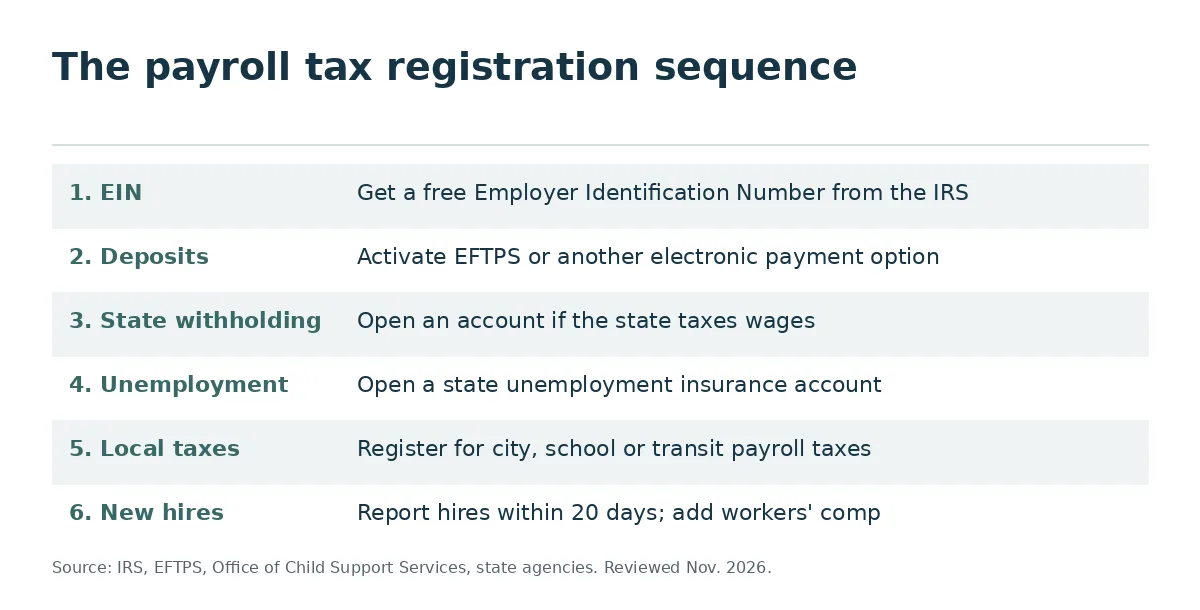
Payroll tax registration is the set of federal, state and local accounts an employer opens so it can withhold, deposit and report employment taxes. For a new employer, the sequence is: get a free Employer Identification Number (EIN) from the Internal Revenue Service (IRS), activate federal deposits through the Electronic Federal Tax Payment System (EFTPS), open a state withholding account and a state unemployment insurance account, add any local payroll taxes, report new hires and secure workers’ compensation coverage. Most of these steps should be done before you pay wages for the first time.
States ask for your EIN on their applications, and payroll providers need your state account numbers before they can file for you. Deadlines are short: Texas and California both measure registration in days, not months.
This guide walks through each step for new employer registration, with state examples and what changes when you hire in more than one state. Rules and figures come from official agency sources reviewed November 2026. Requirements vary by state and city, so confirm each one with the issuing agency.
What is the payroll tax registration sequence for a new employer?
Most employers follow the same seven steps. Some states combine the withholding and unemployment applications into one filing, but the underlying accounts are still separate.
- Get an EIN from the IRS.
- Activate EFTPS or another electronic payment method for federal deposits.
- Learn your federal filing forms: Form 941 (quarterly) and Form 940 (annual).
- Open a state income tax withholding account, if the state taxes wages.
- Open a state unemployment insurance account.
- Register for any local payroll taxes.
- Report new hires to the state directory and put workers’ compensation coverage in place.
Step 1: How do you get an EIN from the IRS?
Apply directly with the IRS to obtain the number. Its online application lets you “get an EIN directly from the IRS in minutes for free,” and if the application is approved, the IRS will “issue your EIN immediately online,” according to the IRS EIN application page. The same page warns, “You never have to pay a fee for an EIN.”
Every later step in payroll tax registration uses this number, so get it first. If you already have an EIN for banking or sales tax, use the same one; our guide on how to find your business tax ID number explains where to look.
Step 2: How do federal payroll tax deposits work?
Federal tax deposits must be made by electronic funds transfer, according to the IRS page on depositing and reporting employment taxes. Free options include an IRS business tax account, Direct Pay for businesses and EFTPS. A payroll service can also make deposits for you, though the IRS notes that third party options may charge a fee.
EFTPS is provided free by the U.S. Department of the Treasury. After your enrollment is validated with the IRS, a personal identification number (PIN) arrives by U.S. mail in five to seven business days, per EFTPS. A new employer that indicated a federal tax obligation when requesting an EIN is pre-enrolled in EFTPS and receives a separate mailing with a PIN and activation instructions, according to Publication 15. Activate the PIN and log in before your first deposit is due to ensure the payment goes through on time.
Which deposit schedule does a new employer use?
A new employer that files Form 941 is a monthly schedule depositor for its first calendar year, because tax liability for lookback quarters before the business began is treated as zero, per Publication 15. Monthly depositors deposit taxes on payments made during a month by the 15th day of the following month.
One rule overrides the schedule: if you accumulate $100,000 or more in taxes on any day during a deposit period, you must deposit by the next business day. After your first year, a lookback period decides your schedule. Employers with $50,000 or less in lookback taxes stay monthly, and those above $50,000 become semiweekly depositors.
Step 3: What are Forms 941 and 940?
Form 941 is the quarterly return employers use to report federal income, Social Security and Medicare taxes withheld from paychecks, plus the employer’s share of Social Security and Medicare taxes, according to the IRS Form 941 page. For 2026, Social Security tax is 6.2% each for employer and employee on wages up to $184,500, and Medicare tax is 1.45% each with no wage limit, per Publication 15.
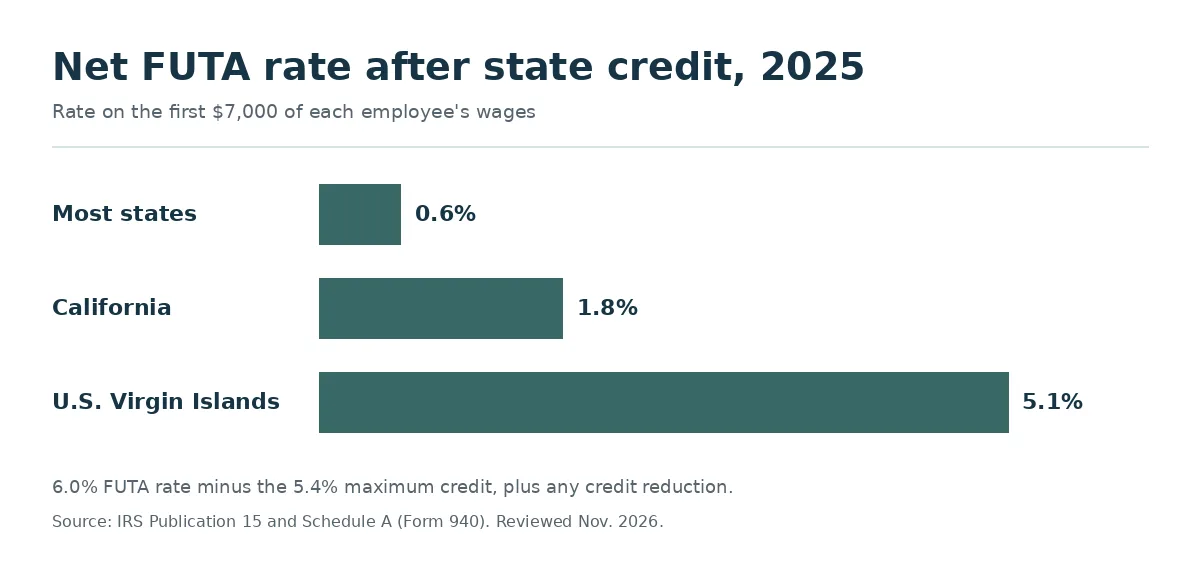
Form 940 is the annual Federal Unemployment Tax Act (FUTA) return, and only employers pay FUTA tax, per the IRS Form 940 page. The FUTA rate is 6.0% on the first $7,000 paid to each employee, reduced to 0.6% for employers that qualify for the maximum 5.4% credit for state unemployment taxes (Publication 15). You generally must file Form 940 if you paid $1,500 or more in wages in any calendar quarter or had an employee in 20 or more different weeks, per the Form 940 instructions.
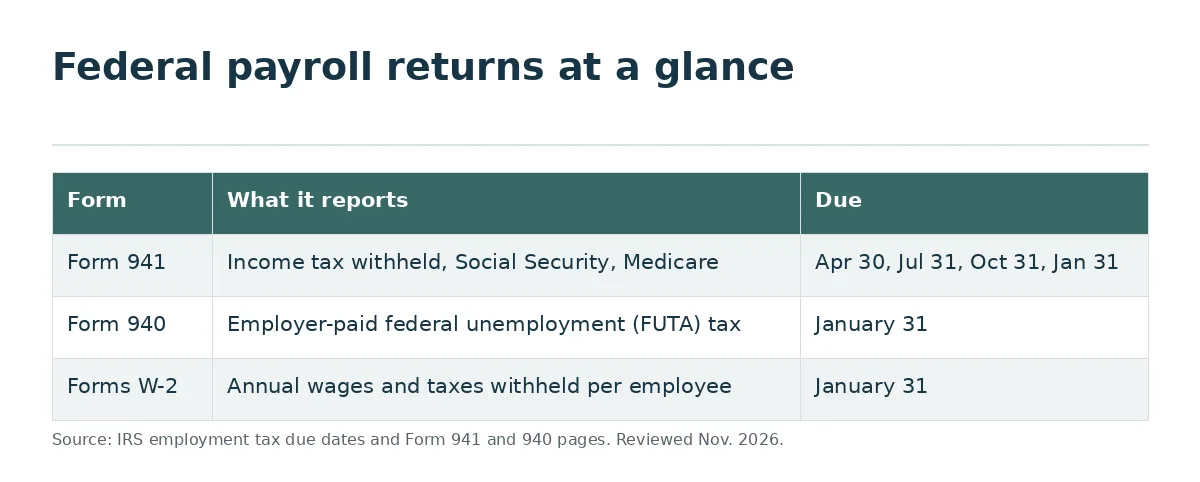
Form 941 is due April 30, July 31, October 31 and January 31, and Form 940 is due January 31, according to the IRS employment tax due dates page. Both get 10 extra calendar days if all taxes were deposited on time. FUTA deposits are required for any quarter in which the tax due exceeds $500.
What is a FUTA credit reduction?
In some years, employers in certain states receive a smaller FUTA credit and owe extra federal tax; these are called credit reduction states. For 2025, the credit reduction rate was 1.2% for California and 4.5% for the U.S. Virgin Islands, per Schedule A (Form 940). The final credit reduction for a year is not determined until November 10 of that year, according to the U.S. Department of Labor.
Steps 4 and 5: How does state payroll tax registration work?
State payroll tax registration usually means two accounts: a withholding account with the state revenue or tax department, and an unemployment insurance account with the state labor or workforce agency. States that do not tax wages skip the withholding account but still require unemployment registration. Texas, which has no state income tax according to the Texas Comptroller, is an example.
Two state deadlines show how fast this happens:
| State | Trigger | Registration deadline |
|---|---|---|
| California | Paying more than $100 in wages in a calendar quarter | Within 15 days (California Employment Development Department) |
| Texas | Paying $1,500 in a quarter or having an employee in 20 weeks | Within 10 days of becoming liable (Texas Workforce Commission) |
| All states | Hiring or rehiring an employee | New hire report within 20 days, or sooner (Office of Child Support Services) |
California’s Employment Development Department (EDD) handles both state payroll accounts through one registration, and its application asks for your nine-digit federal EIN and the date of your first payroll when wages exceed $100. Texas registers unemployment tax accounts online and issues a tax account number and confirmation when you register, per the Texas Workforce Commission page on responsibilities of a liable employer.
State registration examples: Georgia, Missouri and Massachusetts
- Georgia: any business with employees must obtain a payroll withholding tax number, and the Georgia Tax Center usually emails the number within 15 minutes after you submit the online registration, per the Georgia Department of Revenue.
- Missouri: employers register with two agencies. Businesses that must remit withholding tax register with the Missouri Department of Revenue, and the Division of Employment Security must be notified within 30 days of becoming liable for unemployment tax, per the Missouri Department of Labor.
- Massachusetts: employers who pay wages for work done in Massachusetts must register with the Department of Unemployment Assistance (DUA). The owner, staff or a third party administrator can submit the registration online, and DUA will process it and email next steps; most registrations are processed immediately, per Mass.gov. After that, you sign up and log in to Unemployment Services for Employers to manage the account.
- Massachusetts Paid Family and Medical Leave (PFML): employers must withhold PFML contributions and send them through MassTaxConnect. For 2026, employers with 25 or more covered individuals remit 0.88% of eligible wages, which can be split between employee withholding and an employer share, per the Massachusetts Department of Family and Medical Leave and its employer introduction to PFML.
Keep each state account number and online login in one place, and give your payroll provider access once accounts are ready. If an agency asks for additional information, respond quickly so the review process does not delay your first payday.
This guide does not repeat how withholding tax is calculated or how unemployment rates are assigned. For those details, see our state income tax withholding FAQs for employers and our explainer on what state unemployment insurance (SUI) is.
Step 6: Which local payroll taxes might apply?
Some cities, school districts and transit districts levy their own payroll taxes, and each has its own registration or reporting rules. These are four common examples:
- Pennsylvania: employers with worksites in Pennsylvania must withhold and remit local Earned Income Tax (EIT) and Local Services Tax (LST) for employees working there, and register with the local tax collector for a local tax ID, per the Pennsylvania Department of Community and Economic Development.
- Ohio: many municipalities levy an income tax. An employer generally does not have to withhold for an employee who works in a municipality on 20 or fewer days in a calendar year, with exceptions such as the employee’s principal place of work, under Ohio Revised Code Section 718.011.
- Oregon: employers withhold the statewide transit tax of 0.1% from Oregon residents’ wages and nonresidents’ wages for work in Oregon, per the Oregon Department of Revenue. Separate TriMet and Lane transit taxes are paid by the employer; TriMet’s rate is 0.8237% as of February 2026, per TriMet.
- New York: employers withhold New York City and Yonkers income taxes alongside New York State tax and report them quarterly on Form NYS-45, per Publication NYS-50.
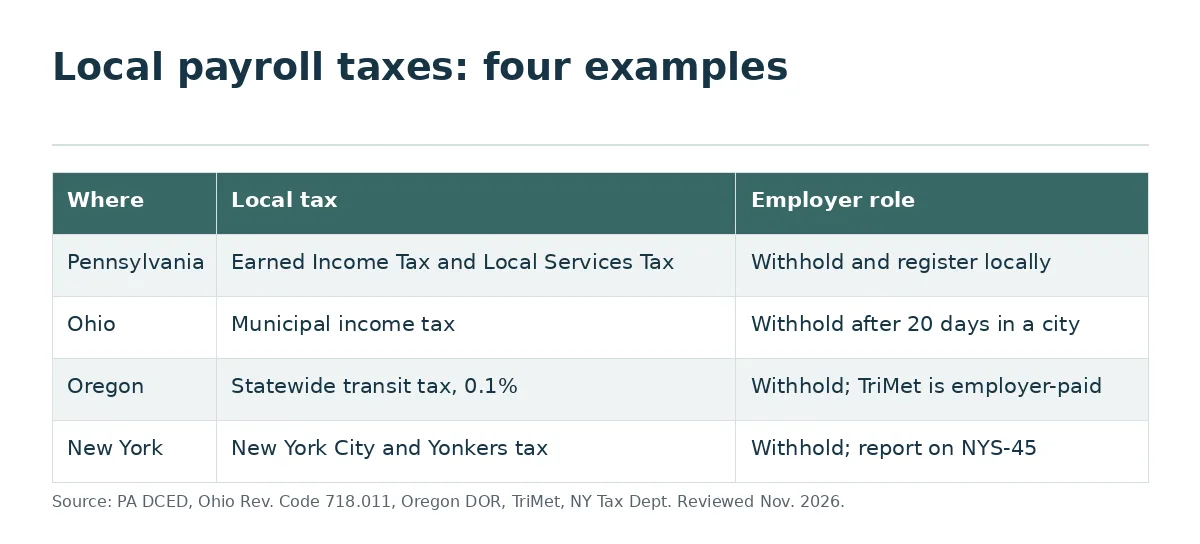
Local taxes are easy to miss because a state registration does not always cover them. Check the city, county and district for every worksite address, and contact the local tax office when the rules are unclear.
Step 7: What else must a new employer set up?
Form I-9 employment eligibility verification
Form I-9 is not a tax registration, but it belongs in the same onboarding process. U.S. Citizenship and Immigration Services (USCIS) says employers use it to verify the identity and employment authorization of every person they hire, citizens and noncitizens alike. Do not file it with USCIS; keep it for three years after the date of hire or one year after employment ends, whichever is later, per the USCIS Form I-9 page.
New hire reporting
Federal law requires employers to report basic information on new and rehired employees within 20 days of hire to the state where the employees work, and some states require reporting sooner, according to the federal Office of Child Support Services. The seven required items are the employee’s name, address, Social Security number and date of hire, plus the employer’s name, address and federal EIN. The state forwards the data to the National Directory of New Hires.
Workers’ compensation insurance
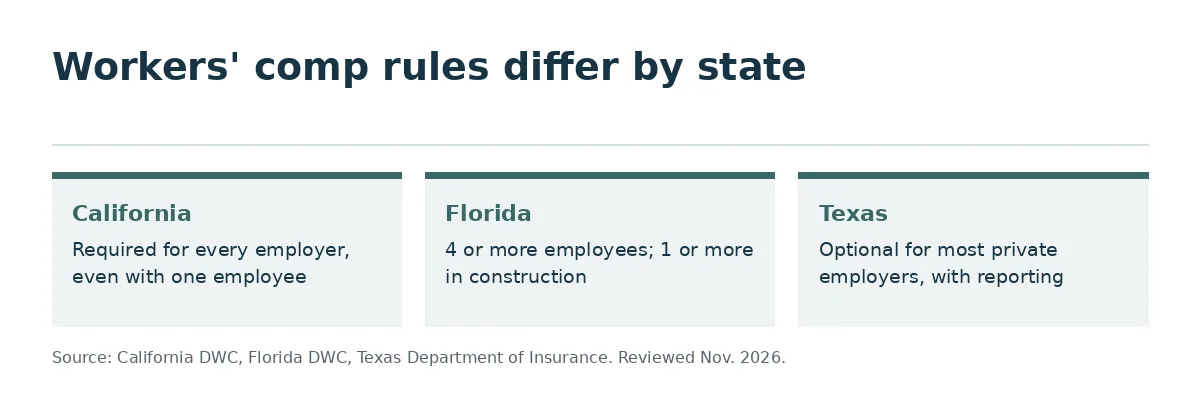
Workers’ compensation is set by state law, not federal law, and each state has its own regulator, as the U.S. Department of Labor directory of state officials shows. Requirements differ sharply:
- California: all employers must provide workers’ compensation, even with only one employee, under Labor Code Section 3700, per the California Division of Workers’ Compensation.
- Florida: non-construction employers with four or more employees and construction employers with one or more employees must have coverage, per the Florida Division of Workers’ Compensation.
- Texas: coverage is optional for most private employers, but employers without it must report that to the state and report certain workplace injuries, per the Texas Department of Insurance.
How long does payroll tax registration take?
Plan for two to four weeks before your first payroll. The EIN can be issued the same day online, but the EFTPS PIN takes five to seven business days by mail, and state account numbers may take longer when an agency reviews an application by hand.
What changes when you hire in several states?
Multi-state employers repeat most of the state and local steps in every state where employees work. The federal EIN, Form 941 and Form 940 stay the same, but each new state can add its own registrations.
- Separate state accounts: each state where employees work can require its own withholding and unemployment accounts, and new hires are reported to the state where each employee works (Office of Child Support Services).
- Local layers per worksite: an Ohio employee who travels to a different city for more than 20 days can trigger withholding for that city (Ohio Revised Code Section 718.011).
- FUTA credit reductions: wages subject to a credit reduction state’s unemployment law raise your federal FUTA cost on Schedule A (IRS).
Hiring in a new state can also trigger registration of the business itself. A limited liability company (LLC) or corporation will “probably need to register with any state where you conduct business activities,” according to the U.S. Small Business Administration. This step is often called foreign qualification, and it is worth confirming early so the legal name on your payroll accounts matches the state’s records. Our guide to the registration sequence when opening in a new state covers the order. LicenseComply’s license and permit filing service handles the business license and permit applications that come with a new location; it does not provide tax advice or open payroll tax accounts on your behalf.
Frequently asked questions
Do I need to register for payroll taxes before my first payroll?
Yes, in most cases. You need an EIN and a way to make electronic federal deposits before taxes are due, and most states expect withholding and unemployment accounts in place before or shortly after the first payday. California requires registration within 15 days of paying more than $100 in wages in a quarter, and Texas within 10 days of becoming liable. Starting two to four weeks ahead avoids missed deadlines.
Is an EIN free?
Yes. The IRS says you can get an EIN directly from the IRS for free and that “you never have to pay a fee for an EIN.” If the online application is approved, the IRS issues the number immediately. Websites that charge for an EIN are third parties, and the IRS warns employers to beware of them. Use the same EIN for federal payroll returns and state registrations.
What is the difference between state withholding and state unemployment registration?
They are two separate accounts. A withholding account covers state income tax taken from employees’ paychecks and usually sits with the state revenue department. An unemployment insurance account covers the employer-paid tax that funds unemployment benefits and usually sits with the state labor or workforce agency. States without a wage income tax, such as Texas, still require the unemployment account.
How soon must I report a new hire?
Federal law requires employers to report each new or rehired employee to the state where the employee works within 20 days of hire, and some states require reporting sooner. The report includes the employee’s name, address, Social Security number and hire date, plus the employer’s name, address and EIN. The hire date is the first day the employee performs services for pay.
Do I need new payroll accounts when I hire an employee in another state?
Usually, yes. Your EIN and federal returns stay the same, but the new state can require its own withholding account, unemployment insurance account, new hire reporting and workers’ compensation coverage. Local payroll taxes may apply too, as in Pennsylvania, Ohio, Oregon and New York City. An LLC or corporation may also need to register to do business in that state first.
Hiring in a new state or city?
LicenseComply files the state and local license and registration applications your business needs before you open or expand into a new location.
Explore License & Permit Filing Talk to a licensing specialist
Official sources and further reading
- Internal Revenue Service: Get an employer identification number
- Internal Revenue Service: Depositing and reporting employment taxes
- Internal Revenue Service: Publication 15, Employer’s Tax Guide
- Internal Revenue Service: About Form 941
- Internal Revenue Service: About Form 940
- Internal Revenue Service: Instructions for Form 940
- Internal Revenue Service: Schedule A (Form 940)
- Internal Revenue Service: Employment tax due dates
- Electronic Federal Tax Payment System
- U.S. Department of Labor: FUTA credit reductions
- U.S. Department of Labor: State workers’ compensation officials
- Office of Child Support Services: New hire reporting
- U.S. Small Business Administration: Apply for licenses and permits
- California Employment Development Department: Register as an employer
- California Division of Workers’ Compensation: Frequently asked questions
- Texas Workforce Commission: Determine whether you need an unemployment tax account
- Texas Workforce Commission: Responsibilities of a liable employer
- Texas Department of Insurance: Workers’ compensation for employers
- Florida Division of Workers’ Compensation: Coverage requirements
- Pennsylvania Department of Community and Economic Development: Local income tax information
- Ohio Revised Code Section 718.011: Municipal withholding for occasional entrants
- Oregon Department of Revenue: Statewide transit tax
- TriMet: Payroll and self-employment tax information
- New York State Department of Taxation and Finance: Publication NYS-50
- U.S. Citizenship and Immigration Services: Form I-9
- Georgia Department of Revenue: Tax registration
- Missouri Department of Revenue: Register a business
- Missouri Department of Labor: Liability for unemployment
- Mass.gov: Register a business with the Department of Unemployment Assistance
- Mass.gov: Paid Family and Medical Leave employer contribution rates
- Mass.gov: Employer’s introduction to Paid Family and Medical Leave
Disclaimer: LicenseComply provides professional business licensing and compliance services. However, the informational content on this site (including articles, guides, tools, and videos) is provided for general educational purposes only and does not constitute legal, tax, or accounting advice. Laws and regulations change frequently, and we cannot guarantee that all information is accurate, complete, or up to date for your specific circumstances. Your use of this website and its content does not create an attorney-client, accountant-client, or other advisory relationship. You should consult with a qualified attorney, accountant, or other appropriate professional for advice tailored to your business.