
Texas Food Truck License Changes for 2026
If you operate a food truck, trailer, or any mobile food unit in Texas, the way you get licensed is about to change. On July 1, 2026, Texas moves from a patchwork of city and county health permits to a single statewide Mobile Food Vendor (MFV) license issued by the Texas Department of State Health Services (DSHS).
To keep operating without interruption, you'll need to transition off your current local permit, determine your risk classification (Type I, II, or III), and prepare for state-led inspections and fees before that date. This guide explains exactly what's changing under House Bill 2844, what stays the same at the local level, and the steps food truck operators should take during the first half of 2026.
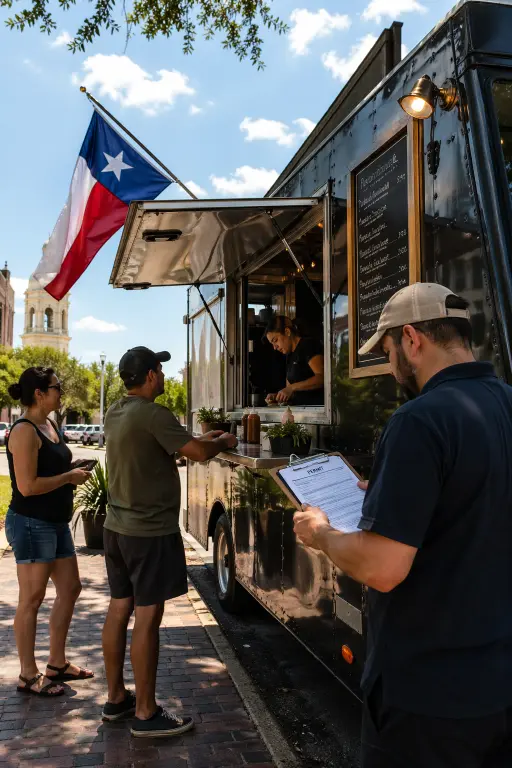
What Changed Under HB 2844
House Bill 2844, passed by the 89th Texas Legislature on May 26, 2025, and signed by Gov. Abbott on June 10, 2025, creates a new Health and Safety Code Chapter 437B dedicated to licensing and inspecting mobile food vendors. The law fundamentally restructures how mobile food businesses are regulated in Texas:
- One statewide license per vehicle. Each food vending vehicle must obtain its own annual MFV license issued by DSHS to operate anywhere in Texas. Local jurisdictions will no longer issue mobile food unit permits under HSC 437.
- DSHS becomes the primary regulator for licensing, inspections, enforcement, administrative penalties, and license suspension or revocation.
- A three-tier, risk-based classification system (Type I, II, III) determines fees and inspection frequency.
- Local rules that conflict with Chapter 437B are preempted, but non-conflicting local ordinances (zoning, allowed locations, fire codes, right-of-way rules) remain enforceable.
- DSHS may enter "collaborative agreements" to reimburse local health departments that conduct inspections on the state's behalf — though local jurisdictions are not obligated to participate.
- A statewide MFV database will track licensed vendors, inspection results, complaints leading to corrective action, and vendor itineraries, with access for local jurisdictions.
In short, the "center of gravity" for food truck licensing moves to DSHS, but operators still need to comply with surviving local ordinances. For the official summary, see the DSHS HB 2844 Overview slides (October 8, 2025).
When the Statewide Licensing System Takes Effect
The transition to statewide licensing follows a fixed timeline. Use it to plan your application calendar:
| Date | Milestone |
|---|---|
| May 26, 2025 | Texas Legislature passes HB 2844 |
| June 10, 2025 | Gov. Abbott signs HB 2844 into law |
| September 1, 2025 | DSHS executive commissioner authorized to begin rulemaking |
| October 17, 2025 | Informal comment period closes on draft 25 TAC Chapter 226 |
| By May 1, 2026 | DSHS must adopt final MFV rules |
| July 1, 2026 | Statewide MFV licensing takes effect; prior local licenses no longer valid |
According to the DSHS HB 2844 Implementation Update (April 8, 2026), operators must apply after the rules are effective or by July 1, 2026, and any prior local license will not be effective after that date. This means the first half of 2026 is your transition window — the time to classify your operation, gather documentation, and prepare to submit a DSHS MFV application.
For the latest official forms, rules, and updates, monitor the DSHS Retail Food Establishments page.
Who Is Considered a Mobile Food Vendor
HB 2844 defines the regulated population broadly so it captures the full range of mobile food concepts:
This includes:
- Food trucks, trailers, and buses serving ready-to-eat meals
- Mobile beverage trucks serving coffee, smoothies, juices, or specialty drinks
- Multi-unit mobile food brands operating fleets across multiple Texas cities or regions
- Specialty mobile concepts such as ice cream trucks, food carts on chassis, and pop-up concession trailers
Each vehicle needs its own MFV license. Commissary kitchens and central preparation facilities remain subject to other DSHS retail or manufacturing permits — they support the MFV license but do not replace it.
How the New Texas Risk Tiers Work
HB 2844 (HSC 437B.151) requires DSHS to classify mobile food vendors into three risk-based tiers. Your tier determines your fees and inspection expectations:
Dispenses prepackaged, non-TCS (time/temperature control for safety) foods.
Examples: trucks selling only sealed snacks, packaged candy, and canned or bottled drinks that don't require temperature control.
Dispenses food that requires limited handling and preparation.
Examples: simple assembly of pre-prepared items, basic cooking with minimal multi-step preparation, no complex cooling or reheating.
Conducts complex preparation including cooking, cooling, holding, and reheating foods on the vehicle.
Examples: full-service food trucks offering multi-step menu items, scratch cooking, and extensive food handling.
Draft DSHS Fees by Tier
The DSHS HB 2844 overview includes draft fee tables. These figures are subject to change as final rules are adopted, but they're useful for budgeting:
| Tier | Application Fee | Pre-Licensing Inspection | Routine Inspection |
|---|---|---|---|
| Type I | $250 | Not listed | Not listed |
| Type II | $500 | $300 | $300 |
| Type III | $800 | $400 | $350 |
DSHS may reclassify a vendor if its menu or processes change, and operators are expected to notify DSHS of changes that would affect their risk tier. If you're considering menu expansion in the near future, factor that into your initial classification decision.
What Happens to Existing Local Licenses and Permits
That said, HB 2844 does not eliminate all local regulation:
- The bill (HSC 437B.003) preempts local rules only where they conflict with Chapter 437B or DSHS rules.
- Local governments may continue to enforce non-preempted ordinances, including:
- Zoning rules
- Allowed operating locations and time-of-day restrictions
- Public right-of-way standards
- Fire and safety codes
- Noise and signage rules
- Special event and festival permits
- Local jurisdictions are required to maintain current permitting and inspection procedures until July 1, 2026, including not pro-rating inspections during the transition.
Practical implication: "Statewide license" does not mean "no local rules." Expect the layered compliance environment to continue — a statewide health license stacked on top of city-by-city zoning, location, and fire requirements. Cities and counties are expected to update their mobile food vendor pages and remaining local processes throughout the first half of 2026.
What Food Truck Operators Should Do Before July 1, 2026
Treat early-to-mid 2026 as a structured transition window. Here's a practical roadmap:
-
1
Inventory every food vending vehicle in your operation
Identify each vehicle that will dispense food or beverages for immediate consumption. Plan for one DSHS MFV license per vehicle, including backup units and seasonal trailers.
-
2
Determine your risk tier (Type I, II, or III)
Compare your current and planned menu to the tier descriptions above. If you intend to expand into more complex cooking soon, consider classifying at the higher tier from the start so you don't immediately outgrow it.
-
3
Prepare your MFV application materials
Monitor the DSHS Retail Food Establishments page for finalized application forms. Assemble:
- Business registration and ownership information
- Vehicle details (VIN, license plate, equipment list)
- Food safety documentation, including Certified Food Manager and Food Handler credentials
- Menu and process descriptions used to support your tier classification
-
4
Verify your commissary or central preparation facility
Draft 25 TAC Chapter 226 indicates MFVs are expected to operate in coordination with a properly permitted central preparation facility unless they qualify for an exemption. Confirm your commissary has the appropriate DSHS retail or manufacturing permit and that your operations match its records.
-
5
Audit surviving local obligations city-by-city
For every jurisdiction where you operate, check for:
- Updated mobile food vendor guidance reflecting HB 2844
- Zoning and allowed location rules
- Fire inspection requirements
- Right-of-way, sidewalk, and parking restrictions
- Special event permits
Watch for announcements about whether your local health department has signed a collaborative inspection agreement with DSHS — that affects who actually inspects your truck.
-
6
Build a budget and inspection calendar
Use the draft DSHS fee tables as planning benchmarks. Build in room for:
- Initial application and pre-licensing inspection fees per vehicle
- Routine inspection fees
- Potential corrective actions
- Surviving local fire or location-specific inspections
-
7
Update internal SOPs and team training
Multi-unit brands should update operating procedures, training materials, and route plans so managers and drivers understand:
- When and where the statewide MFV license applies
- How DSHS inspections will work
- Any required posting of locations or itineraries (draft rules contemplate itinerary tracking in the statewide database)
Quick Transition Checklist (Pre–July 1, 2026)
- List every food vending vehicle that will operate after July 1, 2026
- Assign each vehicle a Type I, Type II, or Type III classification
- Confirm an appropriate commissary or central preparation facility is permitted
- Gather business, ownership, vehicle, and food safety documents
- Review non-preempted local rules (zoning, fire, location, right-of-way) for every city and county served
- Bookmark the DSHS Retail Food Establishments page for forms and rule updates
- Build a budget and renewal calendar for MFV fees per vehicle
- Update SOPs, training, and route planning materials for your team
Frequently Asked Questions
Do Texas food trucks still need local permits after July 1, 2026?
You will no longer need a local mobile food unit health permit — DSHS will issue a single statewide MFV license that replaces those. However, you do still need to comply with non-preempted local rules such as zoning, allowed operating locations, fire codes, right-of-way rules, and special event permits. The statewide license is layered on top of surviving local requirements, not a substitute for them.
What is a Type I, Type II, or Type III mobile food vendor?
The three tiers are risk-based classifications under HSC 437B.151. Type I is low-risk (prepackaged, non-TCS foods only). Type II involves limited handling and preparation. Type III covers complex preparation including cooking, cooling, holding, and reheating on the vehicle. Your tier determines your application fee, inspection frequency, and inspection fees.
Will my current local mobile food unit license stay valid after July 1, 2026?
No. According to the DSHS April 8, 2026 implementation update, prior licenses will not be effective after July 1, 2026. You'll need to apply for the new DSHS MFV license to continue operating. Local jurisdictions are required to maintain their current permitting and inspection processes up to that date.
Do I need a separate license for every vehicle?
Yes. HSC 437B.051 requires each food vending vehicle to obtain its own annual MFV license from DSHS. If you operate a fleet, you'll need an MFV license for each truck, trailer, or mobile beverage vehicle, including backup units.
Can I operate statewide on one license?
Yes — that's the central benefit of the new system. One DSHS MFV license authorizes statewide operation, replacing the previous patchwork of city-by-city health permits. You'll still need to follow each local jurisdiction's surviving rules on zoning, fire safety, and where you can park and serve.
Who will inspect my food truck under the new system?
DSHS has primary inspection authority and conducts both pre-licensing and randomized routine inspections. DSHS may also enter into collaborative agreements to reimburse local health departments for performing inspections, but local jurisdictions are not required to participate. Whether DSHS or your local health department shows up depends on whether your area has a collaborative agreement in place.
What happens if my menu changes and I'm classified at the wrong tier?
DSHS may reclassify vendors when their menu or processes change. You're expected to notify DSHS of changes that affect your risk tier — for example, expanding from prepackaged items (Type I) into hot food preparation (Type II or III).
Does the new system affect commissary kitchens?
Commissaries and central preparation facilities are not directly licensed under Chapter 437B — they continue to be regulated under existing DSHS retail or manufacturing permits. However, draft 25 TAC Chapter 226 indicates MFVs are expected to operate in coordination with a properly permitted central preparation facility unless they qualify for an exemption.
How LicenseComply Can Help
The new statewide mobile food vendor license promises consistency, but it also introduces a new regulator, new risk tiers, and a new way of thinking about inspections, enforcement, and fees. At the same time, city and county governments retain authority in important areas like zoning and fire safety — creating a layered compliance environment that's especially difficult to manage across multiple Texas markets.
For each vehicle and location under HB 2844 and related rules.
Plus ongoing monitoring of rule and fee changes.
Identify which permits and approvals remain in each city and county.
Clear, practical guidance before expanding into a new Texas market.
Get ready for July 1, 2026
Talk to LicenseComply about mapping your Texas state and local food truck licensing requirements.
Official Sources & Further Reading
- Texas DSHS Retail Food Establishments page Primary hub for MFV rules, forms, and updates
- HB 2844 Overview slides (October 8, 2025) DSHS implementation overview
- HB 2844 Implementation Update (April 8, 2026) Most recent DSHS implementation update
- HB 2844 bill history Texas Legislature
- Health and Safety Code Chapter 437 Texas Statutes
- DSHS Certified Food Manager program Required food safety credential information
- DSHS Food Handler program Food handler training program details
Last updated: April 2026. This article reflects the DSHS implementation update issued April 8, 2026. Final MFV rules and fee schedules may differ from draft figures cited above; check the DSHS Retail Food Establishments page for the latest official information.