
What Is a Business Reg Number?
Key Takeaways
-
A business reg number is any official ID a government agency assigns to your business when you register, pay taxes, or obtain licenses, and you often need it for banking, taxes, permits, and contracts.
-
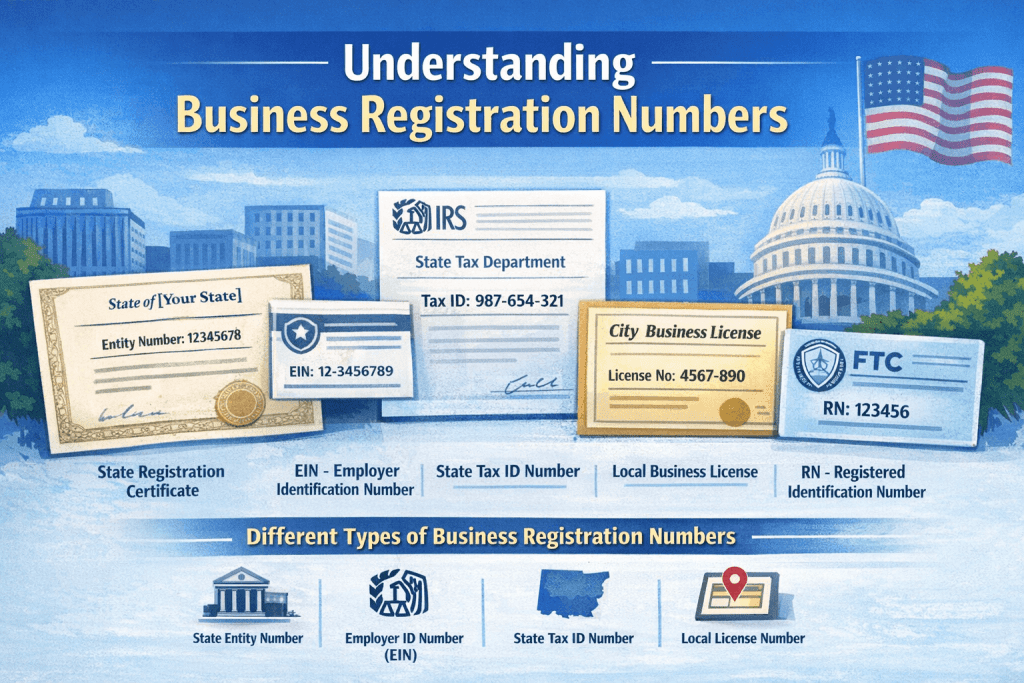
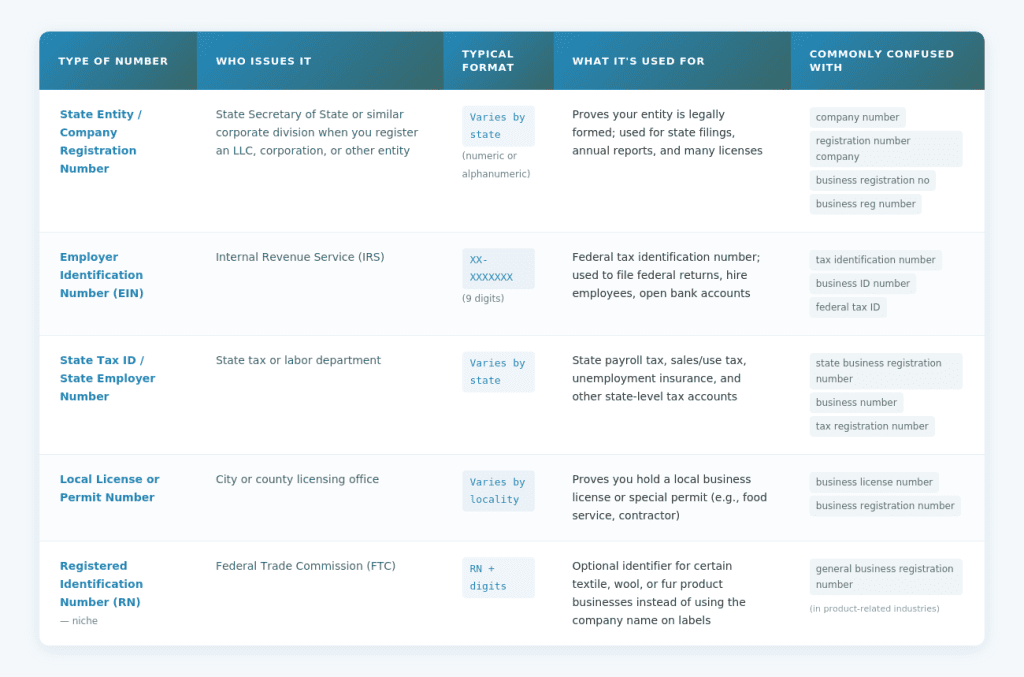
In the U.S., “business registration number” is an umbrella term that can mean a state entity or company registration number, an EIN (federal tax ID), a state tax ID, or a license/permit number, depending on context.
-
An EIN and a state company registration number are different: the EIN is a federal tax ID from the IRS, while the company registration number comes from your state’s corporate filing office and is tied to legal formation and state filings.
-
You usually find your business reg numbers on official documents (formation papers, registration certificates, tax letters, past returns) or through state business search tools and state/IRS contact channels if documents are missing.
-
LLCs, corporations, nonprofits, and partnerships typically have both a state entity number and an EIN, while sole proprietors may rely on a local license number or their SSN/EIN, depending on the form’s instructions.
-
A business registration number is different from a business license number: registration numbers identify the business itself, while license numbers identify specific permissions or activities (like running a restaurant or contracting).**
-
Keeping track of all your registration numbers helps you stay in good standing, avoid penalties, and quickly verify or prove your status to banks, vendors, regulators, and licensing authorities.
-
LicenseComply assists by identifying which registrations and numbers you need, handling filings you authorize, and supporting renewals and updates for the licenses you engage them to manage, especially as you expand into new locations.
The Main Types of Business Registration Numbers in the U.S.
Is a Business Registration Number the Same as an EIN?
- The Employer Identification Number is a federal tax ID issued by the IRS for tax reporting and payroll.
- The company registration number or state entity number is issued when you form an LLC, corporation, or similar entity with the state.
Why Your Business Reg Number Matters
- Filing federal, state, and sometimes local tax returns and reports
- Opening business bank accounts and merchant accounts, where lenders and payment processors use the number to verify your status
- Applying for state and local business licenses, permits, and registrations
- Completing vendor onboarding and contract forms when customers need to verify that you are a registered entity
- Looking up your entity record or confirming good standing in state online databases
The 3-Step Method: How to Find Your Business Reg Number
Step 1: Identify Which Number You Actually Need
- The form or portal you are completing (e.g., “state registration number,” “EIN,” “tax identification number,” “entity ID,” or “certificate number”)
- The context of the request: Bank applications or payroll providers usually need an EIN, sometimes plus the state entity number. State annual reports, business license renewals, or Articles amendments require the state entity or company registration number. Sales tax permits or state employer registrations call for a state tax ID or employer account number.
Step 2: Check Your Official Business Registration Documents
- Check your Articles of Organization (LLC) or Articles of Incorporation (corporation) from your Secretary of State or similar office. These usually list the entity number in the heading or margin.
- Review any registration approval letter or email sent after you registered your new business online.
- The IRS CP 575 EIN confirmation letter is sent when the EIN was first issued
- Prior federal tax returns: look at Form 1120 for corporations, Form 1065 for partnerships, or Schedule C attachments for single-member LLCs filing with a personal return. The EIN appears in the header of these documents.
- Payroll tax filings and W-2/W-3 transmittals, which also list the EIN
- State tax registration letters (sales and use tax, withholding, and unemployment) sent by the state revenue or labor agency
- State business registration certificate or tax account notice assigning an account or registration ID
Step 3: Use Official Online Databases or Contact Agencies
- Go to your state’s Secretary of State (SOS) website or equivalent business registry (e.g., Department of State, Division of Corporations).
- Use the business search tool to perform a business number lookup by your legal name or assumed name.
- Once you locate your entity record, the registration number or entity ID is typically displayed near the top, along with status and filing details.
- Visit your state’s revenue department or employment department website and log in to your business’s online account, where your registration numbers are typically shown.
- If you can’t get online, call the agency’s business help line. After they confirm your identity, you can ask for your number.
Where Can I Find My Business Registration Number? (Common Scenarios)
LLCs and Corporations
- On your Articles of Organization or Articles of Incorporation, as filed with the state
- On your business registration certificate or certificate of good standing obtained from the state
- In your online record on the state’s business search database, under fields like “Entity ID,” “File Number,” or “Registration Number.”
Sole Proprietors and Single-Member LLCs Without a Separate EIN
Nonprofits, Partnerships, and Professional Entities
- In the approved Articles or organization documents from the state
- On correspondence from the state charity or professional licensing board, if applicable
- In state business search databases that maintain public records
Business Registration Number vs. Other Identifiers
Business Registration Number vs. Company Registration Number
Business Registration Number vs. EIN (Federal Tax ID)
- EIN: Issued by IRS; used to file federal taxes, manage payroll, and interact with financial institutions.
- Company registration number: Issued by a state corporate registry; used to file state annual or biennial reports, prove existence, and obtain certain state or local licenses.
Business Registration Number vs. Business License Number
State Business Registration: How It Ties Into Your Business Reg Number
- They are assigned when your organization’s documents are accepted and recorded in the state’s system.
- They remain associated with your company throughout its existence in that state and appear in public records.
- Many states require you to reference this number when filing annual reports, amendments, or dissolution documents.
Registering a New Business Online and Getting Your Number
Typical Online Registration Path
- Create an online account on the Secretary of State or business registration portal.
- Choose your entity type (LLC, corporation, nonprofit, etc.).
- Complete and file the formation document electronically.
- Pay the required state filing fee.
- Receive a confirmation page or email with your entity’s official details, including the registration or file number.
Obtaining an EIN After Registration
Business Registration Certificate and Documents: Why You Should Keep Them
- The official name of your business
- The date of formation or registration
- The state or local jurisdiction of registration
- Your registration or file number and sometimes additional statement IDs
Business Number Lookup: When You Need to Verify or Research a Business
- Verify that a vendor or partner is properly registered and in good standing
- Confirm the exact legal name, entity type, and registration number for contract drafting or compliance checks
- Check whether your own entity is active, dissolved, or delinquent and see the filing history
How LicenseComply Helps
- Clarity on what you really need
We begin by researching and assessing the licenses you need for each location. This way, you know exactly which IDs and licenses apply, like state entity numbers, EINs, state tax accounts, and industry-specific licenses. - Done‑for‑you filings, from start to approval
After you approve the plan, our team prepares and files the applications, works with the agencies, and helps you go from “not started” to “approved” without drowning in paperwork. - Ongoing help, only where you want it
For licenses and registrations you sign up for ongoing service, we can take care of renewals, name or address changes, and closures. This keeps those tasks off your to-do list while you stay in control of costs and what we handle. - Built to scale with multi‑location businesses
If you’re opening in a new city or state, we can handle research and filings for each new location. This helps you get the right numbers and licenses every time you grow.
FAQs: Business Registration Numbers
Is a business registration number the same as an EIN?
No. An EIN is a federal tax ID issued by the IRS, while a business registration number often refers to a state-issued entity or company number. Some forms use “business registration number” as a catch‑all term, so always check whether they’re asking for your EIN, state entity ID, or another number.
How do I know which business registration number a form is asking for?
Look at the exact field label and any instructions on the form. If it mentions “EIN” or “federal tax ID,” use your EIN. If it mentions “entity ID,” “state registration number,” or “file number,” it usually means your state company registration number. If it references “account number” or “tax registration,” it may mean a state tax ID.
Where can I find my business registration number?
Start with your own documents: Articles of Organization/Incorporation, registration certificates, state tax registration letters, and your IRS EIN confirmation letter or past tax returns. If you still can’t find it, use your state’s business search website or contact the relevant agency (state filing office, tax department, or IRS).
Do sole proprietors have a business registration number?
Not always. If you have not formed an LLC or corporation, you may not have a state entity number, but you may still have IDs from local business licenses or state tax registrations. Some forms will let a sole proprietor use an EIN (if they have one) or, in certain cases, a Social Security Number if the instructions say that’s allowed.
How can LicenseComply help me with my business registration numbers?
LicenseComply can research which registrations and IDs you need, then prepare and file the applications you approve for your locations and activities. For licenses you specifically engage us to manage, we can also assist with renewals and updates. Contact us to discuss your situation and get guidance tailored to your business.