
Key points
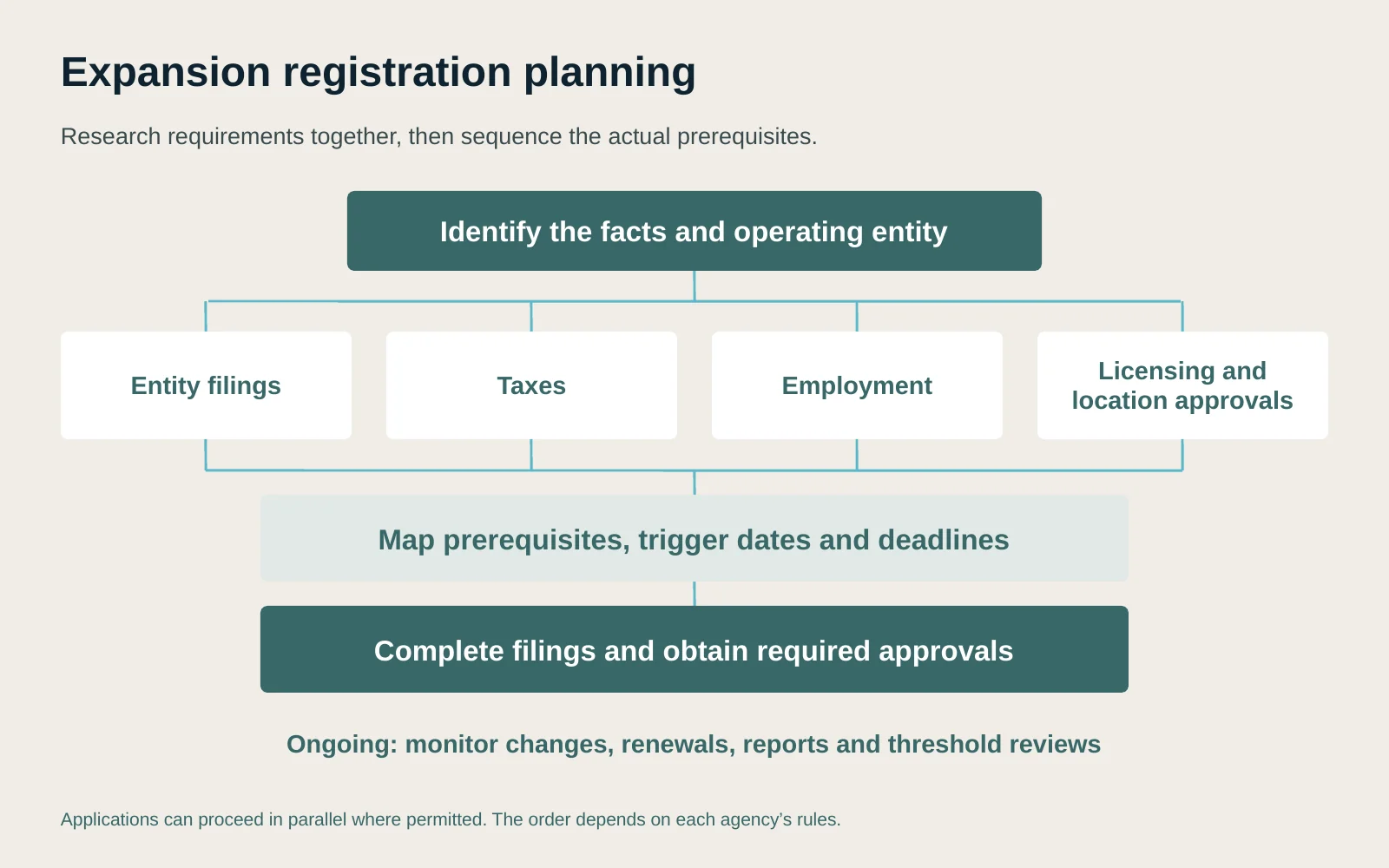
- Expanding to another state works as a sequence: some registrations need another one to exist first, and some deadlines start the day a specific fact becomes true.
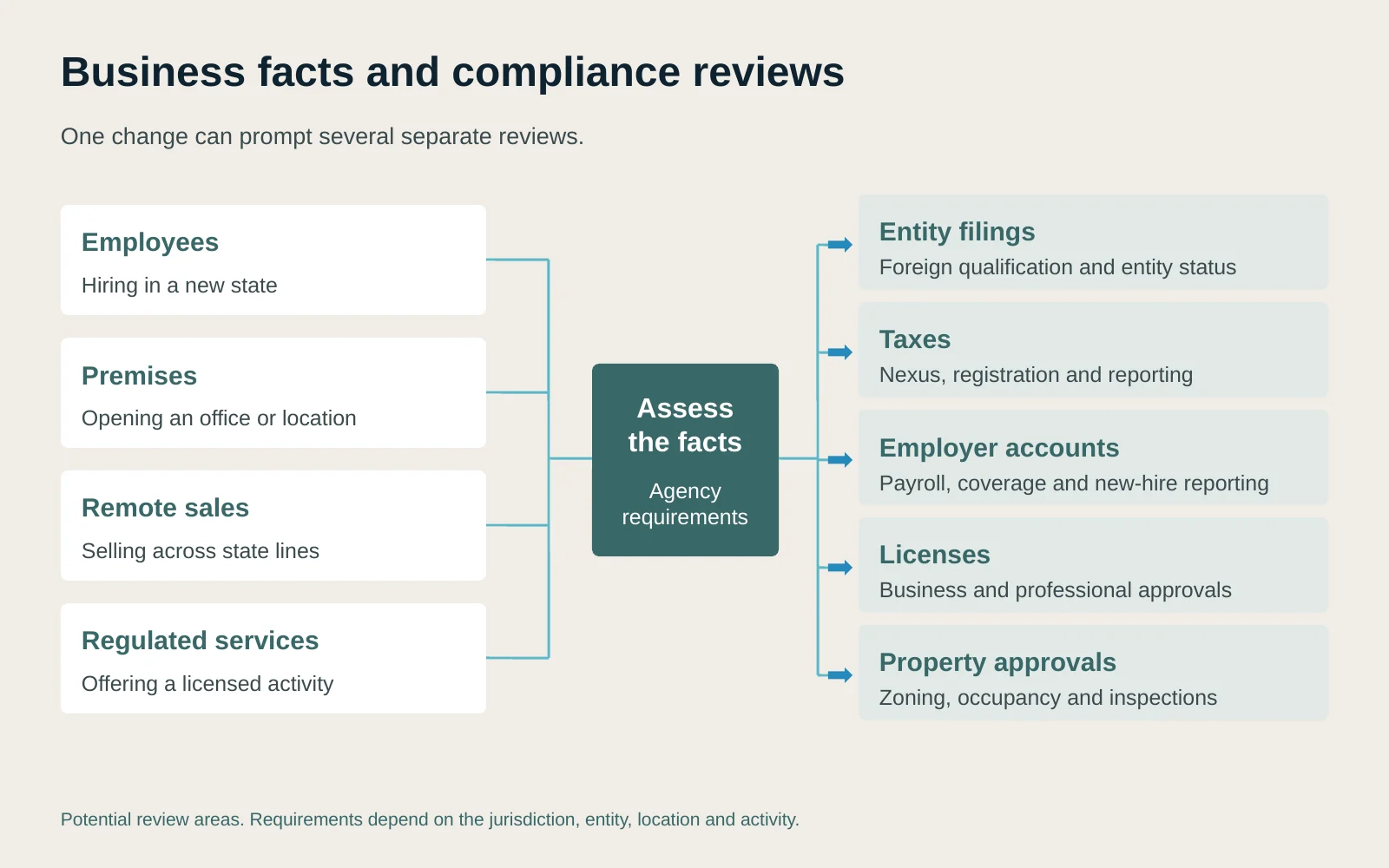
- Start by listing trigger facts for each location: offices, employees, remote sales, regulated activities and street addresses.
- A typical order is home-state good standing, registered agent, foreign registration, tax and employer accounts, general business licenses, location approvals, then activity licenses.
- Thresholds, fees and agency names differ by state, so confirm each requirement with the issuing agency.
Most expansion checklists are flat lists: register the company, get a tax permit, get a license. In practice, expanding into a new state works as a sequence. Some registrations can’t be filed until another one exists, some deadlines start the day a specific fact becomes true, and some obligations attach to a location, not to the company. Operators who treat expansion as a list usually find out about the missing step from a penalty notice.
This article walks through the order of operations for entering any new state. It draws on official rules from several states to show where the structure is the same everywhere and where the details vary. Thresholds, fees and agency names differ by state, so confirm each one with the issuing agency in your target state.
Start with trigger facts, not forms
The U.S. Small Business Administration describes expansion as a combination of foreign qualification, tax nexus and new licensing, noting that license, permit and zoning rules “vary across states and localities” and that federal licenses should be checked with the issuing agency to confirm they cover the new state (SBA, Grow your business). The useful way to apply that advice is to list the facts that trigger obligations before opening any agency website.
| Trigger fact | Obligations it can create | Examples |
|---|---|---|
| An office, store, warehouse or employee in the state | Foreign registration, sales tax registration for each location, employer accounts, local permits | Texas generally treats an office or employee in the state as transacting business (Texas Secretary of State); Florida requires each location to be registered for sales tax (Florida Department of Revenue) |
| Sales delivered into the state with no physical presence | Remote seller registration once the economic threshold is crossed | Thresholds range from $100,000 (Florida, Illinois) to $500,000 (California, New York, Texas), as shown below |
| Gross receipts or entity presence in the state | Franchise, income or gross receipts tax filings | Texas franchise tax economic nexus at $500,000 in Texas gross receipts (Texas Comptroller) |
| Payroll in the state | Unemployment tax, withholding and new hire reporting | Federal new hire reporting within 20 days, to the state where the employee works (U.S. Department of Health and Human Services (HHS), Administration for Children and Families) |
| Any business activity in certain states or cities | General state or city business licenses | Alaska, Nevada and Washington state licenses; Philadelphia and Los Angeles city registrations |
| A regulated activity (food, alcohol, contracting, health care, firearms) | State and sometimes federal licenses tied to the activity | Retail food permits, alcohol permits, contractor licenses |
| A specific street address | Zoning, certificate of occupancy, fire and health inspections | City and county requirements |
Collecting these facts once, for every planned location and activity, is what makes the rest of the sequence predictable.
Step 1: Foreign qualification
A company formed in one state generally must register before it transacts business in another. States use different terms (certificate of authority, application for registration, foreign qualification), but the obligation is the same, and so is the main ambiguity. Most states don’t define “transacting business” precisely. Texas, for example, doesn’t define it by statute, lists 16 activities that don’t count, and explains that an entity generally is transacting business if it has an office or employee in the state or is otherwise pursuing its purposes there (Texas Secretary of State, Foreign Entity FAQs).
What changes from state to state is the price of getting it wrong:
| State | Consequences of transacting business without registering | Source |
|---|---|---|
| California (corporations) | A penalty of $20 per day of willful unauthorized intrastate business, set by a court based on company size and willfulness. The company can’t maintain an action on that business until it qualifies and pays a $250 penalty plus fees and taxes, and it is deemed to consent to California court jurisdiction | California Corporations Code 2203 |
| Florida (LLCs) | Can’t maintain an action in Florida until registered. A civil penalty of $500 to $1,000 for each year or part of a year, on top of the fees and penalties it would have owed. Contracts remain valid | Fla. Stat. 605.0904 |
| New York (LLCs) | Can’t maintain any action, suit or proceeding in New York courts until it receives authority. Contracts remain valid | N.Y. LLC Law 808 |
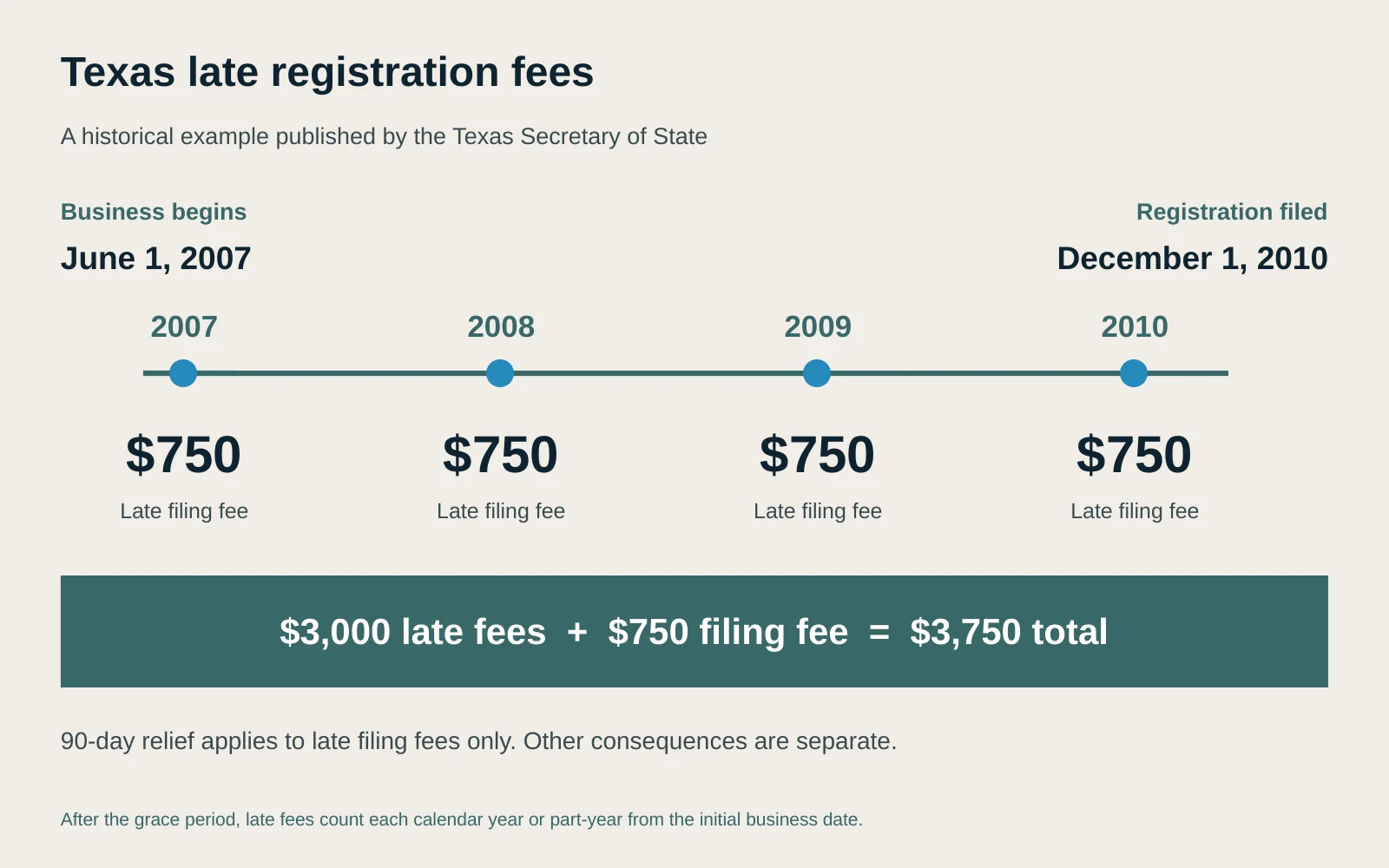
| Texas (all foreign filing entities) | Can’t maintain a lawsuit until registered, may be enjoined by the attorney general, and owes a civil penalty equal to all fees and taxes it would have paid. After a 90-day grace period, a late fee equal to the registration fee ($750 for most for-profit entities) for each calendar year or part of a year | Texas Secretary of State, Form 301 instructions; Texas Secretary of State FAQs |
The pattern is consistent: losing access to the state’s courts is near-universal, and financial penalties grow with time. Texas’s own example shows a corporation that started doing business in June 2007 and registered in December 2010 owing $3,000 in late fees on top of its $750 filing fee (Texas Secretary of State, Foreign Entity FAQs). The court-access penalty also tends to surface at the worst time, when the company needs to collect a debt or enforce a contract.
Two prerequisites are easy to miss in every state:
- A registered agent in the new state. States require a registered agent with a physical address in the state. Texas, for example, requires a street address where the agent can be served during business hours, not just a mailbox or answering service, and doesn’t allow the entity to act as its own agent (Texas Secretary of State, Form 301 instructions).
- Home-state proof of existence. The SBA notes that many states require a certificate of good standing from the formation state with the application (U.S. Small Business Administration). That means the home-state entity has to be current on its own annual reports and taxes before expansion can start.
Step 2: Confirm the federal identifiers you will reuse
Most state tax and license applications ask for the company’s Employer Identification Number (EIN). The IRS issues EINs for free, often online in minutes, and warns businesses about websites that charge for one (Internal Revenue Service (IRS)). Expansion alone usually doesn’t require a new EIN: the IRS says a change of name or location does not, while a change in ownership or structure generally does (IRS, When to get a new EIN). If expansion is happening through a newly formed subsidiary, that subsidiary is a separate legal entity, and every downstream registration belongs to it, not to the parent.
Step 3: State tax registrations
Sales and use tax: same rule, different thresholds
Since South Dakota v. Wayfair in 2018, states may require out-of-state sellers to collect sales tax without any physical presence. The Supreme Court upheld South Dakota’s thresholds of more than $100,000 in sales or 200 transactions per year and overruled the physical-presence rule from Quill (Supreme Court opinion). Every state with a sales tax now sets its own threshold, what counts toward it, the measurement period and the registration deadline. A multi-state seller can’t apply one rule everywhere.
| State | Economic nexus threshold | Measurement period | Registration timing | Source |
|---|---|---|---|---|
| California | More than $500,000 in sales of tangible goods for delivery into the state, including nontaxable sales and sales by related persons | Preceding or current calendar year | Register when the threshold is exceeded | California Department of Tax and Fee Administration |
| New York | More than $500,000 in gross receipts and more than 100 sales, both counting taxable and exempt sales | Immediately preceding four sales tax quarters | Register within 30 days; begin collecting 20 days after registering | NY Department of Taxation and Finance |
| Florida | More than $100,000 in sales into Florida, any number of transactions | Prior calendar year | Register and collect once the prior-year threshold is met | Florida Department of Revenue |
| Illinois | $100,000 in gross receipts; the 200-transaction test was removed effective January 1, 2026 | As set by Illinois | As set by Illinois | Illinois Department of Revenue |
| Texas | $500,000 in Texas revenue, including nontaxable sales, resale sales and separately stated shipping or handling | Preceding 12 calendar months | Register by the first day of the fourth month after the threshold is crossed | Texas Comptroller |
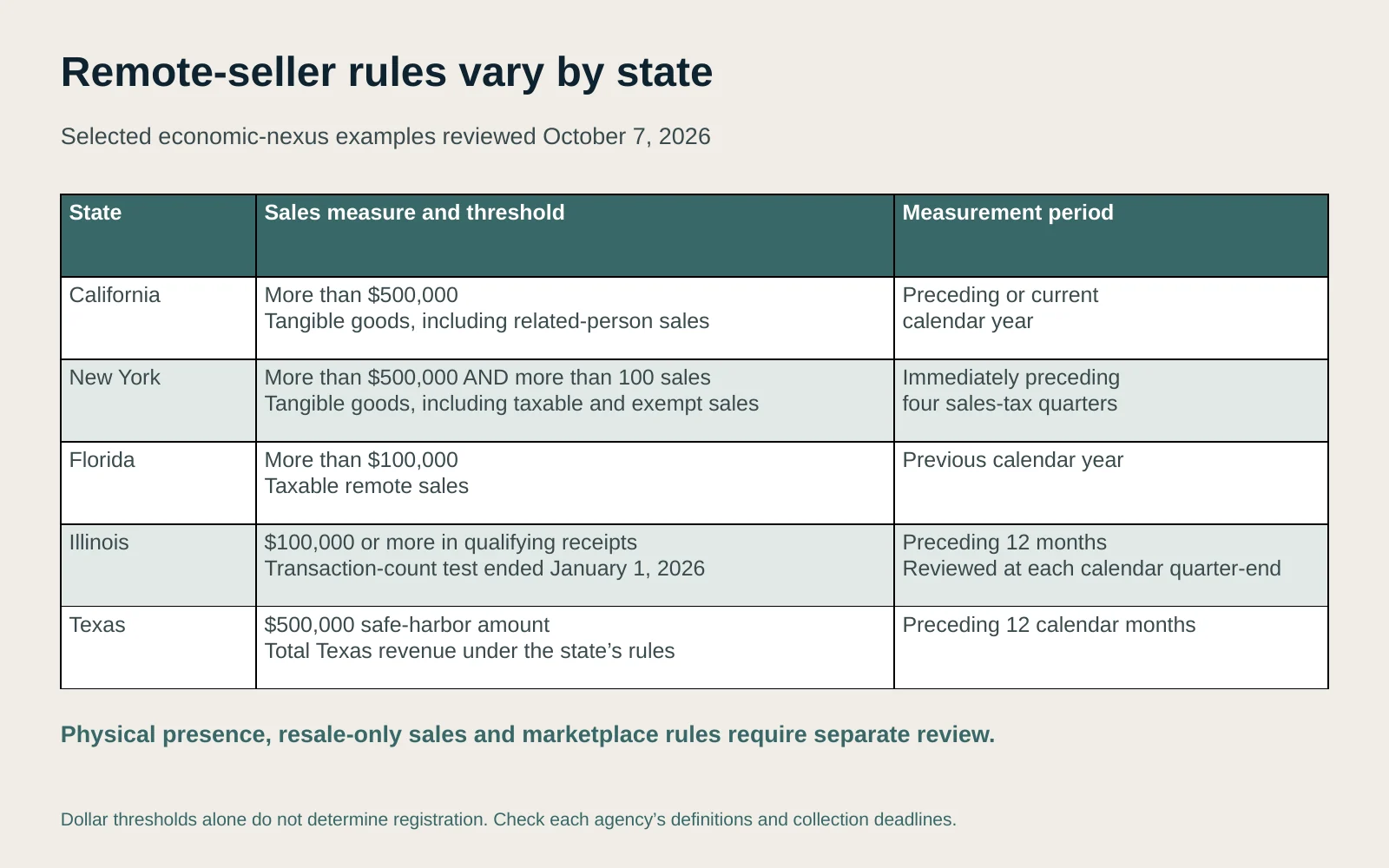
Three lessons from this comparison apply nationally:
- What counts toward the threshold varies. California includes related-party sales. New York, Texas and California all count exempt or resale sales. Companies that track only taxable sales routinely understate their exposure.
- The measurement windows don’t line up. Calendar years, rolling 12 months and trailing sales tax quarters require different monitoring. A single annual review misses mid-year triggers.
- Thresholds change. Illinois removed its transaction count in 2026, which means any monitoring logic needs version dates.
Physical-presence sellers have additional location rules. Florida requires each location to be registered (Florida Department of Revenue). Texas issues a permit for each active place of business, meaning any location that receives three or more orders in a calendar year. Texas permits are free, but a security bond may be required (Texas Comptroller FAQ), and the Comptroller advises allowing two to three weeks to receive one (Texas Comptroller).
Operators expanding into several states at once can use the Streamlined Sales Tax Registration System, which lets a seller register in any of 24 member states (23 full members plus Tennessee as an associate) through one free application. It doesn’t remove the work that follows: returns are still filed with each state, and the system notes that returns must be filed even when a seller has no sales in a state (Streamlined Sales Tax). Registering in states where you have no obligation creates recurring filing duties, so registration should follow the nexus analysis, not replace it.
Entity-level taxes and annual reports
Entity-level taxes have their own nexus rules and calendars, separate from sales tax:
- Texas imposes its franchise tax on taxable entities formed or doing business in Texas, including disregarded entities and series LLCs (Texas Comptroller FAQ). Reports are due May 15, and entities under the $2,650,000 no-tax-due threshold for 2026 and 2027 still file an information report (Texas Comptroller).
- Delaware requires corporations to file an annual franchise tax report and pay franchise tax by March 1, with a $200 penalty for late filing and 1.5% monthly interest. Delaware LLCs pay a $300 annual tax but don’t file an annual report (Delaware Division of Revenue; Delaware Division of Corporations). Because so many multi-state companies are formed in Delaware, this calendar applies regardless of where they operate.
- California’s Franchise Tax Board can suspend a business that falls out of compliance. A suspended business loses the right to do business in the state, to bring or defend a lawsuit, and potentially to keep its name (California Franchise Tax Board).
A new state can owe little or no tax and still produce an annual filing obligation.
Step 4: Employer registrations
Hiring in a new state creates registrations independent of sales or entity filings.
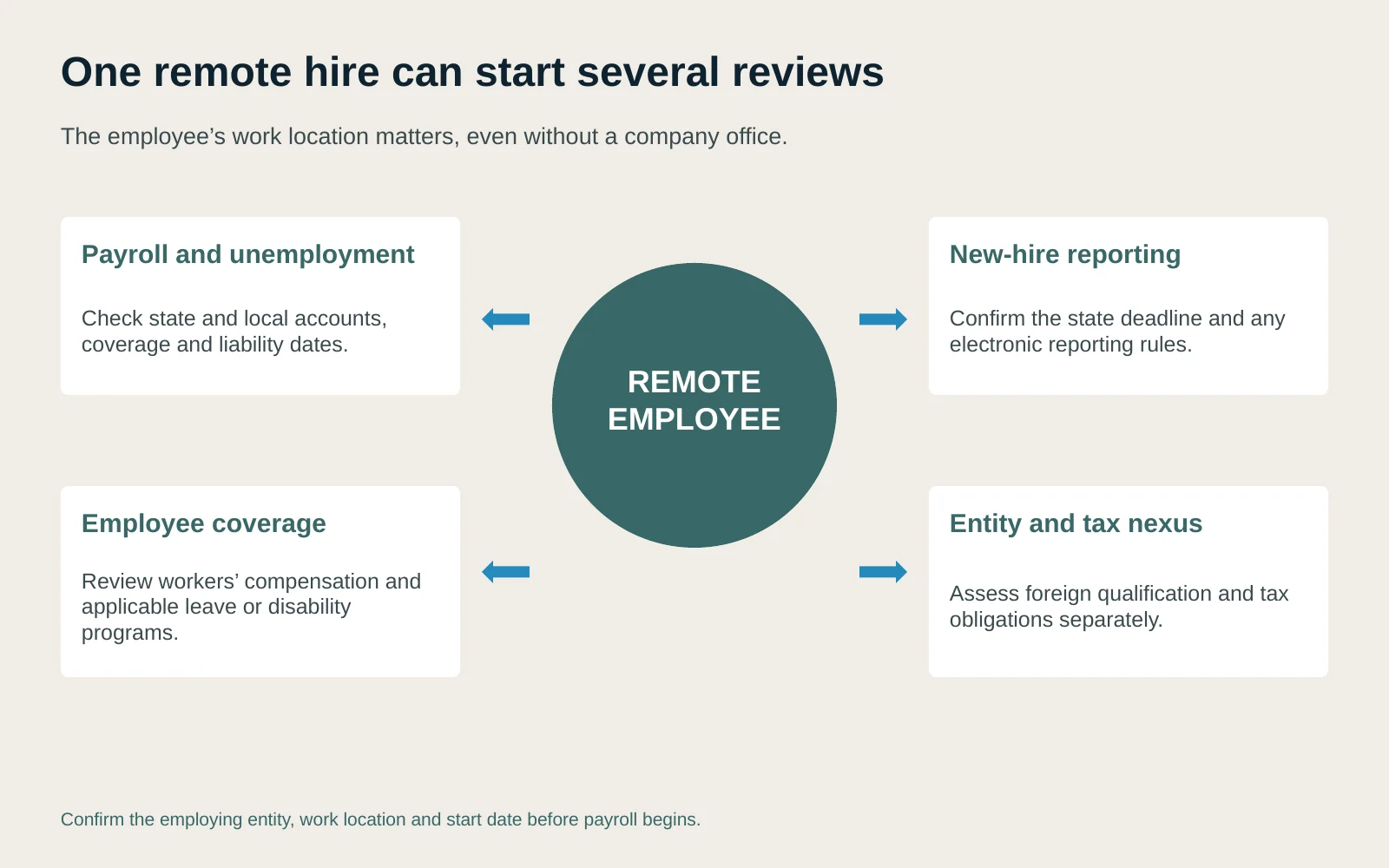
- Federal unemployment tax. Under the IRS general test, an employer is subject to the Federal Unemployment Tax Act (FUTA) if it paid $1,500 or more in wages in any calendar quarter, or had at least one employee for part of a day in 20 or more weeks in the current or prior year (IRS Topic 759).
- State unemployment tax. Each state sets its own liability test and registration deadline. Texas, for example, uses $1,500 in quarterly wages or one employee in 20 weeks, and requires registration within 10 days of becoming liable (Texas Workforce Commission; Texas Workforce Commission, registration).
- New hire reporting. Federal law requires employers to report new and rehired employees within 20 days of hire to the state where they work, and some states require it sooner. Multistate employers can register with the U.S. Department of Health and Human Services to send all new hire reports to one designated state (U.S. Department of Health and Human Services (HHS), Administration for Children and Families).
For multi-state operators, the trap is the remote employee. One person working from home in a new state can create employer registrations there and, depending on the activity, may also be the fact that makes the company “transact business” for foreign-qualification purposes.
Step 5: General business licenses and local requirements
Whether a general business license is required depends on the state and the city, which is exactly why one company-wide answer doesn’t work.
| Jurisdiction | General license requirement | Source |
|---|---|---|
| Alaska | A business license is required to engage in business in Alaska, based on activity, not physical presence. $50 per year | Alaska Division of Corporations, Business and Professional Licensing |
| Nevada | A state business license is required before conducting business, in addition to any local license. $200 per year, or $500 for corporations | NRS 76.100 |
| Washington | A state business license is required if, among other conditions, the business needs city or state endorsements, hires employees, collects sales tax, or has $12,000 or more in gross income per year | Washington Department of Revenue |
| Texas | No general state business license, but activity-specific licenses and local permits still apply | Office of the Texas Governor |
| Philadelphia | A Commercial Activity License is required for anyone doing business in the city, including businesses located outside the city. Free, no renewal, but requires a city business tax account and current city taxes | City of Philadelphia |
| Los Angeles | A Business Tax Registration Certificate is required for anyone engaging in business in the city. Renewals are due January 1 and delinquent after the first business day of March | Los Angeles Office of Finance |
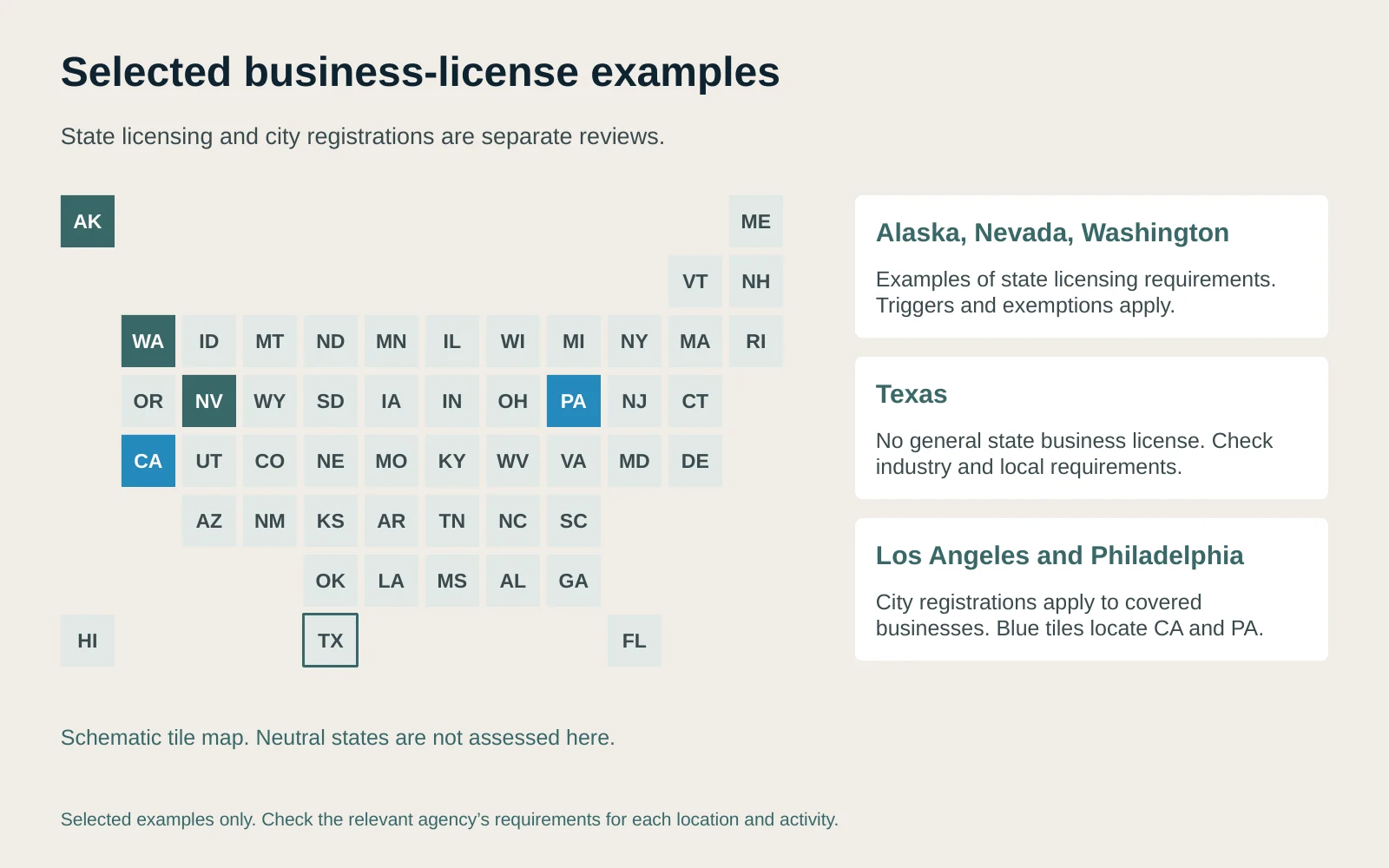
Even where no general license exists, address-level approvals usually do:
- Zoning and occupancy. Cities control what a building may legally be used for. Austin, for example, issues a Certificate of Occupancy as proof that a structure meets building codes for its legal use, after a final inspection for new construction or significant renovations (City of Austin Development Services).
- Health permits. Retail food permitting is often split between state and local authorities. In Texas, the state health department issues permits only where no city or county regulates retail food, and local authorities may set stricter rules (Texas DSHS). Similar splits exist in many states, so two stores in the same metro area can answer to different agencies.
- Fire, signage, alarm and special-district requirements, which vary by city, county and district.
Step 6: Activity licenses
Activity-based licenses come last in the sequence because they usually require the outputs of earlier steps: a registered entity, a tax account, an approved location and a named responsible individual. The SBA notes that states regulate a broader range of activities than the federal government and that many licenses expire on a set schedule (SBA, Apply for licenses and permits). It also lists federally licensed activities, including alcohol (Alcohol and Tobacco Tax and Trade Bureau), firearms and explosives (Bureau of Alcohol, Tobacco, Firearms and Explosives), aviation (Federal Aviation Administration), agriculture and cross-border transport of plants and animals (U.S. Department of Agriculture), and commercial fishing (National Oceanic and Atmospheric Administration) (U.S. Small Business Administration). For those activities, a federal permit doesn’t replace the state and local layers, and a state license doesn’t replace the federal one.
The dependency chain
The practical order for a physical expansion usually looks like this:
- Confirm the home-state entity is current, because a good-standing certificate may be required.
- Appoint a registered agent in the new state.
- File foreign registration before, or as soon as possible after, business begins.
- Confirm whether the existing EIN applies, or obtain one for a new subsidiary.
- Register for sales tax (each location), entity-level tax and employer accounts, and set up new hire reporting.
- Obtain any general state or city business license the jurisdiction requires.
- Secure zoning, occupancy and inspection approvals for the address.
- Apply for activity licenses that depend on the entity, the tax accounts, the location and the qualifying individual.
- Load every renewal, report and expiration date into a single calendar before opening day.
For remote sellers, the chain is shorter but driven by data: monitor revenue and transaction counts by state against each state’s own measurement window, then register on the timeline each state sets after the threshold is crossed.
Where expansions go wrong
- Treating the first sale as the start date. Foreign registration obligations, and grace periods like Texas’s 90 days, often run from the first business activity, which can be the day an employee starts or an office lease begins.
- Using one nexus rule for every state. Thresholds, what counts toward them and measurement windows all differ.
- Counting only taxable revenue. California, New York and Texas all count exempt or resale sales toward their thresholds.
- Assuming no state license means no license. City registrations like Philadelphia’s and Los Angeles’s apply even when the state has no general license, and some apply to businesses located outside the city.
- Reusing one registration for every location. Florida and Texas require location-level sales tax registration.
- Registering everywhere “to be safe.” Each registration produces returns, reports and renewals that must then be maintained.
- Leaving the calendar for later. Every step above creates at least one recurring obligation.
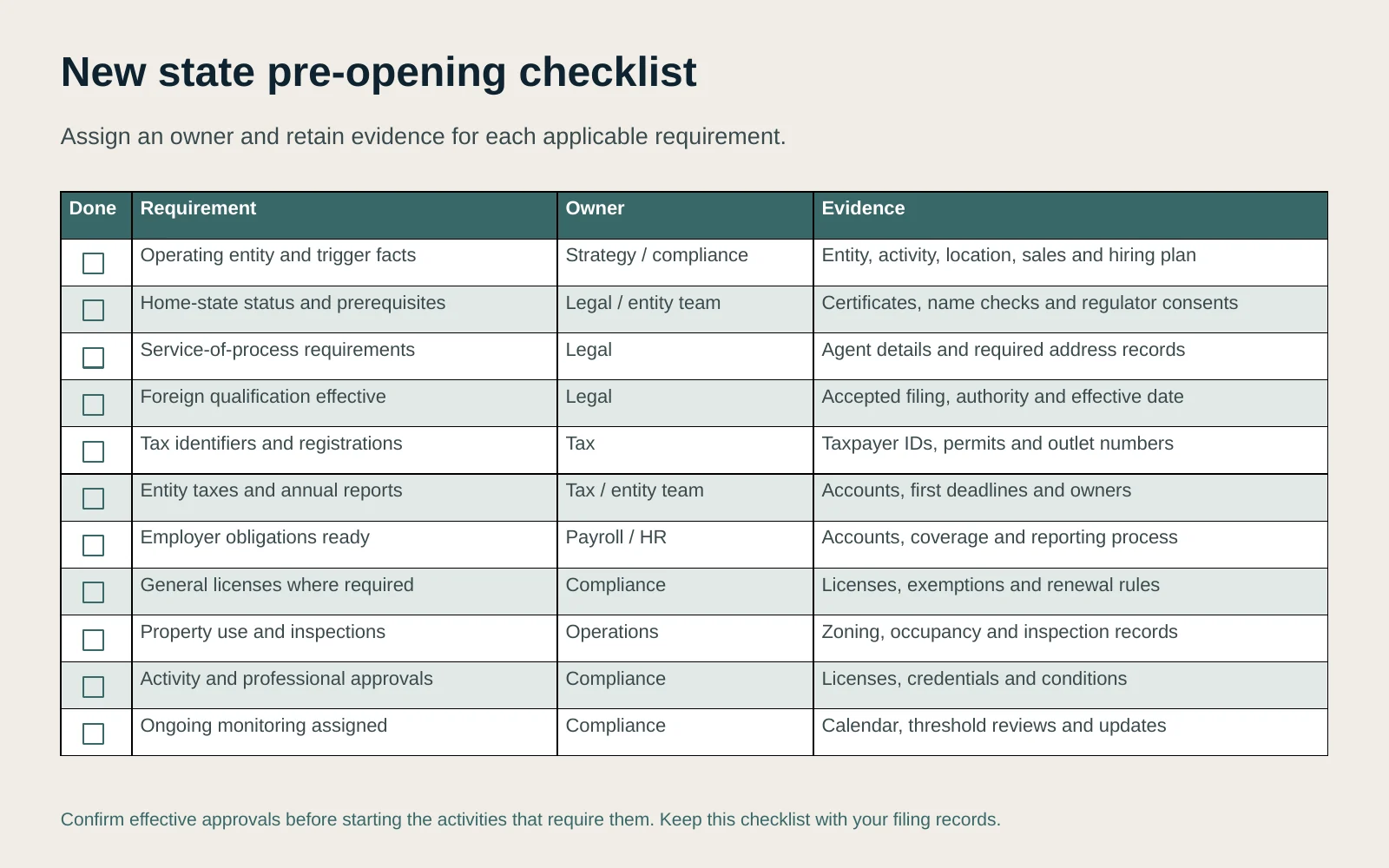
A pre-opening checklist
| Item | Owner | Evidence to keep |
|---|---|---|
| Trigger facts documented for each location and activity | Strategy or compliance lead | Location list, payroll plan, revenue and transaction forecast by state |
| Home-state good standing confirmed | Legal or entity management | Certificate of good standing or status report |
| Registered agent appointed | Legal | Agent consent and service address |
| Foreign registration filed | Legal | Filed application and effective date |
| Sales tax registrations for each location or remote obligation | Tax | Permit and location numbers |
| Entity-level tax accounts and first report dates | Tax | Account status and due dates |
| Employer accounts and new hire reporting | Payroll or HR | Account numbers, liability date, reporting state |
| General state or city business licenses | Compliance | License or registration numbers and renewal dates |
| Zoning, occupancy, health and fire approvals | Operations | Certificates and inspection reports |
| Activity licenses and named qualifiers | Compliance | License numbers, qualifier names, expiration dates |
| Unified renewal and filing calendar | Compliance | Calendar with owners and lead times |
Key takeaway
Expansion compliance is a dependency problem, and every state solves it slightly differently. The right question isn’t only “what do we need in this state” but also “what has to exist first, which fact starts which clock, and how does this state’s version of the rule differ from the last one.” Teams that map trigger facts, sequence the filings and capture every recurring date before launch avoid the penalties, blocked lawsuits and unlicensed periods that come from treating expansion as a list.
Frequently asked questions
What order should registrations be filed in when expanding to another state?
For a physical expansion, a common order is: confirm the home-state entity is in good standing, appoint a registered agent in the new state, file foreign registration, confirm the EIN, register for sales tax, entity-level tax and employer accounts, obtain any general state or city business license, secure zoning, occupancy and inspection approvals, then apply for activity licenses. The exact order depends on each agency’s rules.
Do I need a new EIN to expand into another state?
Usually not. The IRS says a change of name or location does not require a new Employer Identification Number, while a change in ownership or structure generally does. A newly formed subsidiary is a separate entity and needs its own registrations.
Can one remote employee create obligations in a new state?
Yes. One person working from home in a new state can create employer registrations there, such as unemployment tax and new hire reporting, and may also be the fact that makes the company transact business there for foreign registration purposes.
Should a business register in every state to be safe?
Generally no. Each registration creates returns, reports and renewals that must be maintained, so registration should follow a nexus and licensing analysis rather than replace it.
Is there a general state business license in every state?
No. Alaska, Nevada and Washington have state-level business licenses, while Texas has no general state business license. Cities such as Philadelphia and Los Angeles require their own registrations, even for some businesses located outside the city.
Planning an expansion?
LicenseComply researches the licenses and permits each new location needs, files the applications and tracks renewals in one place.
Explore Research & Verification Talk to a licensing specialist
Related guides


Disclaimer: LicenseComply provides professional business licensing and compliance services. However, the informational content on this site (including articles, guides, tools, and videos) is provided for general educational purposes only and does not constitute legal, tax, or accounting advice. Laws and regulations change frequently, and we cannot guarantee that all information is accurate, complete, or up to date for your specific circumstances. Your use of this website and its content does not create an attorney-client, accountant-client, or other advisory relationship. You should consult with a qualified attorney, accountant, or other appropriate professional for advice tailored to your business.