
Key points
- Start by identifying the issuing agency. City business licenses, trade licenses, sales tax permits and entity registrations live in different systems.
- Search the regulator’s own website, not a third-party directory, and read the status, classification and any disclosures on the result.
- Your own license number is usually on the certificate, the renewal notice or the agency’s online account. Replacement copies come from the issuer.
- No search result does not prove there is no license. Try the number, other names and the correct agency before drawing conclusions.
A business license lookup starts with identifying the agency that issued the record. A city business license, a contractor license, and a sales tax permit belong to different systems. Searching the wrong one can make a properly licensed business look as though it has no record at all.
Whether you need your own license number for an application, a replacement certificate for your shop, or proof that a contractor is licensed, the process is similar: identify the record, search the issuing agency, and check what the result actually authorizes. The U.S. Small Business Administration explains that requirements depend on the business activity, location, and government involved. There is no single search that verifies every license a business could need.
This guide explains where to search, how to interpret a match, and what to do when the certificate is missing or the search returns nothing.

Identify the record before searching
Start with the reason you need the number. A supplier asking for a sales tax permit number is not asking for your LLC filing number. A customer checking an electrician wants the applicable trade license. A landlord asking for approval to occupy a space is asking a different question again.
| Record | Typical issuing authority | What it helps establish |
|---|---|---|
| General business license or local business tax receipt | State, city, or county licensing or revenue office | Registration or authorization under that jurisdiction’s business rules |
| Professional or trade license | State licensing board or regulator | Authority to perform specified regulated work |
| Sales tax permit | State tax or revenue department | Registration for applicable sales and use tax obligations |
| Entity registration | Secretary of State or equivalent registry | The legal entity’s formation or registration status |
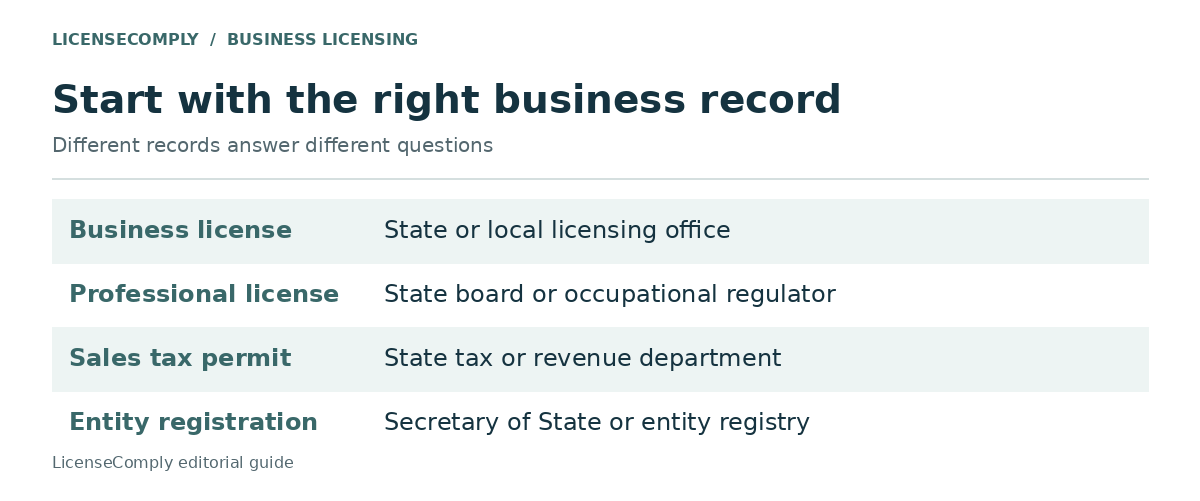
An entity registration does not, by itself, establish that a business holds every operating license. Texas illustrates why terminology causes confusion: the Governor’s Business Permit Office says Texas has no general state business license. That does not eliminate trade, tax, health, or local requirements. Search for the actual authorization relevant to the activity.
If someone simply requests your “business license,” ask which issuing agency or document they will accept. That short clarification often avoids ordering an unnecessary replacement or sending an unrelated tax record.
Search professional and trade licenses
Use the regulator’s official website, rather than a directory that republishes licensing information. Start from the agency’s main page and follow its license verification link. This reduces the chance of using an old database or a paid service that cannot provide authoritative status.
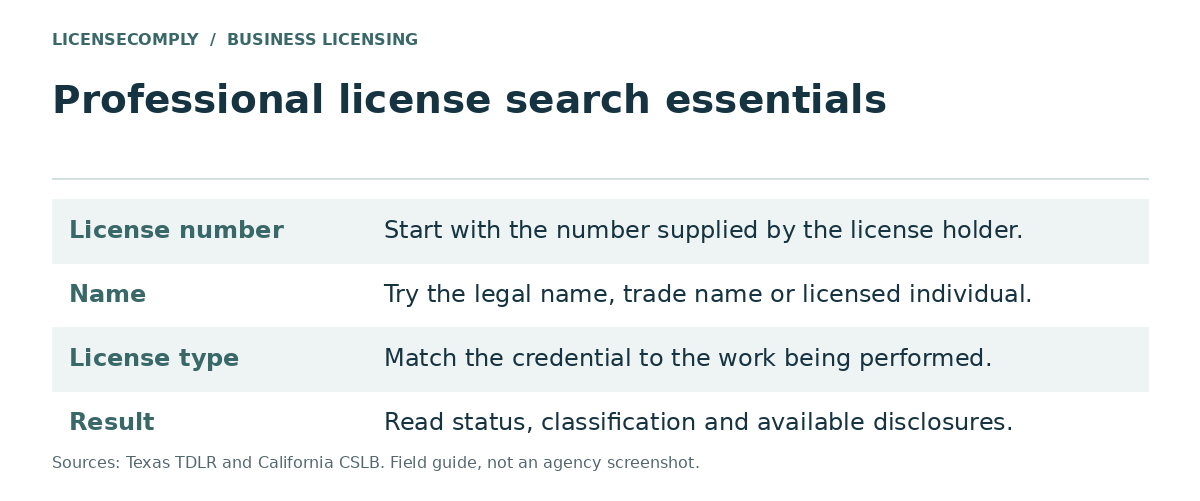
For Texas occupations regulated by TDLR, start with the TDLR Active License Search. Have the license number, license type, and business or individual name ready. A professional’s personal credential and an establishment’s license are not necessarily the same record, so match the record to the work and business you are checking.
For California contractors, use CSLB’s Check a License. The tool provides license verification information and complaint disclosures. CSLB also provides detailed name-search tips. If a business name contains a person’s first and last names, try the last name first. Shortening the name or trying a version without “The” or “A” can help locate a record.
A search result should answer more than whether the name exists. Read the license classification, status, and any restrictions or disclosures. A license covering one category of work should not be treated as permission for every service a company advertises.
Search state business license records
Some states operate business licensing systems that cover multiple endorsements or registrations. Washington’s Department of Revenue business lookup searches business licenses, tax accounts, and reseller permits issued by that department.
Use the available identifiers to narrow the result. A legal name, trade name, or location helps distinguish businesses with similar names. When a result includes several locations or endorsements, inspect the specific location and authorization you need.
A record in a state business licensing system does not automatically confirm a separate professional credential. Keep a note of which agency you searched and which license the result covers. If you need both a business license and a professional license, perform both checks.
Look up a sales tax permit
Sales tax permits belong to state tax agencies. In Texas, the Comptroller’s databases page directs users to Sales Taxpayer Search. Select the sales tax search rather than assuming that a taxable-entity or franchise-tax result proves the same thing.
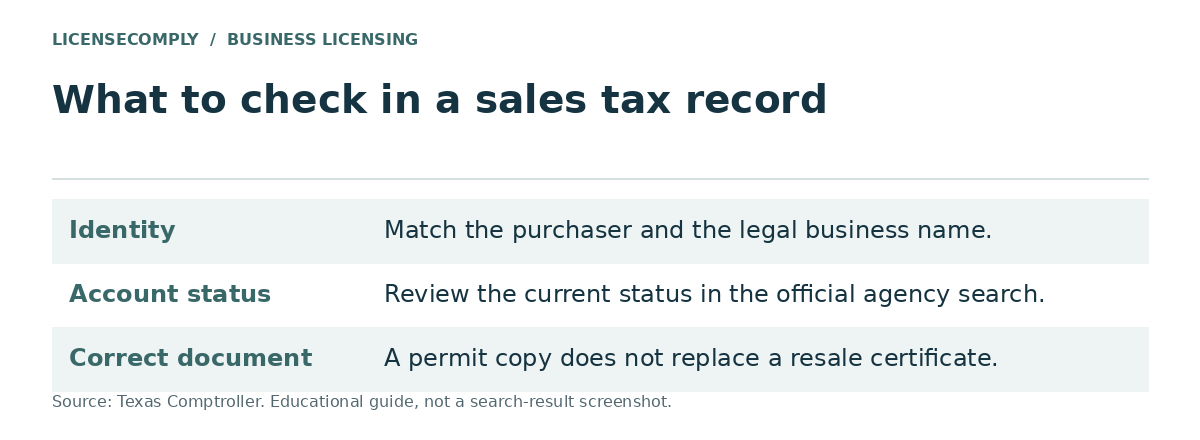
This distinction matters when buying inventory for resale. The Texas resale certificate guidance explains that a permit number or copy of a permit does not replace a properly completed resale certificate. The permit lookup helps check the account; the certificate documents the claimed exemption for the purchase.
When you find a record, compare its name and identifying information with the document the business supplied. A valid account belonging to another entity is not a valid match. Record the date of your check because account status can change.
Search city and county records
For local licenses, begin with the city or county where the business operates. Look for a business licensing office, finance department, tax collector, or clerk. The department name differs by jurisdiction, and a county’s records do not necessarily include a city’s separate licenses.
Determine whether the address is inside municipal boundaries. A mailing address containing a city’s name does not by itself establish that the property lies within that city’s jurisdiction. If the business operates at several addresses, ask which location the license covers.
Some jurisdictions provide searchable records; others require an email, phone call, or public records request. For example, the City of Santee’s business license FAQs direct people seeking information about existing businesses to the city and explain how account holders can obtain certificate copies through its portal.
If no public search is available, request confirmation of the license holder, covered address, license category, and current status. Do not send personal identity documents through a general public-records form unless the agency specifically requires them through an appropriate process.
Find your own business license number
Look at the certificate first. Read the label next to the number, not just the largest number on the page. A single document can show a license number, tax account number, application reference, and customer ID.
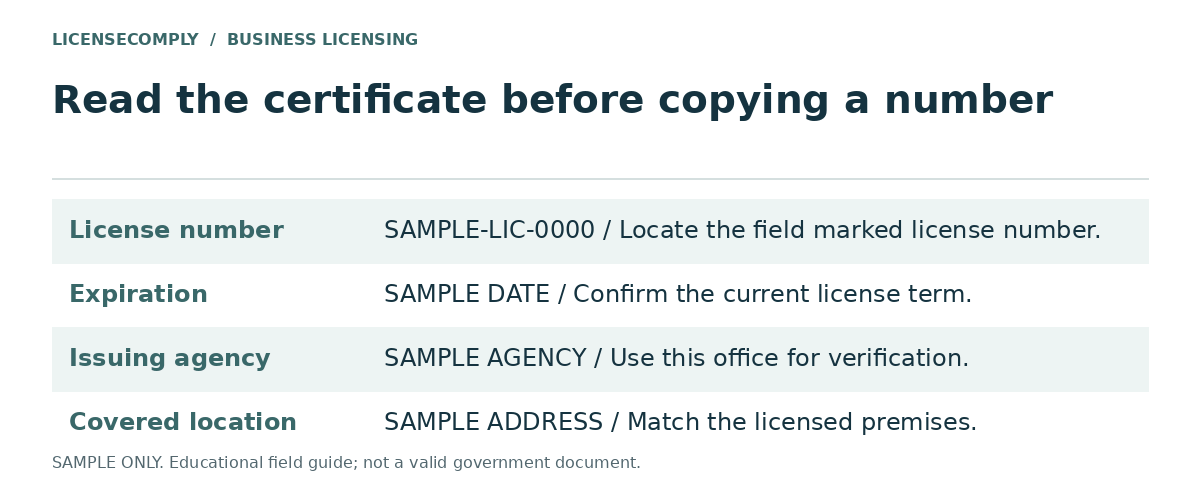
Next, check the agency’s issuance email, renewal notice, and online account. Search your files using the business name and the issuing agency’s name. Old bookkeeping folders and opening checklists sometimes contain a copy that never made it into the current operations folder.
If another person submitted the application, ask for the final issued certificate and account handoff. An application receipt is useful for tracking a submission, but it is not always proof of approval. Avoid applying again simply because you cannot locate the original record.
When the number is still missing, contact the issuing agency with the legal name, trade name, business address, and approximate issue date. Use the agency’s secure verification process if it needs to confirm that you are authorized to access account information.
For a federal EIN or state tax account number, see How to Find Your Business Tax ID Number.
Get a copy of your business license
The replacement process depends on the issuing office. First check whether the agency offers a download or print option for an already processed license. Washington’s Department of Revenue says users can check renewal status or print a processed license through My DOR. Its My DOR help page includes instructions for printing a business license.
At the city level, Santee says a certificate copy is available after signing into its Permitting & Licensing Portal. Follow the city’s current instructions rather than submitting a new business application for an existing certificate.
These examples establish where to obtain copies; they do not establish a nationwide duplicate fee. Check the agency’s current fee schedule if you need a mailed duplicate, certified copy, or other special format. An ordinary account download and a certified agency record are different requests.
Before ordering, ask the recipient what it needs. A bank or contracting party might accept the downloaded certificate, while another process could require direct agency verification. Save the file using the business name, location, license type, and issue date so the next request is easier to handle.
Verify a business before hiring or buying
Use a short checklist whenever the license is relevant to your decision:
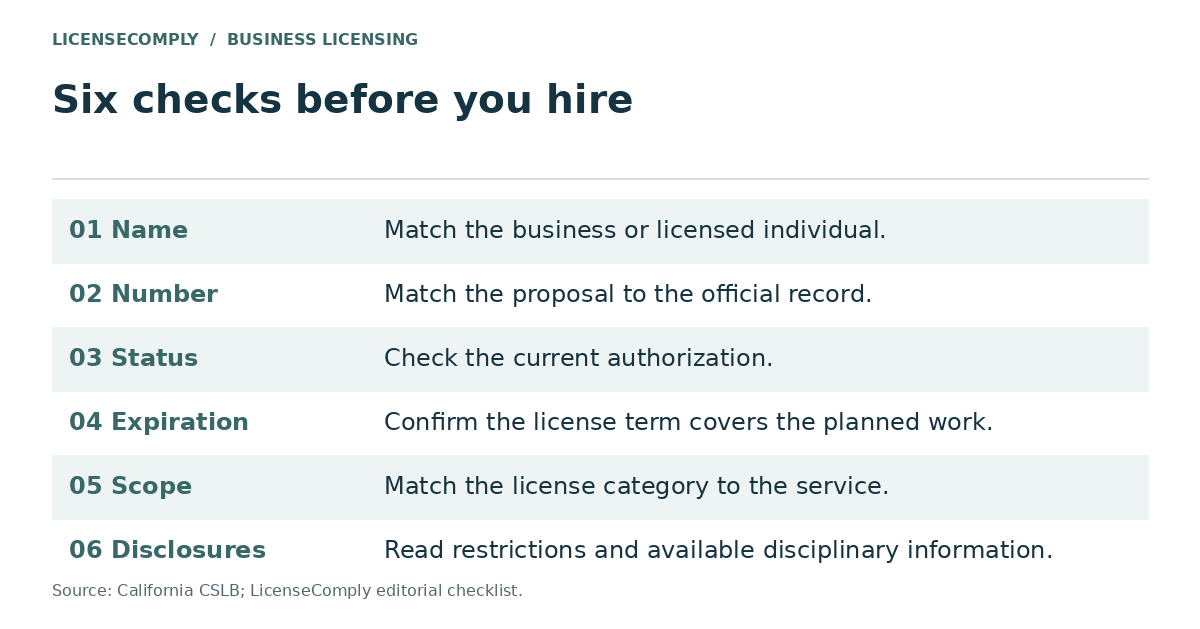
- Match the exact legal name or documented trade name to the business you are hiring.
- Match the license number on the proposal or certificate to the agency’s record.
- Check that the status permits the intended activity.
- Review the expiration date and check again if the work starts much later.
- Confirm the classification or license type covers the proposed services.
- Review restrictions, disciplinary information, or complaint disclosures where provided.
These checks answer a licensing question. They do not guarantee workmanship, financial stability, insurance coverage, or the outcome of a dispute. Obtain separate evidence when those issues matter to the contract.
For larger projects, retain the search date and the relevant agency record with the procurement file. If a result appears inconsistent with the business’s explanation, ask the regulator to clarify before treating a screenshot supplied by the business as conclusive.
What to do when no license appears
A missing result is a reason to investigate, not an automatic conclusion that a business is unlicensed. Try the legal name, trade name, individual license holder, and known number. Check spelling and punctuation using the search tool’s instructions.
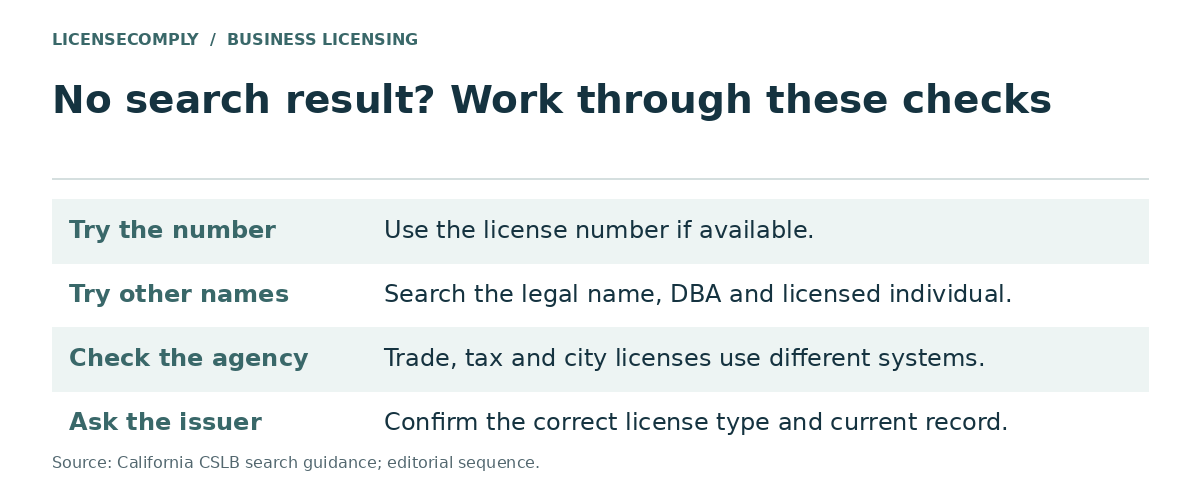
Then reconsider the agency. A contractor search will not necessarily contain a general city business license. A city search will not necessarily contain a state health permit. A recently approved application also might need confirmation directly from the issuing office.
Ask the business for the issuing agency and license number if you are verifying someone else. Ask the agency whether the activity requires the type of license you searched. Keep the response with your records, especially if the agency explains that a different authorization applies.
If the business needs a license it never obtained, getting a copy is not the solution. Start with Do I Need a Business License to identify the correct application route.
Keep records organized across locations
Create one record for each license and location. Include the issuing agency, account access owner, license number, covered activity, expiration date, and link to the final certificate. Separate application status from approved status so an unpaid invoice or submitted form is not mistaken for a completed filing.
Assign someone to review changes when the business moves, adds services, changes ownership, or opens another location. Use Business License Renewal to build a renewal routine around the records you locate.
Need help identifying or organizing licenses across locations? Ask LicenseComply about business license research, verification, and renewal support for your operating footprint.
Frequently asked questions
Is a business license public record?
Many agencies provide public license information, but the fields available and the method of access vary. A public status search does not mean the complete application, personal information, or account documents are publicly available.
Is my EIN my business license number?
No. An EIN is a federal tax identifier. Use the license or account number requested by the particular agency or form; do not substitute an EIN simply because it is easier to find.
Can I search by address?
Only if the agency’s tool supports that field. An address can help narrow a search or records request, but multi-tenant buildings and businesses that have moved require careful name matching.
How long does a replacement take?
An available portal download is different from an agency-reviewed duplicate request. Check the issuing office’s current turnaround and ask whether a certified copy has a separate process. There is no nationwide replacement timeline.
Need licenses found or verified?
LicenseComply researches and verifies the licenses each location holds or needs, files missing applications and tracks renewals.
Explore Research & Verification Talk to a licensing specialist
Official sources and further reading
- U.S. Small Business Administration
- Governor’s Business Permit Office
- TDLR Active License Search
- CSLB’s Check a License
- Department of Revenue business lookup
- Comptroller’s databases page
- Texas resale certificate guidance
- City of Santee’s business license FAQs
- Department of Revenue
- My DOR help page
Related guides



Disclaimer: LicenseComply provides professional business licensing and compliance services. However, the informational content on this site (including articles, guides, tools, and videos) is provided for general educational purposes only and does not constitute legal, tax, or accounting advice. Laws and regulations change frequently, and we cannot guarantee that all information is accurate, complete, or up to date for your specific circumstances. Your use of this website and its content does not create an attorney-client, accountant-client, or other advisory relationship. You should consult with a qualified attorney, accountant, or other appropriate professional for advice tailored to your business.