
Key points
- A certificate of occupancy (CO) documents a building’s approved use under the local building authority’s rules.
- A space approved for the previous tenant is not automatically approved for your use. New construction, major renovation, a change of use or a new tenant can all trigger a review.
- The usual sequence is use and zoning review, permits, approved work, inspections, then the issued certificate.
- A CO, a building permit and a business license answer different questions, so keep them as separate items on your opening checklist.
A certificate of occupancy, often called a CO, documents a building’s approved use under the issuing jurisdiction’s rules. For a business opening a physical location, it is one of the records to check before committing to an opening date. A space that was suitable for the previous tenant is not automatically approved for your operation.
The City of Austin describes its CO as confirming that a structure is habitable for its legal use and property type and meets applicable housing and building codes. Other jurisdictions use their own processes and terminology, so begin with the building or development services office responsible for the address.
This guide explains what the document covers, when to investigate whether a new or updated CO is needed, and how to coordinate it with construction, inspections, and business licensing.

What the certificate establishes
A CO connects the premises to an approved use. It is not a general promise that every possible business can operate there. The relevant record might describe the permitted occupancy, a particular space or suite, and limitations associated with its use.
That distinction matters when leasing. A storefront used for selling clothing presents different operational questions from one converted to a restaurant. Food preparation, seating, equipment, and customer traffic can affect the required review. Describe your actual operation to the building department rather than relying only on a broker’s label such as “retail space.”
The certificate also has limits. It does not replace a business license, a professional credential, or a sales tax permit. It does not by itself establish that a later renovation was approved. Read it alongside the current permit record and ask the local office about changes since issuance.
Who issues a certificate of occupancy
The local building official or responsible city or county department administers the process. Offices might be called Development Services, Building Safety, Inspections, or Permitting. Determine the property’s actual jurisdiction before selecting an application.
The landlord, architect, contractor, and tenant often participate in obtaining the necessary approvals, but the responsible government authority determines issuance. A private party’s assurance that a space is “ready” is not a substitute for the record or the agency’s confirmation.
For a leased property, decide early who will request records, manage applications, arrange inspections, and follow up on outstanding items. Your lease and construction agreements should be reviewed by your advisers for responsibility and timing; the building department’s process is separate from those private arrangements.
When to check whether a new CO is needed
Treat new construction, substantial renovation, and changes in the proposed use as prompts to contact the building department. Austin states that a new CO is provided after a successful final inspection for new construction or significant renovations.
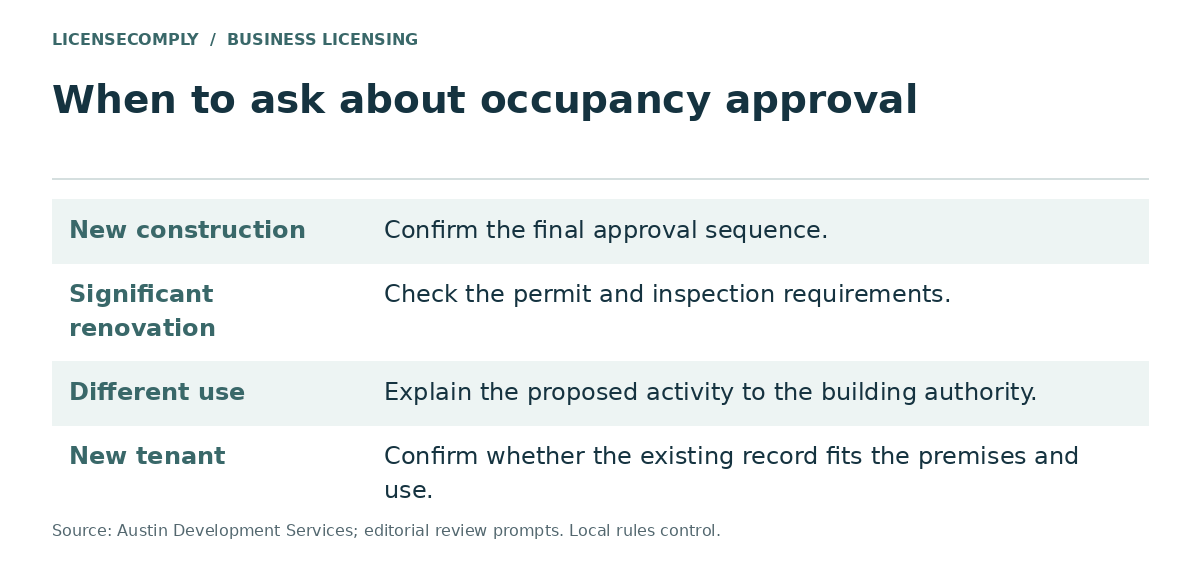
A new tenant should also check the local rule even when the business appears similar to the prior occupant. Some circumstances require a new approval or review; others involve confirming an existing record. Do not make a nationwide assumption that every tenant change either requires or avoids a new CO.
Useful questions include whether the existing certificate covers the specific suite, whether the planned activity fits the approved use, and whether changes to occupant numbers or the layout affect the review. Ask about cooking equipment, customer seating, storage, and other operational details relevant to your premises.
If you cannot find the previous certificate, tell the agency what records you do have. Missing paperwork and missing approval are different problems. A records search can establish whether a document exists before you begin an unnecessary application.
The process from site research to issuance
Confirm the proposed use before committing
Start with zoning and land-use questions. Ask whether your activity is allowed at the address and whether additional review applies. Provide a clear description of customer access, hours, equipment, food preparation, and other relevant operations.
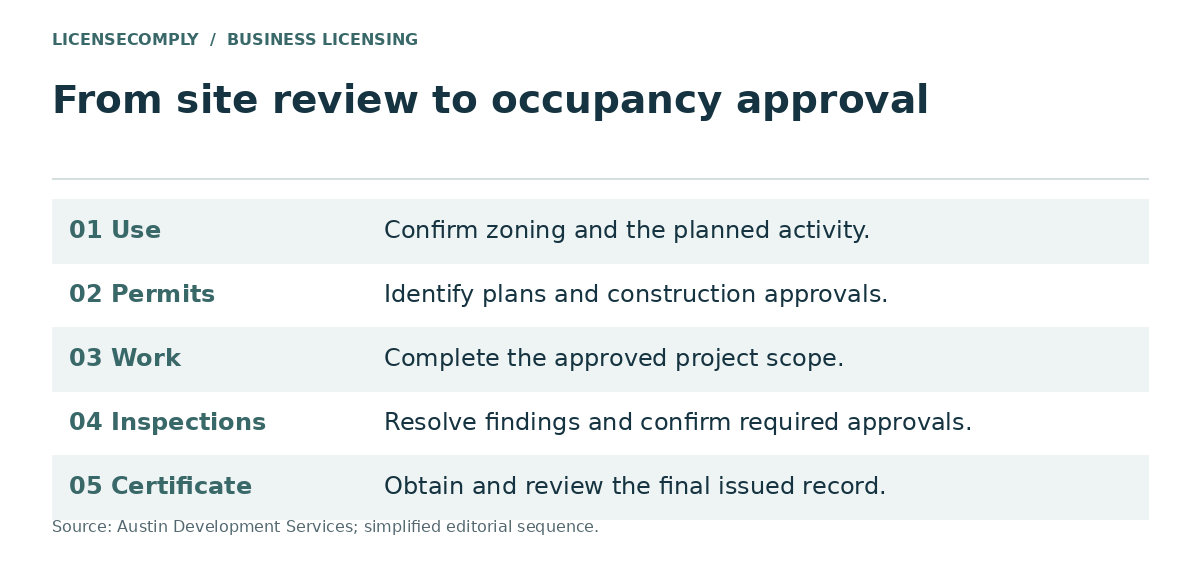
This early conversation helps identify dependencies before design and construction decisions are fixed. It also gives your team a better basis for estimating the opening schedule. Keep the agency’s response and any limitations with the project file.
Identify permits and required plans
Have the building department and your qualified project professionals identify the permits needed for the proposed work. Building and trade permits are different from the eventual occupancy approval. A permit authorizing work does not automatically authorize public use of the finished premises.
Coordinate the scope among the tenant, landlord, contractor, and design team. If one party assumes another is handling a required approval, the omission might not become visible until the end of the project.
Complete the approved work
Follow the approved scope and address changes through the required process. Keep records of approved revisions rather than relying on informal site conversations. When the layout or intended use changes, ask whether the permit and occupancy documentation need to change too.
A realistic project schedule should allow time for corrections. The date construction appears complete is not necessarily the date all approvals are complete. Plan deliveries, hiring, and launch commitments with that difference in mind.
Complete the required inspections
The jurisdiction identifies the inspections applicable to the project. Depending on the work, different building, fire, or trade reviews can be involved. Confirm who schedules them and how completion will be recorded.
If an inspection identifies a problem, keep the correction notice, responsible person, and follow-up date together. An organized correction log helps prevent repeat visits for items that no one addressed. Do not assume one passed inspection resolves every outstanding permit.
Obtain and review the issued document
The Austin CO page says a certificate is provided after a successful final inspection for new construction or significant renovations and gives a contact for cases where it is not received. Follow your jurisdiction’s procedure to obtain the actual record.
Review the address, suite, use, and any conditions. Resolve errors promptly rather than discovering them during a later license application or transaction. Save the final certificate where both facilities and licensing staff can find it.
Temporary certificates require careful reading
A temporary certificate of occupancy, or TCO, is a separate authorization with its own terms. Do not treat it as a permanent CO or assume it is available for every project. The local authority determines whether it can be issued and under what conditions.
Austin provides a temporary CO process involving an application, associated fees, and inspection coordination. The existence of that process does not mean a business can open merely because it has requested one.
If a TCO is issued, record the expiration date, approved area or use, outstanding conditions, and steps needed for the final certificate. Assign someone to monitor it. A temporary authorization can be easy to overlook once the staff is occupied with opening the business.
Ask the issuing office how any extension works before relying on it. Build your schedule around the authorization actually issued rather than an anticipated extension or a general statement from another project.
How to find an existing certificate
Start with the property owner or manager, then verify through the government record source when needed. Ask for the certificate covering the exact address and suite, not simply the building’s oldest available approval.
Some jurisdictions provide online permit records. Others use a direct document request or public information process. Search requirements and turnaround times differ, so allow time for the records inquiry before lease or opening deadlines.
Austin offers a specific example. Its published instructions direct requests for up to six COs to the development services email listed on the page, with the address and unit number. It asks requesters to allow one to five business days for a response. Requests for seven or more go through its Public Information Request process.
That response estimate is for existing records, not for approval of a new project. Keep those timelines separate when planning a launch.
What a certificate looks like
Formats differ, but the useful information generally identifies the issuing jurisdiction, property, approved use, issue date, and responsible official. Depending on the local form and project, the record can also include occupancy classification, occupant load, construction information, or conditions.
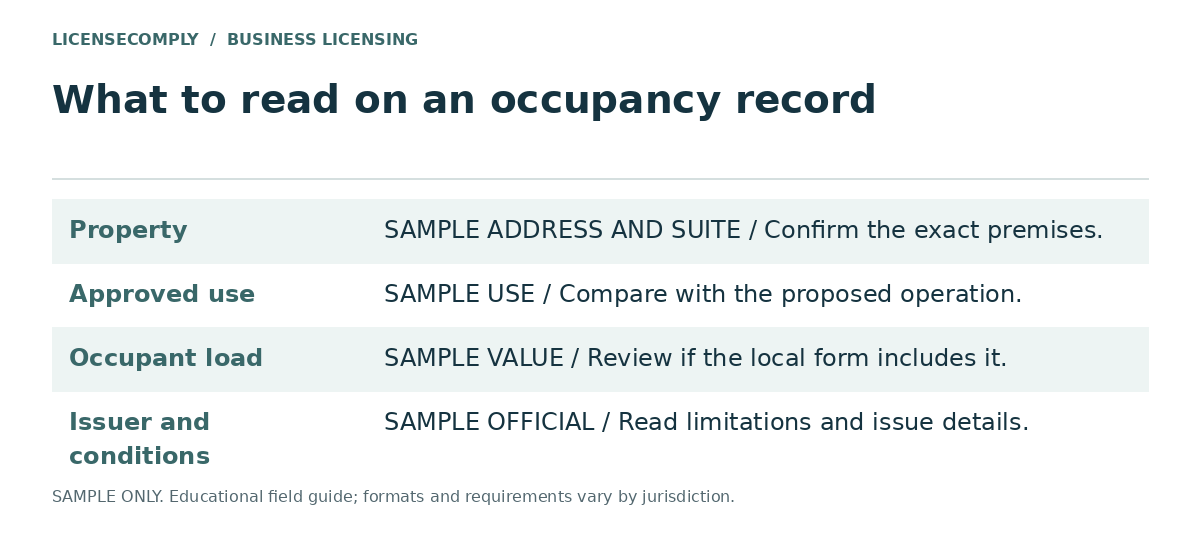
Our accompanying sample is an educational illustration, not a government form or proof of approval. Use it to recognize the kinds of information to review, then read the actual certificate and the issuing office’s instructions.
Pay particular attention to the scope. A record for one suite might not cover an expanded floor area. A certificate associated with an earlier use might not establish approval for a later conversion. If the wording is unclear, ask the building department to interpret it.
CO, building permit and business license compared
Document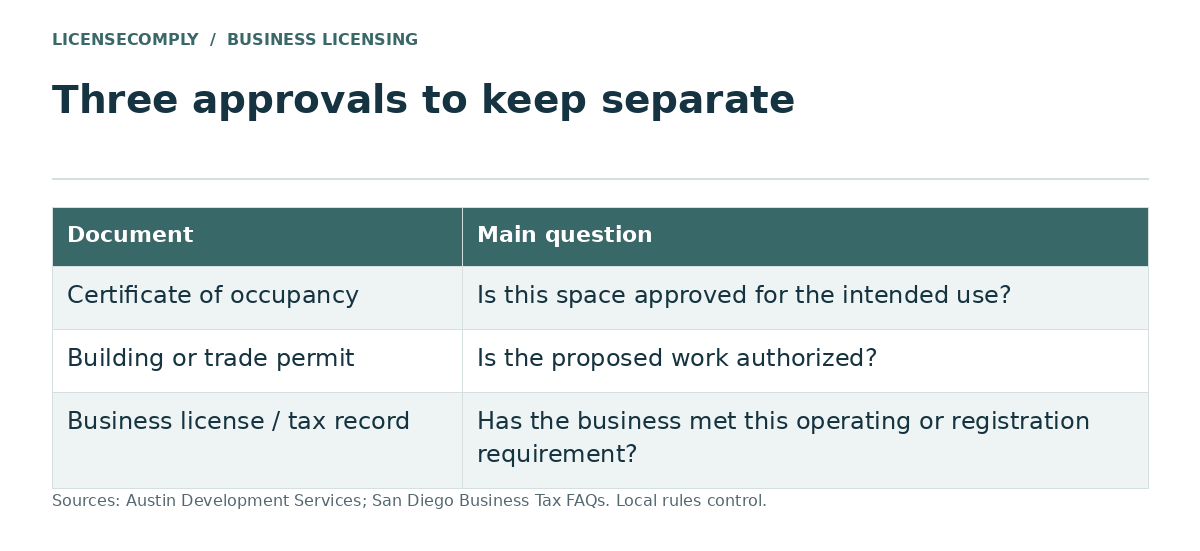 | Main question it addresses | Where to confirm the requirement |
|---|---|---|
| Certificate of occupancy | Is the space approved for this use under local rules | Building or development services authority |
| Building or trade permit | Is the proposed construction or installation authorized | Responsible permitting authority |
| Business license or local business tax record | Has the business met that jurisdiction’s business registration or licensing requirements | Licensing or revenue office |
The sequence is not identical everywhere. A business license process could require occupancy documentation, while a construction project has its own prerequisites. Identify those dependencies for the actual site. Read Do I Need a Business License for the broader licensing review.
A pre-lease checklist for commercial tenants
Before signing a lease or finalizing a build-out budget, gather the current occupancy record, describe your intended use, and identify the responsible building authority. Compare the leased area with the area shown in the records.
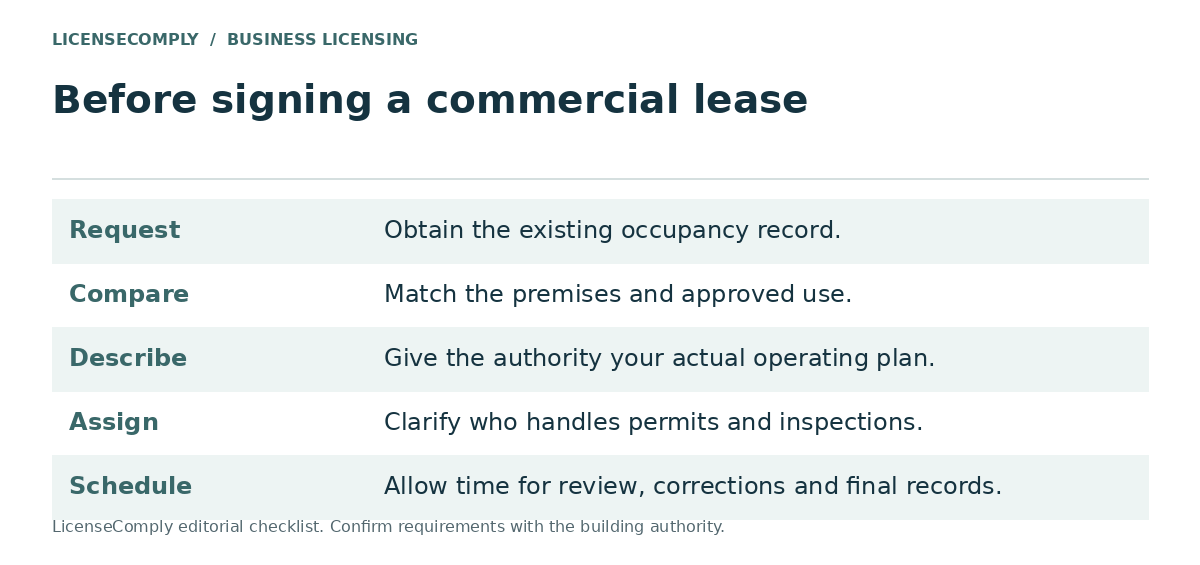
Ask whether the proposed layout, equipment, and customer capacity fit the existing approval. Confirm the path for any new permits or inspections. Clarify who is responsible for completing the work and obtaining final records.
Keep an allowance for agency review, inspection scheduling, and corrections. Avoid promising a public opening date based only on the contractor’s estimated completion. Obtain advice on lease provisions and project responsibilities when approval timing affects your financial commitments.
Finally, keep occupancy documents separate from the rent payment file. The operations team needs to retrieve them quickly for licensing, expansion, and future due diligence.
Coordinating multiple locations
For a rollout, use one project record per site. Track the current use, proposed use, permit dependencies, inspection status, and the final occupancy document. Identify unresolved questions as unresolved rather than marking a site complete because construction finished.
Do not copy a prior city’s requirements without checking the new jurisdiction. A repeat business concept can encounter different premises and different local processes. The same opening checklist should support research, not substitute for it.
LicenseComply can help research applicable business licensing requirements for new locations. Coordinate building, design, and inspection work with the qualified professionals and local authorities responsible for the property. Keep ongoing license obligations in a separate renewal schedule.
Frequently asked questions
Does the landlord handle the certificate?
That depends on the project responsibilities and agreements. Confirm who is managing the process, but independently establish what the jurisdiction requires for your intended use. A private allocation of responsibility does not change the agency’s approval requirements.
Can I open before the final certificate arrives?
Ask the authority responsible for the premises. Do not rely on a submitted application, a contractor’s statement, or an assumed temporary approval. If a TCO is issued, follow its specific conditions.
Does every new tenant need a new CO?
There is no nationwide answer. The local rules, existing approval, proposed activity, and changes to the space determine the next step. Ask the jurisdiction about the specific address and intended use.
How much does a CO cost?
Use the local fee schedule and the project’s actual scope. Document requests, applications, inspections, and construction-related permits can involve different charges. A fee quoted for another city or another project is not a reliable budget for yours.
Opening a new location?
LicenseComply researches the business licenses and permits each new location needs, so occupancy, licensing and opening dates line up.
Explore Research & Verification Talk to a licensing specialist
Official sources and further reading
Related guides



Disclaimer: LicenseComply provides professional business licensing and compliance services. However, the informational content on this site (including articles, guides, tools, and videos) is provided for general educational purposes only and does not constitute legal, tax, or accounting advice. Laws and regulations change frequently, and we cannot guarantee that all information is accurate, complete, or up to date for your specific circumstances. Your use of this website and its content does not create an attorney-client, accountant-client, or other advisory relationship. You should consult with a qualified attorney, accountant, or other appropriate professional for advice tailored to your business.