
Key points
- There is no federal independent contractor business license, so whether a 1099 contractor needs one depends on the state, county and city where the work happens and on the type of work.
- Nevada requires a state business license from the Secretary of State before a sole proprietor conducts business there, and the sole proprietor filing fee is $200 to register and renew.
- Seattle requires anyone doing business in the city to hold a business license tax certificate, and the 2026 default fee for a new license is $73.
- For payments made in 2026, businesses generally file Form 1099-NEC for a contractor paid $2,000 or more, up from $600 for payments made before 2026, according to the Internal Revenue Service.

Whether you need an independent contractor business license depends on where you work and what you do, not on your 1099 status. There is no federal business license for contractors, but many states and cities require every person doing business within their borders to register, and licensed trades need an occupational license on top of that.
That means a contractor doing freelance writing or graphic design in one city may need nothing beyond a free registration, while someone doing the same work across town pays an annual fee and files a gross receipts return. Licensed trades also need a state license tied to the trade itself.
This guide covers who counts as an independent contractor, which licenses apply, how to apply, current fees in real jurisdictions (reviewed November 2026), and multi-state work. Rules vary, so confirm each requirement with the issuing agency.
Do independent contractors need a business license?
Often, yes, but the requirement comes from state and local law. The U.S. Small Business Administration notes that license requirements and fees “vary based on your business activities, location, and government rules,” per its guide to licenses and permits. Federal licenses apply only to federally regulated industries, such as alcoholic beverages, aviation or firearms, so for most self-employed individuals the business license requirements come from state laws and the local government where they work.
Los Angeles requires “all individuals or entities conducting business activities” in the city to obtain a Business Tax Registration Certificate, according to the Los Angeles Office of Finance. Seattle says “anyone doing business in Seattle” must have a business license tax certificate, including home-based businesses, per Seattle City Finance.
Some states also require a general license. Nevada law says a person “shall not conduct a business in this State unless and until the person obtains a state business license” from the Secretary of State, under NRS 76.100. Washington requires a state business license when, among other triggers, your gross income is $12,000 per year or more, you use a name other than your full legal name, or your work needs a city endorsement, according to the Washington Department of Revenue.
Freelance and low-risk service providers sometimes fall under a revenue minimum, such as Washington’s $12,000 trigger or Seattle’s $4,000 exemption (covered below), but local authorities set these thresholds. For a broader walkthrough of how to find out what applies at your address, see our guide to whether you need a business license.
Who is considered self-employed for licensing and tax purposes?
Your licensing obligations follow from your legal status as a business owner, not from how a client labels the job or whether you are paid on a per project basis. The Internal Revenue Service (IRS) says “the general rule is that an individual is an independent contractor if the person for whom the services are performed has the right to control or direct only the result of the work and not what will be done and how it will be done.” The same IRS page adds: “If you are an independent contractor, then you are self-employed.” The IRS also notes that a company paying an independent contractor generally does not withhold or pay any taxes on those payments, while it withholds income, Social Security and Medicare taxes and pays unemployment tax on wages for its employees (IRS). That is why contractors pay taxes on their own and do not get employer-paid unemployment insurance coverage like full time employees.
States can apply stricter tests. In California, the Employment Development Department uses the ABC test, under which a worker is an employee unless they are free from the hiring entity’s control, do work outside its usual course of business, and are customarily engaged in an independently established trade of the same nature, per the California Employment Development Department. All three conditions must be met. The Governor signed Assembly Bill 5 (AB 5) in September 2019 to adopt the ABC test under the Labor Code, the Unemployment Insurance Code and the state wage orders, and the law took effect January 1, 2020, according to the California Labor and Workforce Development Agency. A legal professional can review how a test applies to your contracts.
If you are a true independent contractor, no client’s license covers you. Seattle states it plainly: subcontractors need their own business license tax certificate “even if the contractor who they are working with already has one,” because the license is valid only for the legal owner listed on it (Seattle City Finance).
Which licensing requirements apply to a 1099 contractor?
A self-employed business license is rarely one document. Most contractors deal with some combination of four layers, depending on their industry and location.
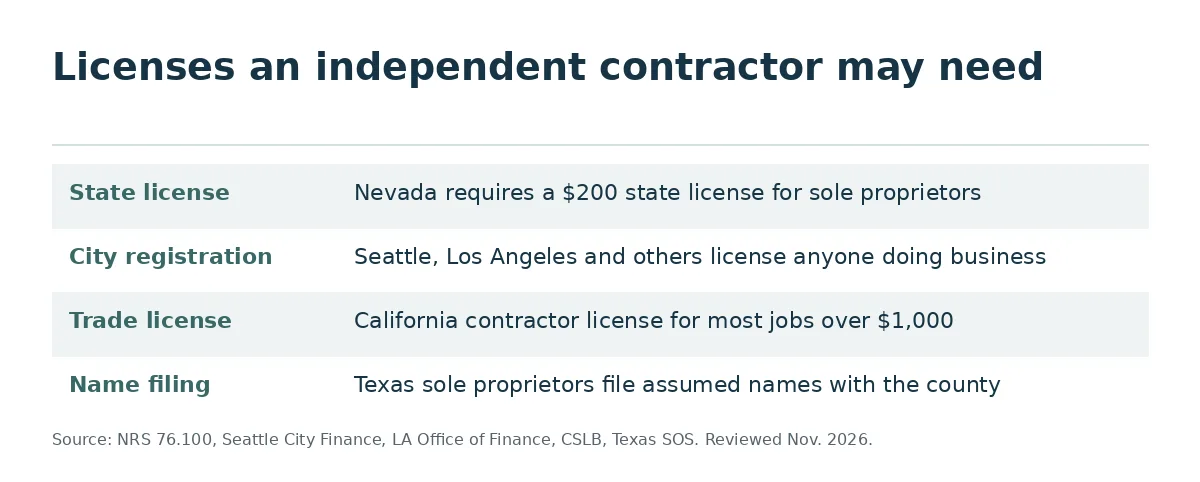
| License layer | Who issues it | Example |
|---|---|---|
| State business license | Secretary of State or revenue agency | Nevada state business license, $200 per year |
| City or county registration | City finance or tax office | Seattle business license tax certificate |
| Occupational or trade license | State licensing board | California contractor license for most jobs over $1,000 |
| Name registration | County clerk or state | Texas assumed name certificate for a sole proprietor |
State business licenses
Only some states have a general state license that covers sole proprietors. In Nevada, the Secretary of State’s sole proprietor form sets the filing fee at $200 to register and renew. Nevada excludes a home-based business whose net earnings are not more than 66 2/3 percent of the state’s average annual wage from the definition of “business,” under NRS 76.020, so check that exclusion before filing.
City and county registrations
This is where most independent contractors pick up a requirement. Cities usually call it a business license, a business tax certificate or a business registration, and many base the fee on gross receipts earned in the city.
Occupational and trade licenses
If your work is regulated, the trade license is separate from any general business license. California requires a Contractors State License Board (CSLB) license for construction work unless the project is $1,000 or less, needs no building permit, and the unlicensed person hires no workers, a limit that rose from $500 on January 1, 2025, per the CSLB industry bulletin. Many regulated industries require proof of experience, exams and financial security before a license is issued. For a California contractor license, the qualifier needs at least four years of journey-level experience in the last 10 years and must pass a law and business exam and, in most classifications, a trade exam. An active license also requires a $25,000 contractor bond, proof of workers’ compensation insurance or an exemption, and, for limited liability company licenses, liability insurance with an aggregate limit of at least $1 million, per the CSLB licensing guide. Our guide to occupational licenses covers how these differ from general business licenses.
Doing business as (DBA) name filings
If you work under a brand instead of your own name, you may need to register it. In Texas, a sole proprietorship must file an assumed name certificate with the county clerk in each county where it maintains a business office, according to the Texas Secretary of State.
How to get an independent contractor business license, step by step
The process is similar almost everywhere, even though the forms differ.
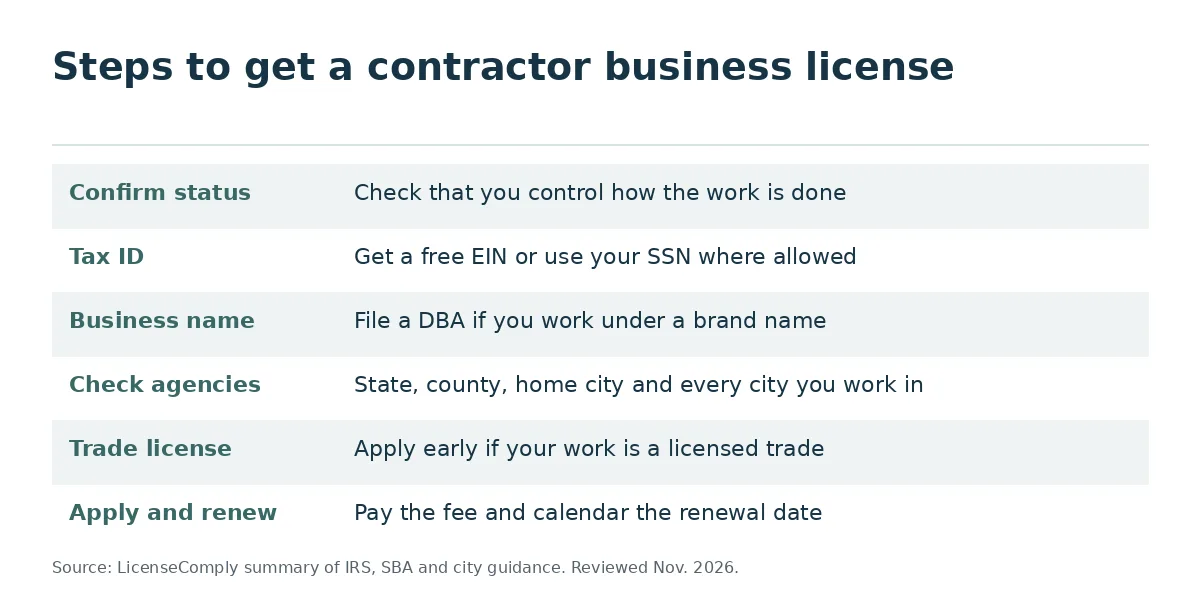
1. Confirm the work is independent contracting
Check that you control how the work is done and that your state’s test treats you as self-employed. If a client really controls your work, licensing will not fix a misclassification.
2. Choose your legal structure
A solo contractor who forms no separate entity is a sole proprietor. A sole proprietor reports business income on Form 1040 with Schedule C, Profit or Loss from Business, and figures self-employment tax on Schedule SE, according to the IRS sole proprietorships page. Decide on structure before you apply, since it sets the name on your licenses.
3. Get your tax identification number ready
Most applications ask for a federal identification number. An Employer Identification Number (EIN) is free, and the IRS says “you never have to pay a fee for an EIN,” per its EIN application page. Los Angeles lets a sole proprietor with no employees use a Social Security Number (SSN) instead, though it recommends an EIN to reduce identity theft risk (City of Los Angeles). See our guide on finding a business tax ID number.
4. Register your business name if you use one
File a DBA, assumed name or trade name where your state requires it, before you apply for local licenses that ask for it.
5. Check state, county and city requirements
Check the state agency, then the city clerk’s office, finance department or county office where you live and in every city where you work. Ask each about thresholds.
6. Get any occupational license first
If your trade is licensed, apply for the board license early, since a city may ask for the license number when you register that activity.
7. Apply, pay and calendar the renewal
Once you know where you need to get a business license, submit the application, pay the fee and record the renewal date. Some clients and some licensing boards also ask for general liability insurance or a bond, so check what your industry and contracts require before you start operating. Philadelphia issues its Commercial Activity License automatically when you apply online, per the City of Philadelphia.
How much does a self-employed business license cost?
Costs range from nothing to a few hundred dollars a year, before any trade license.
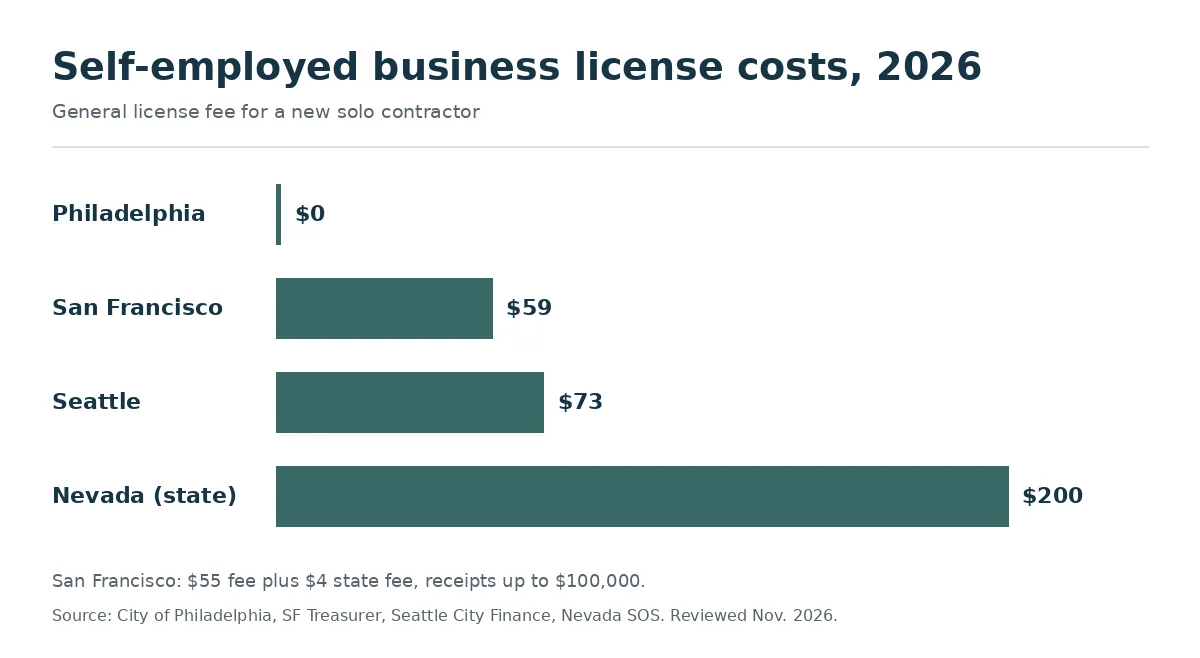
| Jurisdiction | License | 2026 cost for a new solo contractor |
|---|---|---|
| Philadelphia | Commercial Activity License | Free, no renewal required |
| San Francisco | Business Registration Certificate | $55 plus a $4 state fee (receipts up to $100,000) |
| Seattle | Business license tax certificate | $73 default first-year fee |
| Nevada | State business license, sole proprietor | $200 to register and renew |
Philadelphia charges nothing for its Commercial Activity License, and the license does not need to be renewed, according to the City of Philadelphia.
San Francisco’s 2026 to 2027 registration fee is $55 plus a $4 state fee for businesses with up to $100,000 in 2025 San Francisco gross receipts, and registration renews by the last day in February, per the San Francisco Treasurer and Tax Collector.
Seattle charges new general business license applicants the lowest tier fee as a default, which is $73 for 2026, or half that if the business starts on July 1 or later, per Seattle City Finance.
Contractors with global gross receipts under $100,000 who renew on time can claim the Small Business Exemption, but the first year of business tax is not exempt and is paid as back tax at the first renewal (Los Angeles Office of Finance).
What are the tax implications of 1099 work?
A business license is separate from your tax obligations, but contractors usually set up both at the same time. Self-employed individuals pay self-employment taxes and income tax on their own, without employer withholding.
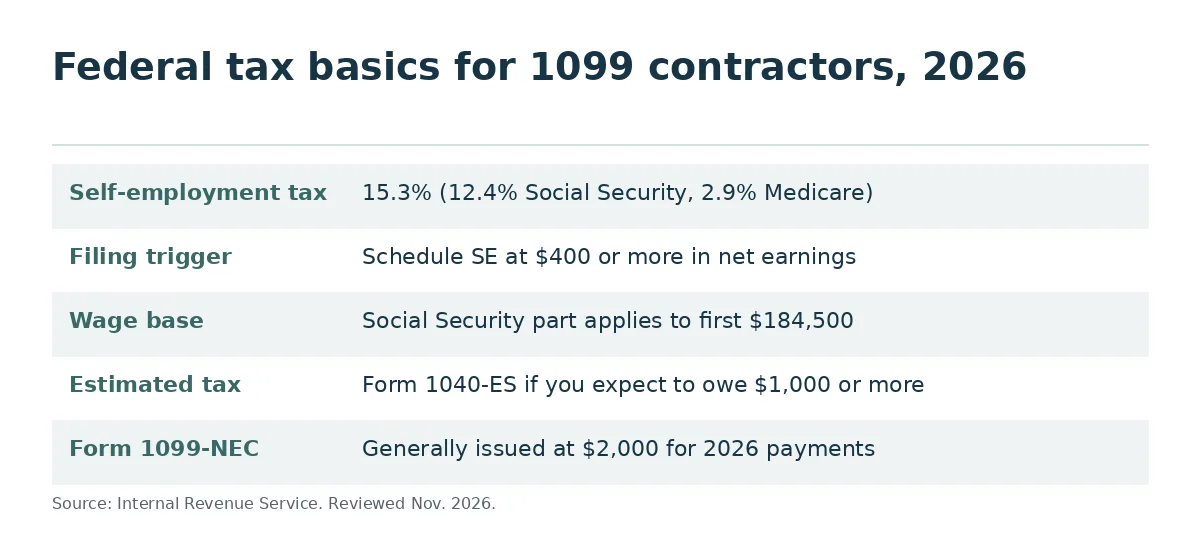
The IRS sets the self-employment tax rate at 15.3 percent, made up of 12.4 percent for Social Security and 2.9 percent for Medicare. You generally owe it and file Schedule SE when net earnings from self-employment are $400 or more, and for 2026 the Social Security part applies to the first $184,500 of combined earnings, per the IRS self-employment tax page.
You can deduct business expenses that are ordinary and necessary on Schedule C, such as car or truck costs and a percentage of business meals (in most cases 50 percent), per the IRS Schedule C instructions. Your net income from the business, after those business expenses, is what flows into your taxable income and your self-employment tax calculation.
Sole proprietors generally make estimated tax payments with Form 1040-ES if they expect to owe $1,000 or more, according to the IRS estimated taxes page.
The Form 1099-NEC threshold has changed. For payments made in 2026, a business generally reports nonemployee compensation of $2,000 or more, compared with $600 for payments made before 2026, per the IRS. Not receiving a 1099 does not change whether you need a license or owe tax.
What changes when you work in several states or cities?
Each new market can add a registration. For contractors, and for any company that may require independent contractors to show proof of licensing across many markets, this is where most gaps appear.
Cities count days and dollars
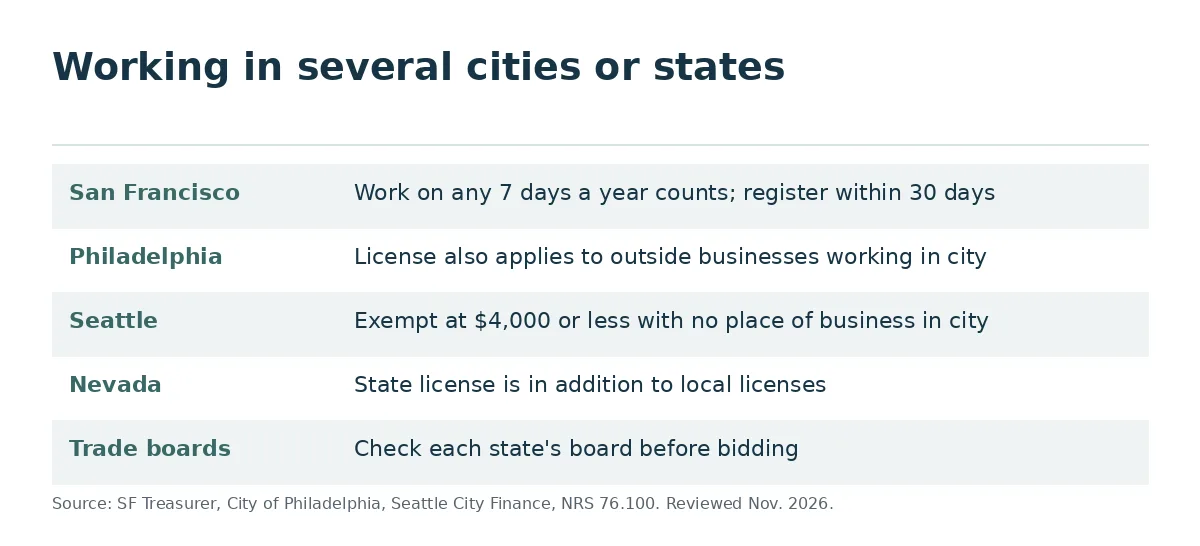
Many cities reach out-of-town contractors. San Francisco requires registration within 30 days of starting business, and performing work or rendering services in the city for all or part of any seven days in a tax year counts as engaging in business there, per the San Francisco Treasurer and Tax Collector. Philadelphia’s license also applies to businesses located outside city limits that do business in the city (City of Philadelphia).
Other cities set a floor. Effective 2026, Seattle exempts a person with $4,000 or less in annual gross income in the city who does not maintain a place of business there, though the exemption does not cover regulatory licenses or specialized permits (Seattle City Finance).
State licenses stack with local ones
A state license does not replace city licenses. Nevada’s statute says its state business license is “in addition to any license to conduct business that must be obtained from the local jurisdiction” (NRS 76.100).
Trade licenses rarely travel
Occupational licenses are issued by state boards, so plan on checking each new state’s board before you bid.
Keep a location inventory
List every state and city where you or your crews work, with the license, number, fee and renewal date for each. Our business license renewal guide explains how to keep those dates from slipping.
Frequently asked questions
Do independent contractors need a business license?
Many do, but it depends on location and type of work. There is no federal license for contractors. Cities such as Los Angeles, Seattle, San Francisco and Philadelphia require people doing business there to register, and states such as Nevada require a state business license for sole proprietors. Regulated trades also need a state occupational license. Check with your state, county and city before taking paid work.
Is a 1099 business license different from a regular business license?
No. A “1099 business license” is not a separate license type. Receiving a Form 1099-NEC simply shows that a client paid you as a nonemployee. If your city or state requires a business license, you apply for the same general license as any sole proprietor, plus any trade license your work requires. The 1099 threshold for payments made in 2026 is $2,000.
How much does a self-employed business license cost?
It varies widely. Philadelphia’s Commercial Activity License is free and never needs renewal. Seattle’s default first-year fee for 2026 is $73. San Francisco charges $55 plus a $4 state fee for businesses with up to $100,000 in city gross receipts. Nevada charges a sole proprietor $200 a year for its state business license. Trade licenses and local business taxes add to these amounts.
Can I work as an independent contractor without a business license?
In some places, yes. Many jurisdictions have no general license, and some exempt small operators, such as Seattle’s 2026 exemption for out-of-city businesses with $4,000 or less in city income. Working without a required license can lead to penalties or back fees, and unlicensed work in a regulated trade carries larger risks. Confirm the rules for each location where you work.
Do I need a separate license in every city I work in?
Often, yes. City licenses usually cover only work in that city, and some cities apply them after a few days of work. San Francisco counts work on all or part of any seven days in a tax year as doing business in the city. A license in your home city generally does not cover jobs in neighboring cities, so check each one.
Working as a contractor in more than one city or state?
LicenseComply researches which state, county and city licenses apply to your work in each location and prepares and files the applications for you.
Explore Research & Verification Talk to a licensing specialist
Official sources and further reading
- U.S. Small Business Administration: Apply for licenses and permits
- Internal Revenue Service: Independent contractor defined
- Internal Revenue Service: Self-employment tax
- Internal Revenue Service: Estimated taxes
- Internal Revenue Service: Am I required to file a Form 1099?
- Internal Revenue Service: Get an Employer Identification Number
- Internal Revenue Service: Independent contractor or employee?
- Internal Revenue Service: Sole proprietorships
- Internal Revenue Service: Instructions for Schedule C
- California Employment Development Department: Employee or independent contractor
- California Labor and Workforce Development Agency: Employment status FAQ
- California Contractors State License Board: Get licensed to build guide
- California Contractors State License Board: Minor work exemption increase bulletin
- Nevada Revised Statutes Chapter 76: State business licenses
- Nevada Secretary of State: Sole proprietor state business license form
- Washington Department of Revenue: Apply for a business license
- Seattle City Finance: Business licenses
- Los Angeles Office of Finance: How to register for a Business Tax Registration Certificate
- City of Los Angeles: Business Tax Registration Certificate
- San Francisco Treasurer and Tax Collector: Register a business
- City of Philadelphia: Get a Commercial Activity License
- Texas Secretary of State: Name filings FAQs
Disclaimer: LicenseComply provides professional business licensing and compliance services. However, the informational content on this site (including articles, guides, tools, and videos) is provided for general educational purposes only and does not constitute legal, tax, or accounting advice. Laws and regulations change frequently, and we cannot guarantee that all information is accurate, complete, or up to date for your specific circumstances. Your use of this website and its content does not create an attorney-client, accountant-client, or other advisory relationship. You should consult with a qualified attorney, accountant, or other appropriate professional for advice tailored to your business.