
Key points
- Business identity theft happens when criminals impersonate a business, often by filing false changes to its state records, to obtain credit, loans, goods or tax refunds in the company’s name.
- The Texas and California Secretaries of State both advise businesses to check their filings at least once a year, and Colorado, Georgia and Florida offer email notices when a filing changes a business record.
- The Internal Revenue Service asks businesses to file Form 14039-B, Business Identity Theft Affidavit, when they receive a notice about a tax return, Form W-2 or balance due they did not file or owe.
- Businesses reported $3.05 billion in business email compromise losses and $185.8 million in identity theft losses to the FBI’s Internet Crime Complaint Center in 2025.

Business identity theft is when criminals impersonate a company, often by filing false changes to its state business records or misusing its Employer Identification Number (EIN), to get credit, loans, goods or tax refunds in the company’s name. You protect against it by monitoring your official records in every state where you are registered, keeping filings current, guarding your tax and account numbers, and acting quickly when a notice does not match anything you filed.
Any business can be targeted, and small business identity theft is common because smaller companies often have fewer controls. The Texas Secretary of State notes that sole proprietorships, partnerships, limited liability companies (LLCs), trusts, nonprofits and corporations are all targets, and that the consequences can be “potentially disastrous.”
This guide covers how business identity fraud works, the warning signs agencies publish, state alert tools, what changes for multi-state operators, and how to report it. Agency guidance was reviewed November 2026. Tools and procedures vary by state, so confirm the details with each agency that holds your records.
What is business identity theft?
It is the imitation of the business itself, sometimes called corporate identity theft, not just the theft of one owner’s personal data. The Texas Secretary of State says it can occur through “the theft or misuse of key business information, or falsification of business filings and records.”
The California Secretary of State describes criminals posing as owners, officers or employees to get cash, credit and loans, “leaving the victimized business with the debts.” Identity thieves often cash out quickly and go unnoticed until bills and collection notices arrive.
How does business identity fraud usually work?
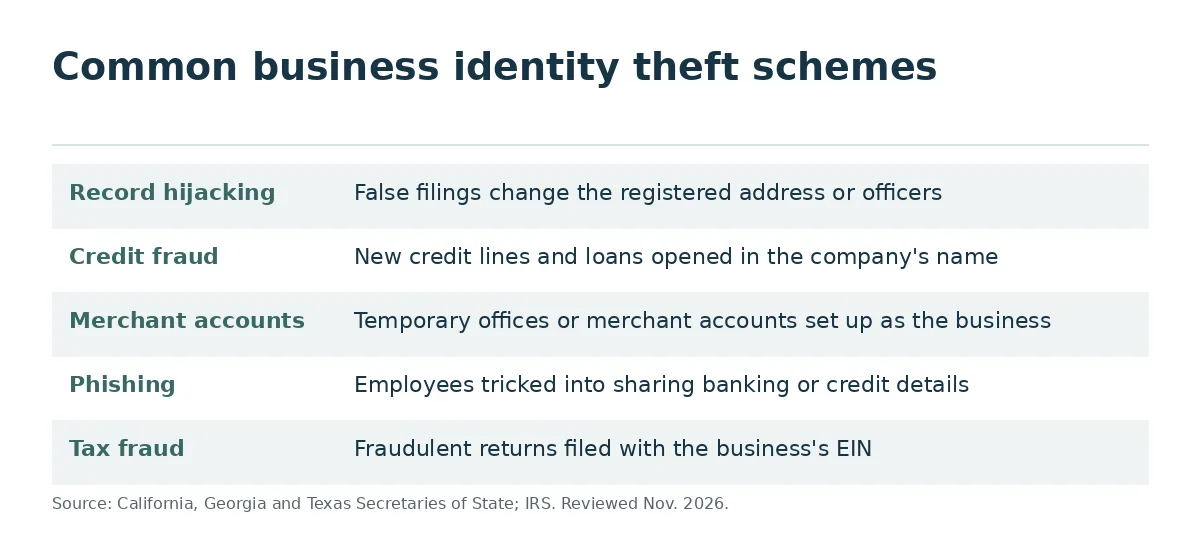
A common pattern starts with the public record. The Georgia Secretary of State explains that thieves often change a business’s registered address or officer information, then use the business identity to commit fraud, such as opening credit lines, obtaining loans or buying goods that are easy to resell.
California lists several other schemes, including setting up temporary office space or merchant accounts in a company’s name, phishing employees for banking details, and going through trash for account numbers, per the California Secretary of State.
Tax fraud is a separate category. The Internal Revenue Service (IRS) warns that thieves may steal sensitive information to file a fraudulent tax return for a refund or to commit other crimes, such as using the business name and EIN to file false Forms W-2.
Which businesses are most at risk?
Inactive and forgotten entities are attractive because nobody is watching them. The Texas Secretary of State warns that “Criminals target businesses that have been tax forfeited,” and advises filing a certificate of termination when a business stops operating.
How common is business identity fraud?
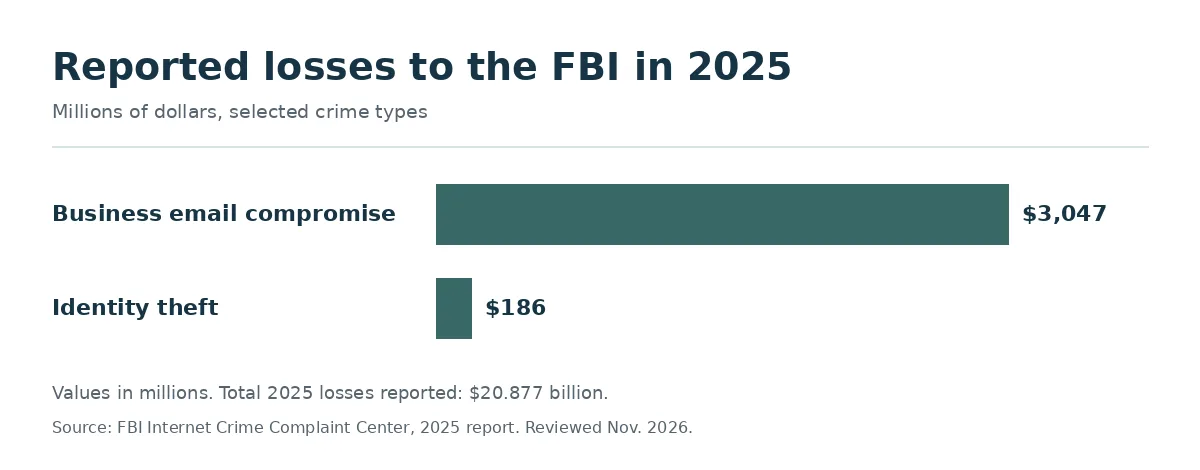
There is no single national count of these cases, but federal crime data shows the scale of related fraud. The FBI’s Internet Crime Complaint Center (IC3) 2025 report recorded 1,008,597 complaints and $20.877 billion in reported losses, a 26 percent increase from 2024.
Business email compromise, where fraudsters take over or imitate email and other communications to redirect payments, was the second costliest crime type, with $3,046,598,558 in reported losses. Identity theft complaints rose to 31,675 in 2025, up from 21,403 in 2024, with $185,832,657 in losses, according to the same IC3 report.
What are the warning signs of business identity theft?
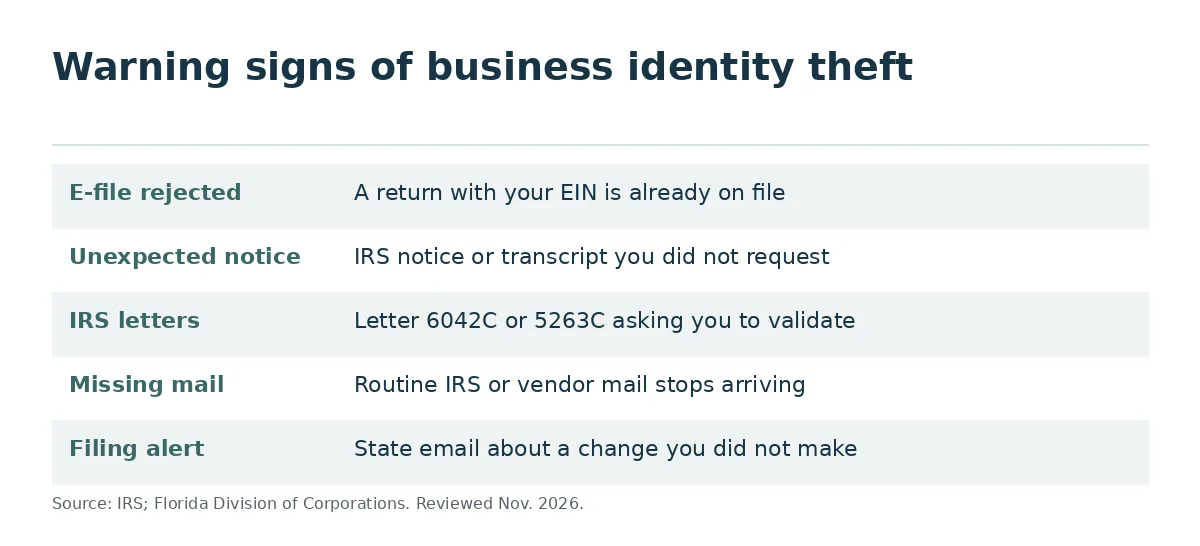
Most victims find out from a document they did not expect. The IRS lists these tax warning signs:
- You cannot e-file a return because one was already filed with the same EIN or Social Security number.
- A routine extension request is rejected because a duplicate return is already on file.
- You receive an unexpected tax transcript or IRS notice that does not match anything you submitted.
- You receive Letter 6042C or Letter 5263C, which the IRS sends when it needs to validate a return or the entity.
- Expected IRS correspondence stops arriving because the business address was changed.
Outside of tax, watch for a state email notice about a filing you did not make, a change in registered agent or officers, unfamiliar accounts or unfamiliar credit inquiries on your business credit report, financial transactions you do not recognize, or regular bills that stop arriving. Report suspicious activity to the bank or company involved right away, as the Texas Secretary of State advises. Florida’s Division of Corporations advises contacting the billing company if “a regular bill doesn’t arrive,” per its identity theft prevention guide.
How can you protect your business from identity theft?
Business identity theft protection is mostly routine record keeping done consistently. Florida puts it plainly: there is no foolproof method, and “the goal is to detect the theft as soon as possible,” per the Florida Division of Corporations.
Monitor your Secretary of State records
Check your entity record and filing history on each state’s business search. Both the Texas Secretary of State and the California Secretary of State recommend checking your filings at least once a year, and California lets anyone view and print a business’s filing history free through bizfile Online without logging in. Florida suggests checking entity records monthly through its Mind Your Sunbizness program.
Sign up for filing alerts where offered
Several states will email you when someone files on your record:
| State | Alert or security tool | What it does |
|---|---|---|
| Colorado | Email notification and Secure Business Filing | Notices when a form is filed, status changes, or a report is due |
| Georgia | E-Notification | Emails every address on the entity when a filing is made |
| Florida | Email on file with Division of Corporations | In most cases, emails you about filings or record changes |
| California | Email delivery of notices | Optional email delivery of Statement of Information reminders |
Sources: Colorado Secretary of State, Georgia Secretary of State, Florida Division of Corporations, California Secretary of State.
Colorado calls email notification “one of the first steps to protecting your business,” and its prevention checklist also recommends assigning a trusted person to maintain and monitor the record.
Keep filings current and close what you no longer use
File address, registered agent and officer changes promptly, and file renewals and periodic reports on time. Colorado’s prevention checklist adds that if you dissolve an entity, you should stay subscribed to notices so you still hear about any change to the record.
Protect your EIN and keep IRS records accurate
The IRS asks every entity with an EIN to keep the number safe and its responsible party and contact information current using Form 8822-B. The Form 8822-B instructions require reporting a change in responsible party within 60 days. If you need to locate the number first, see our guide on how to find your business tax ID number.
Secure data and train employees
The Federal Trade Commission (FTC) recommends five practices in its guide to protecting personal information: take stock of what you hold, scale down to what you need, lock it, pitch what you no longer need, and plan ahead for incidents. The IRS adds basic cybersecurity tools, such as anti-malware software and firewalls on all computers and devices, a password manager, multi-factor authentication, encryption, offline backups and limiting access to sensitive data to people who need to know.
The IRS calls creating and maintaining a data security plan “key” and points small business owners to IRS Publication 4557, Safeguarding Taxpayer Data, and the FTC’s Start with Security guide as free resources. For sensitive documents on paper, Colorado’s prevention checklist recommends a cross cut or “confetti” shredder and treating the personal information of customers and employees as carefully as your own.
Train employees to spot phishing emails
The IRS calls phishing emails “the most common tactic used to steal data” and recommends teaching employees not to respond to suspicious emails, not to open attachments from unknown senders, and to verify requests by phone. IRS-related phishing can be forwarded to phishing@irs.gov.
Verify payment and vendor changes
Business email compromise is a form of financial fraud aimed at payments. The FBI advises verifying payment and purchase requests in person or by calling the person, and verifying “any change in account number or payment procedures” with the person making the request. Look up the phone number yourself, examine email addresses and web addresses for slight misspellings, and be especially wary when a requester pushes you to act quickly.
Check whether the Red Flags Rule applies to you
Some organizations have a legal duty to prevent identity theft against their customers. Under the FTC’s Red Flags Rule, financial institutions and certain creditors must assess whether they have covered accounts and, if they do, adopt a written Identity Theft Prevention Program. The program must identify red flags, detect them, spell out the response, and stay current as threats change. Whether a business is covered depends on its activities, such as regularly deferring payment and using consumer reports, not on its industry.
Treat unexpected government requests with suspicion
For example, scammers imitate government agencies to gain access to business data or collect fake fees. The IRS says it never starts contact by email, text or social media to request personal or financial information.
The Financial Crimes Enforcement Network (FinCEN) warns that letters citing a “Form 4022” or “Form 5102” are fraudulent and that there is no fee to file beneficial ownership information directly with FinCEN, per its beneficial ownership page. Under a final rule effective August 14, 2026, U.S. companies are exempt from beneficial ownership reporting, so a demand that a domestic company file or pay is a red flag.
Can a business license help prevent identity theft?
A business license does not stop identity theft on its own, but accurate license and registration records make fraud easier to spot. Lenders, landlords, customers and suppliers often verify a company or business partner through public records, so an outdated address or lapsed registration can let an impostor’s story look plausible.
Keep the addresses, owners and officers on your licenses consistent with your state entity record and IRS records. Our business license lookup guide explains how to confirm what the official record shows, and the business license renewal guide covers keeping licenses active.
What changes when you operate in several states or cities?
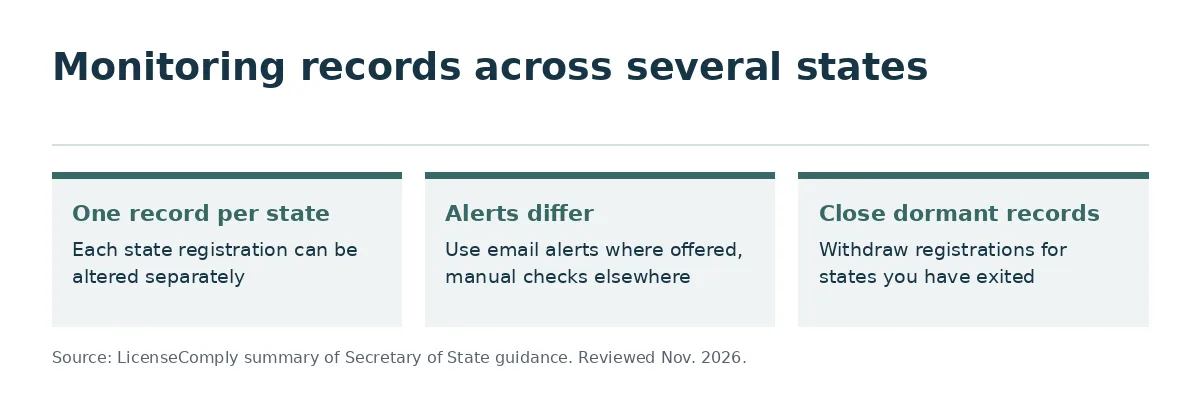
Each state where you register keeps its own record, and each record can be altered separately. A company formed in Delaware and registered in 12 other states has 13 Secretary of State records, plus state tax accounts and city or county licenses.
- Alert tools differ. Colorado, Georgia and Florida offer email notices, but you may need to rely on periodic manual checks elsewhere, so set a review schedule for each state.
- Registered agents and addresses multiply. Confirm the agent and mailing address in every state after any move or agent change.
- Dormant registrations are a weak spot. Withdraw foreign registrations and close tax accounts and licenses for locations you have exited, following each state’s process.
- Notices may go to different people. Route state, tax and license correspondence to one monitored mailbox so a stray notice is not ignored.
- Response is per state. If one record is altered, check the others, because a thief who changes one filing may try more.
If you are expanding, our guide to the registration sequence when opening in a new state shows which records you create along the way, which is also your monitoring list.
What should you do if your business identity is stolen?
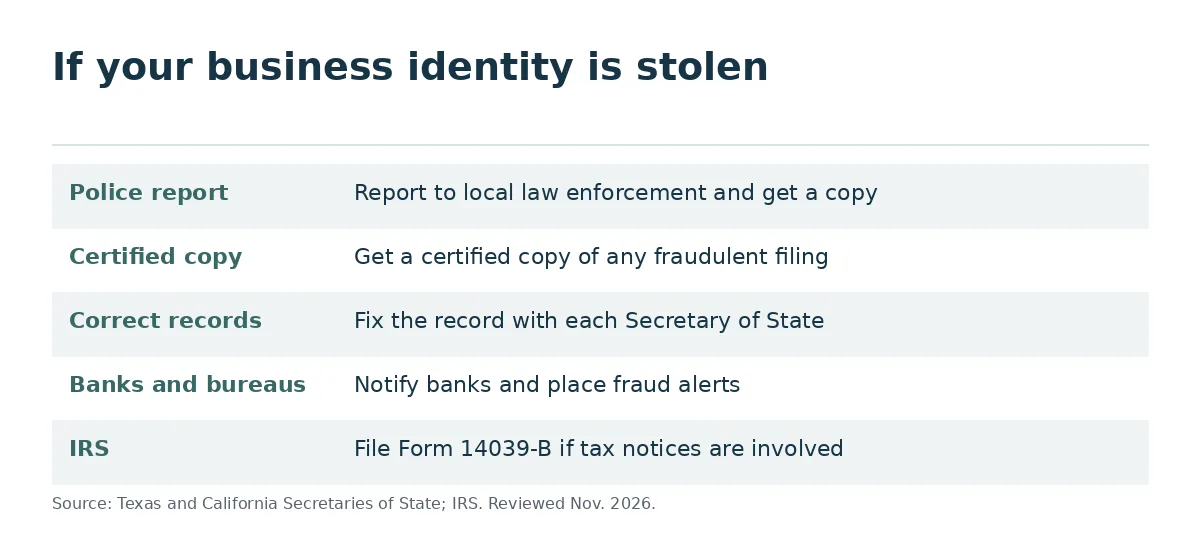
Take immediate action and document everything. The Texas Secretary of State recommends these steps:
- Report the theft to local law enforcement authorities and get a police report.
- Contact your banks and credit providers.
- Contact the major credit reporting agencies’ fraud departments and place a fraud alert on business accounts.
- Request copies of documents used to open fraudulent accounts.
- Ask the U.S. Postal Inspection Service whether your mailing address was changed.
- Contact the Secretary of State, the state tax agency and the IRS.
The Texas page also points victims to the Identity Theft Resource Center and the FTC for additional resources.
Fix fraudulent state filings
Get a certified copy of the fraudulent filing before you correct the record, because it may be used as evidence in court, per the California Secretary of State and the Texas Secretary of State. In Colorado, you can correct hijacked information by filing a Statement of Correction and file a complaint with the Secretary of State, per its checklist for victims.
Report tax-related identity theft to the IRS
File Form 14039-B, Business Identity Theft Affidavit, if you receive a notice about a rejected e-filed return, a return or Form W-2 you did not file, or a balance due you do not owe, per the IRS. Do not file it for a data breach with no tax impact.
You can submit the form online through a Login.gov or ID.me account. Otherwise, mail or fax it to the address on your IRS letter, or if you have no letter, fax it to 855-807-5720 or mail it to Internal Revenue Service, Ogden, UT 84201, per the IRS. Under the Internal Revenue Manual, the IRS sends an acknowledgment letter within 30 days of receiving the form.
Frequently asked questions
What is the difference between business identity theft and personal identity theft?
Personal identity theft misuses an individual’s information, such as a Social Security number. The business version imitates the company itself, often by filing false changes to its state record or misusing its Employer Identification Number to get credit, loans or tax refunds. The two can overlap, because thieves may also steal owners’ personal information to open accounts in the company’s name. Business victims report tax issues to the IRS on Form 14039-B.
How do I protect my business from identity theft?
Check your Secretary of State record in every state where you are registered at least once a year, and sign up for email filing alerts where states offer them, such as Colorado, Georgia and Florida. File address and officer changes promptly, keep your IRS responsible party information current, and protect your EIN and account numbers. Close entities and registrations you no longer use, and monitor your business credit reports.
Do I need a paid business identity theft protection service?
Not necessarily. For a small business, many core protections are free, including state business searches, state email alerts where offered, and California’s free filing history on bizfile Online. Paid credit monitoring can add coverage, and Florida suggests signing up for a credit monitoring service if possible. Whatever you use, someone in the business should own the job of reviewing records and alerts on a set schedule.
What should I do if someone changed my business filing with the Secretary of State?
Get a certified copy of the fraudulent filing first, since California and Texas note it may be used as evidence in court. Then report it to local law enforcement, contact the Secretary of State to correct the record, and notify your bank and credit bureaus. In Colorado, you can correct the record by filing a Statement of Correction. Check your records in other states as well.
When should a business file IRS Form 14039-B?
File Form 14039-B when you receive an IRS notice about a rejected e-filed return because one is already on file, a tax return or Form W-2 you did not file, a balance due you do not owe, or a business EIN you never applied for. The IRS says not to file it for a data breach that has no tax impact. You can submit it online, by mail or by fax.
Operating in several states?
LicenseComply researches which licenses and registrations each of your locations needs and verifies their current status, so you know exactly which records to keep current.
Explore Research & Verification Talk to a licensing specialist
Official sources and further reading
- Texas Secretary of State: Business identity theft
- California Secretary of State: Business identity theft resources
- Georgia Secretary of State: Business identity theft
- Colorado Secretary of State: Email notification
- Colorado Secretary of State: Prevention checklist
- Colorado Secretary of State: Checklist for victims
- Florida Division of Corporations: Preventing identity theft
- Florida Division of Corporations: Mind Your Sunbizness
- Internal Revenue Service: Identity theft information for businesses
- Internal Revenue Service: Report identity theft for a business
- Internal Revenue Service: If you received an EIN you didn’t request
- Internal Revenue Service: Form 8822-B, Change of Address or Responsible Party, Business
- Internal Revenue Manual 25.23.9: Business Master File identity theft processing
- Federal Trade Commission: Fighting identity theft with the Red Flags Rule
- FBI: Business email compromise
- Federal Trade Commission: Protecting personal information, a guide for business
- Financial Crimes Enforcement Network: Beneficial ownership information reporting
- FBI Internet Crime Complaint Center: 2025 Internet Crime Report
Disclaimer: LicenseComply provides professional business licensing and compliance services. However, the informational content on this site (including articles, guides, tools, and videos) is provided for general educational purposes only and does not constitute legal, tax, or accounting advice. Laws and regulations change frequently, and we cannot guarantee that all information is accurate, complete, or up to date for your specific circumstances. Your use of this website and its content does not create an attorney-client, accountant-client, or other advisory relationship. You should consult with a qualified attorney, accountant, or other appropriate professional for advice tailored to your business.