
Key points
- You do not need an LLC to get a business license, because the SBA says you are automatically a sole proprietorship if you do business without registering as another type of business.
- A sole proprietor who operates under a name other than their own legal name usually must register that name as a DBA, such as a Texas assumed name certificate filed with the county clerk or a $50 Florida fictitious name registration.
- Licenses are usually tied to the legal owner, so forming an LLC later can require new licenses, as in Texas, where the Comptroller treats a sole proprietor forming an LLC as a change of ownership that needs a new sales tax permit.
- Washington says changing a business structure follows the same process as starting a new business, with a new Business License Application and a new Unified Business Identifier number.

No, you do not need an LLC to get a business license. A sole proprietorship business license is issued to you as an individual, and the U.S. Small Business Administration (SBA) says you are automatically a sole proprietorship if you do business but do not register as any other kind of business. What you need depends on your activity and location, not on whether you formed a limited liability company (LLC).
Many small business owners, including freelancers, consultants and home based businesses, start as sole proprietors, get licensed under their own name or a registered trade name, and decide later whether an LLC makes sense. The catch is timing: licenses are usually tied to the legal owner, so forming an LLC after you are licensed can mean applying again.
This guide covers DBA (doing business as) names, whether to use a Social Security Number (SSN) or an Employer Identification Number (EIN), and what changes if you form an LLC later. Rules come from official sources reviewed November 2026; confirm each one with the issuing agency.
Do I need an LLC to get a business license?
No. A business license is permission to operate in a jurisdiction, and it is available to sole proprietors as well as entities. The SBA describes a sole proprietorship as easy to form and notes that “you’re automatically considered to be a sole proprietorship if you do business activities but don’t register as any other kind of business,” per its business structure guide.
The Washington Department of Revenue requires a business license if, among other conditions, your gross income is $12,000 or more a year or you do business under a name other than your full legal name, per its business license page. None of those triggers requires an LLC.
Operating without a required license can lead to fines: in Alabama, a city may fine a business up to $500 for each offense, and each day counts as a separate offense, under Code of Alabama Section 11-51-93. To operate legally, get licensed before you open, whatever your business type.
If you want the side-by-side definitions of an LLC, a business license and a business tax license, see our explainer on whether an LLC and a business license are the same thing.
How do you get a sole proprietorship business license?
Getting a sole proprietor business license has five parts. Most owners handle them in this order, though some agencies combine steps on one application.
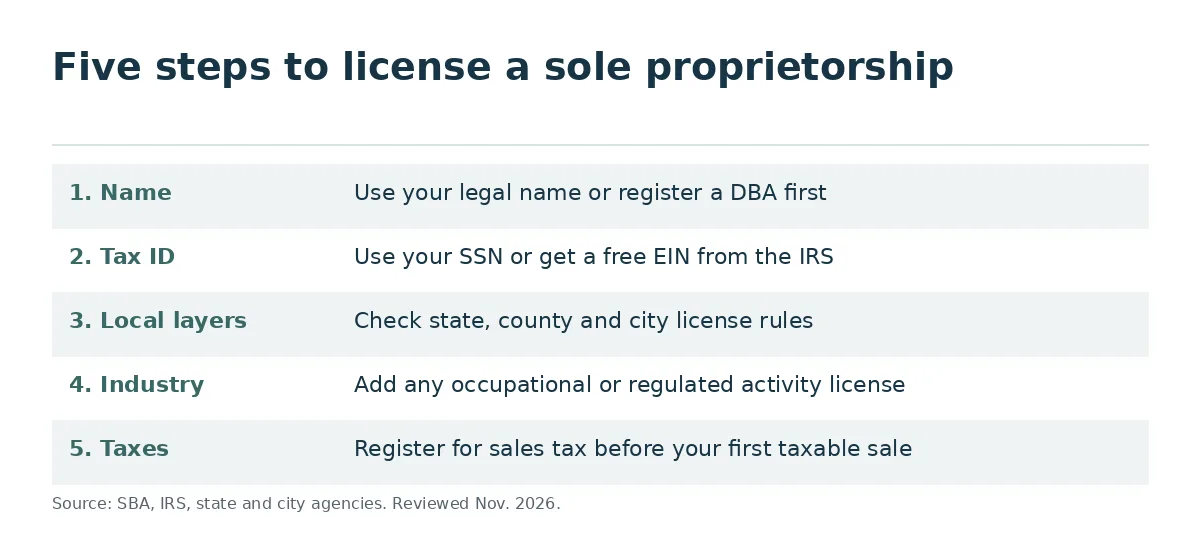
Step 1: Decide on your name and file a DBA if needed
If you do business under your own legal name, you may not need to register anywhere. The SBA says, “If you conduct business as yourself using your legal name, you won’t need to register anywhere,” in its registration guide.
If you use any other name, you usually must register it as a DBA, also called a trade name, fictitious name or assumed name. The SBA notes that most states require DBA registration if you use one, and that registering a DBA “doesn’t provide legal protection by itself.” Where you file depends on the state:
| State | Sole proprietor DBA filing | Key rule |
|---|---|---|
| Texas | Assumed name certificate with the county clerk | File in each county with a business office (Texas Secretary of State) |
| New York | Business certificate with the county clerk | Needed only if a trade name is used (NYC Business) |
| Florida | Fictitious name registration with the Department of State | $50, valid about 5 years (Florida Statutes 865.09) |
| California | Fictitious business name statement | File within 40 days of starting (Business and Professions Code 17910) |
Skipping the DBA can cost more than the filing fee. Under Florida Statutes 865.09, a business that fails to register its fictitious name cannot maintain a lawsuit in a Florida court until it complies, and the failure is a noncriminal violation.
Step 2: Choose your tax identification number
Your federal tax ID number is either your SSN or an EIN. Many sole proprietors can apply for licenses with their SSN; Los Angeles, for example, asks sole proprietors for one, per the Los Angeles Office of Finance. The Internal Revenue Service (IRS) says you need an EIN if you have employees, pay employment or excise taxes, or withhold tax on certain payments to nonresident aliens, per its EIN overview. An LLC, partnership or corporation needs one regardless.
The same IRS page says that if you do not need an EIN for federal tax purposes, “you can still request one for banking or state tax purposes.” An EIN is free, and “You never have to pay a fee for an EIN,” according to the IRS.
To pay taxes, a sole proprietor reports business profit on Schedule C, attached to the personal tax return (Form 1040), and self-employment tax on Schedule SE, per the IRS sole proprietorships page.
Step 3: Check the state, county and city layers
Your business location determines most of what you need, because local governments set licensing rules (SBA). Licensing works at the state and local levels, and a sole proprietor may need multiple licenses from different government agencies:
- State: only some states issue a general business license. Washington issues one state business license with city and state endorsements, and its triggers apply to sole proprietors (Washington Department of Revenue). In Alaska, the business license cost is $50 per year, with a $25 rate for sole proprietors who are 65 or older or service-connected disabled veterans, a discount not available to LLCs, per the Alaska business licensing FAQs.
- City: Philadelphia requires a Commercial Activity License for “any person or legal entity that does business in Philadelphia,” at no cost, per the City of Philadelphia.
- County: some counties license businesses too, especially in unincorporated areas, so check the county website for your address as part of your sole proprietorship business license research.
Check zoning for your physical location, including a home office. The SBA says zoning ordinances “can still apply even to home-based businesses” and that zoning is typically controlled locally, so check with your city planning office first, per its business location guide.
Step 4: Add industry and professional licenses
Regulated industries need a license no matter how the business is structured. Federal licenses apply only to activities regulated by federal agencies, such as alcohol, firearms, aviation and commercial fishing. States regulate a broader range, including construction, plumbing, food service such as restaurants, and retail, per the SBA (licenses and permits guide). For trades and professional services, see our guide on what an occupational license is.
Step 5: Register for state and local taxes
If you sell taxable goods or services, you usually need a sales tax permit (sometimes called a sales tax license or seller’s permit) before your first sale. Texas charges no fee for its permit but may require a security bond, per the Texas Comptroller. California’s seller’s permit is also free, though the California Department of Tax and Fee Administration may require a security deposit, per its seller’s permit FAQs.
When must the license be in your business name?
A license is issued to the legal owner. For a sole proprietor, that is you, plus any registered DBA. Agencies expect the names on your license, tax account and DBA filing to match.
- Washington: using a name other than your full legal name is itself a trigger for a state business license (Washington Department of Revenue).
- Alaska: “A separate business license is required for each different name a business will be operating and advertising under” (Alaska FAQs).
- Philadelphia: the license application must identify the owner exactly as registered on the city tax account, and any DBA must also be listed on that account (City of Philadelphia).
- Chicago: a legal name or DBA change must be reported within 60 days, and the change application costs $40 (City of Chicago).
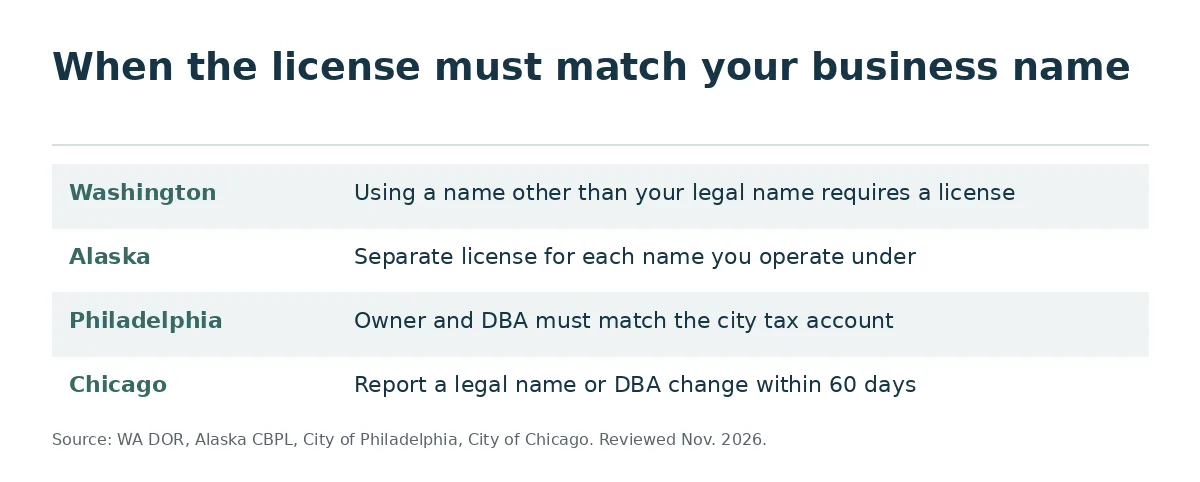
The practical rule for a sole proprietorship business license: register the DBA first, then apply under that exact name.
Do I need an LLC at all?
Licensing does not require one, so the question is about liability, taxes and paperwork. That choice depends on your situation, and LicenseComply does not give legal or tax advice. The SBA’s guidance is a neutral starting point.
The SBA says your business structure “affects how much you pay in taxes, your ability to raise money, the paperwork you need to file, and your personal liability” (SBA). On each structure:
- Sole proprietorship: it “does not produce a separate business entity,” so you can be held personally liable for business debts. The SBA calls it a possible fit for low-risk businesses and owners who want to test an idea.
- LLC: it protects owners “from personal liability in most instances,” and profits can pass through to personal income. Members are still considered self-employed and pay self-employment tax. The SBA calls it a possible fit for medium or higher-risk businesses and owners with significant personal assets.
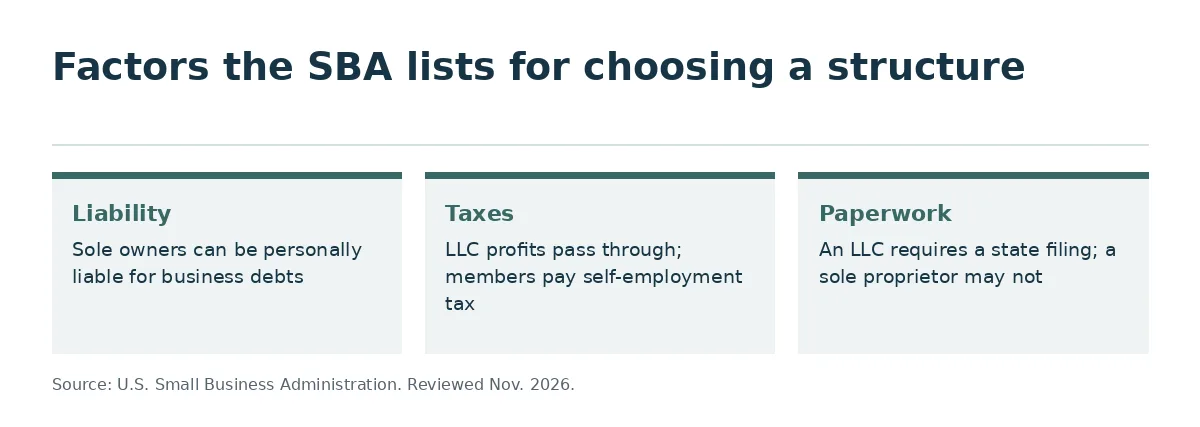
The SBA also cautions that converting later can bring “tax consequences and unintended dissolution, among other complications,” and that “consulting with business counselors, attorneys, and accountants can prove helpful.” If you are weighing the change, an attorney or tax professional can apply those factors to your facts, including tax status and tax advantages. Owners with business partners can also review the SBA’s sections on limited liability partnerships and the S corp. Forming an LLC means a state filing; California, for example, charges $70 to file Articles of Organization, per the California Secretary of State.
Separate personal and business finances either way
Whatever you choose, keep business funds out of your personal accounts. The SBA says business banking “offers limited personal liability protection by keeping your business funds separate from your personal funds,” and that you can open a business bank account once you have an EIN, per its bank account guide. A business credit card can also help build business credit. The SBA adds that business insurance can fill coverage gaps so personal and business assets are protected, and that every business with employees needs workers’ compensation insurance, per its insurance guide.
Should you get an LLC or business license first?
If you have already decided to form an LLC, form it first and then apply for licenses in the LLC’s name. Licenses belong to the legal owner, so a license issued to you as a sole proprietor usually does not carry over to a new LLC.
Washington builds this order into its process: a Washington LLC must file with the Secretary of State before submitting the Business License Application, per the Washington Department of Revenue. Our guide on how to get a business license for an LLC walks through the steps after formation.
If you are not ready to decide, license as a sole proprietor now and expect to replace licenses later.
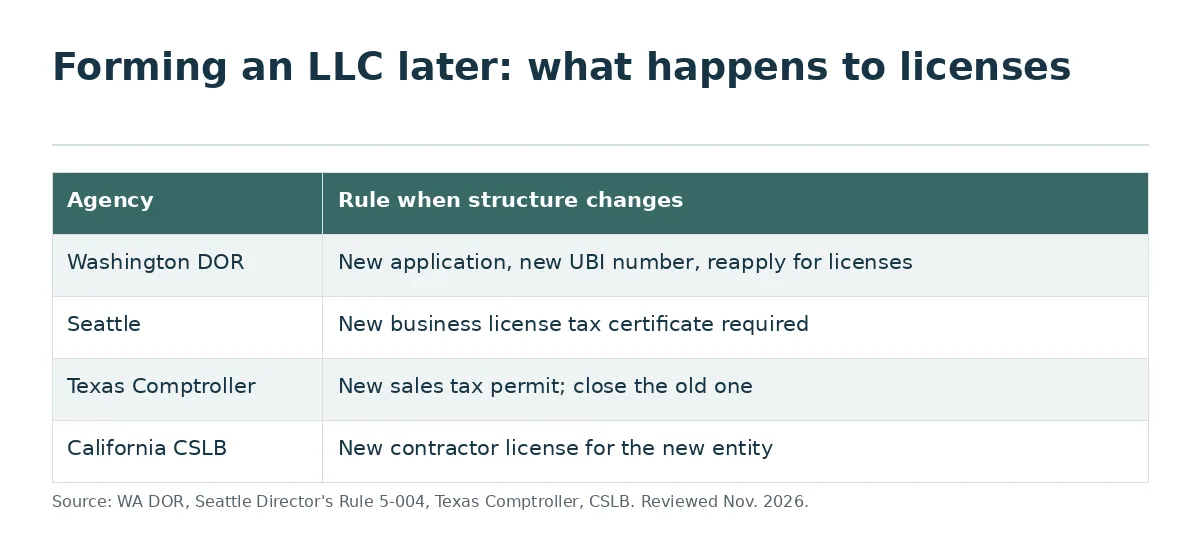
What happens to your licenses when you form an LLC later?
Agencies often treat the switch as a new owner:
- Washington: “The process to change a business structure (for example, change from a sole proprietorship to a corporation) is the same as starting a new business.” You file a new Business License Application, get a new Unified Business Identifier (UBI) number, and “will probably need to re-apply for all of the licenses you currently have,” per the Department of Revenue.
- Seattle: a business license tax certificate is “personal and nontransferable,” and a change in legal structure counts as a change of ownership that requires a new certificate, under Director’s Rule 5-004.
- Texas: a sole proprietor who forms an LLC has a change of ownership, so the LLC needs a new sales tax permit, and the old permit must be closed if no longer needed (Texas Comptroller).
- California contractors: “A new license is required whenever the business entity changes,” and the new business must post new bonds and show workers’ compensation coverage or an exemption, per the Contractors State License Board.
Your federal tax number may change too. The IRS says a sole proprietor needs a new EIN after incorporating or forming a partnership, but not after changing the business name or location, per its guide to new EINs. Ask the IRS or your accountant how this applies to an LLC.
For an existing business, the usual order is: form the LLC, get new tax numbers, apply for new licenses, then close the old accounts. Florida, for example, requires a cancellation and reregistration of a fictitious name within 30 days after ownership changes, under Florida Statutes 865.09.
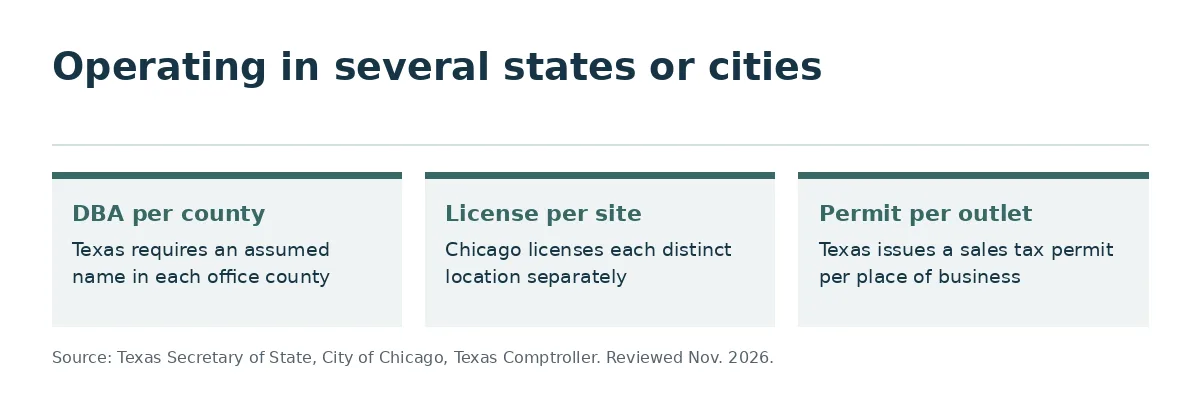
What changes when you operate in several states or cities?
- DBA filings can multiply. Texas requires a sole proprietor’s assumed name certificate in each county where a business office is maintained, or, without a Texas office, in each county where business is conducted (Texas Secretary of State).
- Each location may need its own license. Chicago issues licenses “for a specific location” that are not transferable, so every distinct location needs a new license (City of Chicago).
- Tax permits follow places of business. Texas requires a sales tax permit for each active place of business, issued under one taxpayer number with separate outlet numbers (Texas Comptroller).
- Out-of-town businesses can still owe local licenses. Philadelphia’s Commercial Activity License covers businesses located outside the city that do business there (City of Philadelphia).
If you form an LLC and expand, the LLC will “probably need to register with any state where you conduct business activities,” according to the SBA. Our guide to the registration sequence when opening in a new state covers that order. LicenseComply’s research and verification service maps license requirements location by location for owners who want that done for them.
Frequently asked questions
Can I get a business license without an LLC?
Yes. Sole proprietors get business licenses in their own name or under a registered DBA. The SBA says you are automatically a sole proprietorship if you do business without registering as another type of business, and licensing depends on your activity and location. Washington, Alaska and Philadelphia all license individuals as well as entities. Check your state, county and city requirements before you start.
Do I need an LLC to be a freelancer or run a side business?
Not to get licensed. The SBA treats anyone doing business without registering another structure as a sole proprietor, and many freelancers operate that way and report income on Schedule C. You still need any license your state, county or city requires, plus a DBA if you use a trade name. Whether an LLC is worth it depends on liability, taxes and paperwork, so the SBA suggests consulting an attorney or accountant.
Should I form an LLC or get a business license first?
If you have already decided on an LLC, form it first and apply for licenses in its name, because licenses are tied to the legal owner. Washington, for example, requires an LLC to file with the Secretary of State before applying for a business license. If you license as a sole proprietor first, expect to apply again or update licenses after forming the LLC.
Does a sole proprietor need an EIN to get a business license?
Not always. Many agencies accept an SSN from sole proprietors. Los Angeles, for example, asks sole proprietors for an SSN and LLCs for an EIN. The IRS requires an EIN if you have employees or pay certain employment or excise taxes, and you can request one free for banking or state tax purposes. Check each application’s requirements.
Do I need a new business license if I change from a sole proprietorship to an LLC?
Often, yes. Washington treats a structure change like starting a new business, with a new license and UBI number. Seattle requires a new business license tax certificate when legal structure changes. Texas requires a new sales tax permit, and California requires a new contractor license when the entity changes. Review every license and permit before the LLC starts operating.
Not sure which licenses your sole proprietorship needs?
LicenseComply researches the state, county and city licenses your business needs at each location and lays out the requirements before you apply.
Explore Research & Verification Talk to a licensing specialist
Official sources and further reading
- U.S. Small Business Administration: Choose a business structure
- U.S. Small Business Administration: Register your business
- U.S. Small Business Administration: Apply for licenses and permits
- U.S. Small Business Administration: Pick your business location
- U.S. Small Business Administration: Open a business bank account
- U.S. Small Business Administration: Get business insurance
- Code of Alabama Section 11-51-93: Municipal license violations
- California Secretary of State: Limited liability companies, California domestic
- Internal Revenue Service: Employer identification number
- Internal Revenue Service: Get an employer identification number
- Internal Revenue Service: When to get a new EIN
- Internal Revenue Service: Sole proprietorships
- Washington Department of Revenue: Apply for a business license
- Washington Department of Revenue: Change your business structure
- Seattle Director’s Rule 5-004: Transfer of a business license
- Alaska Division of Corporations, Business and Professional Licensing: Business licensing FAQs
- Texas Secretary of State: Name filings FAQs
- Texas Comptroller: Sales tax permit FAQs
- NYC Business: Business certificate for sole proprietorships and general partnerships
- Florida Statutes Section 865.09: Fictitious name registration
- California Business and Professions Code Section 17910
- California Department of Tax and Fee Administration: Obtaining a seller’s permit
- California Contractors State License Board: Change in business entity
- Los Angeles Office of Finance: How to register for a Business Tax Registration Certificate
- City of Philadelphia: Get a Commercial Activity License
- City of Chicago: Update your business license information
Disclaimer: LicenseComply provides professional business licensing and compliance services. However, the informational content on this site (including articles, guides, tools, and videos) is provided for general educational purposes only and does not constitute legal, tax, or accounting advice. Laws and regulations change frequently, and we cannot guarantee that all information is accurate, complete, or up to date for your specific circumstances. Your use of this website and its content does not create an attorney-client, accountant-client, or other advisory relationship. You should consult with a qualified attorney, accountant, or other appropriate professional for advice tailored to your business.