
Key points
- An LLC (limited liability company) is a business structure formed with a state, while a business license is government permission to operate a particular activity in a particular place, so forming an LLC does not license the business.
- A business tax license, often called a seller’s permit or sales tax permit, authorizes a business to collect sales tax and is separate from both the LLC filing and any general business license.
- Texas requires a sales and use tax permit for each active place of business and charges no fee for the permit, although the Comptroller may require a security bond.
- Los Angeles requires a separate Business Tax Registration Certificate for each type of business activity and each business location in the city.

No. An LLC (limited liability company) and a business license are different things, and having one does not give you the other. An LLC is a legal structure you form with a state to separate the business from its owners. A business license is permission from a city, county, state or federal agency to carry out a specific activity in a specific place.
A third item adds to the confusion: the business tax license. Depending on the state, it may be called a seller’s permit, a sales tax permit or a sales and use tax permit, and it authorizes the business to collect sales tax from customers. Some cities also use “business tax” in the name of their general local license, which blurs the line further.
Most operating businesses end up needing all three: the entity filing, one or more business licenses, and tax registrations for each state and location where they sell. This guide explains what each one does, how they fit together, and how the rules change by state and city, using official sources reviewed November 2026. Requirements vary by jurisdiction and industry, so confirm current rules with each issuing agency.
What is the difference between an LLC and a business license?
The short version: the LLC answers “who is the business,” and the license answers “is this business allowed to do this activity here.”
An LLC is created by filing articles of organization with a state. According to the U.S. Small Business Administration guide to business structures, you choose a structure before you register with the state, and LLCs protect owners from personal liability in most instances. Forming the LLC creates the entity. It does not authorize any particular activity.
A business license is issued by the government that regulates the activity or the location. The Small Business Administration licenses and permits guide notes that most small businesses need a combination of licenses and permits from federal and state agencies, and that requirements and fees vary based on business activities, location and government rules. Cities and counties often add their own general business licenses on top.
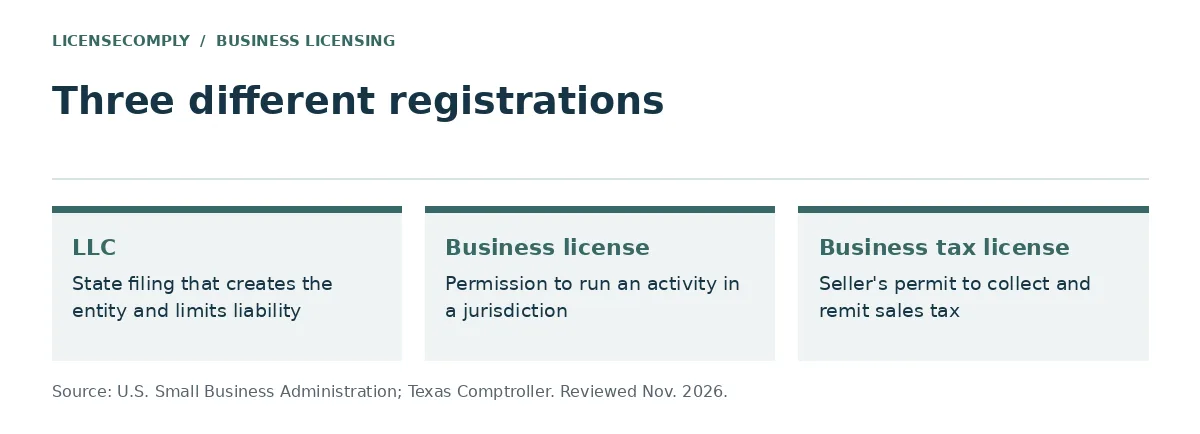
Comparing the three side by side
| LLC | Business license | Business tax license (seller’s permit) | |
|---|---|---|---|
| What it is | A legal business structure | Permission to operate an activity in a jurisdiction | Registration to collect and remit sales tax |
| Who issues it | The state where you form (and states where you register to do business) | City, county, state or federal agency, depending on the activity | State tax agency, and sometimes local tax offices |
| Main purpose | Separates owners from business debts and lawsuits | Confirms the business meets local and industry rules | Lets the state track sales tax you collect from customers |
| Replaces the others? | No | No | No |
Does an LLC need a business license?
Usually, yes, if the business is operating. The entity type does not exempt a company from licensing. A one-person LLC running a consulting practice in a city with a general business license requirement still needs that license, and an LLC that runs a restaurant still needs health permits, a sales tax permit and possibly a liquor license.
The reverse is also true. A sole proprietor can hold a business license without forming an LLC. Licensing follows the activity and location, not the entity type.
How do LLCs work for liability and taxes?
Liability protection is the main reason owners form an LLC. The Small Business Administration explains that personal assets such as a vehicle, house and savings generally are not at risk if the LLC faces bankruptcy or lawsuits. That protection comes from the entity, not from any license.
For federal income tax, the LLC is flexible. The Internal Revenue Service LLC page states that a domestic LLC with at least two members is classified as a partnership unless it elects to be treated as a corporation, and a single-member LLC is disregarded as separate from its owner for income tax purposes unless it makes that election on Form 8832. The Small Business Administration adds that LLC members are considered self-employed and pay self-employment tax.
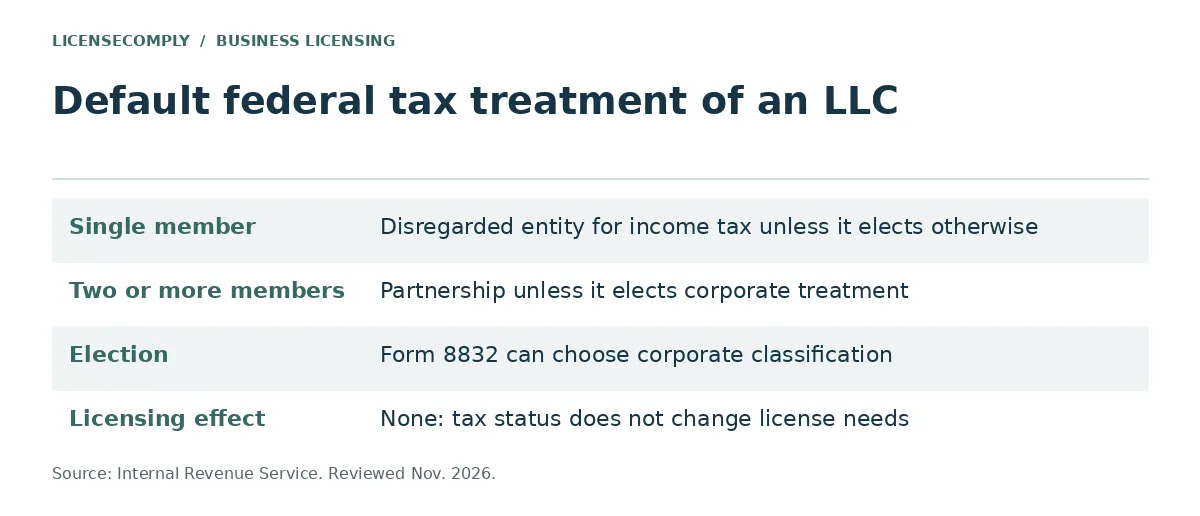
None of this changes licensing. An LLC’s tax classification determines how income is reported to the Internal Revenue Service. It has no effect on whether a city requires a business license or a state requires a seller’s permit.
Do you need to register the LLC in other states?
If you operate in more than one state, you may need to register your LLC as a foreign entity in each state where you conduct business. The Small Business Administration notes that an LLC will probably need to register with any state where it conducts business activities and needs a registered agent in that state. Foreign registration is an entity filing, not a license, and it is often a prerequisite for state licenses and tax accounts. Our guide to the registration sequence for opening in a new state walks through the usual order.
What is a business tax license?
A business tax license is a registration with a tax agency. Its main job is to let the business collect sales tax from customers and send it to the state. It does not, by itself, confirm that the business meets zoning, health, safety or professional standards.
States use different names for the same idea:
- In Texas, it is a sales and use tax permit. The Texas Comptroller of Public Accounts requires one for an individual, partnership, corporation or other legal entity engaged in business in Texas that sells, leases or rents tangible personal property or sells taxable services in Texas. There is no fee, but the Comptroller may require a security bond.
- In California, it is a seller’s permit. The California Department of Tax and Fee Administration requires one for businesses engaged in business in California that intend to sell or lease tangible personal property that would ordinarily be subject to sales tax at retail. The requirement applies to individuals, corporations, partnerships and LLCs, and both wholesalers and retailers must apply. There is no fee, although a security deposit may be required.
For the difference between a seller’s permit and the certificate you give suppliers to buy inventory tax free, see our guide to seller’s permits vs. resale certificates.
When is a “business tax” registration really a business license?
Some cities name their general local license after the tax that funds it. In Los Angeles, the Office of Finance tax information booklet says all persons engaged in business in the city must obtain a Business Tax Registration Certificate unless specifically exempted, and vendors that owe no tax must still register. Here, the “business tax” document is the city’s general business registration, separate from the state seller’s permit issued by the California Department of Tax and Fee Administration.
So when you see “business tax license,” check who issues it. A state tax agency issuing a sales tax permit is one thing. A city finance office issuing a business tax certificate is the local equivalent of a business license.
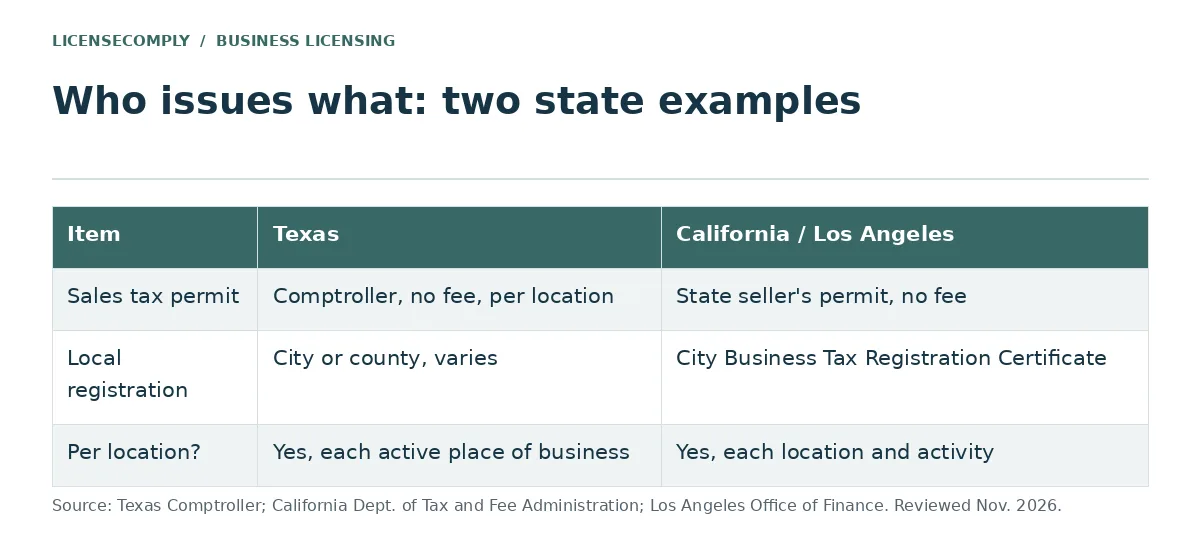
Why multi-location businesses need permits for each location
For operators with several locations, the biggest practical difference between an LLC and its licenses is that the LLC is formed once, while licenses and tax permits often multiply by location.
- The Texas Comptroller requires a tax permit for each active place of business, defined as an outlet, office or location that receives three or more orders for taxable items in a calendar year. Multiple locations receive separate permits with the same taxpayer number but separate outlet numbers.
- The Los Angeles Office of Finance requires a separate registration certificate for each type of business activity and each business location in the city.
- Texas also requires remote sellers to hold a permit once they have $500,000 or more in Texas revenue in the past 12 months, according to the Comptroller’s permit FAQ.
A company with one LLC and 12 locations in four states could need 12 or more local licenses, several state tax permits and foreign registrations in three states, each with its own renewal schedule.
How state business licenses add another layer
A few states issue a general state business license in addition to the entity filing and local licenses. Washington is one example. The Washington Department of Revenue requires a business license if, among other conditions, the business sells a product or service that requires collecting sales tax, plans to hire employees within 90 days, uses a name other than the owner’s full legal name, or has gross income of $12,000 per year or more. Businesses formed in Washington as corporations, partnerships and similar entities must file with the Secretary of State before submitting the business license application, which shows the usual order: entity first, then license.
Many other states, including Texas, do not issue a general statewide business license, so local and industry licenses carry more weight there. If you are unsure what applies, our guide Do I need a business license? explains how to check state, county and city requirements.
A simple order of operations
For most new businesses and new locations, the sequence looks like this:
- Form the entity (or register an existing LLC in the new state) and appoint a registered agent.
- Get an Employer Identification Number from the Internal Revenue Service if the business needs one.
- Register for state tax accounts, including a seller’s permit or sales tax permit if you sell taxable goods or services.
- Apply for state, county and city business licenses and any industry permits for each location.
- Calendar every renewal, because licenses and permits often renew on different cycles.
To confirm whether a license already exists for a company or location, use our business license lookup guide.
Frequently asked questions
Is a business license the same as an LLC?
No. An LLC is a legal entity formed with a state that separates the owners from the business’s debts and lawsuits. A business license is permission from a government agency to operate a specific activity in a specific location. Forming an LLC does not license the business, and holding a business license does not create an LLC or give owners liability protection. Most operating LLCs need both, plus any required tax registrations.
Does an LLC need a business license?
In most cases, yes. Licensing requirements follow the business activity and location, not the entity type. If your city, county or state requires a general business license, or your industry requires a specific permit, your LLC must obtain it. A single-member LLC is treated the same as any other business for licensing purposes, even though the Internal Revenue Service may disregard it for income tax.
Is a seller’s permit a business license?
Not usually. A seller’s permit, also called a sales tax permit, registers the business with the state tax agency so it can collect and remit sales tax. It does not replace a city or county business license or industry permits. In Texas and California, the state issues the tax permit at no charge, while local governments handle general business licenses separately.
Is a business tax license the same as a business license?
It depends on who issues it. A state business tax license is typically a sales tax permit. Some cities, such as Los Angeles, call their general local registration a Business Tax Registration Certificate, which functions as the city’s business license. Check the issuing agency: a state tax department issues tax permits, and a city finance or licensing office issues local business registrations.
Do I need a separate license for each location?
Often, yes. The Texas Comptroller requires a sales tax permit for each active place of business, and Los Angeles requires a separate Business Tax Registration Certificate for each business location and each type of business activity. Many cities and counties license by location as well. Your LLC is formed once, but licenses and tax permits commonly multiply as you add locations.
Formed the LLC, but not sure which licenses each location needs?
LicenseComply researches the state, county and city licenses, permits and tax registrations each of your locations needs, then files the applications and tracks renewals.
Explore Research & Verification Talk to a licensing specialist
Official sources and further reading
- U.S. Small Business Administration: Choose a business structure
- U.S. Small Business Administration: Apply for licenses and permits
- Internal Revenue Service: Limited liability company (LLC)
- Texas Comptroller of Public Accounts: Sales tax permit FAQ
- California Department of Tax and Fee Administration: Obtaining a seller’s permit
- Los Angeles Office of Finance: Tax information booklet
- Washington Department of Revenue: Apply for a business license
Disclaimer: LicenseComply provides professional business licensing and compliance services. However, the informational content on this site (including articles, guides, tools, and videos) is provided for general educational purposes only and does not constitute legal, tax, or accounting advice. Laws and regulations change frequently, and we cannot guarantee that all information is accurate, complete, or up to date for your specific circumstances. Your use of this website and its content does not create an attorney-client, accountant-client, or other advisory relationship. You should consult with a qualified attorney, accountant, or other appropriate professional for advice tailored to your business.