
Key points
- Most states do not issue a document called a wholesale license; buying and selling wholesale usually requires a state seller’s permit or sales tax registration, a resale certificate, and any local business license.
- California requires both wholesalers and retailers to hold a seller’s permit, and the California Department of Tax and Fee Administration issues the permit free of charge.
- Washington issues free reseller permits that are generally valid for four years, or two years for newer businesses and contractors.
- Products such as beverage alcohol, tobacco, prescription drugs and food often require a separate federal or state wholesale license on top of sales tax registration.

A wholesale license is usually not one document. In most states, buying and selling wholesale means registering with the state tax agency for a seller’s permit (also called a sales tax permit or reseller permit), using a resale certificate so you can buy inventory without paying sales tax, and getting any city or county business license your location requires. Some products, such as alcohol, tobacco, prescription drugs and food, also need a separate industry license.
Suppliers use the term “wholesale license” loosely. When a distributor asks for yours, they usually mean proof that you are registered to collect sales tax and a completed resale certificate.
This guide explains how to get a wholesale license in practical terms, with state and city examples reviewed November 2026. Rules, fees and forms differ based on the state, the local jurisdiction and the products involved, so confirm the specific requirements with the issuing agency, its website or its contact line before you buy or sell.
What is a wholesale license?
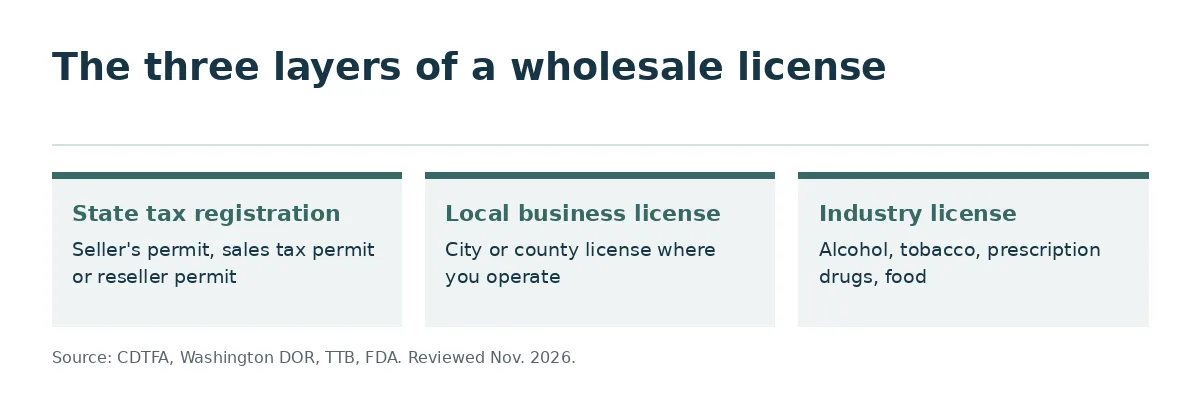
The term is a common name for the registrations that let a business buy products in bulk directly from manufacturers or distributors for resale, then sell them to other businesses. It typically has three layers.
The first layer is state tax registration. California calls it a seller’s permit, Texas a sales and use tax permit, New York a Certificate of Authority, and Washington issues a separate reseller permit. The second layer is a general business license and any other local permits from the city or county where the business operates, which follow local regulations. The third layer applies only to regulated products.
California’s own description is a useful definition. A seller’s permit “is a state license that allows you to sell items at the wholesale or retail level and to issue resale certificates to suppliers,” according to the California Department of Tax and Fee Administration (CDTFA). The same publication says a resale certificate lets you buy items you will sell in your business operations without paying tax to your suppliers.
Do you need a wholesale license to buy in bulk?
You generally need one to purchase goods tax free for resale. Buying large quantities at wholesale pricing does not by itself require a license, but buying without paying sales tax does. Wholesale suppliers must charge sales tax unless the buyer documents that the goods are for resale, so most will ask for your state registration number and a resale certificate before opening a tax-exempt account.
The resale document is what changes the transaction. In Texas, a taxable item purchased for resale is exempt from sales tax “if the seller accepts a properly completed Form 01-339,” the Texas Sales and Use Tax Resale Certificate, according to the Texas Comptroller. The Comptroller adds that a permit number or a copy of the buyer’s permit “is not a substitute for a resale certificate.”
Resale purchases are for inventory, not your own use. Under the Texas resale certificate, knowingly giving one for items bought for use is a criminal offense ranging from a Class C misdemeanor to a second degree felony, depending on the tax evaded (Texas Form 01-339). In Washington, misuse of a reseller permit may result in penalties for the buyer and revocation of the permit, per the Department of Revenue.
Our guide on the seller’s permit vs. resale certificate explains that distinction in detail.
How to get a wholesale license, step by step
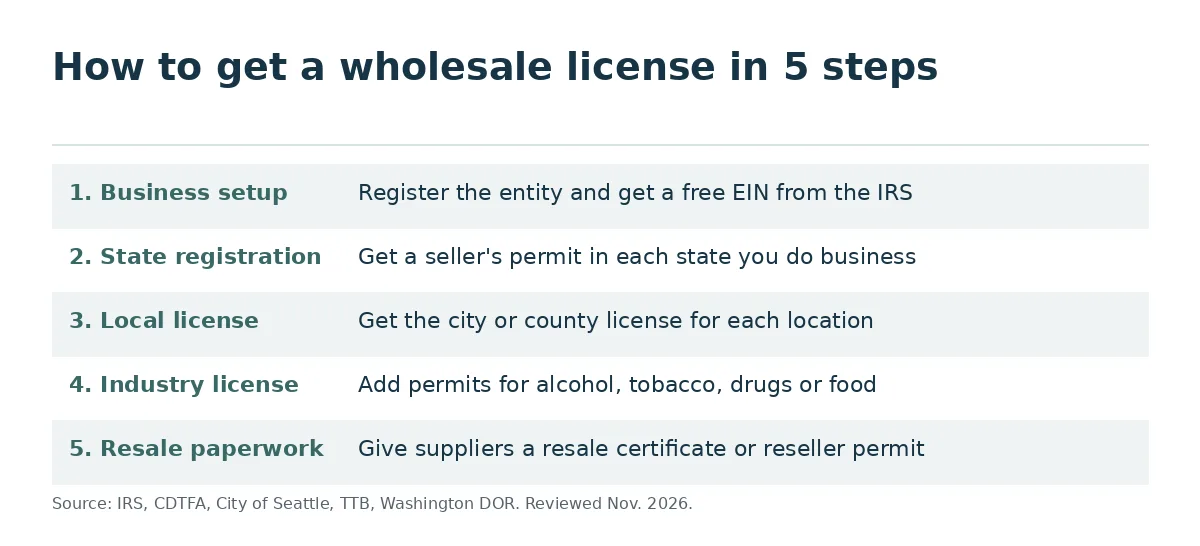
Step 1: Set up the business and get a tax ID
Decide on a legal structure, such as a sole proprietorship, limited liability company (LLC) or corporation, and complete business registration with your state if you form an entity. Use the exact legal name and business name you will use on every later application. Most wholesalers then get an Employer Identification Number (EIN), the federal tax ID. The Internal Revenue Service (IRS) states that “you never have to pay a fee for an EIN,” per its EIN application page. If you already have one, our guide on how to find your business tax ID number can help.
Step 2: Register for a seller’s permit or reseller permit
Register with the tax agency in each state where you are engaged in business. Wholesale-only sellers are not automatically exempt. “Both wholesalers and retailers must apply for a permit,” according to CDTFA’s seller’s permit FAQ.
Gather the necessary documents before you submit. When you apply for a wholesale seller’s permit in California, the application process asks for business information including bank account details and estimated income, plus each owner’s driver license number and Social Security number, according to CDTFA Publication 107. Keep your business address and mailing address consistent across every application. CDTFA says it may be able to issue the permit the same day.
Timing can matter in other states. New York requires you to apply for a Certificate of Authority “at least 20 days before” you make taxable sales or issue or accept New York exemption documents, per the New York Department of Taxation and Finance.
Step 3: Get local business licenses
Many cities and counties require their own license or tax registration, including for wholesalers. Seattle, for example, requires a business license tax certificate for wholesale businesses, among other activities, and requires renewal each year by December 31, per the City of Seattle.
Step 4: Add industry licenses for regulated products
Check whether your product line needs a separate permit before you place your first order. The section below covers common examples.
Step 5: Give suppliers your resale documentation
Once registered, complete each supplier’s resale certificate or your state’s form. Washington is an exception: it no longer accepts resale certificates and instead requires the state-issued reseller permit.
What does a wholesale business license cost by state?
The core state registration is often free, although some states may require a security deposit or bond. Local licenses and industry permits are where fees usually appear.
| State | State registration | Fee or timing | Resale documentation |
|---|---|---|---|
| California | Seller’s permit | Free; security deposit possible (CDTFA) | California resale certificate, given in good faith |
| Texas | Sales and use tax permit | No fee; bond may be required (Texas Comptroller) | Form 01-339 resale certificate |
| New York | Certificate of Authority | Apply 20 days before starting (NY Tax) | Form ST-120 resale certificate |
| Florida | Certificate of Registration | Register each location (Florida DOR) | Annual Resale Certificate, expires December 31 |
| Washington | Business license plus reseller permit | Reseller permit is free (Washington DOR) | State-issued reseller permit only |
Washington’s reseller permit
Washington is the clearest example of a true reseller permit. Its permits allow “retailers and wholesalers to purchase items for resale without paying sales tax,” according to the Washington Department of Revenue. Wholesalers and retailers are likely to receive one automatically when their business license application is processed, per the department’s reseller permit video transcript.
Reseller permits are generally valid for four years. They are valid for only two years if the business is a contractor, has been open less than 12 months, or has not reported gross income or filed returns in the last 12 months. The department aims to process applications within 10 business days, but it can take up to 60 days.
Local taxes on wholesale receipts
Some local and state taxes apply specifically to wholesale sales. Los Angeles taxes wholesale sales at $1.01 per $1,000 of gross receipts, and businesses that sell both wholesale and retail must split their receipts and pay under each classification, according to the Los Angeles Office of Finance.
Washington’s wholesaling business and occupation (B&O) tax rate is 0.484% through December 31, 2026, and rises to 0.5% on January 1, 2027, per a Department of Revenue special notice.
Which products need a separate industry license?
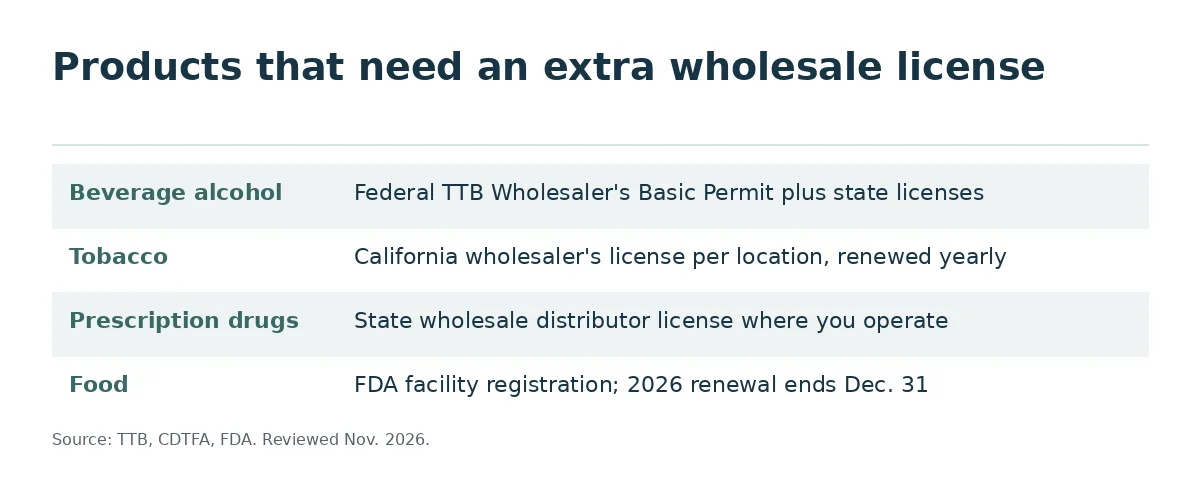
Regulated products add a layer beyond sales tax registration, often federal and state.
Beverage alcohol
Anyone purchasing distilled spirits, malt beverages or wine at wholesale to sell to other wholesalers or retailers must obtain a Wholesaler’s Basic Permit from the Alcohol and Tobacco Tax and Trade Bureau (TTB), according to the TTB. TTB says you must have the approved permit “in hand before commencing business,” and state alcohol licenses are also required.
Tobacco products
In California, a cigarette and tobacco wholesaler must hold a seller’s permit plus a cigarette and tobacco products wholesaler’s license, and wholesalers pay an annual license fee for each location, per the CDTFA wholesaler guide. A wholesaler that also sells directly to consumers needs a retailer’s license as well.
Prescription drugs
Wholesale drug distributors must hold a valid license in the state where they conduct business, and the Food and Drug Administration (FDA) lists the licensing agency for each state, often the board of pharmacy.
Food
Facilities that manufacture, process, pack or hold food for consumption in the United States generally must register with the FDA, per its food facility registration page. The current biennial renewal period runs from October 1, 2026, through December 31, 2026, and registrations not renewed by then are considered expired, according to the FDA renewal guide. See our guide to FDA food facility registration renewal in 2026.
How do wholesalers sell without collecting sales tax?
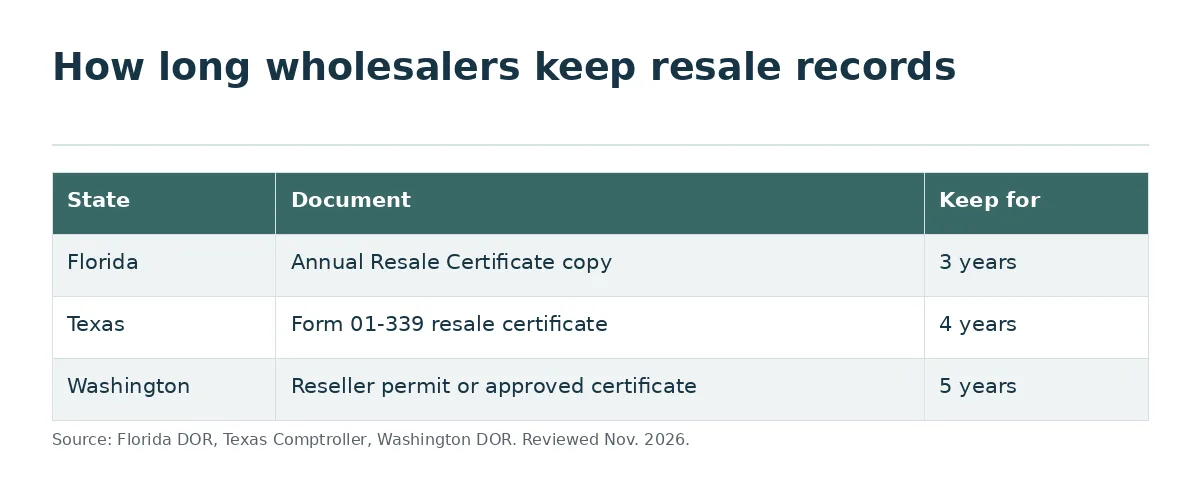
When you sell to other businesses, the burden shifts to you. You must collect sales tax unless you have valid resale documentation on file for that customer, and good record keeping matters because you must keep it with your business records for the applicable state’s record period. Holding a permit also means you must file taxes: CDTFA says permit holders must file sales and use tax returns and pay any tax due (Publication 107).
California lets a registered seller accept a resale certificate “in good faith” if it is timely, meaning before billing, within the normal billing cycle, or before delivery, according to CDTFA’s guide for out-of-state retailers. The certificate must include the purchaser’s name and address, seller’s permit number, a description of the property, a resale statement, the date and a signature.
Washington requires a wholesaler to get a valid reseller permit or other approved documentation from every customer that buys without paying sales tax. Sellers have up to 120 days from the sale to collect it and must keep it five years, per the Washington Department of Revenue.
Florida lets sellers keep a copy of the customer’s Annual Resale Certificate for three years, or instead get a transaction authorization number online, by phone or through its app, according to the Florida Department of Revenue.
What changes when you operate in several states or cities?
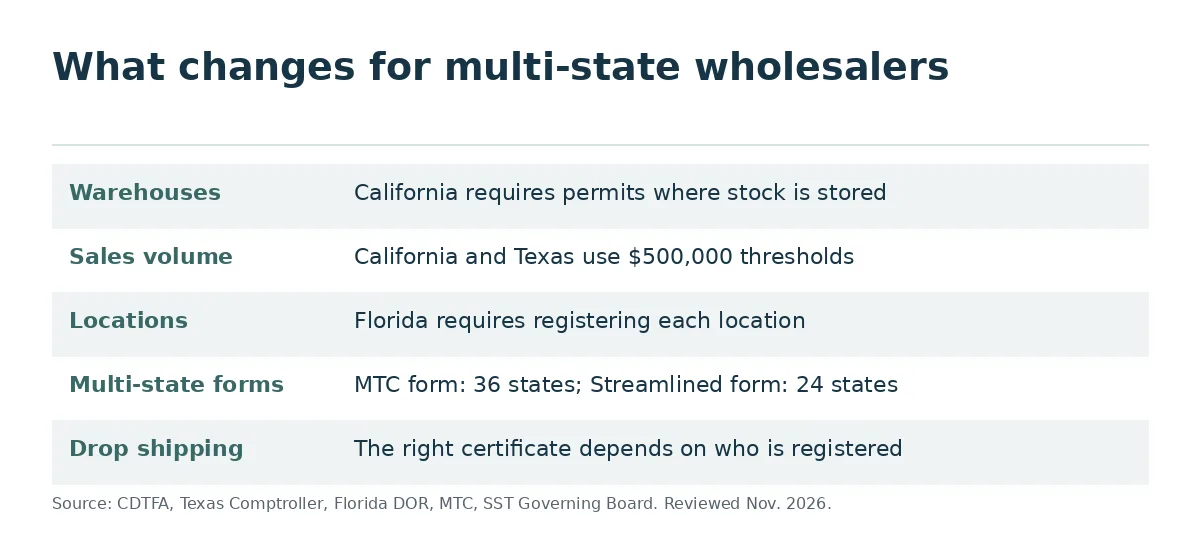
A multi-state wholesaler’s registrations grow with each warehouse, business location and customer state.
Each state decides when you must register
A warehouse or other physical presence usually requires registration in that state. California requires permits for warehouses or other places in the state where merchandise is stored for delivery, “even if merchandise is used to fulfill your sales made outside California,” per CDTFA Publication 73.
Sales into a state can also trigger registration without a location. California’s economic nexus threshold is $500,000 in sales of tangible merchandise for delivery in the state in the current or preceding calendar year, according to CDTFA. Texas uses a $500,000 safe harbor for remote sellers, and its total includes “sales for resale,” so wholesale volume counts, per the Texas Comptroller.
Each location may need its own registration
Florida requires businesses to “register each location to collect, report and pay sales tax,” per the Florida Department of Revenue. City licenses are usually location-specific as well.
Temporary selling counts too. A person who makes sales or takes orders at California conventions and trade shows is generally required to hold an ongoing or temporary seller’s permit, according to CDTFA’s temporary sellers guide.
Multi-state resale certificates help, with limits
Two multi-state forms can reduce paperwork. The Multistate Tax Commission says 36 states have indicated that its Uniform Sales and Use Tax Resale Certificate can be used as a resale certificate. The Streamlined Sales Tax Exemption Certificate is accepted by all 24 Streamlined member states, though not every state allows every exemption.
Neither form replaces registration where you are required to register.
Drop shipping adds another wrinkle
When you ship directly to your customer’s customer, the right resale certificate depends on who is registered where. In California, a drop shipper selling for an out-of-state retailer that holds a California permit should get a resale certificate from that retailer; if the retailer has no permit, the drop shipper generally owes the tax, per CDTFA Publication 121.
If you are entering a new state, our guide to the registration sequence when opening in a new state shows how tax accounts fit with entity registration. For multi-location operators, our research and verification service identifies the licenses each location needs.
How do you keep wholesale registrations current?
Florida resale certificates expire on December 31 each year, and new ones are available each November. Washington will send a notice about 90 days before a reseller permit expires if it will not renew automatically, and its permits are not transferable to a new owner. Florida requires a new registration when a business changes its legal entity or ownership, such as a sole proprietorship becoming an LLC, and it must be notified when the business name, mailing address or location address changes, per the Florida Department of Revenue.
Selling without registration carries real cost. In New York, a business that must register but operates without a valid Certificate of Authority faces a penalty of up to $500 for the first day and up to $200 for each additional day, up to $10,000, according to Form ST-120.
Frequently asked questions
Do I need a wholesale business license to buy from wholesale suppliers?
Most wholesale suppliers require proof that you are buying for resale before they sell to you without sales tax. In practice, that means a state seller’s permit or sales tax registration and a completed resale certificate. In Washington, the supplier needs your state-issued reseller permit instead. Some suppliers also ask for a local business license or an EIN. Without resale documentation, the supplier must charge sales tax.
How much does it cost to get licensed to sell wholesale?
The state registration is often free. California’s seller’s permit, Texas’s sales and use tax permit and Washington’s reseller permit have no application fee, although California and Texas may require a security deposit or bond. Costs usually come from local business licenses and taxes, such as the Los Angeles wholesale business tax of $1.01 per $1,000 of gross receipts, and from industry licenses for products like tobacco or alcohol.
What is a reseller permit?
A reseller permit is a state document that lets a business buy goods for resale without paying sales tax. Washington issues reseller permits through its Department of Revenue, free of charge, generally valid for four years, or two years for contractors and newer businesses. Other states use a seller’s permit plus a resale certificate for the same purpose, and many people use “reseller permit” to mean either document.
Can I use one resale certificate in every state?
Not always. The Multistate Tax Commission’s uniform certificate is accepted by 36 states, and the Streamlined Sales Tax certificate is accepted by its 24 member states, but each state sets its own conditions. If you are required to register in a state, you generally must use that state’s registration number on the certificate. Check each state’s revenue department before relying on a multi-state form.
How long does it take to get a wholesale license?
It depends on the state and the license. California says it may be able to issue a seller’s permit the same day. Washington aims to process reseller permit applications within 10 business days but may take up to 60 days, which can mean several weeks. New York requires you to apply for a Certificate of Authority at least 20 days before you start. For federal alcohol permits and state tobacco or drug licenses, check each agency’s posted processing times.
Buying or selling wholesale in more than one state?
LicenseComply researches the state, county and city licenses and tax registrations each of your locations needs and lists them in one report.
Explore Research & Verification Talk to a licensing specialist
Official sources and further reading
- California Department of Tax and Fee Administration: Obtaining a seller’s permit
- California Department of Tax and Fee Administration: Publication 107, Do you need a California seller’s permit?
- California Department of Tax and Fee Administration: Publication 73, Your California seller’s permit
- California Department of Tax and Fee Administration: Tax guide for out-of-state retailers, resale certificates
- California Department of Tax and Fee Administration: Marketplace Facilitator Act and economic nexus
- California Department of Tax and Fee Administration: Publication 107, Applying for a seller’s permit
- California Department of Tax and Fee Administration: Temporary sellers
- California Department of Tax and Fee Administration: Publication 121, Drop shippers and resale certificates
- California Department of Tax and Fee Administration: Cigarette and tobacco products wholesaler getting started
- Texas Comptroller: Sales tax permit FAQs
- Texas Comptroller: Resale certificate FAQs
- Texas Comptroller: Form 01-339, Texas Sales and Use Tax Resale Certificate
- Texas Comptroller: Remote sellers
- New York Department of Taxation and Finance: Instructions for a Certificate of Authority
- New York Department of Taxation and Finance: Form ST-120, Resale Certificate
- Florida Department of Revenue: Sales and use tax registration
- Florida Department of Revenue: Annual Resale Certificate for sales tax
- Washington Department of Revenue: Reseller permits
- Washington Department of Revenue: Reseller permit questions answered
- Washington Department of Revenue: Wholesalers need a copy of customer’s reseller permit
- Washington Department of Revenue: B&O tax rate increases effective January 1, 2027
- City of Seattle: Business licenses
- Los Angeles Office of Finance: Know your rates
- Internal Revenue Service: Get an Employer Identification Number
- Alcohol and Tobacco Tax and Trade Bureau: Getting started in the distilled spirits industry
- Food and Drug Administration: Check licensure of wholesale drug distributors
- Food and Drug Administration: Registration of food facilities
- Food and Drug Administration: Biennial registration renewal user guide
- Multistate Tax Commission: Uniform Sales and Use Tax Resale Certificate
- Streamlined Sales Tax Governing Board: Exemptions
Disclaimer: LicenseComply provides professional business licensing and compliance services. However, the informational content on this site (including articles, guides, tools, and videos) is provided for general educational purposes only and does not constitute legal, tax, or accounting advice. Laws and regulations change frequently, and we cannot guarantee that all information is accurate, complete, or up to date for your specific circumstances. Your use of this website and its content does not create an attorney-client, accountant-client, or other advisory relationship. You should consult with a qualified attorney, accountant, or other appropriate professional for advice tailored to your business.