
Key points
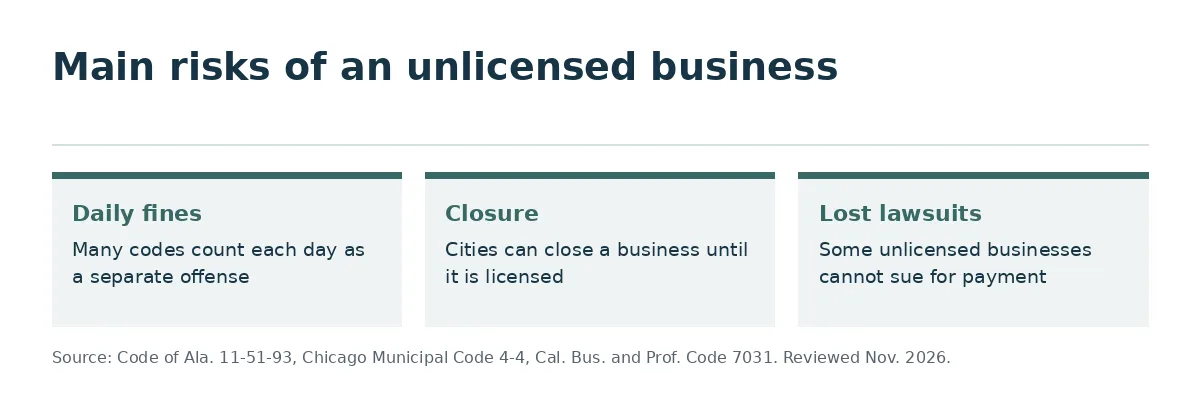
- Operating without a business license that your city, county or state requires is generally illegal, and many laws count each day of unlicensed operation as a separate offense.
- In Chicago, operating without a required city license carries a fine of $200 to $500 per offense under Municipal Code Section 4-4-010, and the city can close the business until it is licensed.
- In Texas, engaging in business as a retailer without a sales tax permit is a Class C misdemeanor for a first offense under Tax Code Section 151.708.
- In California, an unlicensed contractor cannot sue to collect payment for work that required a license, and customers can sue to recover everything they paid.

You cannot legally operate a business without a business license if your city, county, state or a federal agency requires one for your activity or location. Operating without a business license can lead to fines that grow every day, closure orders, criminal misdemeanor charges, and the loss of your right to sue customers for payment. Not every business needs a general license everywhere, but many businesses need at least one license, permit or registration to operate legally.
The real question is which licenses apply to you, and what happens if you have been operating without them. The answer depends on where you do business and what you sell, because there is no single national business license.
This guide covers the penalty for operating without a business license in several states and cities, what changes for multi-state operators, and how to get compliant. Penalties below come from statutes and agency pages reviewed November 2026. Rules change and vary by jurisdiction, so confirm each requirement with the issuing agency.
Can you legally operate without a business license?
Sometimes, but only when no agency requires a license for your activity in that location. The legal test is not whether you have a “business license” in general. It is whether you hold a valid license, permit or registration for everything your state requires and your city or county requires.
According to the U.S. Small Business Administration (SBA), most small businesses need a combination of licenses and permits from federal and state agencies, and you may also need licenses from your county or city. The licenses you need depend on your business activities and your business location.
The three layers of licensing
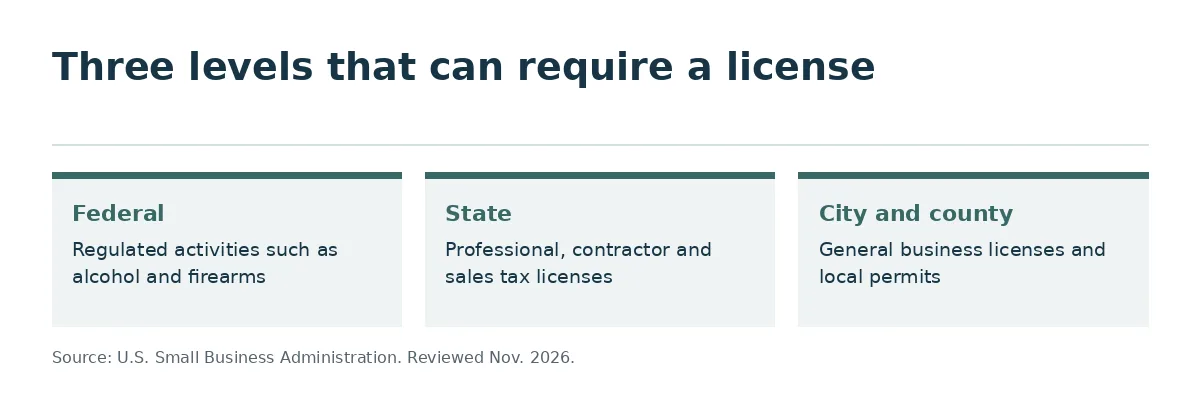
Business license requirements come from three levels of government, and each one enforces its own rules:
- Federal: activities regulated by a federal agency need a federal license or permit. The SBA lists examples such as alcoholic beverages, firearms, commercial fishing, aviation and broadcasting.
- State: states regulate a broader range of activities, including professional and occupational licenses, contractor licenses and sales tax permits.
- Local: cities and counties often require a general business license or business tax registration, plus permits for certain types of activities such as restaurants, retail stores, construction and vending machines.
A business can be fully registered with the state and still be an unlicensed business in the city where it operates. If you are unsure what applies, our guide to whether you need a business license walks through the common triggers.
When a business may not need a general license
Some states and cities do not require a general business license at all, and some exempt certain activities or small operations. That does not mean the business is free of licensing. A home-based seller in a city without a general license may still need a state sales tax permit, and a solo consultant may still need a professional license. Check every layer before concluding that nothing applies. Assuming there is no business license required for your activity is a common and costly mistake, because most people only discover the gap when an inspector, a customer or a bank asks for proof of licensing.
What happens if you don’t have a business license?
The consequences of non compliance fall into five groups. Most unlicensed businesses face more than one at the same time, and the financial impact usually goes well beyond the fine itself.
Fines that accrue daily
Many local codes treat each day of operating without a business license as a separate offense. In Alabama, Code of Alabama Section 11-51-93 makes it unlawful to engage in a business in a municipality that requires a license without first getting one. A violation can be fined up to $500 per offense, a willful violation can also bring up to six months of imprisonment, and each day is a separate offense.
Business closure orders
A city can stop you from operating until you are licensed, which turns a paperwork problem into lost revenue. In Chicago, the commissioner of business affairs and consumer protection may close any business that needs a license and does not have one until the license is obtained, under Municipal Code Section 4-4-015.
Criminal charges
Operating without a required license is a misdemeanor in many places, not just a civil fine. Repeat violations usually bring higher penalties and, in some cases, jail time. Defending any enforcement action can also mean you pay legal fees on top of the penalty.
Losing the right to collect payment
Some licensing laws block unlicensed businesses from using the courts to collect what they are owed. This is often the most expensive consequence, because it can wipe out the money earned on an entire job.
Back fees, taxes and penalties
When you finally register, agencies can charge the fees, taxes and penalties that would have applied from the date you first needed the license. Late payment penalties often apply on top of the license fee itself. Customers, landlords and partners can also lose trust in a business without a license, and in a competitive market that reputational damage can outlast any fine.
What is the penalty for operating without a business license?
There is no single penalty for operating without a business license. Each state, county and city sets its own, and industry licenses carry their own penalties. The examples below show the range.
Chicago: per-day fines and closure
Most business activities taking place in Chicago require a Chicago business license, according to the City of Chicago. The Department of Business Affairs and Consumer Protection regulates industries as diverse as retail, food and liquor establishments, entertainment venues and theaters, day care centers, manufacturing facilities and motor vehicle repair shops, per CHI 311. Liquor establishments need a city liquor license, food service businesses need a food license, and venues that present amusement need a Public Place of Amusement license, according to the City of Chicago. There is no single flat fee; the Public Place of Amusement license alone costs $770 to $13,200 based on occupancy.
Enforcement is active. Anyone can file a 311 service request to report a person or business operating without the proper license, and Business Compliance Enforcement investigators respond to those complaints and conduct proactive investigations, per the City of Chicago. Applications can be filed online through Chicago Business Direct or in person at the Small Business Center.
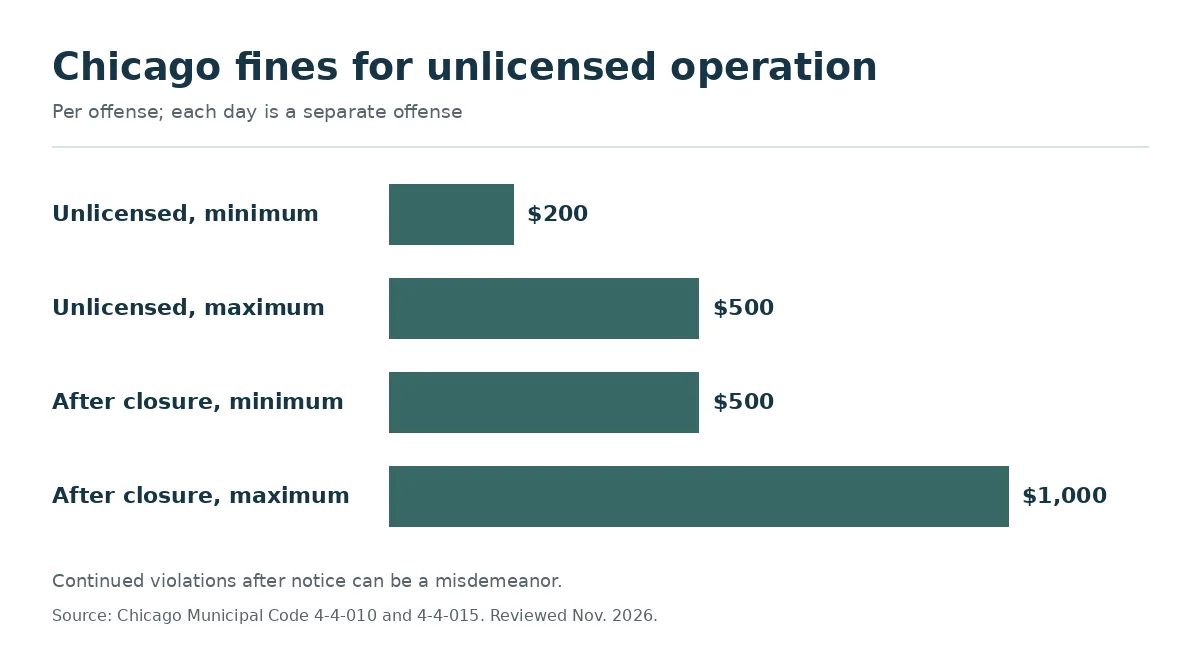
Under Chicago Municipal Code Section 4-4-010, anyone operating a business that requires a city license without one is fined $200 to $500 for each offense, and every day the violation continues is a separate offense. A person who keeps violating after being notified can be charged with a misdemeanor and jailed for up to six months.
If the city closes the business and it keeps operating, fines rise to $500 to $1,000 per offense, again with each day counted separately. Failing to renew a license is also grounds for closure after a 30-day notice of violation.
Texas: selling without a sales tax permit
A sales tax permit is a state license to sell, and Texas treats selling without one as a crime. Under Texas Tax Code Section 151.708, a person or corporate officer commits an offense if the business engages in business as a retailer without a required permit or after the permit is suspended. Each day of operation without a permit is a separate offense, and a Class C misdemeanor is punishable by a fine of up to $500 under Texas Penal Code Section 12.23.
| Offense | Classification | Maximum penalty |
|---|---|---|
| First | Class C misdemeanor | Fine up to $500 |
| Second | Class B misdemeanor | Fine up to $2,000 |
| Third | Class A misdemeanor | Fine up to $4,000 |
| Fourth or later | Class A misdemeanor | Fine up to $4,000, up to one year in jail, or both |
Texas also requires a separate permit for each place of business, and a permit is valid only for the person and place of business it names, according to Tax Code Section 151.201.
California: unlicensed contracting
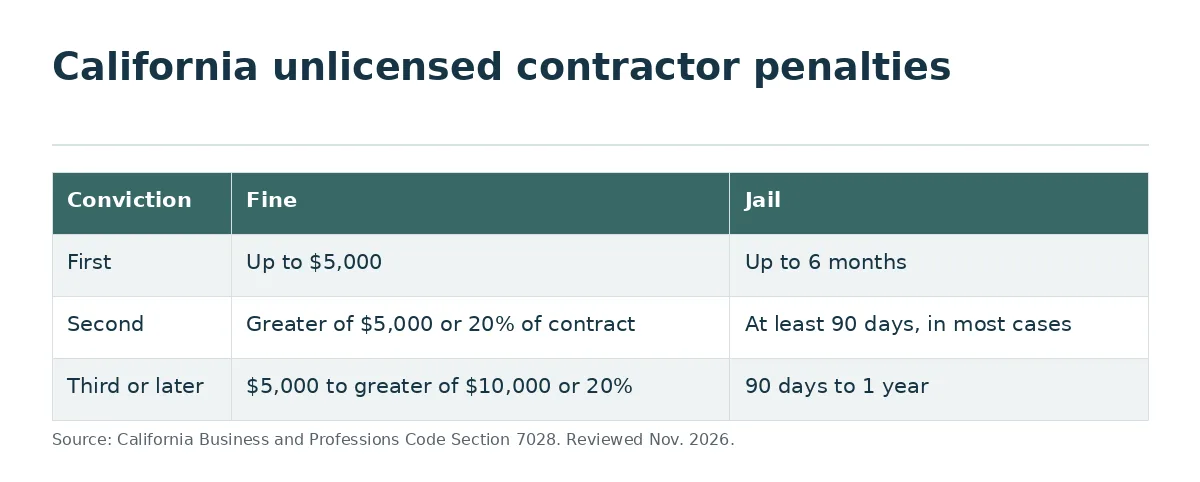
Contractor licensing shows how serious industry penalties can be. Under California Business and Professions Code Section 7028, a first conviction for contracting without a license is punishable by a fine of up to $5,000, up to six months in county jail, or both. A second conviction brings a fine of the greater of $5,000 or 20 percent of the contract price, and at least 90 days in jail in most cases. Unlicensed contractors also cannot simply bid their way into public work: submitting a bid to a public agency without a contractor license is itself a misdemeanor, with exceptions, under Business and Professions Code Section 7028.15.
Florida: unlicensed professional practice
Professional and occupational licenses carry their own enforcement. Under Florida Statutes Section 455.228, the Department of Business and Professional Regulation can issue a cease and desist notice to an unlicensed person practicing a regulated profession, seek an injunction, and impose an administrative penalty of up to $5,000 per incident. For more on these licenses, see our guide to occupational licenses.
Can an unlicensed business enforce its contracts?
Often it cannot, at least not in court. A contract signed by a business that lacked a required license can be effectively unenforceable when the customer refuses to pay, a hidden cost of operating without a business license.
California’s rule for contractors is the clearest example. Under Business and Professions Code Section 7031, a contractor cannot bring a lawsuit to collect compensation for work that required a license unless it was duly licensed at all times during the work, regardless of the merits of the claim. The same section lets a customer who used an unlicensed contractor sue to recover all compensation paid.
Unregistered entities face similar limits. A foreign entity that fails to register in Texas may not maintain a lawsuit in a Texas court until it registers, according to the Texas Secretary of State. In practice, an unpaid invoice can become uncollectible until the business fixes its status.
What changes when you operate in several states or cities?
Multi-state and multi-location operators face the same rules many times over, plus a few extra ones. More states mean more agencies, and the responsibility to stay compliant sits with the business. Licensing that is correct in your home state does not carry over to a new state or city.
Each location needs its own license
Local licenses are usually tied to an address. Chicago requires a separate license for each separate place of business under Municipal Code Section 4-4-010, and Texas issues a separate sales tax permit for each place of business. Opening a second site without a second license makes that site an unlicensed business, even if the first site is fully compliant.
Foreign registration comes before many licenses
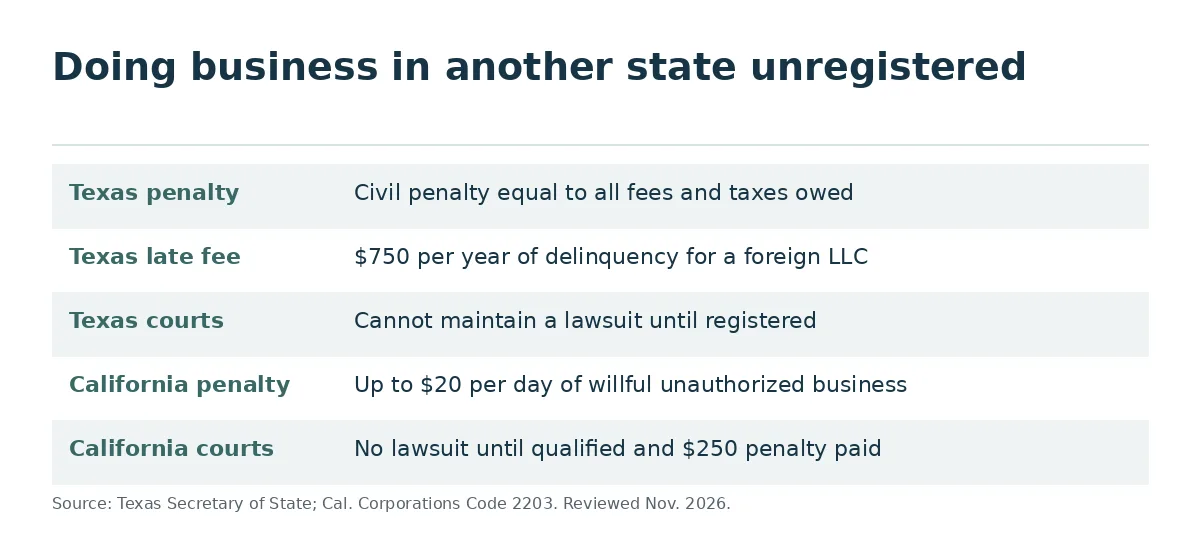
An entity formed in one state usually must register as a foreign entity before transacting business in another. The penalties for skipping this step are separate from local license penalties:
- Texas: a foreign entity that fails to register faces a civil penalty equal to all fees and taxes that would have applied had it registered on time. A foreign limited liability company (LLC) that transacted business for more than 90 days before registering is assessed a late filing fee of $750 for each year of delinquency, per the Texas Secretary of State. The attorney general can also seek to stop it from doing business in Texas.
- California: a foreign corporation transacting intrastate business without a certificate from the Secretary of State may be penalized $20 per day of willful unauthorized business. It also cannot maintain a lawsuit on that business until it qualifies and pays a $250 penalty plus back fees and taxes, under Corporations Code Section 2203.
Penalties multiply across locations
Because many codes count each day and each location separately, a small gap can add up quickly across a portfolio. Our guide to the registration sequence when opening in a new state explains the order in which entity registration, tax accounts and local licenses usually happen.
How do you fix operating without a business license?
If you discover a gap, act quickly, because penalties generally grow the longer the violation continues and you remain subject to daily fines.
- Identify every requirement. List each location, activity and the number of employees at each site, then check federal, state, county and city requirements for each one. City licensing offices, state small business portals and your local chamber of commerce are helpful resources for a first pass.
- Confirm what you already hold. Our business license lookup guide explains how to verify license status in official records.
- Register the entity where needed. If you transact business in another state, complete foreign registration first, since many local licenses ask for it.
- Apply for the missing licenses. Expect the application to ask when you started operating, and answer truthfully.
- Pay back fees and penalties. Ask the agency whether penalties can be waived. Alabama, for example, requires waiver of municipal license fines and penalties when reasonable cause exists, such as a natural disaster that closed the business, under Code of Alabama Section 11-51-93.
- Set up renewal tracking. A license that lapses can put you back in the same position. Chicago, for instance, treats failure to renew as grounds for closure. Note that some owners keep tracking in house while others outsource renewal management to an outside provider; either way, keep a written report of every license, its expiration date and who owns it.
For businesses with many locations, a structured review such as our business license research package can identify which licenses each site needs before you file.
Frequently asked questions
Can you operate a business without a business license?
Only if no federal, state, county or city agency requires a license for your activity and location. Most businesses need at least one license, permit or registration, such as a city business license, a state sales tax permit or a professional license. Operating without a required license can lead to daily fines, closure and misdemeanor charges, so check every level of government before you open.
What is the penalty for operating without a business license?
It depends on the jurisdiction. Chicago fines unlicensed businesses $200 to $500 per offense, with each day a separate offense. Alabama allows municipal fines up to $500 per offense, plus up to six months in jail for willful violations. Texas treats selling without a sales tax permit as a misdemeanor, and repeat offenses carry fines up to $4,000 and possible jail time.
What happens if you don’t have a business license and a customer refuses to pay?
You may not be able to sue. In California, an unlicensed contractor cannot sue to collect payment for work that required a license, and the customer can sue to recover what was paid. A foreign entity that has not registered in Texas cannot maintain a lawsuit in Texas courts until it registers. Fixing your licensing status quickly protects your ability to collect.
Is an unlicensed business still responsible for back fees and taxes?
Usually, yes. Agencies commonly charge the fees and taxes that would have applied from the date you first needed the license, plus late penalties. In Texas, an unregistered foreign entity faces a civil penalty equal to all fees and taxes it would have paid if it had registered on time, plus late filing fees for each year of delinquency.
Do I need a separate business license for each location?
Often, yes. Many cities issue licenses for a specific address. Chicago requires a separate license for each separate place of business, and Texas issues a separate sales tax permit for each place of business. When you open a new location or expand into another state, review state, county and city requirements for that site before it opens.
Not sure every location is licensed?
LicenseComply researches the state, county and city licenses each of your locations needs, files the applications and tracks renewals.
Explore Research & Verification Talk to a licensing specialist
Official sources and further reading
- U.S. Small Business Administration: Apply for licenses and permits
- City of Chicago Municipal Code Chapter 4-4: General licensing provisions
- City of Chicago: Applying for a business license
- City of Chicago: Public Place of Amusement license
- City of Chicago: Business Compliance Enforcement
- CHI 311: Operating without a business license
- California Business and Professions Code Section 7028.15: Bidding without a license
- Code of Alabama Section 11-51-93: Municipal license violations and penalties
- Texas Tax Code Chapter 151: Sales tax permits and selling without a permit
- Texas Penal Code Chapter 12: Punishments, including Class C misdemeanors
- California Business and Professions Code Section 7028: Unlicensed contractor penalties
- California Business and Professions Code Section 7031: Actions by unlicensed contractors
- California Corporations Code Section 2203: Foreign corporations transacting business without a certificate
- Florida Statutes Section 455.228: Unlicensed practice of a profession
- Texas Secretary of State: Foreign LLC registration instructions (Form 304)
Disclaimer: LicenseComply provides professional business licensing and compliance services. However, the informational content on this site (including articles, guides, tools, and videos) is provided for general educational purposes only and does not constitute legal, tax, or accounting advice. Laws and regulations change frequently, and we cannot guarantee that all information is accurate, complete, or up to date for your specific circumstances. Your use of this website and its content does not create an attorney-client, accountant-client, or other advisory relationship. You should consult with a qualified attorney, accountant, or other appropriate professional for advice tailored to your business.