
Key points
- There is no special federal or state license just for selling clothes; most clothing sellers need a local business license, a state seller’s permit or sales tax registration, and federal tax and labeling compliance.
- California and Texas issue seller’s permits and sales tax permits at no charge, although either state may require a security deposit or bond in some cases.
- Chicago requires a Limited Business License, with a $250 fee and a two-year term, to sell clothing and other general merchandise from a brick-and-mortar store.
- Remote sellers with more than $500,000 in sales into California, or $500,000 or more in Texas revenue over the previous 12 months, must register to collect tax in that state.

You do not need a special clothing license to sell clothes in the United States, but you usually need a general business license to sell clothes from your city or county and a seller’s permit (also called a sales tax permit) from each state where you must collect sales tax. If you make, import or put your own label on garments, federal labeling and product safety rules apply too.
This guide walks through each layer with examples from official sources, reviewed November 2026. Rules and regulations vary by state and city, so confirm the specific requirements for each location with the department or agency that issues the license before you start operating.
Do you need a business license to sell clothes?
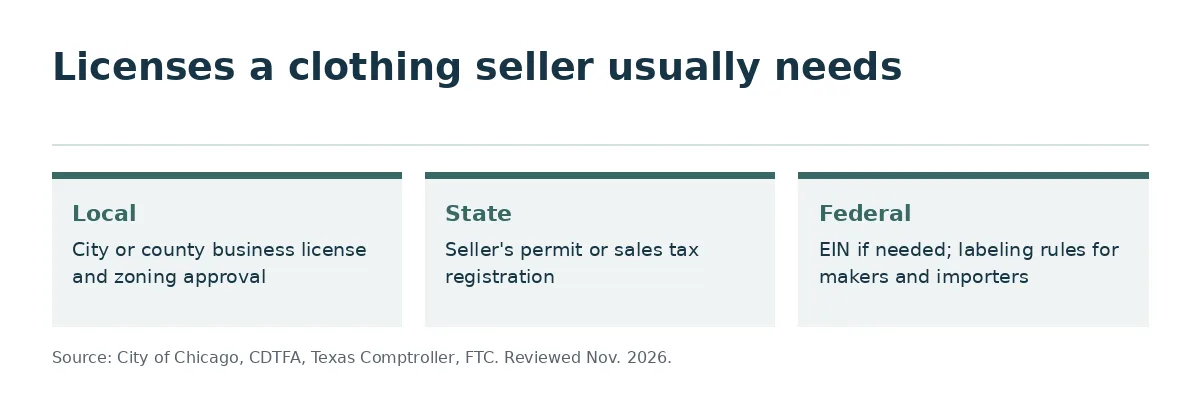
In most places, yes, though it is a general license rather than a specific license for apparel. Instead, to operate legally a clothing business picks up obligations at three levels.
- Local: a city or county business license, plus zoning approval for your location.
- State: a seller’s permit or sales tax registration, entity registration if your business entity is a limited liability company (LLC) or corporation, and an assumed name filing in some states if you use a name other than your legal name.
- Federal: an Employer Identification Number (EIN) if you need one, and labeling rules if you manufacture, import or private label garments.
If you are unsure whether your city requires a license, our guide to whether you need a business license explains how to check.
What does a clothing business license look like at the local level?
Local licenses vary the most. Some cities require a general license for every business, some only for certain activities, and some have none.
Chicago is a clear example of a city that licenses clothing retail directly. Selling general retail merchandise “such clothes, cosmetic products or gifts” at a brick-and-mortar store requires a Limited Business License, which costs $250 and is issued for two years, according to the City of Chicago. The same page notes that retail sales are prohibited in residentially zoned districts, which matters if you plan to sell from home.
Pennsylvania sits at the other end of the legal spectrum. The state’s business portal says there is no general business license that all Pennsylvania businesses must obtain, and for clothing stores and boutiques it points mainly to the state sales tax license, per the Pennsylvania Business One-Stop Hub. The hub also offers help guides for assistance with online registration. Cities and counties may still have their own requirements, so contact the local office where your store is located.
Used and vintage clothing
Resale shops should check whether a secondhand dealer license applies. Chicago’s Secondhand Dealer license, which carries a $1,100 fee, covers specific categories such as used audio and video equipment, sporting goods and jewelry, per the City of Chicago used merchandise page. Other cities draw the line differently, so confirm locally before opening a thrift or consignment store.
Do you need a seller’s permit for clothing?
Usually yes. A seller’s permit for clothing lets you collect the correct amount of sales tax from customers, remit it to the state and, in most states, buy inventory for resale without paying tax.
In California, you must obtain a seller’s permit if you are engaged in business in the state and intend to sell tangible personal property that would ordinarily be taxable at retail, and both wholesalers and retailers must apply, according to the California Department of Tax and Fee Administration (CDTFA). The permit is free, though CDTFA may require a security deposit in some cases, per CDTFA Publication 107. To complete the process you provide information such as bank account details and estimated income, and CDTFA may issue the permit the same day.
Texas requires a sales and use tax permit for anyone engaged in business in the state who sells tangible personal property there. “There is no fee for the permit, but you may be required to post a security bond,” according to the Texas Comptroller.
Once you hold a permit, you can usually give suppliers a resale certificate instead of paying tax on inventory. Our guide to the seller’s permit versus a resale certificate explains the difference.
What if clothing is tax exempt in your state?
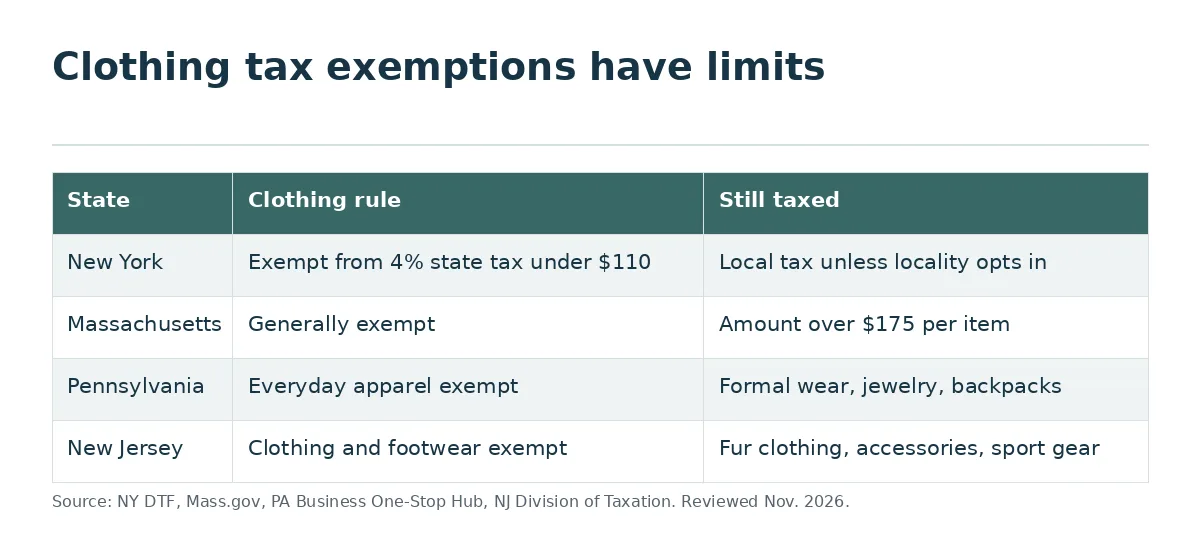
Several states exempt most clothing from sales tax, but that rarely means a clothing seller can skip registration. Exemptions usually have price caps or exclude accessories, and most shops also sell some items subject to tax.
- New York: clothing and footwear sold for less than $110 per item is exempt from the 4 percent state tax, but local taxes still apply unless the county or city elects the exemption, per the New York Department of Taxation and Finance. New York also says every seller of taxable goods must register before beginning business, even if selling from home or only once a year, per its vendor registration page.
- Massachusetts: clothing is generally exempt, but tax applies to the amount of any single item above $175, per Mass.gov.
- Pennsylvania: everyday wearing apparel is not taxed, but formal wear, jewelry and backpacks are, and there is no fee to apply for the sales tax license, per the Pennsylvania Business One-Stop Hub.
- New Jersey: clothing and footwear are exempt, but the exemption does not cover fur clothing, accessories or sport and protective equipment, per the New Jersey Sales Tax Guide.
Do you need a DBA or permission to sell branded clothing?
If your shop trades under a name other than your legal name, you may need an assumed name registration, often called a DBA (“doing business as”). In Texas, individuals and unincorporated businesses that use an assumed name must file a certificate with the county clerk in each county where they maintain business premises, and a corporation, LLC or limited partnership using a name other than its legal name files with both the Secretary of State and the county clerk, per the Texas Secretary of State. A DBA filing does not give you trademark rights to the name, the Texas Secretary of State trademark FAQs note.
Selling clothing that carries someone else’s brand raises a separate question. Federal trademark law allows a registrant to sue anyone who, without the registrant’s consent, uses a counterfeit or confusingly similar copy of a registered mark in connection with selling goods, under 15 U.S.C. Section 1114. If you print logos, characters or team names, secure written permission from the owner first. Keep supplier invoices as documentation for branded goods you resell.
Do you need a license to sell clothes online?
A license to sell clothes online follows the same logic as a store: your home city or county may require a business license, and your home state will usually require a seller’s permit. Selling online adds two questions: marketplace tax collection and registration in other states.
Marketplaces such as Etsy, Amazon or Poshmark
Many states treat large marketplaces as the retailer for sales they facilitate. In California, a marketplace facilitator has been considered the seller and retailer for each sale it facilitates since October 1, 2019, and a marketplace seller does not need to worry about a seller’s permit if all of its retail sales go through a registered marketplace facilitator, according to CDTFA. Selling even part of your stock through your own website or in person brings the permit requirement back.
Shipping into other states
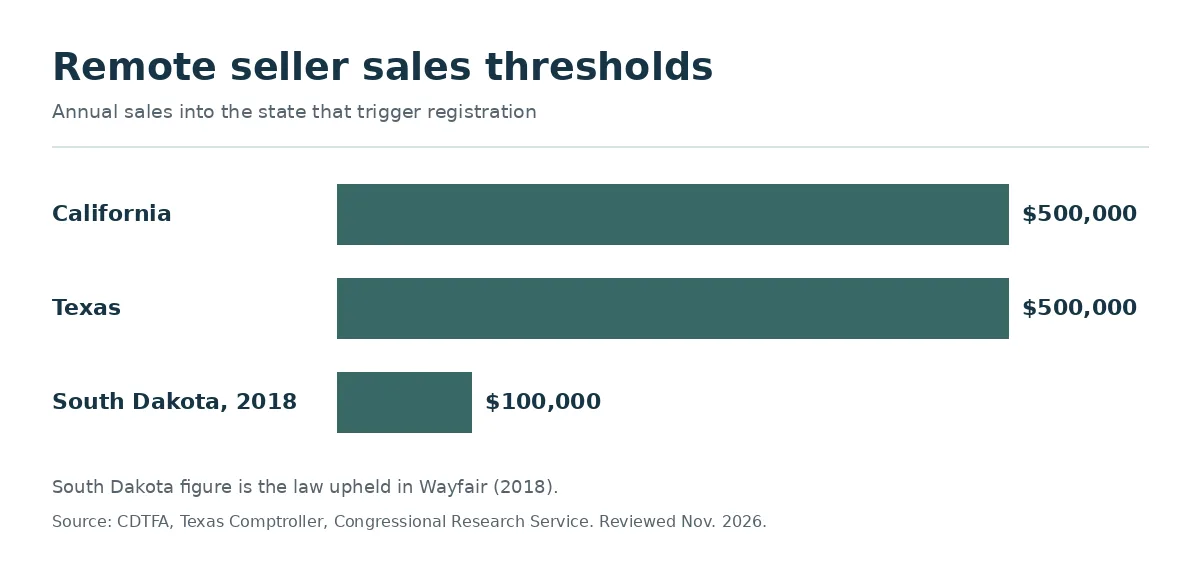
Since the Supreme Court’s 2018 decision in South Dakota v. Wayfair, states can require out-of-state sellers to collect sales tax based on economic activity rather than physical presence, as the Congressional Research Service explains. The South Dakota law upheld in that case applied to sellers delivering more than $100,000 of goods or services or 200 transactions into the state each year.
Each state sets its own threshold. California requires registration once combined sales for delivery into the state exceed $500,000 in the current or preceding calendar year, counting marketplace sales, per CDTFA. Texas lets remote sellers with less than $500,000 in Texas revenue over the previous 12 months skip the permit, and that revenue includes nontaxable sales, per the Texas Comptroller.
Our guide on how to get a business license to sell online covers ecommerce registration in more detail.
Do you need a permit to sell clothes at pop-ups and markets?
Often yes, and out-of-state vendors are not exempt.
In California, making three or more taxable sales in a 12-month period generally requires a seller’s permit, and anyone without a permanent place of business who sells at one location for 90 days or less needs a temporary seller’s permit for each temporary location, per CDTFA. If you already hold a regular permit, you register a sub-permit for each temporary location instead.
Texas says sellers at fairs, festivals, markets and shows, including sellers from outside Texas, are engaged in business in the state and must hold a Texas sales and use tax permit if they sell or take orders for taxable items, per the Texas Comptroller.
| How you sell clothes | Usually needed | Watch for |
|---|---|---|
| Brick-and-mortar store | Local license, seller’s permit, zoning approval | Per-location permits, signage and occupancy rules |
| Your own website | Home-state seller’s permit, local license if required | Remote seller thresholds in other states |
| Marketplace only | Local license if required; permit may not be needed in some states | Any sales outside the marketplace |
| Pop-ups and fairs | Temporary or sub-permit for each event location | Out-of-state events count as doing business there |
What if you make, import or private label clothing?
Brands that design, manufacture or import garments take on federal obligations that resellers of finished, labeled goods generally do not.
Textile labels and the RN number
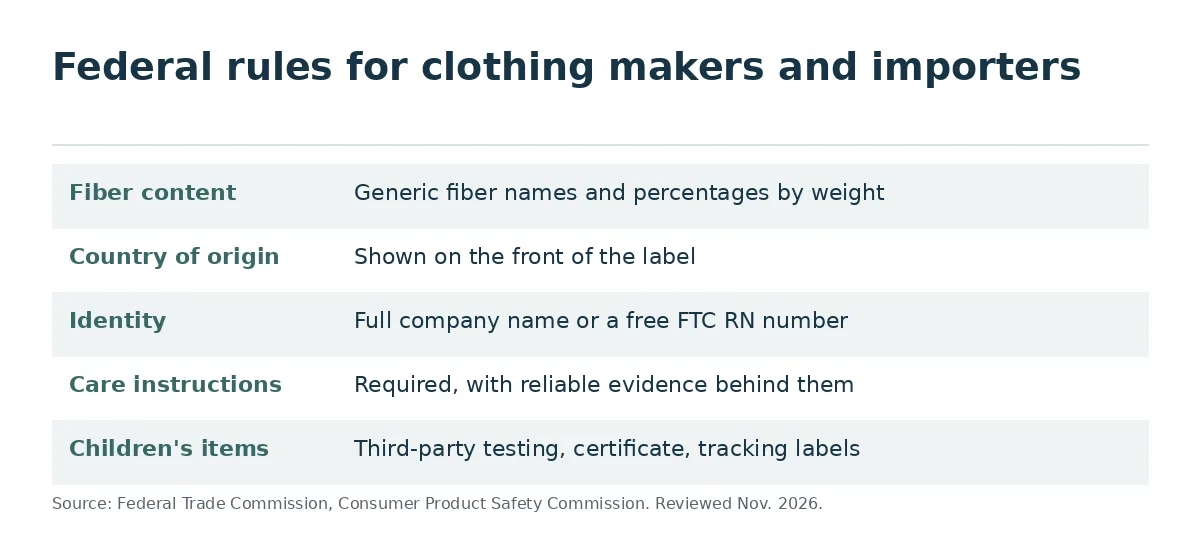
The Federal Trade Commission (FTC) says anyone who manufactures, imports, sells, offers to sell, distributes or advertises products covered by the Textile and Wool Acts must comply with its labeling requirements. Labels must show fiber content, country of origin, and either the company name or the Registered Identification Number (RN) of a business responsible for the product, per the FTC textile labeling guide.
An RN is optional, because you can use your full business name instead. The FTC issues RNs at no charge to businesses residing in the United States, per its RN frequently asked questions.
Care labels
Under the FTC Care Labeling Rule, manufacturers and importers must attach care instructions to clothing and must have a reasonable basis, meaning reliable evidence, for those instructions, per the FTC care labeling guide.
Flammability and children’s clothing
The Consumer Product Safety Commission (CPSC) enforces a general wearing apparel flammability standard at 16 C.F.R. part 1610. For children’s clothing, CPSC requires third-party testing at a CPSC-accepted laboratory, a Children’s Product Certificate from the domestic manufacturer or importer, permanent tracking labels, and compliance with lead limits, per the CPSC clothing FAQ.
What changes when you sell clothes in several states or cities?
For multi-location retailers, the work multiplies by jurisdiction.
- Permits often attach to a location. Texas requires a sales tax permit for each active place of business, issued under one taxpayer number with separate outlet numbers, per the Texas Comptroller. California handles temporary locations through sub-permits.
- Local licenses do not travel. A Chicago Limited Business License covers a store in Chicago, not a second store in another city, which may require its own license or none at all.
- Remote seller thresholds differ by state, and some count nontaxable or marketplace sales. Track revenue by destination state, not just by channel.
- Opening a store or warehouse in a new state usually creates physical presence immediately, so tax registration is required regardless of sales volume. Entity registration often follows, and in addition, hiring local staff brings payroll tax and labor registrations, covered in our payroll tax registration guide.
- Keep one record of every license number, issuing department, expiration date and renewal process, so the effort does not restart from scratch each time you open a location.
Our guide to the registration sequence when opening in a new state shows how these filings fit together. Teams that want each location researched and verified in one place can use our research and verification service.
How do you get a business license to sell clothes, step by step?
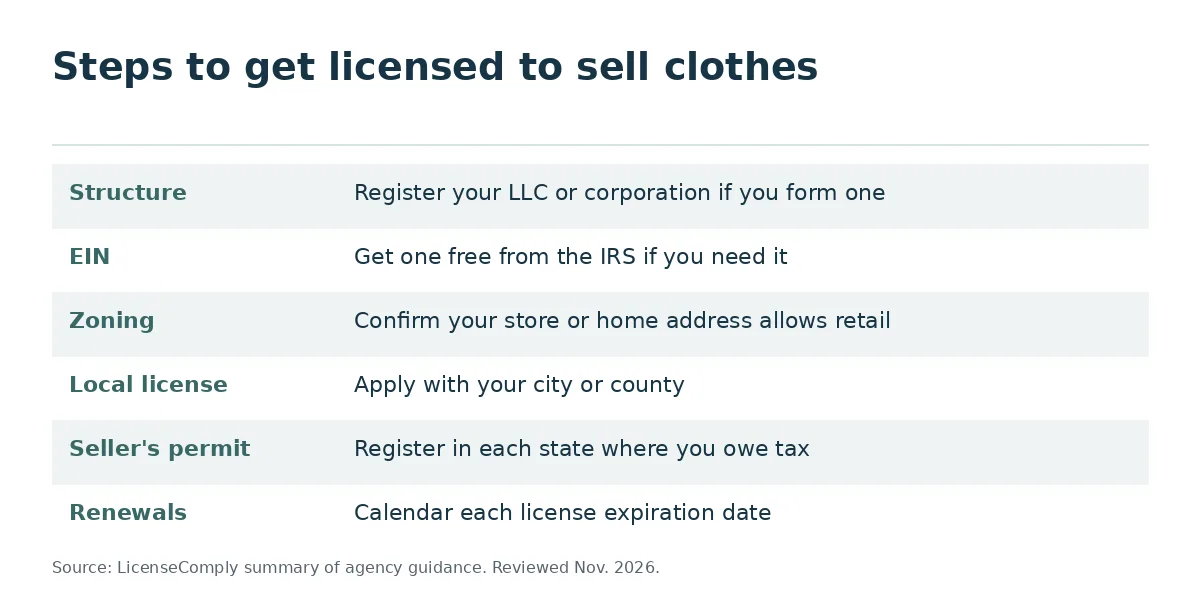
- Determine your business structure and register it with your state if you form an LLC or corporation, plus a DBA if you trade under another name.
- Get an EIN if you will hire employees or need one for your entity. The IRS says “you never have to pay a fee for an EIN,” per the Internal Revenue Service.
- Confirm zoning for your store or home address before signing a lease.
- Visit your city or county licensing office or website, gather the required information and submit your business license application.
- Register for a seller’s permit in your home state and in any state where you have a location or cross a remote seller threshold.
- If you make or import garments, set up compliant fiber, origin, identity and care labels, plus CPSC testing for children’s items.
- Calendar each renewal date, such as Chicago’s two-year Limited Business License term, and keep copies of every permit and receipt provided by the agencies. If anything is unclear, consult the issuing agency to ensure your filings are correct.
Frequently asked questions
Do I need a business license to sell clothes from home?
Often yes, but home sales add a zoning question. Many cities require a business license or home occupation approval for home-based sellers, and some restrict retail in residential zones. Chicago, for example, prohibits retail sales under its Limited Business License in residentially zoned districts. You will also usually need a state seller’s permit if you make taxable sales. Check with your city’s licensing and zoning offices before you start.
Do I need a license to sell clothes online?
Usually you need the same basics as any seller: a local business license if your city requires one and a seller’s permit in your home state. Some states, including California, do not require a permit if all of your sales go through a registered marketplace facilitator. If you ship into other states, you may need to register there once you pass that state’s remote seller threshold, such as $500,000 in California or Texas.
Is there a special clothing business license?
No. No federal agency or state issues a license specific to selling apparel. A clothing business license is typically a general city or county business license combined with a state seller’s permit. Brands that manufacture or import garments must also follow FTC labeling rules and CPSC safety rules, which are compliance requirements rather than licenses. Secondhand dealer licenses may apply to some resale shops depending on the city.
Do I need a seller’s permit for clothing if clothing is tax exempt?
In most cases you still register. Clothing exemptions usually have limits: New York’s state exemption applies only to items under $110 and not to most local taxes, Massachusetts taxes the portion of an item above $175, and Pennsylvania taxes formal wear and accessories. A seller’s permit also lets you buy inventory tax free for resale. Ask your state tax agency if you sell only fully exempt items.
How much does a business license to sell clothes cost?
Costs vary by location. California seller’s permits, Texas sales tax permits and Pennsylvania sales tax licenses carry no application fee, though California and Texas may require a deposit or bond. Chicago’s Limited Business License for retail costs $250 for two years. EINs and FTC registered identification numbers are free. Local business license fees elsewhere range widely, so check each city and county.
Selling clothes in more than one state or city?
LicenseComply researches the licenses and permits each of your locations and sales channels needs, then prepares and files the applications for you.
Explore Research & Verification Talk to a licensing specialist
Official sources and further reading
- City of Chicago: Brick-and-mortar store license
- City of Chicago: Used merchandise license
- Pennsylvania Business One-Stop Hub: Clothing stores and boutiques
- California Department of Tax and Fee Administration: Obtaining a seller’s permit
- California Department of Tax and Fee Administration: Publication 107, Do you need a California seller’s permit?
- California Department of Tax and Fee Administration: Tax guide for the Marketplace Facilitator Act
- California Department of Tax and Fee Administration: Temporary sellers
- Texas Comptroller: Sales tax permit FAQs
- Texas Comptroller: Remote sellers
- Texas Comptroller: Fairs, festivals, markets and shows
- Texas Secretary of State: Formation of Texas entities FAQs (assumed names)
- Texas Secretary of State: Trademarks FAQs
- United States Patent and Trademark Office: U.S. trademark law, including 15 U.S.C. Section 1114
- New York Department of Taxation and Finance: Clothing and footwear exemption
- New York Department of Taxation and Finance: Register as a sales tax vendor
- Massachusetts Department of Revenue: Sales and use tax guide
- New Jersey Division of Taxation: Sales tax guide
- Congressional Research Service: The Commerce Clause and Wayfair
- Federal Trade Commission: Labeling requirements under the Textile and Wool Acts
- Federal Trade Commission: Registered identification number FAQs
- Federal Trade Commission: Complying with the Care Labeling Rule
- Consumer Product Safety Commission: Clothing FAQ
- Internal Revenue Service: Get an Employer Identification Number
Disclaimer: LicenseComply provides professional business licensing and compliance services. However, the informational content on this site (including articles, guides, tools, and videos) is provided for general educational purposes only and does not constitute legal, tax, or accounting advice. Laws and regulations change frequently, and we cannot guarantee that all information is accurate, complete, or up to date for your specific circumstances. Your use of this website and its content does not create an attorney-client, accountant-client, or other advisory relationship. You should consult with a qualified attorney, accountant, or other appropriate professional for advice tailored to your business.