
Key points
- Most lawn care companies need a general business registration or local business license, and some states add a landscaping license or pesticide applicator license depending on the work performed.
- California requires a Contractors State License Board license when a project costs $1,000 or more in labor and materials, needs a building permit, or uses employees, and the C-27 classification covers landscaping.
- Applying pesticides for hire usually requires a state license, and the federal government requires certification for anyone who applies or supervises restricted use pesticides.
- Texas taxes landscaping and lawn maintenance as real property services, so lawn care companies there generally must collect sales tax on their charges.
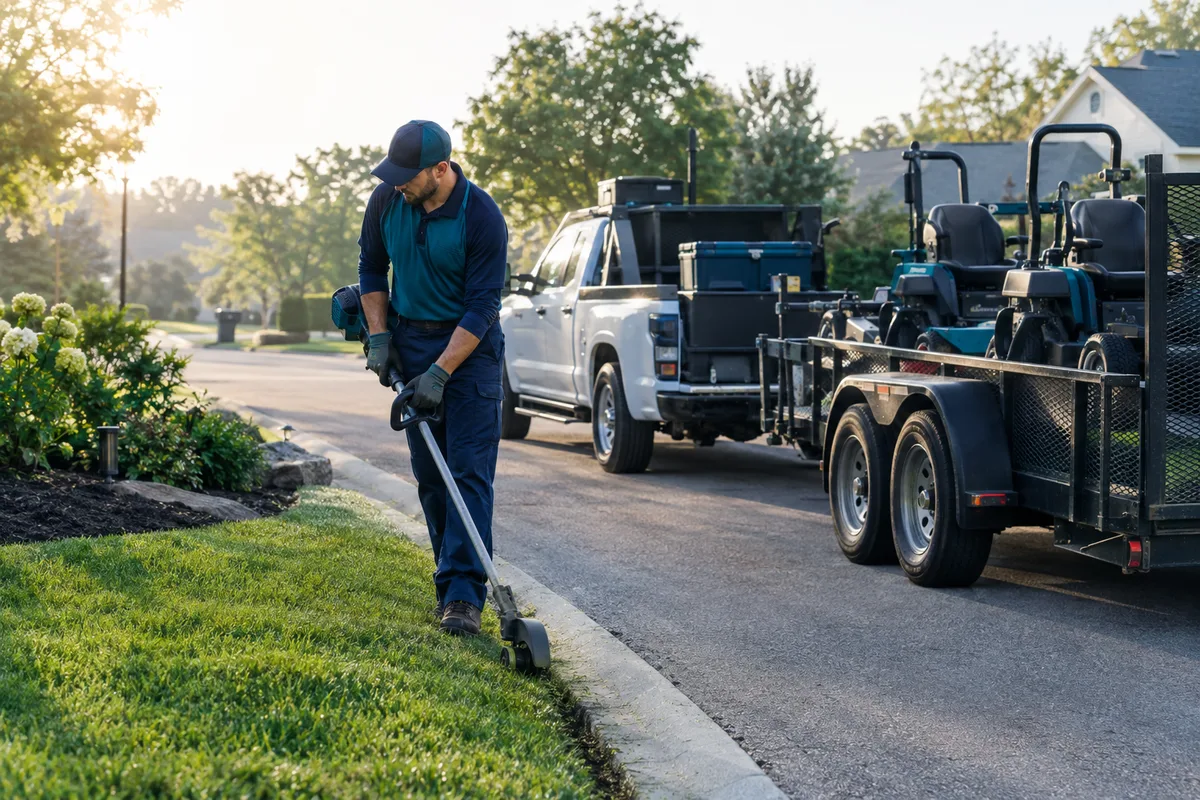
A lawn care business license is usually a general business registration or local business license from your city or county, plus your state tax accounts. Many mowing and basic yard maintenance companies need nothing more, but landscaping installation, pesticide or fertilizer application, irrigation work and tree work can each trigger a separate state license.
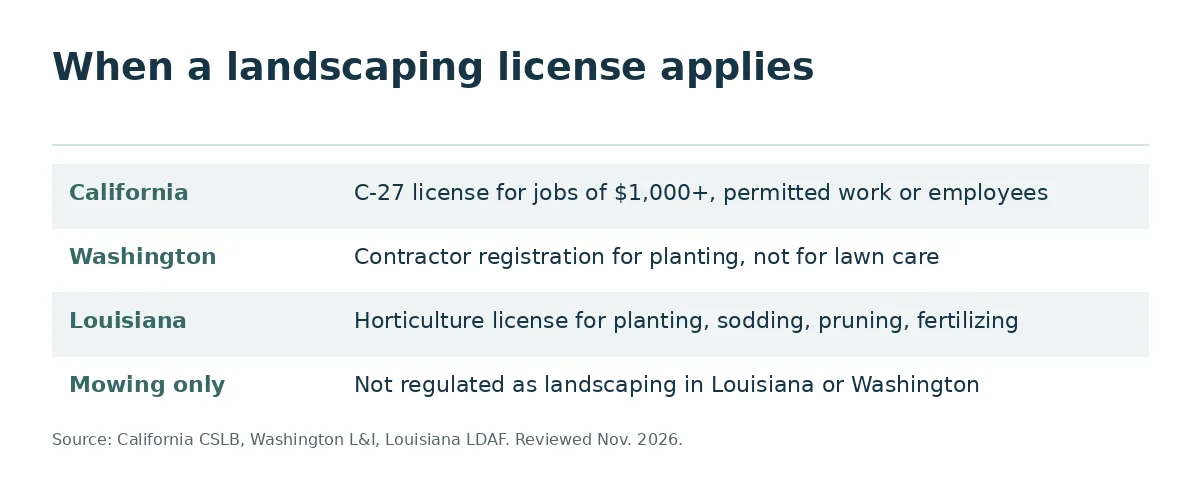
The licensing requirements depend on where you work and which landscaping services you sell. Louisiana does not license routine mowing but does license plant installation and fertilizing, while California requires a contractor license once a landscaping job reaches $1,000 or meets other conditions.
This guide uses state examples from official sources reviewed in November 2026. Rules vary by city, so confirm each requirement with the issuing agency so you can operate legally from day one.
Do you need a lawn care business license?
In most places, yes. What varies is how many of these three layers apply:
- General registration: a state business registration where required, a city or county business license or business tax certificate, and tax accounts.
- Trade licenses: a landscaping license or contractor registration for installation and construction-type work, issued by a state board.
- Chemical and specialty licenses: a pesticide applicator license, fertilizer certification, irrigation license or arborist license, depending on the services you offer.
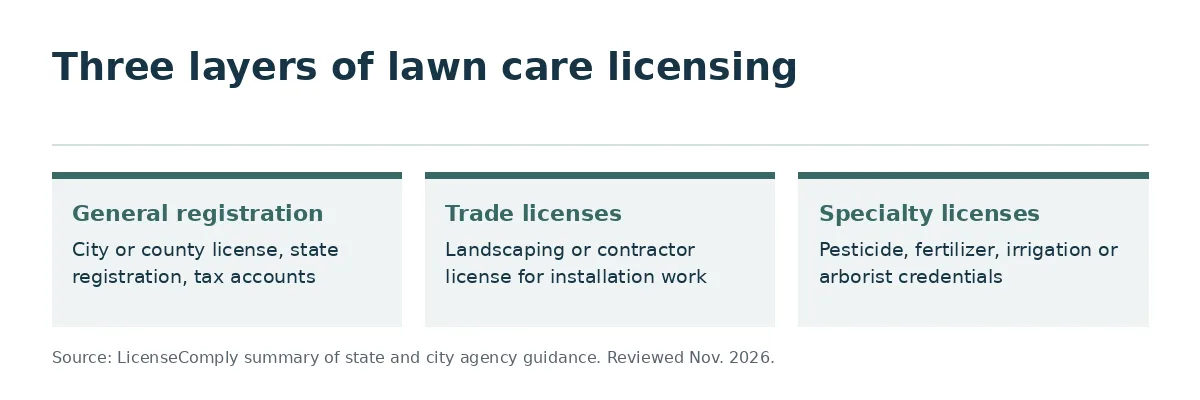
A solo operator who only mows may stop at the first layer, while a full-service company can need all three. Our guide to whether you need a business license covers the general layer.
What general registrations does a lawn care company need?
Business structure and business name
A new business owner usually starts by choosing a business structure. Your structure affects taxes, paperwork and personal liability, according to the U.S. Small Business Administration. A sole proprietorship is not a separate legal entity, so the owner can be held personally liable for business debts, while a limited liability company protects owners from personal liability in most instances.
For a small business with crews on customer property, that liability protection can limit financial risk. Some trade boards, such as Tennessee’s contractor board, also require you to bid and contract in the exact name on your license.
City and county business licenses and local permits
Many cities require a business license or business tax registration before you work within city limits. In Los Angeles, every business engaged in business activity in the city must obtain a Business Tax Registration Certificate unless specifically exempted, according to the Los Angeles Office of Finance.
Los Angeles counts you as doing business there when you perform work in the city seven or more days per year, per its business tax information FAQ. Businesses based outside the city that travel in to provide services must register by the second month of operation, per the city’s industry tax compliance guide. Check each local ordinance for other local permits that may apply to your business operations.
Tax accounts and sales tax
Most businesses also need a federal Employer Identification Number, especially once they hire or form an entity. Our guide on finding your business tax ID number explains how these numbers work.
Sales tax is easy to miss. Texas treats landscaping and lawn maintenance as taxable real property services, per the Texas Comptroller list of taxable services. The Comptroller’s landscaping and lawn care guide says providers collect tax on mowing, edging, fertilizing and tree trimming.
Texas exempts a self-employed individual with no employees or partners and gross receipts of $5,000 or less over the most recent four calendar quarters, under the same guidance. Other states treat lawn services differently.
When do you need a landscaping license?
A landscaping license is usually tied to installation and construction work, not routine lawn mowing, and each state law draws that line differently. Boards licensing contractors often assign a license classification that limits the landscaping work you may perform.
California: the C-27 landscaping contractor license
California’s Contractors State License Board (CSLB) requires a license when a project needs a building permit, uses employee labor, or totals $1,000 or more in labor and materials, per the CSLB’s licensing requirements page.
The threshold rose from $500 to $1,000 on January 1, 2025, under Assembly Bill 2622, according to a CSLB industry bulletin.
The C-27 Landscaping classification covers contractors who construct, maintain, repair or install landscape systems and facilities, and who prepare and grade land for that work, per the CSLB classification definition. The CSLB’s guidance on gardeners versus landscaping contractors says routine mowing, weeding and trimming generally needs no state license, while irrigation systems, landscape lighting, patios and retaining walls are examples of projects that require one.
Washington: contractor registration for landscaping
Washington’s Department of Labor and Industries (L&I) treats landscaping as a contractor specialty. Registration requires a state business license, a surety bond, general liability insurance and a $150.20 application fee, per L&I’s contractor registration page.
Specialty contractors must post a $15,000 bond and carry $200,000 public liability and $50,000 property damage coverage, or a $250,000 combined single limit. L&I’s guidance on applying for a business license lists planting plants and building flower or garden beds on someone else’s property as work that requires registration. By contrast, its consumer guide says registration is not required for pruning or lawn care.
Louisiana: a horticulture license for plant work
Louisiana’s Horticulture Commission requires a Landscape Horticulturist License for bed preparation, plant and sod installation, pruning, fertilizing and landscape maintenance, according to the Louisiana Department of Agriculture and Forestry. Yard work such as cutting lawns, edging and hand-weeding beds is not regulated and does not require a license.
Applicants pay a $150 exam fee, pass the exam with 70 percent or higher, and pay a $125 license fee. All horticulture licenses expire January 31 each year. Drawing landscape designs for a fee is landscape architecture, which requires a separate Landscape Architect License held by licensed landscape architects.
Oregon: two licenses for landscape construction
Oregon requires two licenses for landscaping work: an individual Landscape Construction Professional license and a Landscape Contracting Business license, per the Oregon Landscape Contractors Board. The business carries the bond, liability insurance and workers compensation, and must employ or be owned by a licensed professional.
The board’s guide on when a license is required lists mowing, edging and weeding as work not requiring a license, while new plantings, sod, irrigation, patios and tree work do. Individual licensees complete continuing education every two years, per the Oregon license directory.
North Carolina and Tennessee: dollar thresholds
North Carolina exempts landscaping work where all contracts for a job site total less than $30,000 in any 12-month period, under Chapter 89D of the General Statutes. Above that, the work requires a landscape contractor license, and work done by a company must be performed under a licensed individual.
In Tennessee, a contractor license is required before bidding on projects of $25,000 or more, and landscaping is a recognized license classification (BC-29), per the Tennessee Board for Licensing Contractors. Landscaping-only applicants take the Business and Law exam but no trade exam, and the general contractor’s license runs two years. Smaller residential landscaping projects of $3,000 to $24,999 may need a home improvement license in certain counties, which requires general liability and workers compensation insurance.
| State | Who issues it | When it applies | Key cost or rule |
|---|---|---|---|
| California | Contractors State License Board (C-27) | Jobs of $1,000 or more, permitted work, or any employee labor | $1,000 minor work limit since 2025 |
| Washington | Department of Labor and Industries | Planting, bed building and other landscaping construction | $150.20 fee, $15,000 specialty bond |
| Louisiana | Horticulture Commission | Plant installation, sodding, pruning, fertilizing | $150 exam, $125 license, expires Jan. 31 |
| Oregon | Landscape Contractors Board | Plantings, sod, irrigation, hardscapes | Individual and business licenses required |
| North Carolina | Landscape Contractors’ Licensing Board | Job sites totaling $30,000 or more in 12 months | $10,000 bond or letter of credit |
| Tennessee | Board for Licensing Contractors | Projects of $25,000 or more | Business and Law exam, two-year license |
Do you need a pesticide applicator license for lawn care?
If you apply weed killer, insecticide or fungicide for customers, you almost certainly need a pesticide applicator license. Pesticide application is regulated separately from turf management and landscaping, through professional certifications held by individuals and, in many states, a company license.
The federal baseline
Federal law requires any person who applies or supervises the use of restricted use pesticides to be certified, and certification is issued by states, territories and tribes, per the Environmental Protection Agency (EPA). Most states go further and license anyone who applies any pesticide for hire.
California: the maintenance gardener license
California offers a Maintenance Gardener Pest Control Business License for gardeners who occasionally do pest control in support of their primary gardening business, per the Department of Pesticide Regulation (DPR) license packet.
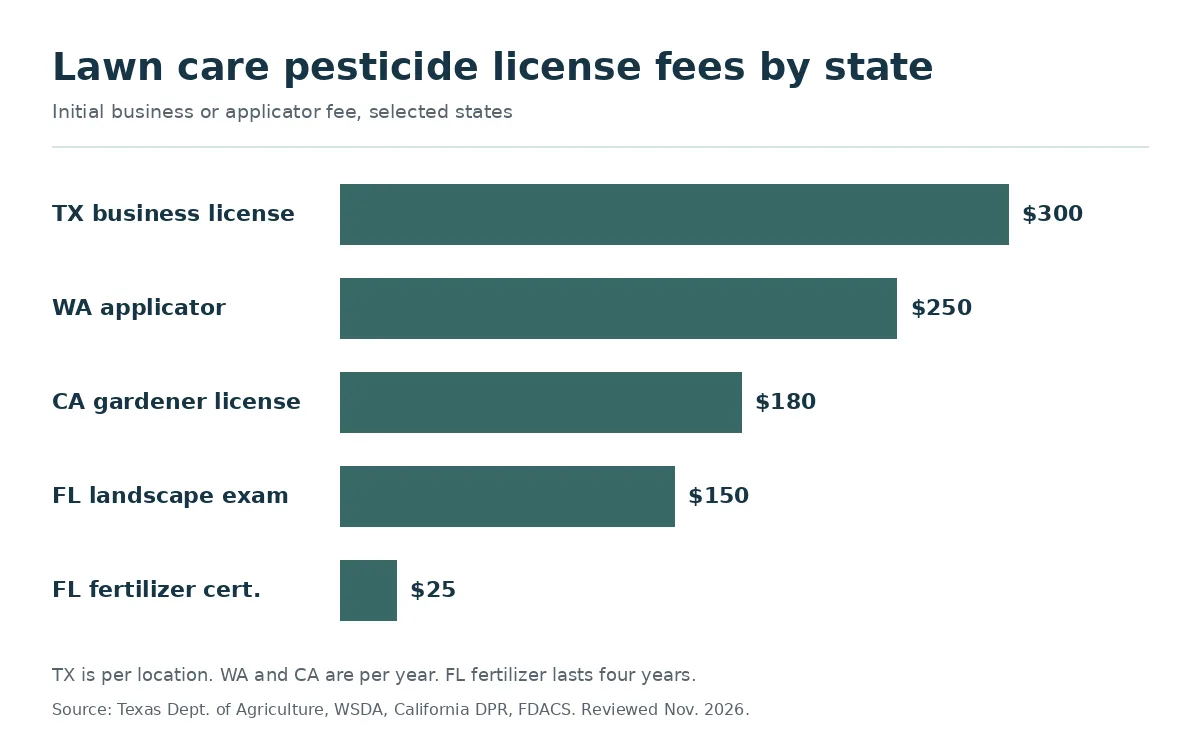
The application fee is $180 per calendar year, and renewals cost $360 for a two-year cycle. Each location needs a qualified applicator with a category Q or B certificate, and renewals postmarked after December 31 carry a 50 percent late fee, per the DPR renewal packet.
Florida: limited certifications for landscape crews
Florida’s Limited Commercial Landscape Maintenance certification lets landscape maintenance personnel apply herbicides, insecticides and fungicides to ornamental plants and plant beds only, never to turf, per the Florida Department of Agriculture and Consumer Services (FDACS). The exam fee is $150 per category, and the FDACS fee table lists an annual renewal of $75 with a $50 late fee.
Commercial fertilizer applicators in Florida need the Limited Urban Commercial Fertilizer Applicator certification, which requires six hours of best management practices training, costs $25 and lasts four years, per the same FDACS guidance.
Texas and Washington: business-level licenses
In Texas, lawn and ornamental pest control and weed control are categories of structural pest control. Any business doing that work for hire needs a business license from the Texas Department of Agriculture for each location, costing $300, and must designate a certified commercial applicator, per the Structural Pest Control Service.
Washington’s commercial pesticide applicator license, the Commercial Applicator license, goes to the person who makes pesticide decisions for a company that applies pesticides to others’ property. It costs $250 per year, plus $27 for each piece of motorized spray equipment after the first, and requires proof of at least $50,000 public liability and $50,000 property damage coverage, per the Washington State Department of Agriculture.
What insurance requirements apply to landscaping businesses?
Insurance coverage is often a licensing condition, not just a business choice. Workers compensation insurance is the main legal requirement once you hire. California requires employers, including construction contractors, to carry workers compensation even with only one employee, per the CSLB workers compensation page. Licensees with no employees can file an exemption today, but tree service contractors must carry coverage regardless. A CSLB stakeholder packet explains that Senate Bill 1455 delayed the requirement for all licensees to hold workers comp until January 1, 2028. Under the 2026 CSLB law book, an employer must provide weekly benefit payments and medical treatment for work injuries, covering lost wages and care.
Many boards also require you to carry general liability insurance. Washington’s contractor registration and Oregon’s landscape business license both require proof of liability coverage. Commercial auto or equipment insurance is usually a business decision, not one of the licensing rules, so ask an insurance professional about the right insurance for your crews.
What other licenses can landscapers need?
Irrigation is one. In Texas, no one may sell, design, install, maintain, repair or service an irrigation system without a license from the Texas Commission on Environmental Quality (TCEQ), which requires an exam and a $111 fee, per the TCEQ licensing page. Licenses last three years, per the TCEQ irrigator notice.
Tree work is the other. Louisiana requires an Arborist License for tree removal, pruning, trimming, cabling, fertilization and cavity work done for a fee, per the Louisiana Department of Agriculture and Forestry. Our explainer on what an occupational license is covers how these individual credentials differ from business licenses.
What changes when you operate in several states or cities?
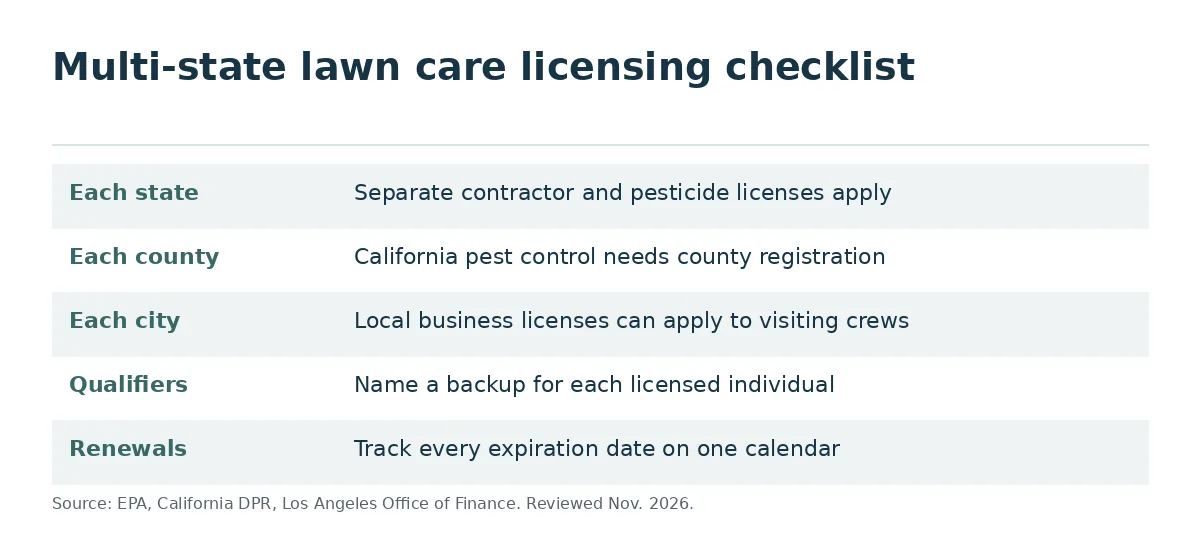
Each new market can add state, trade, pesticide and city licenses on separate calendars.
Licenses do not travel
Pesticide certification is state-specific. The EPA states you must be certified in each state where you apply restricted use pesticides, and many states also require their own commercial license for general use products. Contractor licenses work the same way: a California C-27 license does not authorize landscaping construction in Washington.
Counties and cities add their own layer
Local rules stack up too. California’s maintenance gardener licensees must register with the county agricultural commissioner in each county where they will do pest control before starting work, and most counties charge an annual fee, per the DPR license packet.
Track people, not just entities
Many lawn care credentials belong to an individual, such as a qualified applicator, a certified commercial applicator or a licensed irrigator. If that person leaves, the company can lose the service, so plan a backup qualifier in each state.
If you are entering a new state, our guide to the registration sequence when opening in a new state shows where trade licenses fit after entity and tax registration.
How do you get a lawn care business license?
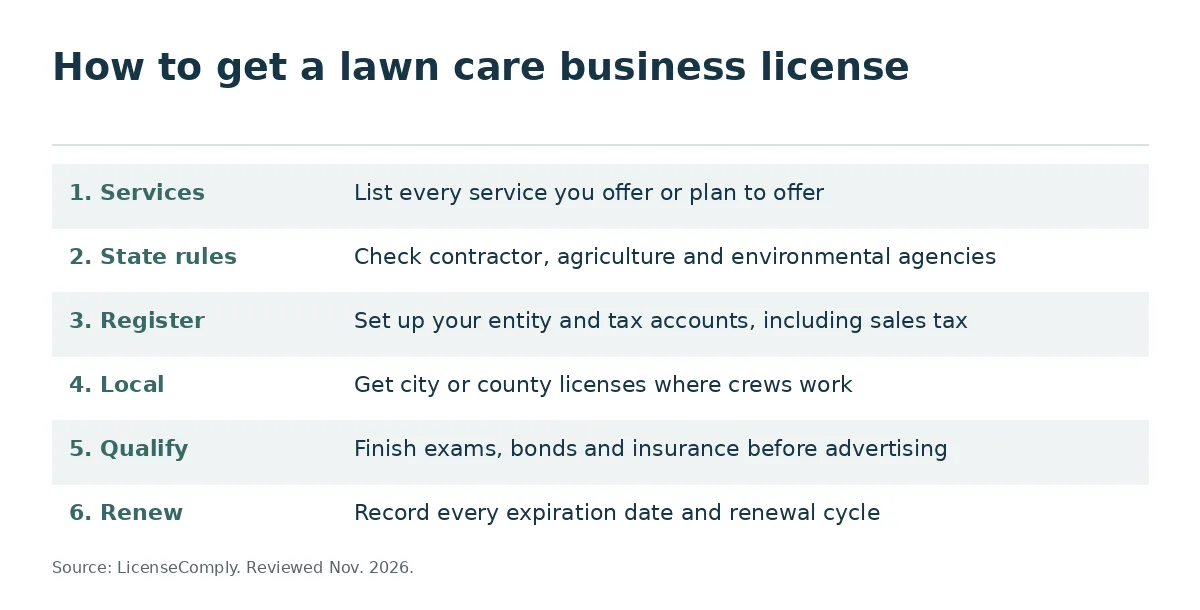
- List every service you offer, such as mowing, planting, weed control, irrigation and tree work.
- Check your state’s contractor board, horticulture board, agriculture department and environmental agency for licenses tied to those services.
- Register your business entity and tax accounts, including sales tax where lawn services are taxable.
- Apply for the city or county business license in your base location and in each city where crews work.
- Complete any exams, training, bonds and insurance required, then submit applications for trade and pesticide licenses before advertising those services.
- Record renewal deadlines and renewal fees for each license, since cycles range from annual December 31 deadlines to three-year terms.
For help keeping those dates straight, see our business license renewal guide.
Frequently asked questions
Do I need a license to mow lawns?
Often you need only a general business license or local business registration to mow lawns for pay. Louisiana states that cutting lawns, edging and hand-weeding are not regulated by its horticulture program, and Washington says lawn care does not require contractor registration. Your city may still require a business license.
What is the difference between a lawn care business license and a landscaping license?
A lawn care business license is typically a general city, county or state registration that lets you operate any business. A landscaping license is a trade license from a state board that covers installation and construction work, such as planting, grading, irrigation or patios. California’s C-27 and Washington’s landscaping contractor registration are examples. Many landscaping companies need both, plus pesticide licenses if they treat lawns.
Do I need a pesticide applicator license to spray weeds?
In most states, yes, if you spray weeds for customers. Federal law requires certification for restricted use pesticides, and states such as Texas, Washington, Florida and California license companies or individuals that apply pesticides for hire. California’s maintenance gardener license and Florida’s limited landscape certification are designed for lawn and garden crews.
Is a landscaping business license valid in other states?
No. Landscaping contractor licenses and pesticide licenses are issued by individual states and generally apply only within that state. Some states accept another state’s pesticide license as a basis for qualifying, but you still apply, pay fees and meet local rules in each state.
How much does a landscaping license cost?
Costs vary widely by state and license type. Washington landscaping contractor registration has a $150.20 application fee plus a $15,000 surety bond. Louisiana charges a $150 exam fee and a $125 license fee for a Landscape Horticulturist License. Pesticide credentials add more, such as $250 per year for a Washington commercial applicator.
Running crews in more than one state?
LicenseComply researches the business, landscaping and pesticide licenses each of your service areas requires, files the applications and tracks every renewal.
Explore Research & Verification Talk to a licensing specialist
Official sources and further reading
- Contractors State License Board: Licensing requirements and exemptions
- Contractors State License Board: Minor work threshold increase bulletin (AB 2622)
- Contractors State License Board: C-27 Landscaping Contractor classification
- Contractors State License Board: Gardener or landscaping contractor
- California Department of Pesticide Regulation: Maintenance Gardener Pest Control Business License packet
- California Department of Pesticide Regulation: Maintenance Gardener business renewal packet
- U.S. Environmental Protection Agency: How to get certified as a pesticide applicator
- Florida Department of Agriculture and Consumer Services: Pest control licensing and certification
- Florida Department of Agriculture and Consumer Services: Pest control FAQ and fees
- Texas Department of Agriculture: Structural pest control business license
- Texas Commission on Environmental Quality: Landscape irrigator licenses
- Texas Comptroller: Landscaping and lawn care services
- Washington Department of Labor and Industries: Register as a contractor
- Washington State Department of Agriculture: Steps for commercial applicator license applicants
- Louisiana Department of Agriculture and Forestry: Nursery and landscape licensing
- Louisiana Department of Agriculture and Forestry: Arborist licensing
- Los Angeles Office of Finance: Tax information booklet
- Oregon Landscape Contractors Board: Steps to becoming licensed
- Oregon Landscape Contractors Board: When is a license required
- Oregon License Directory: Landscape Construction Professional
- North Carolina General Statutes Chapter 89D: Landscape contractors
- Tennessee Board for Licensing Contractors
- Tennessee Board for Licensing Contractors: Online application resource
- Tennessee Board for Licensing Contractors: Home improvement license
- Contractors State License Board: Workers compensation insurance
- Contractors State License Board: Workers compensation stakeholder packet (November 2024)
- Contractors State License Board: 2026 Law Book
- U.S. Small Business Administration: Choose a business structure
Disclaimer: LicenseComply provides professional business licensing and compliance services. However, the informational content on this site (including articles, guides, tools, and videos) is provided for general educational purposes only and does not constitute legal, tax, or accounting advice. Laws and regulations change frequently, and we cannot guarantee that all information is accurate, complete, or up to date for your specific circumstances. Your use of this website and its content does not create an attorney-client, accountant-client, or other advisory relationship. You should consult with a qualified attorney, accountant, or other appropriate professional for advice tailored to your business.