
Key points
- California has no single statewide general business license; most businesses get a business license or business tax certificate from the city where they operate, or from the county if the location is in an unincorporated area.
- A California seller’s permit from the California Department of Tax and Fee Administration is free, although the agency may require a security deposit.
- Every local business license issued or renewed in California carries an added $4 state disability access fee under Government Code Section 4467.
- Every limited liability company organized or registered in California owes an $800 annual tax to the Franchise Tax Board, even if it is not doing business.

California does not issue one statewide general business license. To get a California business license, you apply to the city where your business operates (or the county, if you are in an unincorporated area), then add any state registrations your activities require, such as a seller’s permit, an entity filing or a professional license.
Most California cities call the local license a business tax certificate or business tax registration certificate, and the business license fee depends on the local government that issues it. Los Angeles, San Francisco, San Diego and San Jose each use a different name, deadline and fee structure.
This guide walks through how to get a business license in California step by step, what each piece costs, and what changes when you operate in several cities or states. Fees and deadlines below were reviewed November 2026 against official sources. Rules change, so confirm each requirement with the issuing agency.
Does California have a statewide business license?
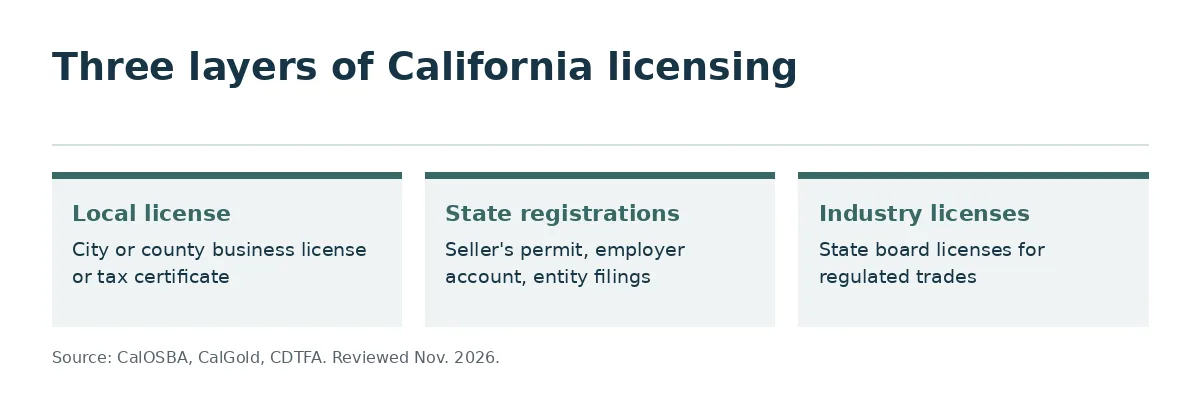
No. Licensing in California runs on three layers, and most California businesses need something from each one before they can operate legally.
The local layer is the general business license. The California Office of the Small Business Advocate tells new owners that requirements depend on location and business activities, and that owners in unincorporated areas should check with the county.
The state layer covers tax accounts and entity filings. That includes a seller’s permit if you sell taxable goods, an employer account if you hire, and California Secretary of State filings if you form or register a legal entity.
The industry layer covers regulated industries and regulated professions. Contractors, cosmetologists, engineers, pharmacies and many other trades need industry specific licenses from the state on top of the local one, and some sites need industry specific permits such as a health permit.
The state’s CalGold permit assistance tool lists agencies and permits by location and business type, but it does not issue permits, so you still apply with each agency.
If you are not sure whether your activity needs a license at all, our guide on whether you need a business license covers the general tests.
How to get a business license in California, step by step
The order matters, because later applications ask for numbers you get in earlier steps.
Step 1: Form or register your entity
Your business structure decides what you file. Sole proprietors can skip this step. A limited liability company (LLC) files Articles of Organization (Form LLC-1) with the Secretary of State for $70, plus a $20 Statement of Information due within 90 days and every two years after that. A general stock corporation pays $100 for Articles of Incorporation and $25 for its Statement of Information.
An LLC formed in another state registers in California with Form LLC-5, which costs $70 and must include a current Certificate of Good Standing from the home state.
Next, get a federal employer identification number (EIN) if you need one. The Internal Revenue Service says you need an EIN if you have employees or operate a partnership, LLC or corporation, and that you should form the entity with the state before applying. The online application is free.
Step 2: File a fictitious business name if needed
If you operate under a name other than your legal name, California law requires a fictitious business name statement (often called a “doing business as” or DBA filing). You must file with the county clerk within 40 days of starting business under that name, publish it in a local newspaper once a week for four weeks, and file proof of publication. The statement expires five years after filing, or 40 days after the facts in it change.
Step 3: Apply for your city or county business license
This is the core California business license. Apply with the city where your business location sits, or the county for unincorporated areas. The application process usually asks for business information such as your legal name, business address, start date, tax identification number and a description of your business activities. Many cities also require a license when you only perform work inside city limits for a few days a year, as the city examples below show.
Step 4: Register for state tax accounts
Get a seller’s permit if you sell or lease taxable goods, and register as an employer once you start paying wages. Both are covered below.
Step 5: Add industry licenses and location permits
Check whether your trade needs a state board license and whether the site needs local permits such as zoning clearance, building permits, health permits or fire inspections before you open. Local zoning regulations decide whether your business operations are allowed at the address, so confirm local requirements with the planning department first.
Which cities have their own license rules?
Each city writes its own ordinance and collects its own local business taxes. Four of the largest California cities show how much the rules vary.
Los Angeles
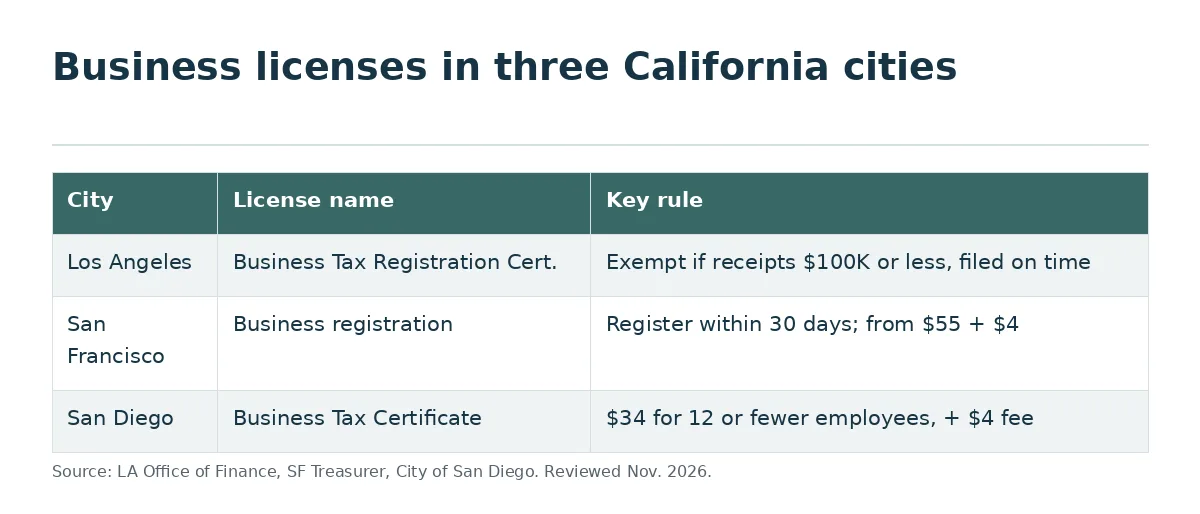
Everyone conducting business in the city must get a Business Tax Registration Certificate (BTRC) from the Office of Finance. Online applicants receive a temporary certificate right away.
The city considers you engaged in business there if you physically perform work in Los Angeles for seven or more days a year. Renewals are due January 1 and become delinquent after the last day of February. Registered businesses with worldwide gross receipts of $100,000 or less owe no tax for the year, but only if they file the renewal on time.
San Francisco
The Treasurer and Tax Collector requires most San Francisco businesses to register within 30 days after starting business in the city, and to renew by the last day of February each year. The 2026 to 2027 fee is based on 2025 San Francisco gross receipts and starts at $55 plus the $4 state fee, for $59 total. Instead of a flat fee, the charge rises with gross receipts.
San Diego
All businesses operating in the City of San Diego, including home-based businesses, self-employed people and independent contractors, need a Business Tax Certificate. The annual tax is $34 for 12 or fewer employees, or $125 plus $5 per employee for 13 or more.
Applicants also pay the $4 state fee and a $1.47 per employee Minimum Wage Enforcement Fee, and applications received more than 15 days after the start date are charged late fees.
San Jose
Anyone doing business in San Jose must register for a Business Tax Certificate within 90 days of starting the business. The city notes you may hear it called a business license or business permit. The tax is due annually on the 15th of the month your business started, even if no renewal notice arrives. For a new business paying for the first time, the city waives penalties and interest if the tax is paid in full within 90 days of the due date.
Outside city limits, unincorporated areas follow county rules. Our guide to county business licenses explains how county licensing works.
Do you need a California seller’s permit?
You need a California seller’s permit if you are engaged in business in California and intend to sell or lease tangible personal property that would ordinarily be subject to sales tax at retail. The California Department of Tax and Fee Administration (CDTFA) issues the permit, and both wholesalers and retailers need one.
The permit is free. However, the CDTFA may require a security deposit depending on your type of business and expected taxable sales, and it can sometimes issue the permit the same day.
If you sell at one location for 90 days or less, such as a seasonal booth, you need a temporary seller’s permit instead. Businesses that already hold a regular permit add a sub-permit for each temporary location.
A seller’s permit belongs to a location. Businesses with more than one selling location must register each location, either separately or as sub-permits under a consolidated permit.
For how this permit relates to the certificate buyers give you, see our explainer on the seller’s permit versus a resale certificate.
What other state registrations apply?
Employer registration
Once you pay more than $100 in wages in a calendar quarter, you must register with the Employment Development Department (EDD) within 15 days.
Professional and trade licenses
The Department of Consumer Affairs oversees 36 boards and bureaus that license more than 3.4 million people in more than 280 license types. In health care, physicians, registered nurses and physical therapists are each licensed by their own board, and the department’s licensing requirements table shows that many license types carry a fingerprint requirement for background checks.
Food service is regulated locally. Under the California Retail Food Code, a food facility may not open for business without a valid permit from the local enforcement agency, usually the county environmental health department.
Contractors are licensed separately by the Contractors State License Board (CSLB). A license is required when a project needs a building permit, uses employee labor, or totals $1,000 or more in labor and materials. The threshold rose from $500 to $1,000 on January 1, 2025, under Assembly Bill 2622.
How much does a California business license cost?
There is no single California business license cost, because each city sets its own fee or tax. Expect a local fee that may be small or may scale with gross receipts or headcount, plus state filing fees that depend on your structure. Budget for annual renewal fees too, since most local certificates and the LLC tax recur every year.
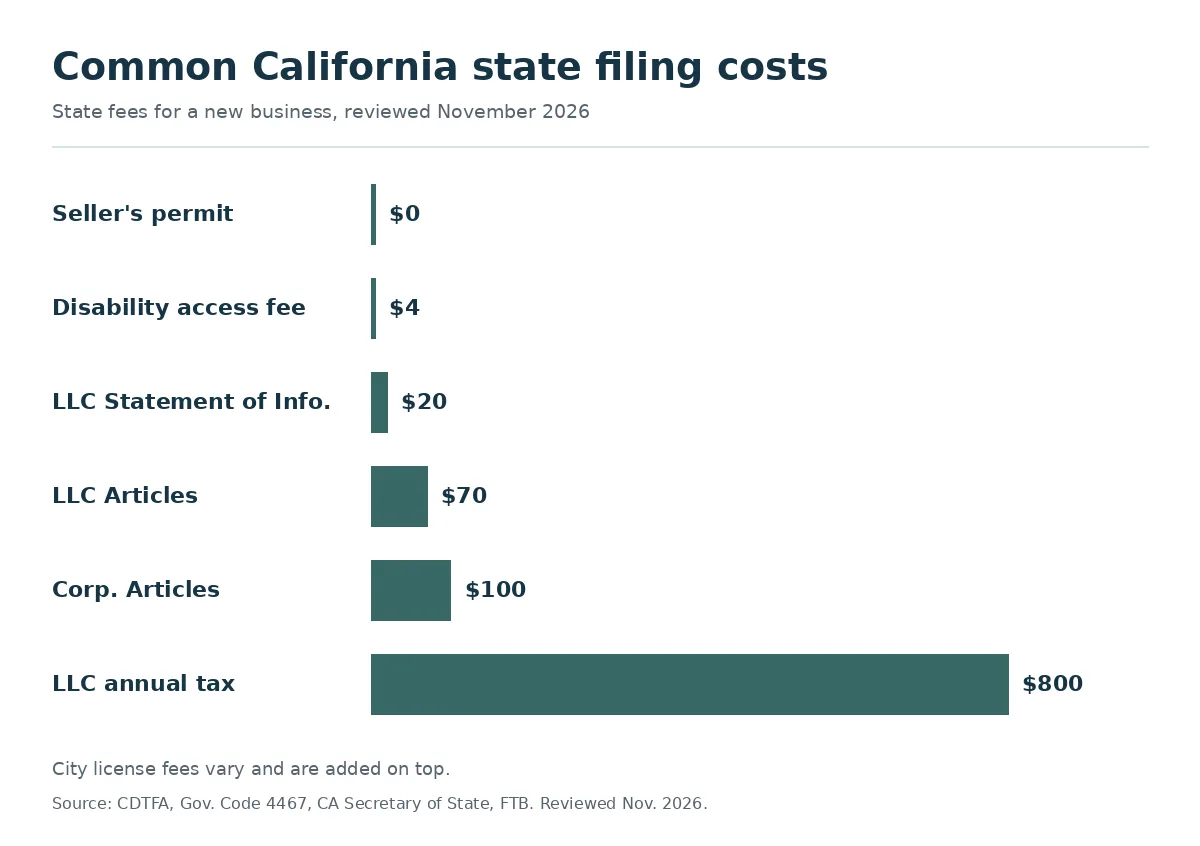
| Item | Agency | Cost (reviewed November 2026) |
|---|---|---|
| Local business license or tax certificate | City or county | Varies; San Diego $34 for 12 or fewer employees, San Francisco from $55 |
| State disability access fee | Added to every local license | $4 per issuance or renewal |
| Seller’s permit | CDTFA | Free (security deposit possible) |
| LLC Articles of Organization | Secretary of State | $70 |
| LLC Statement of Information | Secretary of State | $20 every two years |
| Corporation Articles of Incorporation | Secretary of State | $100 |
| LLC annual tax | Franchise Tax Board | $800 per year |
Under state law, since January 1, 2018, every applicant for a local business license or renewal pays an additional $4 fee, and a 2022 law made that $4 fee permanent.
Every LLC organized or doing business in California owes an $800 annual tax to the Franchise Tax Board until it is canceled. The first payment is due by the 15th day of the fourth month after filing with the Secretary of State. The first-year exemption applied only to tax years beginning in 2021 through 2023, so it does not apply to LLCs formed in 2026.
What deadlines should you track?
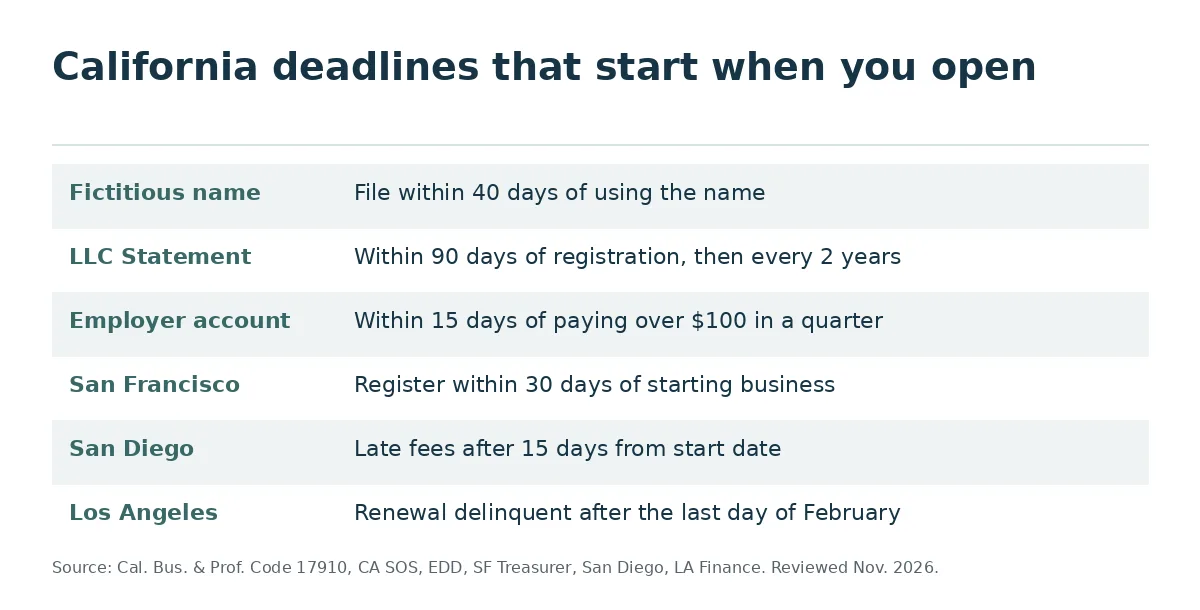
Several California deadlines start running the day you open, not the day you apply: 40 days for a fictitious business name, 90 days for an LLC’s first Statement of Information, 15 days for employer registration after the first qualifying payroll, and 30 days for San Francisco registration.
The Secretary of State warns that failing to file a required Statement of Information may result in Franchise Tax Board penalties and suspension or forfeiture.
What happens if you operate without a license?
The steepest penalties apply to regulated work. Contracting without a required license is a misdemeanor; the CSLB says a first offense can bring up to six months in jail and a $5,000 fine, plus administrative fines of $200 to $15,000, and a second offense brings a mandatory 90-day jail sentence.
Unlicensed contractors also lose the right to get paid through the courts. Under Business and Professions Code Section 7031, they cannot sue to collect compensation for work that required a license, and customers can sue to recover what they paid.
Food businesses face closure. A food facility operating without the necessary permits is subject to closure and a penalty of up to three times the permit cost. For city licenses, Los Angeles warns of penalties, interest and other legal remedies for unregistered businesses.
Do licenses change when ownership changes?
Often, yes. Seller’s permits are not transferable, food facility permits are valid only for the person and location named, and the Internal Revenue Service says you generally need a new EIN when you change your entity’s ownership or structure. A business owner buying a company should plan to apply for most required licenses in the new name.
What changes when you operate in several cities or states?
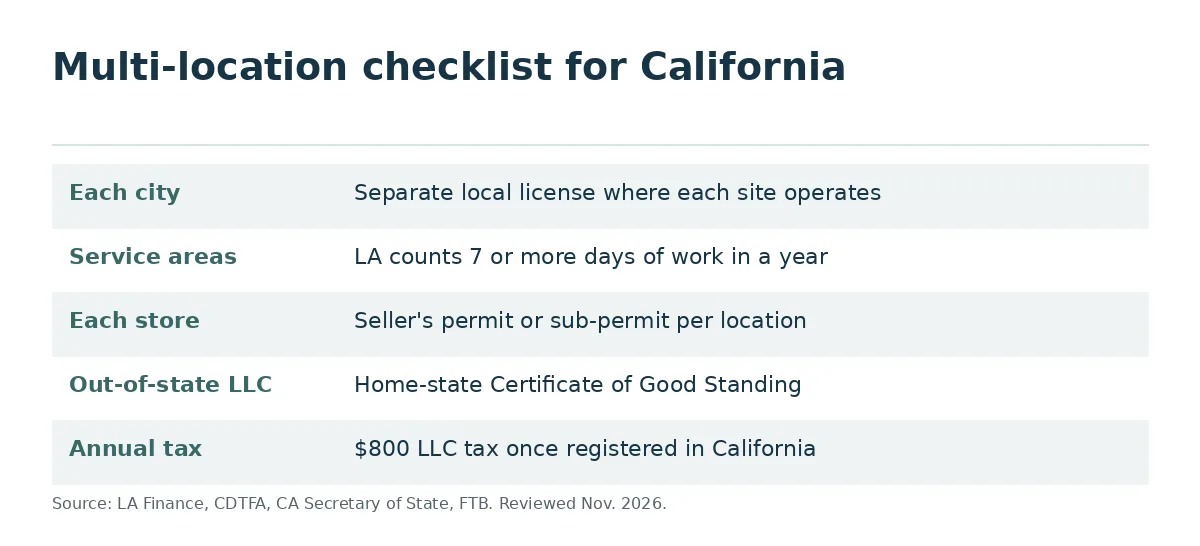
For multi-location operators, California adds work in three places.
First, licenses multiply by city. Stores in Los Angeles, San Francisco and San Diego mean three ordinances, fee formulas and renewal calendars. Service businesses can trigger licenses in cities where they have no office; Los Angeles counts seven days of work in a year.
Second, state registrations attach to each location. Each selling location needs its own seller’s permit or sub-permit, and the CDTFA notes that seller’s permits are not transferable, so a new owner applies for its own.
Third, out-of-state entities have an extra prerequisite. A company formed elsewhere needs a current Certificate of Good Standing from its home state to register in California, and an LLC that registers takes on the $800 annual tax.
The usual sequence is entity registration, then state tax accounts, then local licenses, because local applications ask for state numbers. Los Angeles, for example, asks for your sales tax number if you hold a seller’s permit. Our guide to the registration sequence when opening in a new state covers that order across states.
Frequently asked questions
Do I need a California business license if I work from home?
Usually, yes. Local licensing is tied to where the business operates, and many cities include home-based businesses. San Diego, for example, requires a Business Tax Certificate for home-based businesses, self-employed people and independent contractors. Your city may also require a home occupation permit or zoning clearance. Check with the city where your home is located, or the county if you live in an unincorporated area.
How long does it take to get a business license in California?
It depends on the city. Some, like Los Angeles, issue a temporary certificate immediately after an online application, with the permanent certificate mailed later. The CDTFA can sometimes issue a seller’s permit the same day. Entity filings, fictitious business name publication (four weeks) and industry licenses usually take the longest. Build in time for zoning or health approvals if your location needs them.
Is a California seller’s permit the same as a business license?
No. A California seller’s permit is a state tax registration from the CDTFA that lets you collect and report sales tax on taxable goods. A business license comes from your city or county and authorizes you to operate there. Most retailers need both. The seller’s permit is free, while the local license usually carries a fee or tax plus the $4 state disability access fee.
What is the California business license cost for a new LLC?
Expect at least $70 for Articles of Organization, $20 for the Statement of Information, the $800 annual LLC tax and your city’s license fee plus $4. In San Diego, a business with 12 or fewer employees pays $34 for the certificate; San Francisco starts at $55. A seller’s permit is free, though a security deposit may apply. Industry licenses and fictitious business name filings add more.
Do I need a new license for each California location?
Often, yes. Each city licenses businesses within its own limits, so locations in different cities need separate local licenses. The CDTFA also requires each selling location to be registered, either separately or as a sub-permit under a consolidated seller’s permit. Within a single city, ask the issuing office whether each additional location needs its own certificate before you open.
Opening locations in California?
LicenseComply researches the city, county and state licenses each California location needs, then prepares and files the applications for you.
Explore Research & Verification Talk to a licensing specialist
Official sources and further reading
- California Office of the Small Business Advocate: Set up your business in California
- CalGold permit assistance tool
- California Secretary of State: Limited liability companies, California (domestic) forms and fees
- California Secretary of State: Corporations, California (domestic) forms and fees
- California Secretary of State: Foreign limited liability companies forms and fees
- California Secretary of State: Statements of Information filing tips
- California Business and Professions Code: Fictitious business names, Sections 17900 to 17930
- California Government Code Section 4467: Disability access fee
- Division of the State Architect: SB 1186 license fee report
- California Department of Tax and Fee Administration: Obtaining a seller’s permit
- California Department of Tax and Fee Administration: Publication 107, Do you need a California seller’s permit?
- California Department of Tax and Fee Administration: Temporary sellers
- California Department of Tax and Fee Administration: Publication 51, Doing business in California
- Franchise Tax Board: Limited liability company annual tax
- Employment Development Department: Register as an employer
- Department of Consumer Affairs: About us
- Department of Consumer Affairs: Licensing requirements by license type
- California Health and Safety Code Section 114381: Food facility permits
- Senate Bill 241 (2009): Retail food facilities, including Section 114387 penalties
- Contractors State License Board: Consequences of contracting without a license
- California Business and Professions Code Section 7031
- Internal Revenue Service: Employer identification number
- Internal Revenue Service: When to get a new EIN
- Contractors State License Board: Who must be licensed
- City of Los Angeles Office of Finance: How to register for a BTRC
- LA Business Navigator: Business Tax Registration Certificate
- City of Los Angeles Office of Finance: Business tax information FAQ
- City of Los Angeles Office of Finance: Small business exemption FAQ
- San Francisco Treasurer and Tax Collector: Register a business
- City of San Diego: Business tax rates and fees
- City of San Diego: Apply for a Business Tax Certificate
- City of San Jose: Register for a business tax certificate
- City of San Jose: Business tax and registration
- City of San Jose: Pay or renew business tax
Disclaimer: LicenseComply provides professional business licensing and compliance services. However, the informational content on this site (including articles, guides, tools, and videos) is provided for general educational purposes only and does not constitute legal, tax, or accounting advice. Laws and regulations change frequently, and we cannot guarantee that all information is accurate, complete, or up to date for your specific circumstances. Your use of this website and its content does not create an attorney-client, accountant-client, or other advisory relationship. You should consult with a qualified attorney, accountant, or other appropriate professional for advice tailored to your business.