
Key points
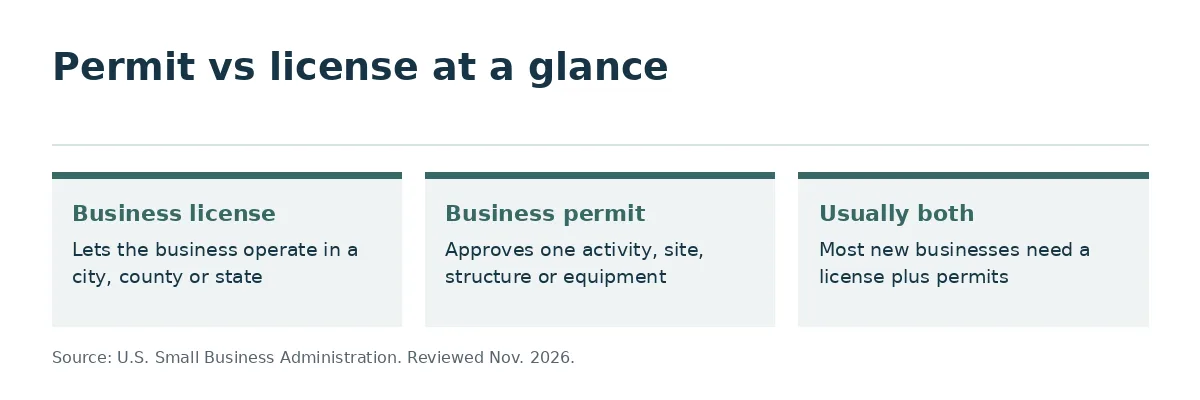
- A business license generally authorizes a business to operate in a jurisdiction, while a permit authorizes a specific activity, location, structure or piece of equipment, and many new businesses need both.
- The U.S. Small Business Administration says most small businesses need a combination of licenses and permits from both federal and state agencies, and many also need county or city licenses.
- In Texas, a sales and use tax permit is free, but a seller needs a separate permit for each active place of business, and the permit cannot be transferred to a new owner.
- Chicago requires Zoning to review and approve every business license, location expansion and change of location application before the license application can be processed.

Most new businesses need both: a business license that lets the business operate in a city, county or state, and one or more permits for specific activities, locations or equipment. In the permit vs license question, the license usually covers the business as a whole, while each permit covers one regulated thing, such as serving food, selling taxable goods or occupying a building.
The line is not always clean, because agencies use the words differently. California calls its sales tax registration a seller’s permit, Seattle calls its general license a business license tax certificate, and New York City’s consumer agency licenses businesses industry by industry rather than through one citywide general license.
This guide explains the business permit vs business license distinction, lists the permits needed to open a business in most places, and shows what changes when you operate in several states or cities. Fees and rules below were reviewed November 2026 against official sources, but requirements vary by jurisdiction, so confirm each one with the issuing agency. For the step-by-step application process, see our guide on how to get a business license.
What is the difference between a permit vs license?
A business license is a general authorization, often a legal document issued by state and local governments, to do business in a jurisdiction. A business permit is narrower: it approves a particular activity, site, structure or piece of equipment, often after an inspection or plan review.
What a business license does
A general or basic business license usually registers the business with a city, county or state and often ties into local business taxes, so it matters for tax purposes as much as for regulation. In Seattle, anyone doing business in the city must have a business license tax certificate, also called a business license or general business license, and it must be renewed each year by December 31, according to the City of Seattle.
The City of Los Angeles takes a tax-based approach. All individuals or entities conducting business activities in the city must obtain a Business Tax Registration Certificate from the Office of Finance, per the Los Angeles Office of Finance. The application asks for the owner’s legal name, any business name used as a doing business as name, a business address, a description of the business activity, and either the owner’s Social Security Number or, for businesses that report employment taxes, a federal Employer Identification Number, according to the Los Angeles tax information booklet.
What a business permit does
A permit answers a narrower question: is this specific activity or place allowed and safe under local regulations and state regulations? A restaurant needs a food permit, a retailer needs a sales tax permit, and a business that hangs a sign over a sidewalk may need a sign or public way permit.
In New York City, a food service establishment needs a permit from the Department of Health and Mental Hygiene, and a supervising manager must pass a Food Protection Course, per NYC MyCity Business.
Why the terms overlap
There is no national naming standard. Focus on what the document authorizes and who issues it, not on its name.
| Business license | Business permit | |
|---|---|---|
| What it covers | The business operating in a jurisdiction | A specific activity, site, structure or equipment |
| Typical issuer | City, county or state licensing or tax office | Health, building, zoning, fire or tax agency |
| Common trigger | Doing business in that city or state | Selling taxable goods, serving food, building out space |
| Inspection | Often none for a general license | Often required before or after approval |
Most new businesses end up holding both kinds of approval.
Do I need a permit or a business license to open a new business?
Usually you need both, though the exact licensing requirements depend on your activities, business entity and location. The U.S. Small Business Administration says most small businesses need a combination of licenses and permits from both federal and state agencies, and that you may also need licenses from your county or city.
Some places require a general business license; others do not. Washington requires a state business license if any of several triggers applies, including needing city, county or state endorsements, doing business under a name other than your full legal name (for example, a sole proprietorship that does not operate under the owner’s own name), planning to hire employees within 90 days, or having gross income of $12,000 or more per year, per the Washington Department of Revenue.
Industry licensing can also take the place of a general license. New York City’s Department of Consumer and Worker Protection licenses businesses in more than 45 industries, per the NYC Department of Consumer and Worker Protection, and health, building and fire approvals are handled by other city agencies.
What permits are needed to open a business?
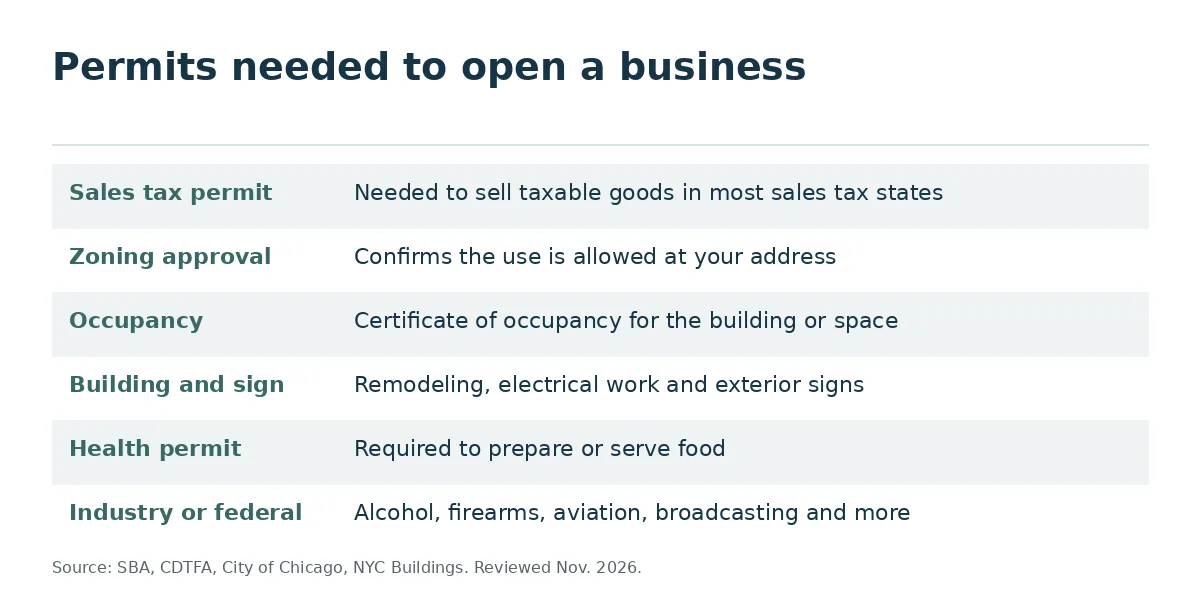
The permits needed to open a business fall into a handful of common categories. Not every business needs all of them, but most physical locations need several.
Sales tax permit or seller’s permit
If you sell taxable goods to customers, most states with a sales tax require a permit before you start selling, so you can collect sales tax and remit sales tax to the state government. States call this a sales tax license, seller’s permit or, informally, a retail license. In California, you need a seller’s permit if you are engaged in business in the state and intend to sell or lease tangible personal property that would ordinarily be subject to sales tax, and both wholesalers and retailers must apply, according to the California Department of Tax and Fee Administration. There is no fee for the permit, though the department may require a security deposit. Generally, making three or more taxable sales in a 12-month period requires a California seller’s permit, per the department’s temporary sellers guidance. The permit does not renew on a set cycle; it stays valid only while you are actively engaged in business as a seller.
The Texas Comptroller also charges no fee for a sales and use tax permit but may require a security bond. A business with a physical presence in Texas, such as an office or warehouse, is engaged in business there, and an out-of-state seller needs a permit once Texas revenue reaches $500,000 or more in the past 12 months. Each state sets its own permit requirements. A resale certificate is a different document that a buyer gives a seller when purchasing items for resale; our article on seller’s permits vs resale certificates explains how they differ.
Zoning approval and certificate of occupancy
Before a location opens, the use usually has to be allowed by local zoning. In Chicago, every business license, location expansion and change of location application must be reviewed and approved by Zoning before the license application can be processed, per the Chicago Small Business Center.
Many cities also require a certificate of occupancy for the building. In New York City, no one may legally occupy a building until the Department of Buildings has issued a certificate of occupancy or temporary certificate of occupancy, and existing buildings need a current or amended certificate when there is a change in use, egress or type of occupancy, per the NYC Department of Buildings. See our guide to the certificate of occupancy for more.
Building, sign and public way permits
Construction, remodeling, electrical work and signs commonly need permits, which let local authorities check the work against building codes and zoning rules. In Chicago, items on, over or under the public way, such as signs, canopies, awnings and lighting, require a permit from the Department of Business Affairs and Consumer Protection, per the City of Chicago.
Health and food permits
Any business preparing or serving food will need a health permit from a state or local health agency. In New York City, the permit fee for most food service establishments is $280, plus $25 for making frozen desserts, and a business can begin operating 22 days after submitting its application even without a pre-permit inspection, per NYC MyCity Business.
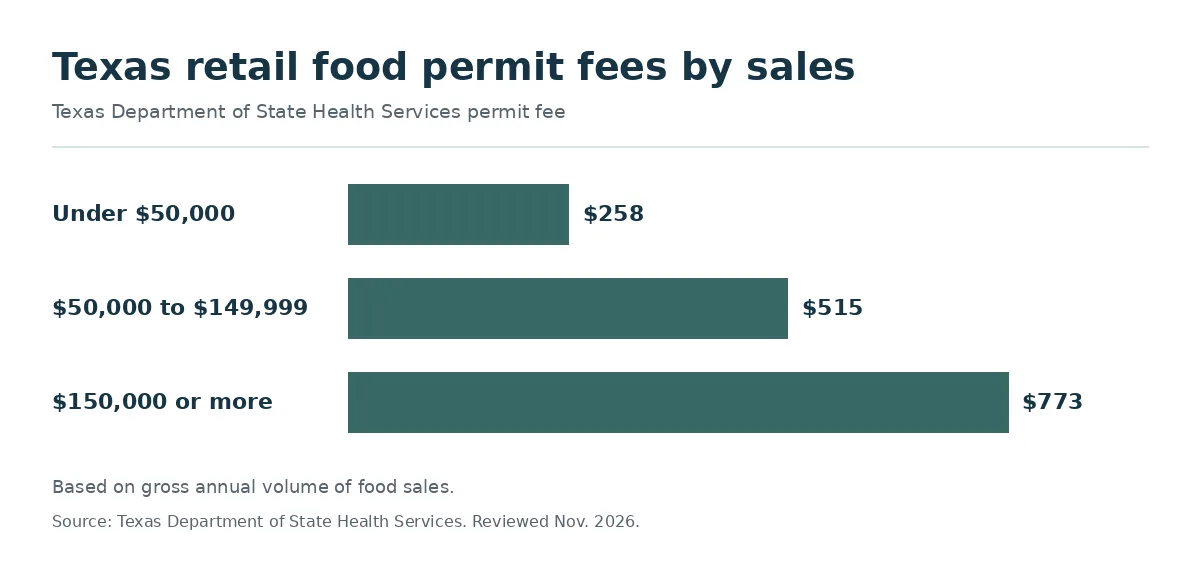
In Texas, the Department of State Health Services sets retail food establishment permit fees by gross annual food sales: $258 under $50,000, $515 from $50,000 to $149,999.99, and $773 at $150,000 or more, per the Texas Department of State Health Services.
Home occupation permits
Running a business from home does not always avoid permits. Colorado Springs requires a home occupation permit with a $120 non-refundable application fee; once approved it does not require renewal, but a new application is required if the business moves, per the City of Colorado Springs.
Temporary and special event permits
Some permits last only as long as an event or selling period. In California, a business selling at a location for less than 90 days is a temporary seller and needs a temporary seller’s permit for each temporary location, per the California Department of Tax and Fee Administration. Texas defines a temporary food establishment as one operating no more than 14 consecutive days with a single event or celebration, per the Texas Department of State Health Services.
Events open to the public often need their own permit. In Chicago, outdoor events must apply for a special event permit if they close city streets, sell or serve food or alcohol to the public, sell merchandise, or use large tents or stages, per the Chicago Department of Cultural Affairs and Special Events.
Industry and federal permits
Some activities need a federal license or permit. The U.S. Small Business Administration lists activities regulated at the federal level, including the import or transport across state lines of animals and animal products (U.S. Department of Agriculture), alcoholic beverages (Alcohol and Tobacco Tax and Trade Bureau), firearms and explosives (Bureau of Alcohol, Tobacco, Firearms and Explosives), aviation (Federal Aviation Administration) and broadcasting (Federal Communications Commission). It notes that states regulate a broader range of activities, with restaurants, retail, construction and plumbing commonly regulated locally.
Do professional licenses work differently from business licenses?
Yes. Professional licenses, also called occupational licenses, are usually issued to an individual and certify that the person meets specific requirements for education, experience or examination. A business license, by contrast, covers business operations at a location.
California’s Department of Consumer Affairs groups licensure requirements into categories such as higher education or professional schooling, postgraduate training, professional experience, examination and fingerprinting, per its licensing requirements overview. Its table shows physicians and surgeons need professional schooling, postgraduate training and an examination, while engineer licenses require professional experience and an examination.
In regulated business types, such as medical or engineering firms, compliance means professional licenses for the people plus a business license and permits for the location.
How do names for licenses and permits differ by state and city?
The same type of approval can carry very different names. That matters when a landlord or lender asks for “your business license.”
| Jurisdiction | Document name | What it is |
|---|---|---|
| Seattle | Business license tax certificate | General city business license, renewed by December 31 |
| Los Angeles | Business Tax Registration Certificate | City business tax registration for all businesses |
| California | Seller’s permit | State sales tax registration, no fee |
| Texas | Sales and use tax permit | State sales tax registration, one per place of business |
Sources: City of Seattle, Los Angeles Office of Finance, California Department of Tax and Fee Administration, Texas Comptroller.
What changes when you operate in several states or cities?
Opening in more than one place multiplies the permit vs license analysis, because each license and permit is tied to a jurisdiction, a location or an owner.
Licenses follow where you do business
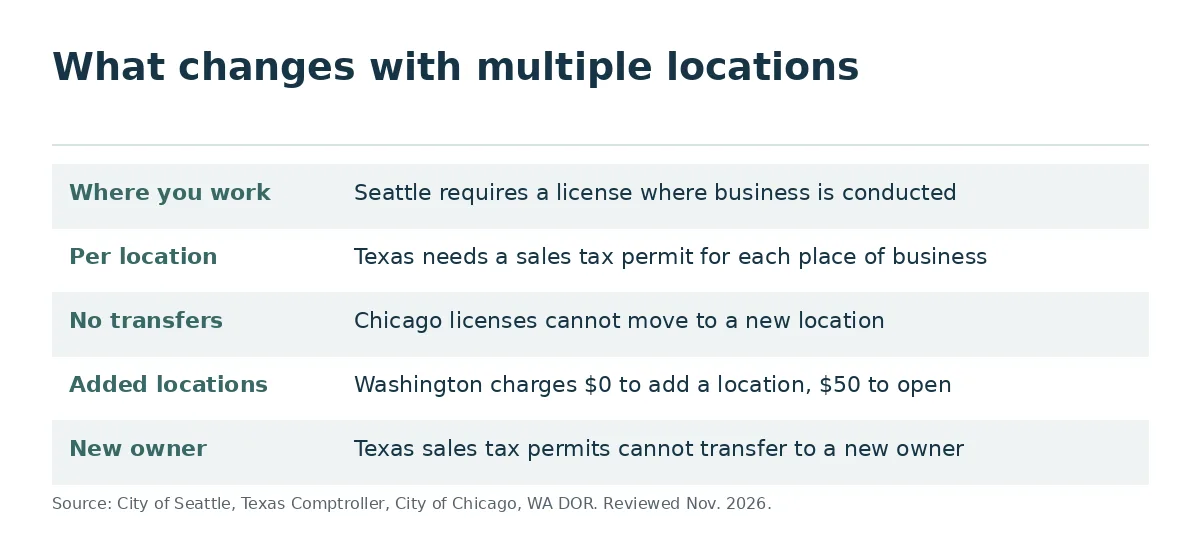
Seattle states that a business based outside the city still needs a Seattle business license tax certificate if it does business in the city, because a license is needed for where business is conducted, not just where the business is located, per the City of Seattle.
Permits are often per location
The Texas Comptroller requires a sales tax permit for each active place of business; multiple locations share one taxpayer number but receive separate outlet numbers. In Chicago, business licenses are issued to a specific business at a specific location and cannot be moved, so a new license is needed before operating at a new location, per the City of Chicago.
Fees and processes differ for added locations
Washington charges a $50 processing fee to open the first location of a new business but $0 to add a location to an existing business, with endorsement fees billed separately, per the Washington Department of Revenue.
Ownership changes reset permits
Many permits belong to the owner, not the address. A Texas sales tax permit cannot be transferred to a new owner, and a sole proprietor who incorporates or forms a limited liability company (LLC) is treated as a change of ownership that needs a new permit, per the Texas Comptroller.
For a new state, licensing usually comes after entity registration and tax accounts. Our guide to the registration sequence when opening in a new state walks through that order. Our research and verification service can identify what each location needs.
How do I find out which licenses and permits apply to me?
Start with your activities and each address, then work through each level of government, because local requirements often add to state and federal rules.
- Federal: check the federal activity list from the U.S. Small Business Administration.
- State: check the state tax agency, the Secretary of State and any state licensing boards for your industry.
- County: check the county clerk’s office or licensing office, especially for unincorporated areas.
- City: check the city licensing office, zoning or planning department, building department, fire marshal and health department.
Before signing a lease, ask the city whether your intended use is allowed at that address, since zoning problems are harder to fix after you commit to a space.
Frequently asked questions
Is a business permit the same as a business license?
No. A business license generally authorizes a business to operate in a city, county or state, while a business permit authorizes one specific activity, location, structure or piece of equipment. Agencies sometimes use the words loosely, so California calls its sales tax registration a seller’s permit. Check what each document authorizes and which agency issues it rather than relying on the name alone.
What is the business permit vs business license difference for a home business?
A home business may need a general business license where the city or state requires one, plus a home occupation permit from the local zoning or planning office. Colorado Springs, for example, charges a $120 application fee for a home occupation permit that does not require renewal but must be reapplied for if the business moves. Rules on employees, client visits and signs vary by city.
Which permits are needed to open a business with a storefront?
Most storefronts need zoning approval for the use, a certificate of occupancy or similar building approval, and building permits for any remodeling. Many also need a sign permit and a sales tax permit if they sell taxable goods. Food, alcohol, salon and other regulated businesses add health or industry permits. The exact list depends on the city, county and state where the storefront is located.
Do I need a separate license or permit for each location?
Often, yes. Texas requires a sales tax permit for each active place of business, and Chicago issues business licenses for a specific location that cannot be moved. Other jurisdictions let you add locations under one registration, such as Washington, which charges no processing fee to add a location to an existing business. Check each license and permit with its issuing agency before opening.
Can I operate while my permit application is pending?
Usually not, unless the agency says so. New York City is one exception for food service: a food service establishment can begin operating 22 days after submitting its permit application, even without a pre-permit inspection. Most building, zoning and occupancy approvals must be in place before you open, so plan for processing time when setting an opening date.
Not sure which permits each location needs?
LicenseComply researches the business licenses and permits each of your locations needs and confirms them with the issuing agencies.
Explore Research & Verification Talk to a licensing specialist
Official sources and further reading
- U.S. Small Business Administration: Apply for licenses and permits
- City of Seattle: Business licenses
- Los Angeles Office of Finance: The business registration process
- Washington Department of Revenue: Apply for a business license
- Washington Department of Revenue: Variable business license processing fees
- California Department of Tax and Fee Administration: Obtaining a seller’s permit
- Texas Comptroller: Sales tax permit FAQs
- Texas Department of State Health Services: Retail food establishment permits
- NYC MyCity Business: Food service establishment permit
- NYC Department of Consumer and Worker Protection: Licenses
- NYC Department of Buildings: Certificate of occupancy
- Chicago Small Business Center: Business licensing
- City of Chicago: Update your business license information
- City of Colorado Springs: Home occupation permit
- Los Angeles Office of Finance: Tax information booklet
- California Department of Tax and Fee Administration: Temporary sellers
- California Department of Consumer Affairs: Licensing requirements
- City of Chicago: Special events permit application
Disclaimer: LicenseComply provides professional business licensing and compliance services. However, the informational content on this site (including articles, guides, tools, and videos) is provided for general educational purposes only and does not constitute legal, tax, or accounting advice. Laws and regulations change frequently, and we cannot guarantee that all information is accurate, complete, or up to date for your specific circumstances. Your use of this website and its content does not create an attorney-client, accountant-client, or other advisory relationship. You should consult with a qualified attorney, accountant, or other appropriate professional for advice tailored to your business.