
Key points
- Florida does not issue a single statewide general business license; most businesses instead get a local business tax receipt from their county and, inside city limits, often from the city as well.
- Under section 205.053, Florida Statutes, local business tax receipts are due by September 30 each year and expire on September 30 of the following year.
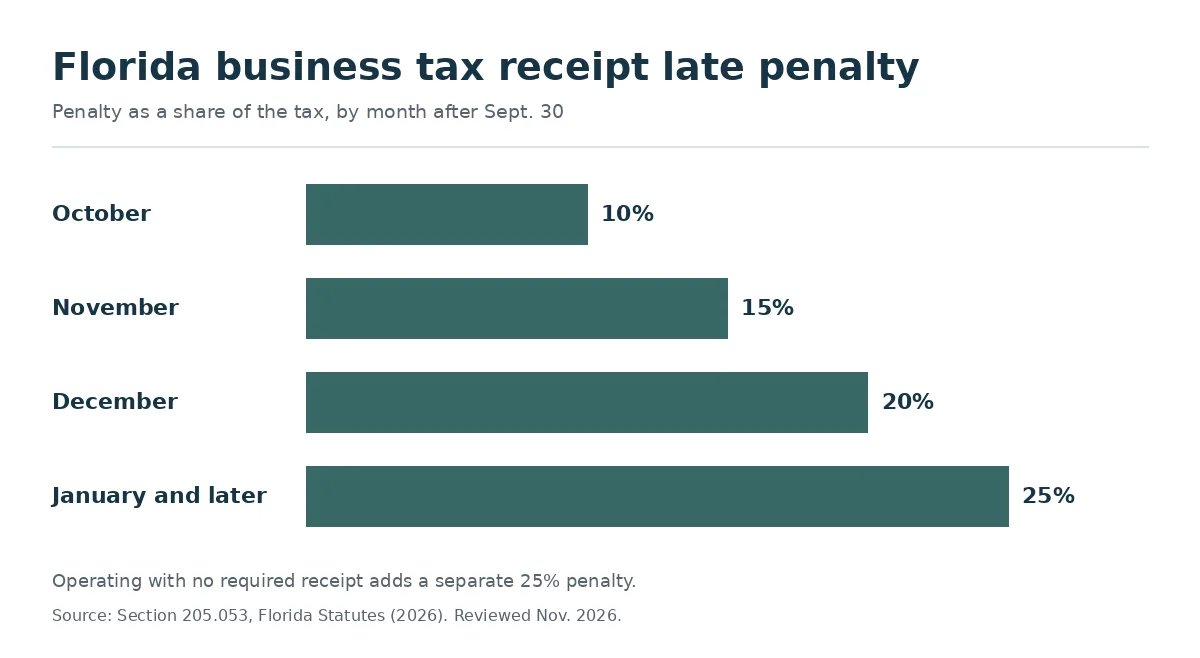
- A late Florida business tax receipt renewal carries a 10 percent penalty for October plus 5 percent for each later month, capped at 25 percent of the tax.
- Florida limited liability companies pay $125 to form and $138.75 for each annual report, and a report filed after May 1 adds a $400 late fee.

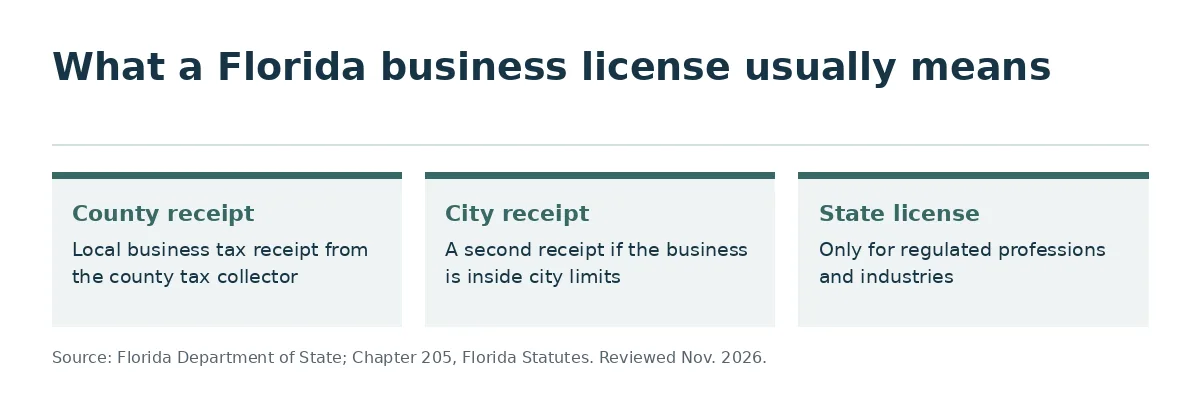
Florida does not issue one statewide general business license. Instead, a Florida business license usually means a local business tax receipt from the county where you operate, a second receipt from the city if you are inside city limits, and a state license only if your profession or industry is regulated. Most businesses also register with the Florida Department of State and the Florida Department of Revenue before opening.
This guide explains how to get a business license in Florida step by step, what the state filings cost, when receipts expire, and the penalties for late renewal. Fees and rules were reviewed November 2026 against official sources.
Local rules vary from county to county, and Florida business license requirements depend on your business type, business activities and physical location. We recommend contacting the tax collector and city where each location sits to confirm category, rate and zoning before you file any paperwork.
Does Florida require a statewide business license?
No. Florida has no general state business license that every business owner must hold. At the state level, Florida licenses specific professions and industries, while counties and cities tax the privilege of doing business locally through local licenses called business tax receipts.
The Florida Department of State’s business licensing resource page explains that the Department of Business and Professional Regulation licenses “everything from architects to auctioneers,” and the Department of Agriculture and Consumer Services licenses “everything from pawn shops to private investigators.” Other state agencies license fields such as health care and financial services.
Some business activities also need a federal license. The U.S. Small Business Administration’s licenses and permits guide lists examples such as alcohol manufacturing, wholesale and import (Alcohol and Tobacco Tax and Trade Bureau), firearms sales (Bureau of Alcohol, Tobacco, Firearms and Explosives), aviation (Federal Aviation Administration) and broadcasting (Federal Communications Commission).
For everything else, the requirement is local. The state’s guide to business taxes notes that most county tax collectors require a local business tax, formerly called an occupational license, and that some cities require their own. If you are unsure whether your activity needs a license at all, our guide to whether you need a business license walks through the general test.
What is a business tax receipt in Florida?
A business tax receipt in Florida is the document a county or city issues to show you paid the local business tax. Chapter 205 of the Florida Statutes defines the local business tax as the fee a local government charges for “the privilege of engaging in or managing any business, profession, or occupation within its jurisdiction,” and the receipt must bear the words “Local Business Tax Receipt.”
Counties may levy the tax under section 205.032 and cities under section 205.042. The receipt is a tax, not a regulatory permit: inspection, permit and registration fees are charged in addition to it.
Is the Florida local business tax being repealed?
Not as of November 2026. During the 2026 session, the Florida House passed CS/HB 103, which would have repealed Chapter 205, by a vote of 82 to 26. The bill died in the Senate Appropriations Committee on March 13, 2026, and the companion Senate Bill 122 died in committee the same day. Chapter 205 remains in the 2026 Florida Statutes, so local business tax receipts are still required where counties and cities levy them.
How to get a business license in Florida: step by step
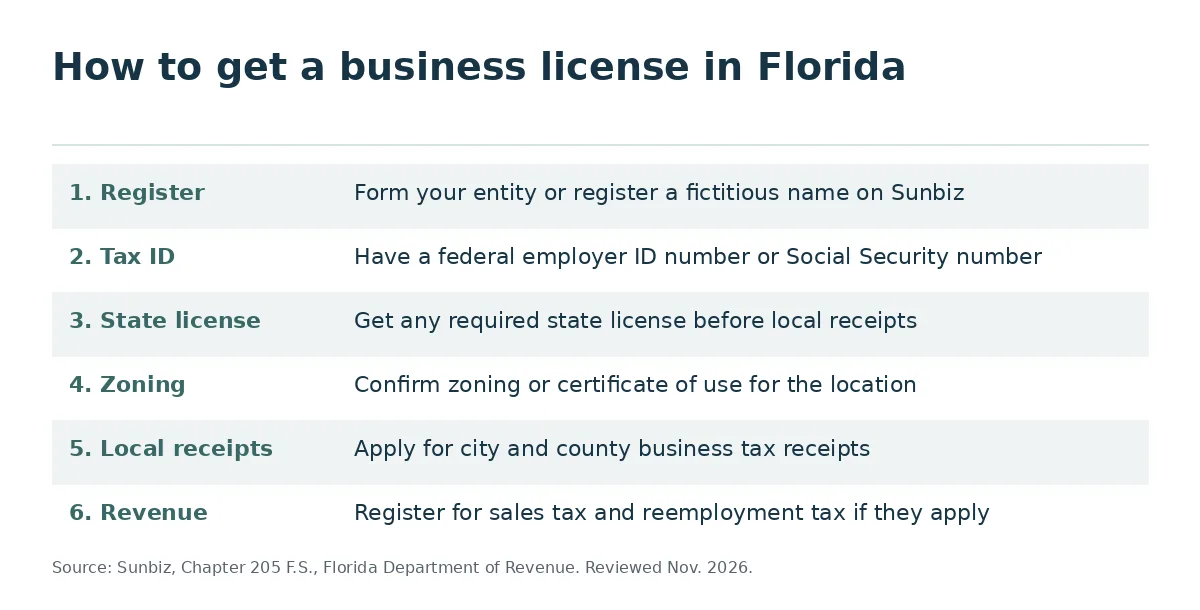
The order matters, because local tax collectors usually ask for proof of the earlier steps.
1. Register your business entity or trade name
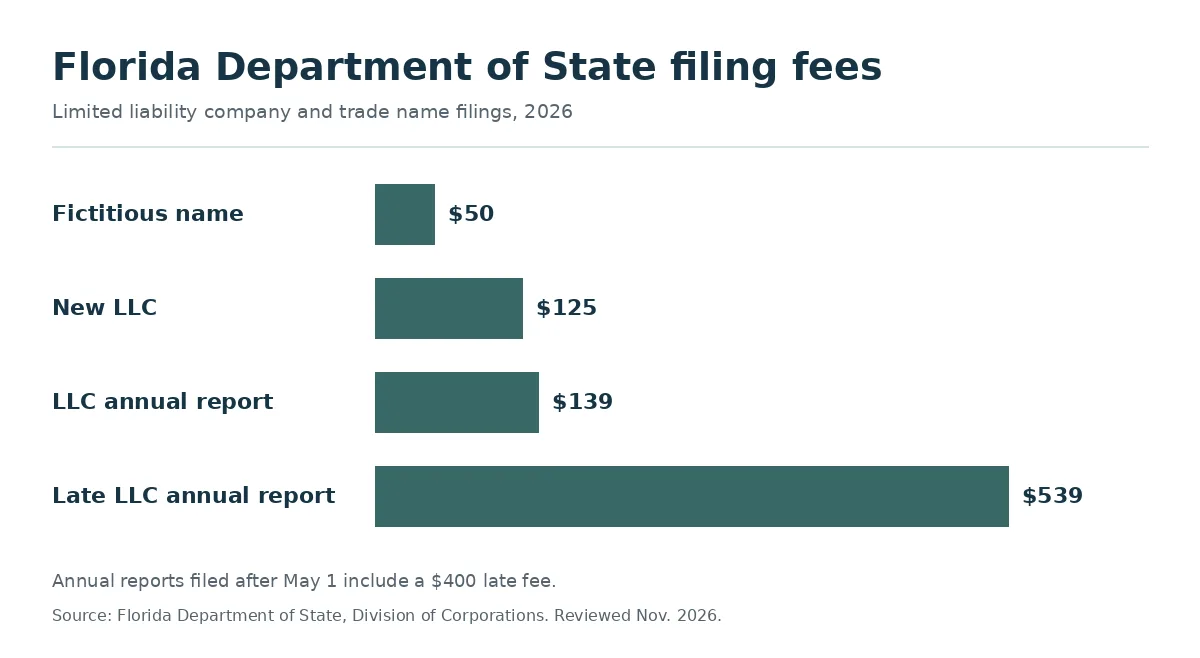
Corporations, limited liability companies (LLCs) and limited partnerships register with the Division of Corporations, known as Sunbiz. A new Florida or foreign LLC pays a $100 filing fee plus a $25 registered agent fee, for $125 total, according to the Sunbiz LLC fee schedule.
A sole proprietorship does not file formation documents with Sunbiz. Any business operating under a business name other than its legal name, whether a sole proprietor or an entity, must register a fictitious name. Registration costs $50 and is valid for five years, expiring December 31 of the final year, per the Sunbiz fictitious name page. Applicants certify that the name has been advertised at least once in a newspaper in the county where the business is located, per the Sunbiz fictitious name FAQ.
2. Get your tax identification number
The Internal Revenue Service issues employer identification numbers online, and it states that you never have to pay a fee for one, per the IRS employer identification number page. Under section 205.0535(6), a receipt may not be issued unless the local government obtains the applicant’s federal employer identification number or Social Security number. Our guide on how to find a business tax ID number covers where to locate an existing number.
3. Obtain any required state license or additional licenses first
If your work is regulated by a state agency, you must show an active state license, certificate or registration before a county or city can issue or renew your receipt, under section 205.194. The Department of Business and Professional Regulation keeps a list of services requiring a state license, and it advises checking with your county or city about a local receipt or certificate of competency for work that does not need a state license.
4. Obtain zoning approval for the business location
Many jurisdictions require you to obtain approval of the business location before issuing a receipt. In unincorporated Orange County, the Orange County Zoning Division must approve all proposed new businesses, and applications go through its online Fast Track system. Orange County also notes that building permits are required for a new structure or changes to an existing one, per its Zoning Division FAQ. In unincorporated Miami-Dade County, a certificate of use must be obtained before opening any business. See our guide to the certificate of occupancy for how use approvals relate to building occupancy.
5. Apply for your city and county business tax receipts
Find out first whether your address is inside a city. If it is, you will often need a city receipt and a county receipt, and some counties require the city receipt before they issue theirs. Required documents typically include your Sunbiz filing or fictitious name registration, a tax ID number, any state license, and zoning approval, with additional information required depending on the category, such as number of employees or seats.
6. Register with the Florida Department of Revenue
If you sell taxable goods or services, you must register as a sales and use tax dealer before you begin conducting business, according to the Department of Revenue registration page. If you are unsure whether you must collect sales tax, the department’s sales tax guide says to contact Taxpayer Services. The same Florida Business Tax Application registers employers for reemployment tax, which applies once you pay $1,500 or more in wages in a calendar quarter or have at least one employee in 20 weeks of a calendar year, per the reemployment tax page.
How much does a Florida business license cost?
Local business tax rates are set by each county and city by business category, and some categories are measured by employees, seats or machines. The Hillsborough County Tax Collector notes that the amount due varies with the nature of the business. Hillsborough issues receipts at a half-year rate to new businesses applying between April 1 and June 30, according to its open a business page.
State filing fees are uniform. These are the main Department of State charges most new businesses see:
| Filing | Fee | Official source |
|---|---|---|
| New Florida or foreign LLC | $125 | Sunbiz LLC fees |
| LLC annual report, by May 1 | $138.75 | Sunbiz LLC fees |
| LLC annual report, after May 1 | $538.75 | Sunbiz LLC fees |
| Profit corporation annual report, by May 1 | $150 | Sunbiz corporate fees |
| Fictitious name registration or renewal | $50 | Sunbiz fictitious name renewal |
How do local business license requirements differ across Florida?
Four of the state’s largest markets show how procedures and license requirements differ.
Miami-Dade County
A business located inside a municipality must obtain both a city receipt and a county receipt, and county receipts run from October 1 to September 30, according to Miami-Dade County. The county’s application guidance says anyone providing merchandise, entertainment or service to the public, including a one-person or home-based business, must obtain a local business tax receipt, and lists entity documents, a federal tax ID number and either a certificate of use or a city receipt among the requirements.
Orange County and Orlando
The City of Orlando requires a business tax receipt before a business opens and requires a certificate of use alongside it, per the City of Orlando. Businesses in Orlando and ten other Orange County cities and towns must get the municipal receipt before applying for the county receipt, according to the Orange County Tax Collector.
Hillsborough County and Tampa
New businesses must obtain a receipt before engaging in their enterprise and can apply online through BTExpress, with review in three to five business days, per the Hillsborough County Tax Collector. A business in Tampa or another of the county’s three cities needs a county receipt in addition to any city receipt. The City of Tampa takes applications through its own new business tax receipt form.
Fort Lauderdale and Broward County
Effective October 1, 2026, businesses in Fort Lauderdale must obtain zoning approval through a certificate of use before applying for a city business tax receipt, according to the City of Fort Lauderdale. Most businesses operating in the city need both a city receipt and a Broward County receipt, and in most cases the city receipt comes first. The city’s business tax FAQ puts standard processing at about 30 business days once all correct documentation is submitted, and a business cannot operate until the receipt is approved.
When do Florida business tax receipts expire, and what are the penalties?
Every receipt follows the same statewide calendar. Under section 205.053, receipts go on sale July 1, are due by September 30, and expire September 30 of the following year.
Late renewals are delinquent and carry a penalty of 10 percent for October plus 5 percent for each later month, up to a maximum of 25 percent of the tax. Operating without a required receipt brings a separate 25 percent penalty on the tax due. Not paying within 150 days after the initial notice can lead to civil action, collection costs, attorney fees and a penalty of up to $250.
Entity filings run on a different calendar. Annual reports for corporations and LLCs are due between January 1 and May 1, a $400 late fee applies after May 1, and reports not filed by the third Friday in September risk administrative dissolution, according to the Sunbiz annual report page. For a broader renewal routine, see our business license renewal guide.
Are any businesses exempt from the Florida local business tax?
Some owners qualify. Under section 205.055, honorably discharged veterans and their spouses or unremarried surviving spouses, spouses of active duty servicemembers relocated under permanent change of station orders, people receiving public assistance, and people with household income below 130 percent of the federal poverty level are exempt. A business with fewer than 100 employees that is majority owned by an exempt person is also exempt. Each applicant signs a Request for Fee Exemption and provides documentation.
Home-based businesses still pay, but only locally. Under section 559.955, a qualifying home-based business is subject only to business taxes in the county and city where it is located.
What changes if you operate in several states or Florida cities?
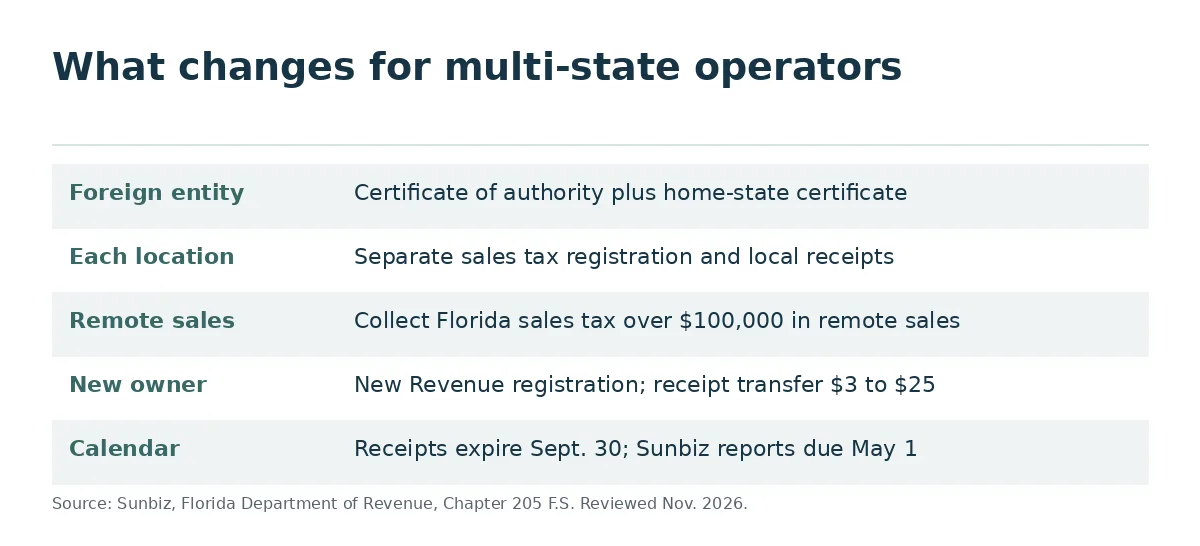
Multi-state operators usually face more filings in Florida, not fewer, because the local layer repeats for each location. For example, a retailer with stores in Orlando and Fort Lauderdale needs two city receipts and two county receipts.
- Foreign registration: An LLC formed elsewhere may not transact business in Florida until it obtains a certificate of authority, and it must submit a certificate of existence from its home jurisdiction no more than 90 days old, per the Sunbiz foreign LLC instructions.
- Each location: The Department of Revenue requires businesses to register each location for sales tax. Miami-Dade County issues local business tax receipts for each place of business and each separate category at the same location, per its tourist tax registration form.
- Remote sellers: Out-of-state businesses with more than $100,000 in taxable remote sales into Florida in the previous calendar year must collect and remit Florida sales tax, according to the Department of Revenue.
- Ownership changes: Purchasing an existing business does not carry over its state tax registration. A change of legal entity or ownership requires a new Department of Revenue registration. A local receipt may be transferred to a new owner after a bona fide sale for a fee of $3 to $25, under section 205.043 for cities and section 205.033 for counties.
- Traveling professionals: A business regulated by the Department of Business and Professional Regulation that paid the tax where its permanent location sits cannot be charged a business tax by another Florida city or county for temporary work there, under section 205.065.
- Calendar alignment: Every Florida receipt expires September 30, while Sunbiz reports are due May 1, so Florida deadlines need their own entries in a multi-state renewal calendar.
Our guide to the registration sequence when opening in a new state shows where Florida filings fit in an expansion plan. Teams opening several Florida sites at once sometimes use a license research service to map each county and city requirement before signing leases.
Frequently asked questions
Do I need a business license to operate in Florida?
Most businesses need a local business tax receipt rather than a state license. Florida has no general statewide business license, but counties and cities levy a local business tax under Chapter 205, and many businesses need both a county and a city receipt. Regulated professions also need a state license from agencies such as the Department of Business and Professional Regulation. Confirm requirements with your county tax collector.
What is the difference between a business tax receipt and a business license in Florida?
A business tax receipt shows you paid the local tax for the privilege of doing business in a county or city. A state license shows you meet the qualifications to practice a regulated profession or run a regulated business. They are separate, and under section 205.194 a local government cannot issue a receipt for regulated work until you show the active state license.
How much is a business tax receipt in Florida?
There is no single statewide price. Each county and city sets rates by business category, and some charge based on employees, seats or machines. Hillsborough County charges a half-year rate to new businesses applying between April 1 and June 30. Check the category schedule with your county tax collector and city, since one location may owe both.
When does a Florida business tax receipt expire?
Every Florida local business tax receipt expires on September 30. Renewals go on sale July 1 and are due by September 30, or the next working day if it falls on a weekend or holiday. A late renewal costs 10 percent of the tax for October plus 5 percent for each later month, up to 25 percent.
Do home-based businesses need a business tax receipt in Florida?
Usually, yes. Florida law protects qualifying home-based businesses from being regulated differently from other businesses, but they remain subject to local business taxes in the county and city where the home is located. Miami-Dade County states that home-based occupations must obtain a local business tax receipt. Zoning conditions for home offices vary by jurisdiction.
Opening locations in Florida?
LicenseComply researches the county, city and state licenses each Florida location needs, files the applications and tracks every renewal date.
Explore Research & Verification Talk to a licensing specialist
Official sources and further reading
- Florida Statutes Chapter 205: Local Business Taxes (2026)
- Section 205.053, Florida Statutes: Dates due and delinquent; penalties
- Section 205.055, Florida Statutes: Exemptions for veterans, military spouses and low-income persons
- Section 205.194, Florida Statutes: State license required before local receipt
- Section 205.065, Florida Statutes: Nonresident persons regulated by DBPR
- Section 559.955, Florida Statutes: Home-based businesses
- Florida Senate: CS/HB 103 (2026) Local Business Taxes, bill history
- Florida Department of State: Get a business license
- Florida Department of State: Set up taxes
- Sunbiz: LLC fees
- Sunbiz: File annual report
- Sunbiz: Fictitious name registration
- Sunbiz: Foreign LLC registration instructions
- Florida Department of Revenue: Account management and registration
- Florida Department of Revenue: Sales and use tax
- Florida Department of Revenue: Reemployment tax
- Department of Business and Professional Regulation: Services requiring a license
- Miami-Dade County: How to apply for a local business tax receipt
- Orange County Tax Collector: Obtaining a new business tax receipt
- City of Orlando: Get a business tax receipt
- Hillsborough County Tax Collector: Open a business
- City of Fort Lauderdale: Business tax
- Internal Revenue Service: Get an employer identification number
- U.S. Small Business Administration: Apply for licenses and permits
Disclaimer: LicenseComply provides professional business licensing and compliance services. However, the informational content on this site (including articles, guides, tools, and videos) is provided for general educational purposes only and does not constitute legal, tax, or accounting advice. Laws and regulations change frequently, and we cannot guarantee that all information is accurate, complete, or up to date for your specific circumstances. Your use of this website and its content does not create an attorney-client, accountant-client, or other advisory relationship. You should consult with a qualified attorney, accountant, or other appropriate professional for advice tailored to your business.