
Key points
- Most Maryland business licenses, including the trader’s license, are issued by the Clerk of the Circuit Court in the county or city where the business is located.
- A Maryland trader’s license is required to sell goods, applies to both retailers and wholesalers, and is needed separately for each store or place of business.
- Maryland trader’s license fees are based on inventory value and range from $15 to $800, or up to $2,125 in Baltimore City, plus a $2 issuing fee.
- Maryland business licenses run from May 1 through April 30, and every domestic and foreign entity must also file an annual report with the Department of Assessments and Taxation by April 15.

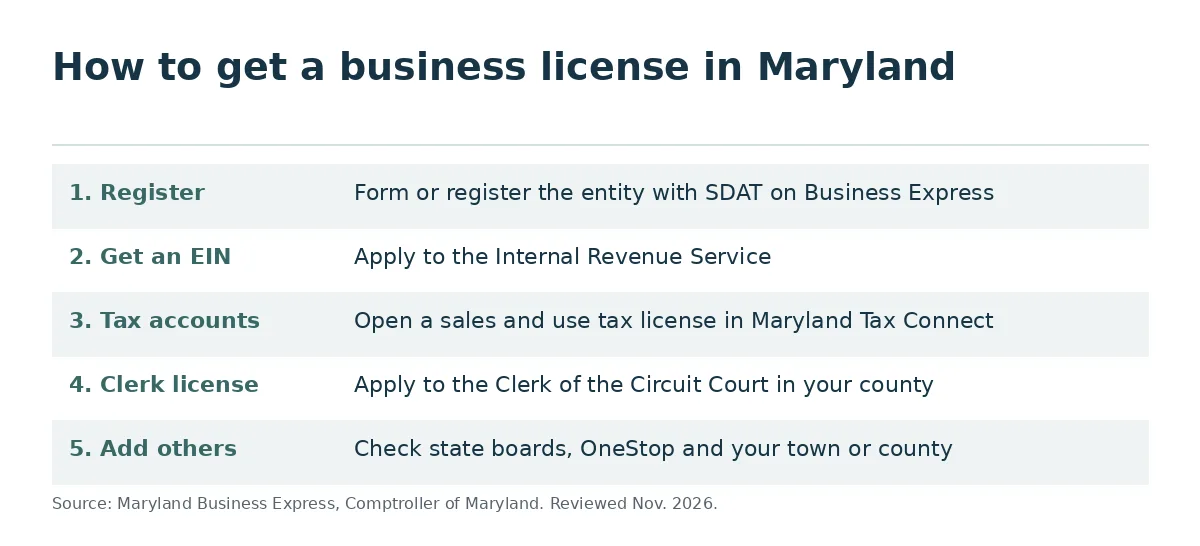
To get a Maryland business license, register your business with the Maryland Department of Assessments and Taxation (SDAT), open a sales and use tax account with the Comptroller of Maryland, and then apply to the Clerk of the Circuit Court in the county where you operate. Most businesses that sell goods need a trader’s license, and certain industries also need a state occupational license, local permits or a local business license.
Maryland does not issue one general business license. The state uses activity licenses handled by local clerks and enforced by the Comptroller’s State License Bureau.
This guide, reviewed November 2026 against official sources, walks through each step, current fees, the annual renewal cycle and how to look up a license. Requirements change and vary by location, so confirm the details with the issuing agency before you apply.
Do you need a Maryland business license?
Not every business does; your licensing obligations depend on your business activity and business location. The Comptroller’s business license FAQ says licenses should go only to businesses the state requires to be licensed, and it suggests calling your local Clerk of the Court or the State License Bureau if you are unsure.
Activities that require a state license from the clerk include traders, chain stores, construction firms, out-of-state contractors, hawkers and peddlers, restaurants, storage warehouses, vending machines and tobacco retailers, according to the same FAQ. A Comptroller business tax tip adds amusements, auctions, dry cleaners and garages to the list. Industry specific licenses from state boards and local permits sit on top of these.
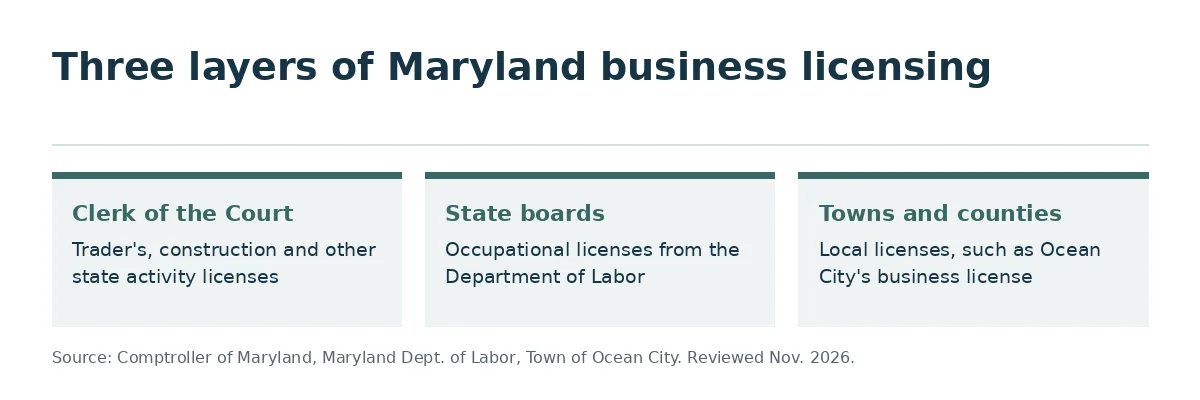
Maryland business licensing works in three layers, and one business can need licenses from all of them.
What is the Maryland traders license?
The Maryland traders license is the most common state business license. Unless you are a grower or manufacturer, you may not sell goods in Maryland without a trader’s license from the Clerk of the Circuit Court and a sales tax account, per the Comptroller’s license types page. Wholesalers are not exempt.
Under Business Regulation Article Section 17-1803, a separate trader’s license is required for each store or place of business. Growers, makers and manufacturers are exempt.
Who needs a state occupational license?
Many professions are licensed by the state, not the clerk. The Maryland Department of Labor oversees 21 licensing boards and programs covering 25 professions, including barbers, cosmetologists, electricians, plumbers, heating, ventilation, air conditioning and refrigeration (HVACR) contractors, and real estate licensees.
Home improvement contractors need an industry specific license from the Maryland Home Improvement Commission. Holding that license means you do not also need the clerk’s construction license, per the Comptroller. Our guide to occupational licenses explains how these differ from general business licenses.
How to get a business license in Maryland, step by step
The order matters, because the clerk checks your state registrations before issuing a license.
Step 1: Choose a business structure and register with SDAT
Your business structure decides which formation documents you file. Corporations, limited liability companies (LLCs) and other business entity types form or register through Maryland Business Express. Under the SDAT fee schedule, Articles of Organization for an LLC cost $100 and Articles of Incorporation start at $120, with an optional $50 expedited fee. Online payments carry a 3 percent service fee. A sole proprietorship can register on Maryland Business Express with no base filing fee, and online account holders can change a principal office address or resident agent (the registered agent role) there.
A first-time applicant must be registered with SDAT and present its SDAT identification number to the clerk, per the Comptroller’s business tax tip. The clerk cannot issue a trader’s license if the registered trade or corporate name is not on file with SDAT, so sole proprietors using a trade name should register it first.
Step 2: Get a federal tax ID number
Most entities and any business with employees need a federal tax ID number, the Employer Identification Number (EIN), from the Internal Revenue Service. The state tax registration asks for it, and Maryland Business Express lists it as step two of starting a business.
Step 3: Get a Maryland sales tax license and tax account number
New businesses register with the Comptroller’s Office Central Registration Division, using the Combined Registration Application in Maryland Tax Connect, the Comptroller’s free portal. One application can open a sales and use tax license, a withholding account and an unemployment insurance account. The paper application instructions say to allow two weeks for processing.
Maryland’s general sales and use tax rate is 6 percent, with 9 percent on alcoholic beverages, per the Comptroller’s sales tax guidance. Event vendors without a permanent license need a 30-day temporary license. Any business that will collect sales tax needs a Maryland sales tax license, and you will need that eight-digit tax account number before applying for a trader’s license, according to the Cecil County Clerk.
Step 4: Apply to the Clerk of the Circuit Court
State business licenses come from the clerk in the county where the business is located. Most counties accept applications through Maryland Business Licenses Online, the Maryland Judiciary’s portal, as well as by mail or in person. Trader’s license applicants usually submit a Declaration of Inventory form so the clerk can set the fee, per the Comptroller’s FAQ.
Howard County is a good example of what the local clerk’s office asks for. The License Department at the Circuit Court for Howard County issues State of Maryland business licenses for businesses located in the county, and its business license application requires your SDAT account number (for an entity or a sole proprietorship), location address and mailing address, a workers’ compensation insurance binder number if you have employees, and inventory value for a trader’s license, per the Howard County Clerk. The exact business activity must be listed so Planning and Zoning can approve it, and missing information delays approval.
Step 5: Add industry and local licenses
Use the Maryland OneStop portal to find specific licenses issued by state government, and check local requirements with your county and town before opening. The next section covers the local permits that most often hold up a new location.
What local permits and zoning approvals apply?
State licenses are only part of the picture. Local requirements vary by local jurisdiction, and several counties will not issue a state license until local offices sign off on the physical location.
Local zoning approval
In Cecil County, proof of zoning approval is required from anyone seeking a trader’s license within county limits, and the clerk asks for a copy of any occupancy permit if the business is in new or renovated construction, per the Cecil County Clerk. In Calvert County, Planning and Zoning must approve all new licenses and any change of business location address, according to the Calvert County Clerk. Home-based businesses face their own local zoning rules, and our guide to the certificate of occupancy explains how use and occupancy approvals work.
Health department permits for food businesses
Restaurants, grocery stores, mobile units and temporary event vendors need a food service facility license from the local county health department under the state food service regulations. In Queen Anne’s County, an application goes to the Environmental Health office, a new owner must get a new license before taking over, and licenses cannot transfer, per the Queen Anne’s County Department of Health.
Municipal licenses
Some towns add municipal licenses on top of state ones. The Town of Ocean City requires its own local business license for businesses providing a service within town limits, in addition to any state or county license.
How much does a Maryland business license cost?
Most clerk-issued licenses are inexpensive, but the trader’s license scales with inventory. Every license carries a $2 issuing fee, and the cost is usually prorated if you start partway through the year, per the Carroll County Clerk.
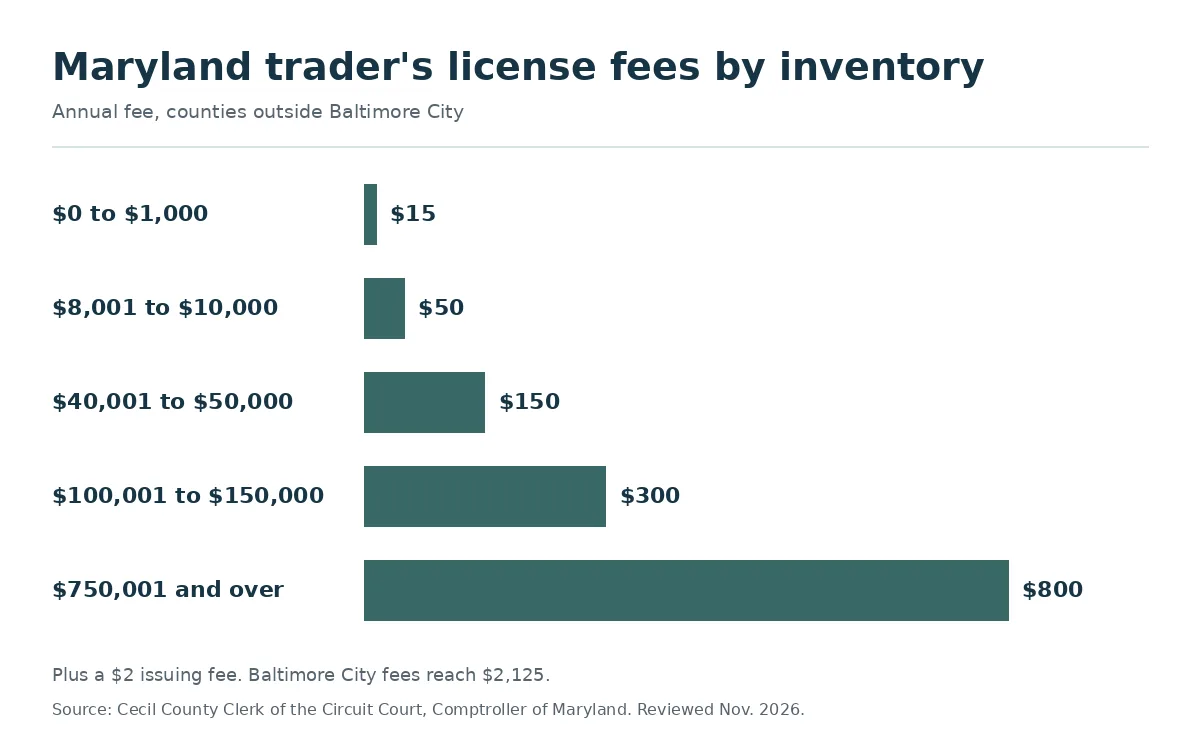
Trader’s license fees are based on the average commercial inventory a business owns. They range from $15 to $800, or up to $2,125 in Baltimore City, according to the Comptroller. A Department of Legislative Services report puts the Baltimore County range at $20 to $1,600. In other words, the same required license generally costs more in Baltimore City than in the other counties.
| Inventory value (counties outside Baltimore City) | Trader’s license fee |
|---|---|
| $0 to $1,000 | $15 |
| $8,001 to $10,000 | $50 |
| $40,001 to $50,000 | $150 |
| $100,001 to $150,000 | $300 |
| $750,001 and over | $800 |
Source: Cecil County Clerk of the Circuit Court fee chart, plus the $2 issuing fee.
Other common licenses have flat fees. A construction license issued by the clerk costs $15 in most counties, $30 in Cecil County and $40 in Baltimore City and Baltimore County. A vending machine license is $2.50 per machine, per the Comptroller’s license types page.
When do Maryland business licenses expire?
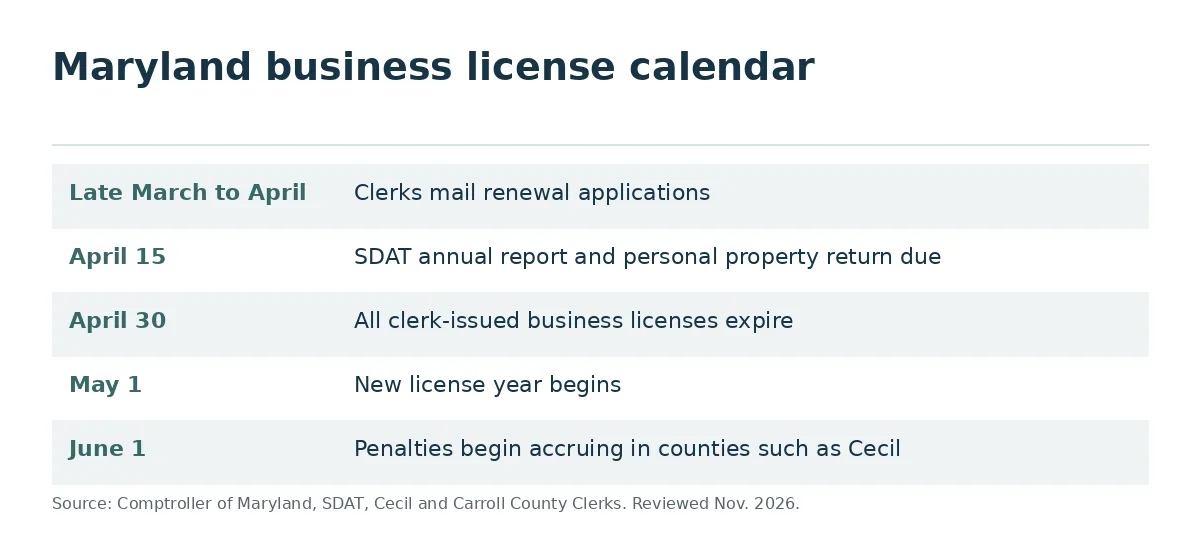
Maryland business licenses run from May 1 through April 30 and must be renewed by May 1 each year, per the Comptroller’s business tax tip. A license expires on April 30 no matter when during the year you bought it. Keep your mailing address current with the clerk’s office so the renewal reaches you.
Clerks mail renewal applications in late March or early April. The Cecil County Clerk notes that penalties accrue starting June 1 and that renewals are returned if the application is unsigned or missing the workers’ compensation certification. Online renewal is available in some counties but not all.
Late trader’s licenses cost 10 percent extra for the first month of delinquency, plus 2 percent for each additional month, according to the Comptroller. Before renewing, the clerk and other state licensing agencies must confirm you have paid all state taxes or set up a payment plan, and the Comptroller’s FAQ warns that waiting until renewal time to fix a tax liability can delay your renewal. If a business fails to pay required license fees, the Comptroller’s Field Enforcement Bureau may contact it and confiscate the license if necessary, and the state can pursue delinquent licenses for up to four years.
The SDAT annual report affects your license
Every domestic and foreign entity formed, qualified or registered in Maryland must file an annual report with SDAT by April 15, according to SDAT. The 2026 Form 1 shows a $300 filing fee for most entities. A business must also file a personal property return if it owns, leases or uses personal property in Maryland or maintains a trader’s license.
This matters for licensing because a trader’s license cannot be issued if the business has not filed its personal property return, owes personal property taxes or has had its charter forfeited, per the Comptroller. Failing to file can lead to forfeiture of a Maryland charter or the right to do business in the state.
How do you do a Maryland business license lookup?
A Maryland business license lookup depends on which agency issued the license. No single statewide database covers every license or every business type, so check the right source, whether you are verifying your own records or checking other businesses you work with.
| What you want to confirm | Where to look |
|---|---|
| Clerk-issued licenses, such as trader’s licenses | Maryland Business Licenses Online, searched by jurisdiction and trade or owner name |
| Entity status and good standing | SDAT entity search on Maryland Business Express |
| Occupational and professional licenses | Maryland Department of Labor licensing queries |
| Sales and use tax registration | Public search in Maryland Tax Connect |
Our business license lookup guide covers verification across other states.
What changes when you operate in several states or cities?
Multi-location and multi-state operators doing business in Maryland face three Maryland-specific issues, plus the fact that neighboring jurisdictions work very differently.
Licenses are tied to each location
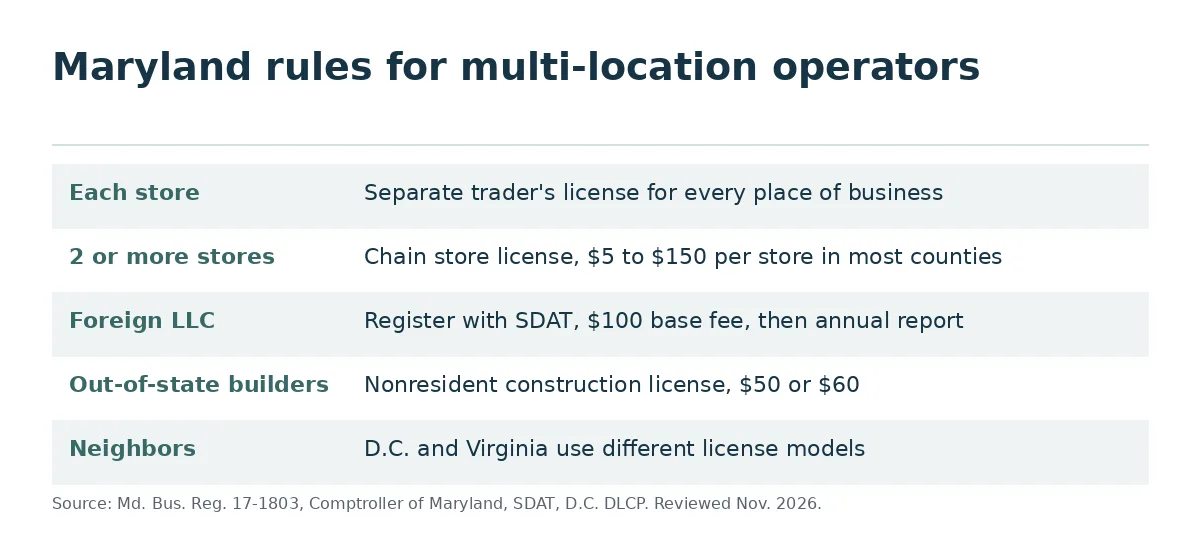
A trader’s license states the place where the licensee may do business, and the trader may keep a place of business only at that address, under Section 17-1808. Opening a new store means a new license from the clerk in that local county, plus any local zoning approval it requires.
If you run two or more retail stores in Maryland under the same ownership or management, you also need a chain store license on top of each trader’s license. In most counties the fee is $5 per store for 2 to 5 stores, rising to $150 per store for more than 20, per the Comptroller.
Out-of-state companies register first
An LLC formed elsewhere registers as a non-Maryland LLC through SDAT, which has a $100 base fee on the Maryland Business Express fee schedule, and then owes the same April 15 annual report as domestic entities. Out-of-state construction businesses may need a nonresident construction license, which costs $50 in the counties and $60 in Baltimore City, per the Comptroller’s FAQ.
Neighbors follow different models
Washington, D.C. issues a Basic Business License by activity, valid for two or four years, and requires one for each location, per the D.C. Department of Licensing and Consumer Protection. In Virginia, localities may impose a business, professional and occupational license (BPOL) tax on businesses with a definite place of business there, according to the Virginia Department of Taxation.
Our guide to the registration sequence for opening in a new state shows how to order registrations when you expand across state lines.
Frequently asked questions
Does Maryland require a general business license?
No. Maryland does not issue a single general business license. Instead, the Clerk of the Circuit Court in each county issues activity licenses, such as trader’s, construction, restaurant and vending machine licenses, and state boards issue occupational licenses. Some towns, such as Ocean City, add municipal licenses. Whether you need one depends on your business activity and location, so check with your local clerk’s office or the State License Bureau for business license information.
How much is a Maryland traders license?
A Maryland traders license costs $15 to $800 in most counties, based on the value of your commercial inventory, plus a $2 issuing fee. Baltimore City fees reach $2,125, and Baltimore County fees reach $1,600. The license runs from May 1 to April 30, and the fee is usually prorated for businesses that start mid-year. Late licenses add 10 percent for the first month and 2 percent for each month after that.
How do I renew a Maryland business license?
All licenses expire April 30. Sign the application, include any required workers’ compensation certification, resolve any tax holds and pay the fee by mail, in person or online where your county allows it. Penalties start accruing June 1 in counties such as Cecil. Your SDAT annual report and personal property return must also be current.
How do I look up a Maryland business license?
Search clerk-issued licenses on Maryland Business Licenses Online by county and trade or owner name. Check entity status on the SDAT entity search at Maryland Business Express, professional licenses through the Maryland Department of Labor’s licensing queries, and sales tax registration through the public search in Maryland Tax Connect. Each database covers only the licenses its agency issues, so use all four to confirm a company holds the necessary licenses.
Do online sellers need a business license in Maryland?
A Maryland-based business selling goods generally needs a trader’s license, because the requirement applies to selling goods in the state and covers retailers and wholesalers alike. It also needs a sales and use tax account with the Comptroller. Out-of-state online sellers have separate sales tax registration rules, so confirm your obligations with the Comptroller and the Clerk of the Circuit Court before you start selling.
Opening locations in Maryland?
LicenseComply researches the state, county and city licenses each of your Maryland locations needs and verifies them with the issuing agencies.
Explore Research & Verification Talk to a licensing specialist
Official sources and further reading
- Maryland Business Express: Obtain licenses or permits
- Comptroller of Maryland: Types of business licenses
- Comptroller of Maryland: Business license FAQs
- Comptroller of Maryland: Business Tax Tip 64, A guide to business licenses
- Comptroller of Maryland: Maryland Tax Connect FAQ for businesses
- Comptroller of Maryland: Sales and use tax guidance
- Maryland Business Regulation Article Section 17-1803: Trader’s license required
- Maryland Business Regulation Article Section 17-1808: Place of business on license
- Cecil County Clerk of the Circuit Court: Business licenses
- Carroll County Clerk of the Circuit Court: Business license information
- Howard County Clerk of the Circuit Court: Business license information
- Calvert County Clerk of the Circuit Court: Business licenses
- Queen Anne’s County Department of Health: Permanent food service facility licensing
- Maryland Judiciary: Maryland Business Licenses Online
- Maryland Department of Assessments and Taxation: Forms, annual reports and personal property returns
- Maryland Department of Assessments and Taxation: Charter fee schedule
- Maryland Department of Labor: Division of Occupational and Professional Licensing
- Maryland Department of Legislative Services: Clerks of the Circuit Courts and Business Licensing
- Town of Ocean City: Business and occupational licenses
- D.C. Department of Licensing and Consumer Protection: Business licensing FAQs
Disclaimer: LicenseComply provides professional business licensing and compliance services. However, the informational content on this site (including articles, guides, tools, and videos) is provided for general educational purposes only and does not constitute legal, tax, or accounting advice. Laws and regulations change frequently, and we cannot guarantee that all information is accurate, complete, or up to date for your specific circumstances. Your use of this website and its content does not create an attorney-client, accountant-client, or other advisory relationship. You should consult with a qualified attorney, accountant, or other appropriate professional for advice tailored to your business.