
Key points
- To get a business license in the United States, you identify every license your activity and location require at the federal, state, county and city levels, then apply to each issuing agency separately.
- There is no single national business license, and the U.S. Small Business Administration says most small businesses need a combination of licenses and permits from federal and state agencies, plus county or city licenses.
- Business license costs vary widely: Delaware’s annual license is generally $75 for a first location, Washington charges a $50 application fee to open a business, and Nevada’s state business license is $200, or $500 for corporations.
- Processing times range from minutes to weeks: the Internal Revenue Service issues an employer identification number immediately online, while Washington says online license applications take about 10 business days.

Here is how to get a business license in the United States: you work out which licenses your business activity and location require, register the business and its tax accounts, and then apply separately to each issuing agency at the state, county and city level. There is no single national business license, so most businesses end up with several licenses rather than one.
The U.S. Small Business Administration (SBA) notes that requirements and fees “vary based on your business activities, location, and government rules,” and that most small businesses need licenses and permits from more than one level of government (SBA).
This step by step guide walks through how to get a business license, how much a business license costs using real fee examples, how long approval takes, and what changes when you operate in several states or cities. Fees and rules below were reviewed November 2026 against official agency sources. Rules change and vary by jurisdiction, so confirm each requirement with the issuing agency before you apply.
What is a business license, and who issues it?
A business license is government permission to operate a business in a specific jurisdiction. Depending on where you are, it may be called a business license, business tax registration certificate, local business tax receipt, trader’s license or business license tax certificate.
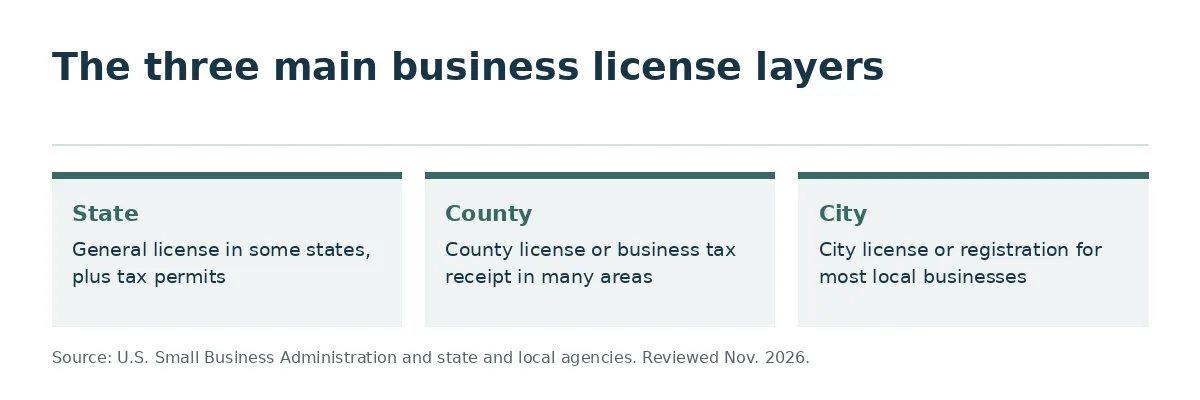
Licenses come in layers, and each layer is issued by different government agencies, so one business often holds multiple licenses.
Federal licenses
Only regulated activities need a federal license. The SBA lists examples such as alcoholic beverages (Alcohol and Tobacco Tax and Trade Bureau), firearms (Bureau of Alcohol, Tobacco, Firearms and Explosives), aviation (Federal Aviation Administration) and broadcasting (Federal Communications Commission) (SBA). Most businesses do not need one.
State licenses
Some states issue a general business license to nearly every business. Nevada requires a state business license from the Secretary of State, and Delaware licenses each business activity through its Division of Revenue. Other states, such as California and Texas, have no general state business license and rely on tax registrations and special licenses for certain professions instead.
County and city licenses
Most licensing happens at the local level. Cities such as Seattle, Los Angeles and San Francisco require nearly every business operating inside city limits to register. In Florida, the county government and the city each issue a local business tax receipt under Chapter 205 of the Florida Statutes, and a business inside a city may need both. In Maryland, many licenses come from the local Clerk of the Court, which works much like a county clerk. Our guide to county business licenses covers the county layer in more detail.
How to get a business license: step by step
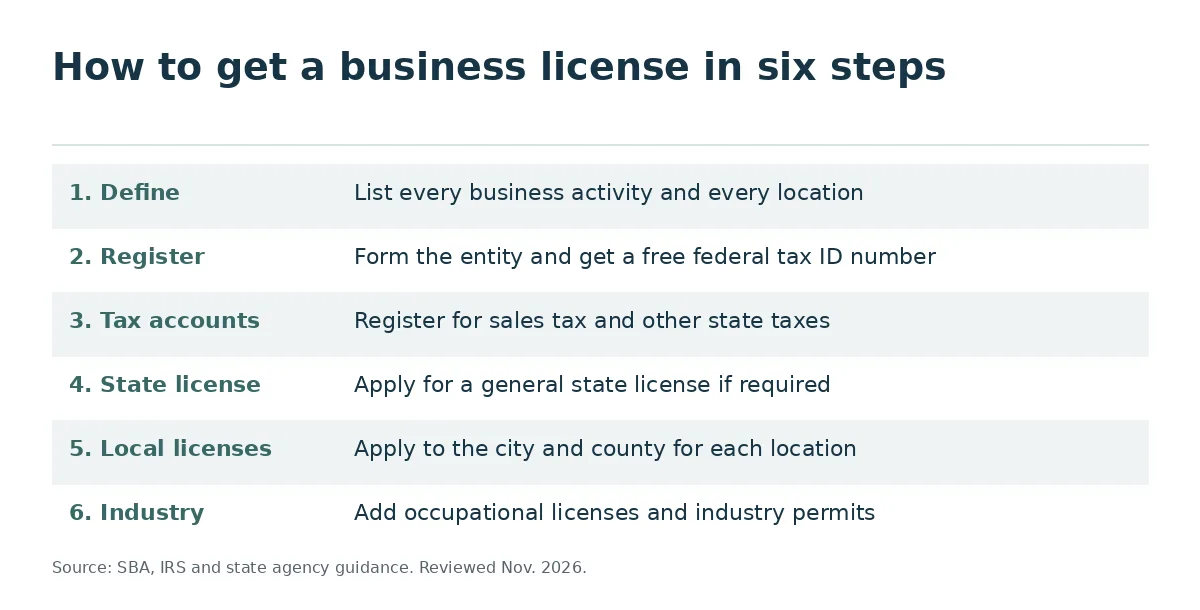
The order matters, because later applications ask for details from earlier ones. These steps apply in most states, and most agencies now let you apply online.
1. Define your activity and every location
Determine your type of business and list every physical location where you will operate, including home offices, warehouses and job sites. Licensing is triggered by activity and location together, and our guide on whether you need a business license explains common triggers.
2. Choose a business structure and register the business entity
Your business structure (sole proprietorship, partnership, limited liability company (LLC) or corporation) shapes which registrations you need. If you are forming an LLC or corporation, register it with the Secretary of State first. If you will operate under a business name other than your own or your entity’s legal name, you may need to register a doing business as (DBA) name with the state, county or city, and the SBA notes that most states require DBA registration if you use one (SBA). Next, get an employer identification number (EIN) from the Internal Revenue Service (IRS). The IRS states that “you never have to pay a fee for an EIN” and that approved online applications receive the number immediately (IRS). Many local applications ask for an EIN, or a Social Security number for a sole proprietorship, as Los Angeles does (Los Angeles Office of Finance).
3. Register for state taxes
If you sell taxable goods or services, you usually need a sales tax permit. In California, anyone engaged in business who intends to sell or lease tangible personal property that would ordinarily be taxable at retail must get a seller’s permit. The permit is free, though a security deposit may be required (California Department of Tax and Fee Administration), and the department says it may be able to issue the permit the same day (Publication 107). In Texas, there is no fee for the permit, though the Comptroller may require a security bond (Texas Comptroller).
4. Apply for the state business license, if your state has one
In Washington, you need a state business license if any of several conditions apply, including doing business under a name other than your full legal name, planning to hire employees within 90 days, or earning $12,000 or more per year (Washington Department of Revenue).
5. Apply for county and city licenses
Check the city first, then the county. Local approvals can include zoning, a building permit and a certificate of occupancy for the space. Chicago reviews zoning before issuing a license, may review architectural plans and Department of Buildings building permits, and warns applicants not to make financial commitments until the city confirms the activity is allowed at the address (City of Chicago).
Home-based businesses are not automatically exempt. Many cities issue a home occupation permit or license; in Chicago, a Home Occupation license costs $1,000 and lasts two years (City of Chicago).
6. Add industry licenses and permits
Food, alcohol, construction, health care, child care and many other activities need separate permits based on the activity, such as a health permit for food service, or occupational licenses for certain professions. Our overview of occupational licenses explains the difference.
What do you need to apply for a business license?
Most applications ask for the same core details, so gather them before you start the licensing process. Los Angeles, for example, asks for your Social Security number or EIN, a description of your business activities, your legal business name and any DBA, your start date in the city, the exact business address and mailing address, and contact information (Los Angeles Office of Finance).
Chicago also asks for ownership information, the square footage of the business location and a detailed description of every business activity (City of Chicago). Regulated activities may add proof of a professional license, background checks or inspections. Many cities let you register online and manage renewals through an online account, so keep your login details with your license records.
How much is a business license?
A general business license often costs between a few dozen dollars and a few hundred dollars per year, but there is no standard price. Fees may be flat or based on revenue, inventory, headcount or entity type.
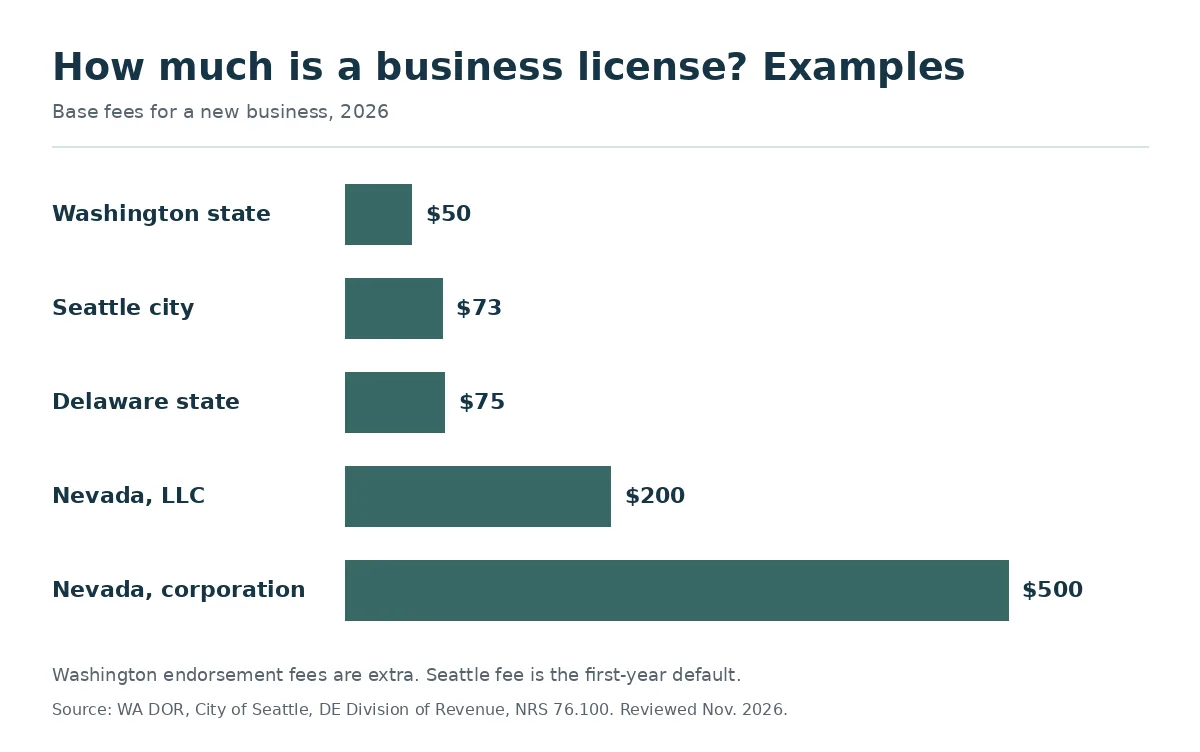
These official examples show the range:
| Jurisdiction | License | Fee |
|---|---|---|
| Delaware | State business license | Generally $75 per year for a first location (Delaware Division of Revenue) |
| Washington | State business license application | $50 to open a business, plus endorsement fees (Washington Department of Revenue) |
| Nevada | State business license | $200, or $500 for corporations, each year (Nevada Revised Statutes 76.100 and 76.130) |
| Seattle, Washington | Business license tax certificate | $73 default first-year fee in 2026 (City of Seattle) |
| Maryland | Trader’s license | $15 to $800, or up to $2,125 in Baltimore City (Comptroller of Maryland) |
Why fees differ so much
Seattle charges by revenue tier, ranging from $73 to $3,210 in 2026, plus $10 for each branch location (City of Seattle). Maryland bases trader’s license fees on average commercial inventory, and the fees increase as inventory values increase (Comptroller of Maryland). San Francisco bases new business registration fees on anticipated gross receipts, and its First Year Free program waives the first registration fee for many businesses (SF.gov).
Small add-on fees
Some cities charge by headcount. San Diego’s annual Business Tax Certificate fee is $34 for businesses with 12 or fewer employees, or $125 plus $5 per employee for larger businesses, and a late fee applies if the tax is not paid within 15 days of the business start date (City of San Diego).
Expect processing and state surcharges on top of the license fee. California requires a $4 fee on every local business license application and renewal, collected by the city or county (California Government Code Section 4467). Renewal fees matter too: Washington charges a $5 processing fee on each annual renewal (Washington Department of Revenue).
How long does it take to get a business license?
A simple business license online registration can be done in a day, while a license that needs zoning review or inspections can take several weeks. Plan for the slowest license in your stack.
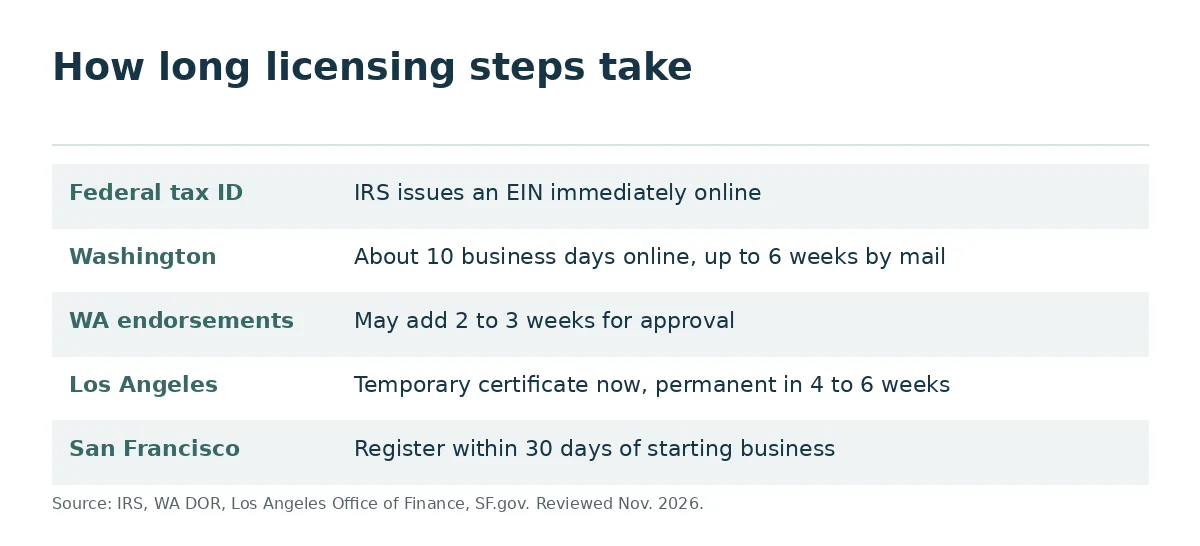
- EIN: issued immediately online when approved (IRS).
- Washington: online applications take about 10 business days, endorsements may add 2 to 3 weeks, and mailed applications can take up to six weeks (Washington Department of Revenue).
- Los Angeles: you receive a temporary Business Tax Registration Certificate or registration number when you register, and the permanent certificate is mailed within 4 to 6 weeks (Los Angeles Office of Finance).
- Clark County, Nevada: most general licenses are issued within 45 days after the county receives a complete application, while regulated, liquor and gaming licenses take longer because of background investigations (Clark County).
- Chicago: licenses are issued only after zoning approval, any required inspections and resolution of account holds (City of Chicago).
Registration deadlines
Plan for approval time before you begin operations, because some cities set a deadline after you start. San Francisco requires registration within 30 days of commencing business in the city (SF.gov). Clark County may issue a temporary license so you can conduct business while final approval is pending (Clark County). Applying before you open is still the safer default everywhere.
How do the rules differ by state?
Each state builds its licensing system differently, which is why a state-specific guide is useful once you know where you will operate.
California
California has no general state business license. Cities and counties issue local licenses, and the state’s CalGold tool helps identify permits by location and business type, though it “does not issue permits or licenses” (CalGold). See our guide on how to get a business license in California.
Arizona
Arizona does not require every business to have a license, and some businesses need more than one. The Arizona Department of Revenue describes a transaction privilege tax (TPT) license for taxable sales and services, regulatory licenses for certain businesses and professions, and local business licenses from each city or town where you operate (Arizona Department of Revenue). The state TPT license costs $12 per location (Arizona Department of Revenue). The department also points businesses to the Arizona Commerce Authority’s Small Business Checklist, a business checklist tool for researching requirements.
Florida
Florida uses local business tax receipts issued by counties and cities. Miami-Dade County requires a receipt for each place of business, and businesses inside a municipality need both a city and a county receipt, valid October 1 to September 30 (Miami-Dade County Tax Collector). Read more in how to get a business license in Florida.
Maryland
Maryland businesses may need one or more licenses from the local Clerk of the Court, such as a trader’s license, which applies to both wholesale and retail businesses (Comptroller of Maryland). Our guide on how to get a business license in Maryland has the details.
Delaware
Delaware requires a separate license for each business activity. After the first year, businesses may buy a three-year license at three times the annual fee (Delaware Division of Revenue). See how to get a business license in Delaware.
What changes when you operate in multiple states or cities?
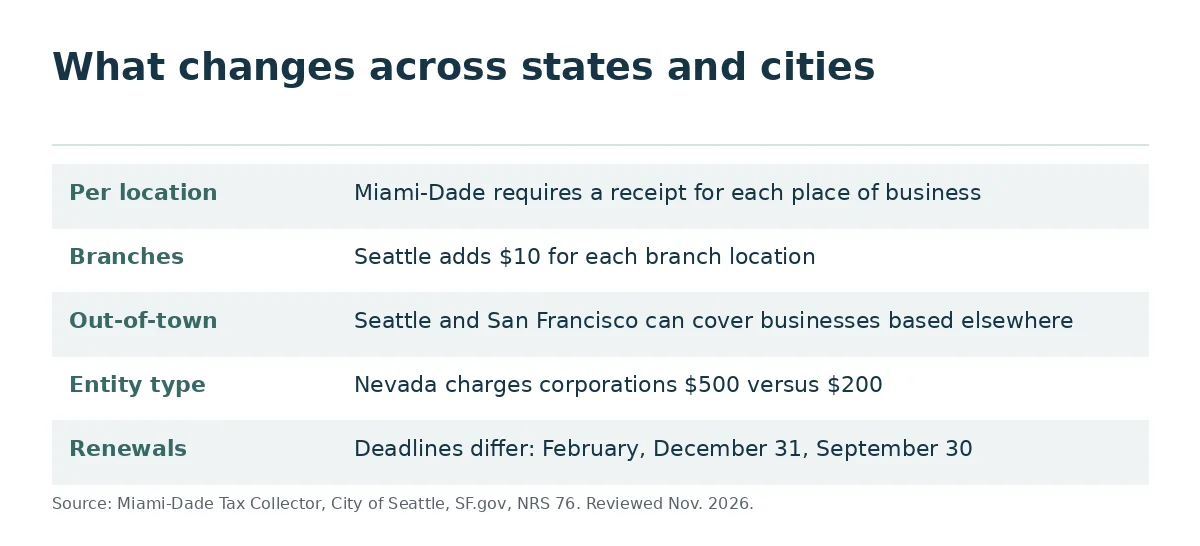
Multi-state and multi-location operators repeat the process for every jurisdiction, and licenses do not carry over.
Each location usually needs its own license
Miami-Dade requires a receipt for each place of business (Miami-Dade County Tax Collector), and Seattle charges an extra $10 per branch location (City of Seattle). In Washington, adding a location to an existing account has no processing fee, but it still requires an application (Washington Department of Revenue). In Arizona, a business operating in multiple cities may need a TPT or business license from each city where it has a base of operation (Arizona Department of Revenue).
Out-of-town businesses can still need a local license
Many cities require businesses based elsewhere to hold a local license. Seattle requires a certificate for businesses based outside the city that do business within it, with a 2026 exemption only for those earning $4,000 or less in the city and keeping no place of business there (City of Seattle). San Francisco requires registration from anyone who performs work there on all or part of seven days in a calendar year (SF.gov).
Entity type changes the price
Nevada charges corporations $500 for the state business license, compared with $200 for other applicants (Nevada Revised Statutes 76.100). The same entity may pay different amounts in different states.
Sequence and renewals multiply
Most states expect foreign entity registration and tax accounts before local licenses, so follow a registration sequence for opening in a new state. Renewal calendars also differ: San Francisco renews by the end of February, Delaware licenses generally expire December 31 (Delaware Division of Revenue), and Miami-Dade receipts run October to September. A master inventory by location, listing each licensing agency, license number and expiration date, keeps these dates visible.
Frequently asked questions
How do I get a business license?
Start by listing your business activities and every location. Choose a business structure, register your entity and get an employer identification number from the IRS, which is free. Register for state taxes, then apply for any state business license, followed by county and city licenses and industry permits. Each agency has its own application and fee, so check each issuing agency’s website before applying.
How much is a business license?
It depends on the state, city, activity and business size. Delaware’s annual license is generally $75 for a first location, Washington charges a $50 application fee to open a business, Seattle’s default 2026 first-year fee is $73, and Nevada charges $200 or $500 for corporations. Regulated industries usually pay more.
Where do I apply for a business license?
You apply directly with each issuing agency. State licenses usually go through the Secretary of State, Department of Revenue or a state business portal. Local licenses go through the city or county finance, tax collector or business licensing office. Federal permits apply only to regulated activities, such as alcohol, firearms and broadcasting, and are issued by the relevant federal agency.
How long does it take to get a business license?
Simple registrations can be immediate, such as an online EIN. Washington’s online business license applications take about 10 business days, with 2 to 3 more weeks for some endorsements. Los Angeles issues a temporary certificate at registration and mails the permanent one within 4 to 6 weeks. Licenses needing zoning approval or inspections take longer.
Do I need a separate business license in each state?
Usually, yes, if you do business there. Licenses issued by one state or city do not cover operations in another. Each state may also require foreign entity registration and tax accounts, and many cities and counties require a license for each location. Some cities, such as Seattle and San Francisco, require licenses even from businesses based elsewhere.
Need licenses in more than one place?
LicenseComply researches which state, county and city licenses each of your locations needs, then prepares and files the applications for you.
Explore License & Permit Filing Talk to a licensing specialist
Official sources and further reading
- U.S. Small Business Administration: Apply for licenses and permits
- Internal Revenue Service: Get an employer identification number
- Washington Department of Revenue: Apply for a business license
- Washington Department of Revenue: Variable business license processing fees
- Delaware Division of Revenue: Requirements for Delaware businesses
- Nevada Revised Statutes Chapter 76: State business licenses
- U.S. Small Business Administration: Register your business
- California Department of Tax and Fee Administration: Your California seller’s permit (Publication 73)
- California Department of Tax and Fee Administration: Do you need a California seller’s permit? (Publication 107)
- Arizona Department of Revenue: Business licensing and taxes
- Arizona Department of Revenue: TPT license
- City of San Diego: Business tax rates and fees
- Clark County: Business license FAQ
- Delaware Division of Revenue: Business licenses FAQs
- City of Chicago: Home based business
- Texas Comptroller: Sales tax permit FAQs
- Comptroller of Maryland: Business license FAQs
- City of Seattle: Business licenses
- Los Angeles Office of Finance: Register a new business
- SF.gov: Learn about business registration
- City of Chicago: Business license application steps
- Miami-Dade County Tax Collector: Local business tax receipt
- Florida Statutes Section 205.022: Local business tax definitions
- California Government Code Section 4467
- CalGold: California permit assistance
Disclaimer: LicenseComply provides professional business licensing and compliance services. However, the informational content on this site (including articles, guides, tools, and videos) is provided for general educational purposes only and does not constitute legal, tax, or accounting advice. Laws and regulations change frequently, and we cannot guarantee that all information is accurate, complete, or up to date for your specific circumstances. Your use of this website and its content does not create an attorney-client, accountant-client, or other advisory relationship. You should consult with a qualified attorney, accountant, or other appropriate professional for advice tailored to your business.